
Articles Mar 31, 2026, 9:00:00 AM Seth Mattison 18 min read

Agile leadership is all about adjusting to fast-changing environments while empowering teams to thrive. In today's world, traditional leadership methods often fall short, leaving organizations struggling to keep up. This article lays out seven key principles to help leaders navigate change effectively:
- Co-Create Solutions: Involve teams and stakeholders in decision-making to build trust and ownership.
- Transparent Communication: Open, honest dialogue fosters alignment and reduces uncertainty.
- Delegate Decisions: Push decision-making to those closest to the work to improve speed and outcomes.
- Link Vision to Daily Work: Connect individual tasks to the bigger picture for a sense of purpose.
- Provide Support: Equip teams with tools, training, and resources to succeed without burnout.
- Feedback Loops: Regular feedback drives improvement and keeps teams engaged.
- Lead by Example: Show a willingness to learn and adapt, inspiring teams to do the same.
These principles aim to replace outdated command-and-control styles with a leadership approach that prioritizes collaboration, trust, and resilience. By applying these methods, leaders can close the gap between their intentions and the experiences of their teams, driving better results.
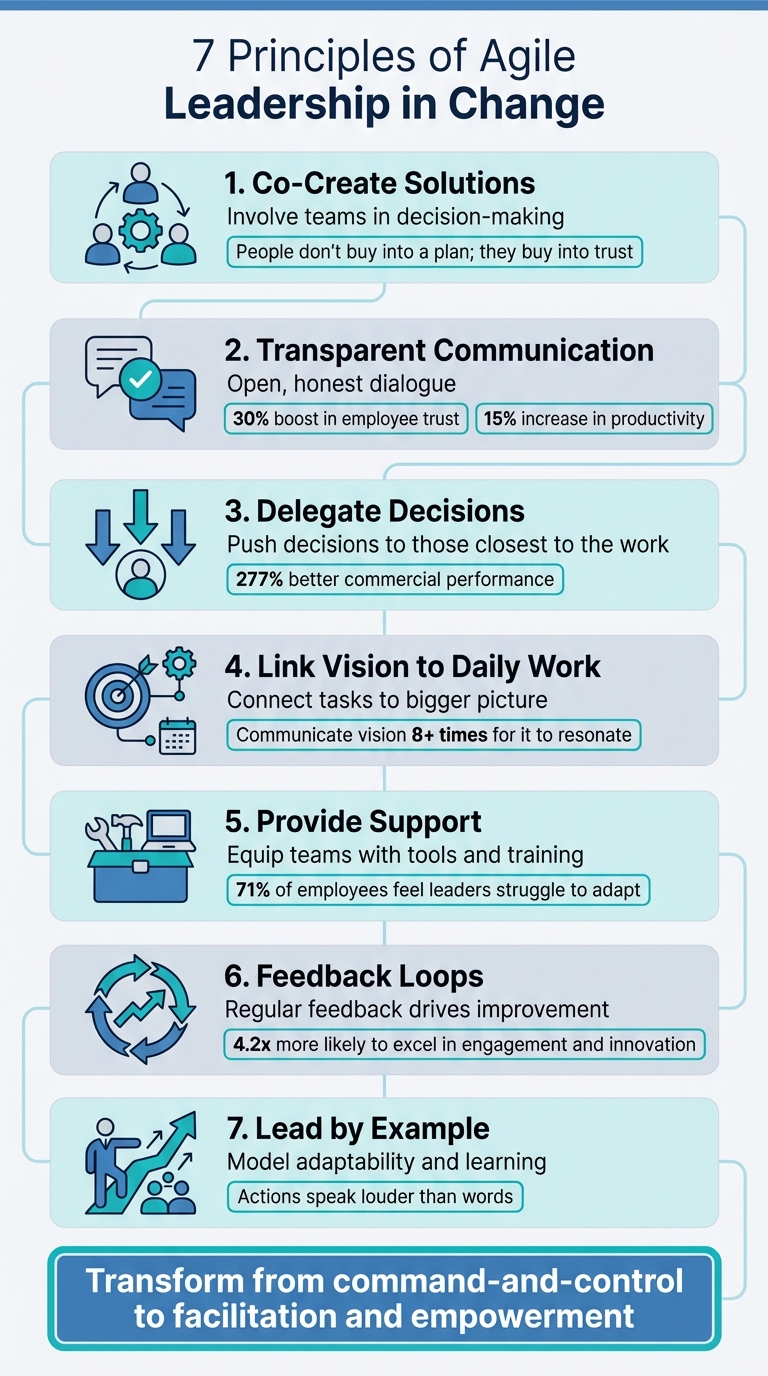
7 Principles of Agile Leadership in Change Management
1. Co-Create with Teams and Stakeholders
Making decisions behind closed doors often erodes trust during times of change. On the other hand, co-creation invites teams and stakeholders to actively participate in shaping plans, turning potential resistance into a sense of ownership. As Dr. Jen Frahm, Co-founder of the Agile Change Leadership Institute, aptly states:
"It's hard to push back on the plan, if you've taken part in designing it" [5].
Southwest Airlines demonstrated the power of this approach in 2024. Faced with a highly publicized issue in baggage handling, Director of UX Research & Design Cindi Schulenberg led cross-functional teams to develop a "Bag Tracker" solution. Instead of launching a lengthy, top-down initiative, these teams focused on delivering a functional product within the same year by prioritizing high-value tasks. This collaborative effort not only addressed a major customer pain point but also boosted employee confidence in the transformation process [6]. Success stories like this highlight the importance of defining clear decision-making boundaries.
Leaders must clearly communicate the "what" and "why" - the vision and success criteria - while trusting their teams to figure out the "how." Bala Vinayagam, President of Qualitrol, encapsulates this idea:
"You can't scale innovation through control. Give teams the what and the why. Trust them with the how" [6].
This doesn't mean relinquishing leadership. Instead, it’s about positioning decision-making where the expertise lies.
Equally important is ensuring teams have access to the data and context they need. Without this, empowerment can lead to frustration and guesswork. Establish safe spaces, such as open one-on-ones or Lean Coffees, where risks and concerns can surface early. Engaging middle managers in co-creating solutions is another key step, as it transforms them into advocates for change [6]. These practices reflect agile leadership in action: providing teams with clear information, fostering open communication, and encouraging innovation in a supportive environment.
A 2023 meta-analysis revealed a strong link between agile leadership practices, like co-creation, and improved trust, innovation, and organizational performance [3]. As Vinayagam wisely points out:
"People don't buy into a plan; they buy into trust" [6].
When teams are involved in creating the path forward, they commit fully to its success.
2. Maintain Open and Honest Communication
Agile leaders know that clear and transparent communication is the glue that holds trust and action together. When uncertainty arises, it can create confusion and anxiety. But open, two-way communication cuts through the noise, empowering teams to make timely decisions and stay aligned [7][8].
The benefits of transparency are measurable. Organizations that prioritize open communication see a 30% boost in employee trust and a 15% increase in productivity [9]. Despite this, a gap remains: while 87% of executives agree that navigating constant change is critical, only 45% feel prepared to lead effectively through such uncertainty [11].
Google's "Project Oxygen" study sheds light on what makes communication effective. After surveying over 80,000 managers, the research revealed that the most important leadership trait is being a good coach - asking questions and actively listening. This isn’t about delivering top-down directives; it’s about fostering a dialogue where team members feel safe to share openly [8]. This sense of psychological safety is crucial for navigating change swiftly and collaboratively [7].
Michael Spayd from The Collective Edge captures this idea perfectly:
"You can't tell someone to 'go transform.' You need to show them." [1]
Agile leaders make it a priority to share what they know, acknowledge what they don’t, and keep teams informed about upcoming updates [5]. By doing so, they prevent misinformation from spreading and show that team input directly influences decisions [4]. This openness creates an environment where creativity and innovation can flourish. When leaders remain approachable, teams feel encouraged to present new ideas and solutions [4].
Braden Kelley, an expert in innovation and transformation, highlights a key shift in leadership mindset:
"The moment you stop seeking control over the how, you gain absolute control over the what." [10]
In practice, this means leaders focus on clearly communicating the mission - the "North Star" - and the reasons behind changes, while trusting their teams to figure out the execution. By sharing their own mistakes and modeling vulnerability, leaders build trust and create space for individuals to bring their best to the table [11].
Seth Mattison, a thought leader in this space, emphasizes that agile leadership thrives on transparency and authentic dialogue. This approach not only strengthens trust but also lays the groundwork for shared ownership and deeper collaboration during times of change.
3. Delegate Decision-Making Authority
Agile leaders know that speed is everything. When decisions get tangled in layers of approval, organizations lose their ability to act quickly. The solution? Push decision-making authority to the people closest to the work. These individuals are often in the best position to spot challenges and address them in real time [12].
Research backs this approach - agile companies outperform their competitors by as much as 277% in commercial performance [3]. Lucy Georgiades, Founder & CEO of Elevate Leadership, sums it up perfectly:
"The people closest to the work often understand the reality best and can act quickly when challenges arise" [3].
Of course, not all decisions are created equal. Leaders should delegate reversible, low-stakes decisions to keep things moving while maintaining oversight on the big, irreversible ones [15]. A great example of this philosophy is HCL Technologies. By empowering employees with real decision-making authority, the company tripled its revenues and boosted customer satisfaction by 73% in just five years, ending in 2017 [14].
Amazon’s Jeff Bezos takes a similar approach with his "disagree and commit" philosophy. Even if he personally disagrees with a team’s decision, he supports it to ensure the company can act quickly, learn from mistakes, and adjust as needed - without waiting for approvals from the top [14]. This method fosters trust while maintaining clear boundaries. As the Agile Business Consortium explains:
"Empowerment means trusting the employees' ability to determine the optimal way to solve a problem" [14].
Shifting from a command-and-control style to a facilitation-focused approach transforms leaders into coaches. Instead of acting as gatekeepers, they focus on clearing roadblocks for their teams [13]. When employees are empowered to make decisions, they take ownership of their work, act with confidence, and adapt to changes without waiting for permission. This not only speeds up progress but also ensures that daily efforts align with the organization’s bigger goals.
4. Connect Vision to Daily Work
A vision confined to a boardroom presentation won't create real change. Agile leaders know that a vision becomes powerful only when every team member can clearly see how their daily efforts contribute to the bigger picture. Without this connection, work can feel like a series of tasks rather than a meaningful journey toward a shared goal.
The challenge lies in shifting the focus from numbers to purpose. Instead of motivating teams with goals like "increasing revenue by 30%", it's more impactful to tie objectives to human values. Take American Express, for example - they frame their vision as delivering the "world's best customer experience every day." This approach highlights the importance of helping real people, rather than merely chasing market share [16]. For this alignment to work, leaders must weave the vision into day-to-day activities, ensuring every task supports the broader mission.
Clear communication is essential. Leaders need to articulate the vision's purpose in a way that helps teams see how their contributions drive long-term success.
Interestingly, research shows that a message must be communicated around 8 times before it truly begins to resonate [17]. Michael Hyatt, author and CEO, captures this perfectly:
"If you have presented your vision so many times and in so many settings that you're tired of talking about it, congratulations! You're about half done" [17].
Building on this, agile leaders prioritize open dialogue. Small-group Q&A sessions, for instance, allow team members to question, critique, and take ownership of the vision. These discussions help clarify uncertainties and connect individual tasks to the larger purpose, even in the face of global challenges [16][18].
Seth Mattison, a respected keynote speaker and advisor on leadership transformation, highlights how aligning daily work with a broader vision not only fosters engagement but also encourages a culture of constant improvement. (For more insights, visit https://sethmattison.com)
5. Provide Resources and Support
For teams to navigate change while managing daily operations, they need dedicated resources. Agile leaders recognize that successful transformation takes time, the right people, effective tools, and a sense of psychological safety. Dr. Jen Frahm, Co-founder of the Agile Change Leadership Institute, puts it plainly:
"Bringing in something new is not the time to be stingy and expect your managers and employees to wear multiple hats. Multi-tasking during change means everything is compromised." [5]
A staggering 71% of employees feel their leaders struggle to adapt to shifting market conditions [3]. This often boils down to a lack of proper support. Just as delegation empowers teams, allocating the right resources allows them to act decisively. Teams need access to digital collaboration tools like Jira or Confluence and data platforms such as Tableau [2]. Additionally, backfill staffing is crucial to prevent burnout and ensure team members aren’t stretched too thin [5]. With these elements in place, teams are better equipped to tackle change initiatives effectively.
But support goes beyond tools and staffing. Continuous, relevant learning opportunities are just as important. Agile leaders focus on providing training that directly ties to current challenges. For instance, offering feedback training right before performance review season is far more impactful than abstract workshops scheduled months earlier [3]. They also create environments where failure is treated as a chance to learn, a hallmark of high-performing teams [19][20].
Rolling out resources gradually aligns with agile principles. By introducing tools one at a time, refining processes based on team feedback, and prioritizing simplicity over complexity [3], leaders ensure their teams can adapt quickly and confidently. When teams are supported with the right resources and a sense of autonomy, they thrive - delivering results instead of struggling under the weight of insufficient support.
6. Create Continuous Feedback Loops
Agile leaders understand that feedback isn't a one-time event - it's an ongoing dialogue that drives growth and improvement. Without consistent feedback, teams can miss opportunities to correct course when things go awry or to acknowledge and build on successes. As the Agile Business Consortium aptly states:
"Feedback is a critical ingredient of continuous improvement and without it, little or no learning would take place in the organisation." [21]
The key to effective feedback is closing the loop. When leaders solicit input but fail to act on it, team engagement plummets. People stop contributing ideas when they feel their voices aren't heard. Agile leaders take a different approach - they act on feedback promptly and visibly, ensuring team members see how their suggestions lead to meaningful changes [21][4]. This isn't just about addressing outcomes; it also means reflecting on teamwork dynamics and refining processes to work smarter [21].
The impact of open feedback is striking. Companies that foster a culture of feedback are 4.2 times more likely to excel in areas like employee engagement and innovation [22]. Yet, a troubling gap often exists between what executives intend and how employees perceive their actions [3]. This disconnect frequently arises when leaders ask for feedback but fail to show they're genuinely listening.
To make continuous feedback actionable, there are practical tools and techniques that fit seamlessly into agile workflows:
- SBI Model (Situation-Behavior-Impact): This framework helps deliver feedback that’s clear and specific. Instead of vague comments, it focuses on describing the situation, the observed behavior, and its impact [22].
- Weekly Check-ins: Encourage team members to share one strength and one area for improvement. These regular discussions normalize open communication and help teams grow together [22].
- Pulse Surveys: These quick, real-time surveys allow leaders to gauge team sentiment between formal reviews. They can uncover potential issues early, giving leaders a chance to address them before they escalate [23].
7. Model Adaptability and Learning
Leaders can’t just tell their teams to adapt to change - they need to lead by example. The disconnect between what leaders think and what employees experience highlights a key point: adaptability is about actions, not just words.
The best agile leaders make their learning process visible. They talk about the books they’re reading, the skills they’re working on, and the challenges they’re dealing with. By openly sharing their progress and even their setbacks, they foster an environment where continuous growth feels safe and encouraged. When leaders admit they’re "figuring things out" and invite their teams to learn with them, it sends a powerful message: growth and learning are priorities for everyone.
On top of this, agile leaders need to understand the kind of challenges they’re tackling. Adaptability means knowing the difference between technical challenges, which have clear solutions, and adaptive challenges, which require new thinking and experimentation. As Harvard Professor Ronald Heifetz explains:
"The single biggest failure in the exercise of leadership is to treat adaptive challenges like technical problems, and therefore to apply technical solutions." [25]
Practical ways to show adaptability include reviewing what went well and what didn’t after projects, setting aside time specifically for trying new ideas without fear of failure, and adjusting leadership approaches based on the situation. Start the day by asking questions instead of offering answers. Keep a visible record of what you’re learning. And most importantly, get comfortable with discomfort - accept that you won’t always have the answers and let go of the need to control everything [24].
When leaders model this kind of flexibility, they pave the way for team independence and creativity. They create a culture where adaptability thrives, leading to organizations that consistently outperform their competitors [3].
Conclusion
These seven principles are designed to transform leadership from a command-and-control approach to one centered on facilitation and empowerment. By co-creating with teams, fostering open communication, delegating decision-making, aligning vision with daily tasks, providing essential resources, establishing continuous feedback mechanisms, and leading by example, leaders can build organizations that adapt quickly to change without being bogged down by bureaucracy [3]. This method nurtures a culture where psychological safety promotes innovation, trust replaces micromanagement, and employees feel connected to a meaningful purpose. Together, these principles equip teams to handle rapid change and achieve long-term success.
While performance metrics highlight the effectiveness of agile practices, a significant gap exists between how leaders perceive their efforts and how employees experience them [3]. Bridging this gap requires more than just good intentions - it demands consistent practice, personal growth, and actionable frameworks.
This highlights the pressing need for leadership to evolve.
"Traditional leadership models are outdated - today's environment demands a dynamic, adaptable leadership style."
– Seth Mattison, Leadership Strategist [26]
For leaders seeking to close this gap, Seth Mattison's services offer practical tools to embrace human-centered leadership and navigate the complexities of the modern workplace. His insights help organizations like NASA, MassMutual, and ATB Financial challenge outdated assumptions, enhance leadership accountability, and drive digital transformation [26].
Adopting agile leadership requires a fundamental shift in how leaders think, empower their teams, and manage uncertainty. By applying these principles, adaptability becomes more than just a survival tactic - it becomes a powerful edge. Step into agile leadership and turn challenges into opportunities for growth.
FAQs
How do I start leading more agile without losing control?
To lead in a more agile way without losing control, focus on staying flexible, encouraging teamwork, and embracing continuous learning - all while keeping your strategic goals clear. Demonstrate qualities like curiosity, integrity, and humility to build trust within your team. Encourage regular feedback, ensure everyone is aligned with a shared vision, and give your team the freedom to explore new ideas. Strengthen your leadership by adopting an agile mindset: stay focused on solutions, remain open to change, and guide your organization with purpose and direction.
What decisions should leaders delegate - and which should stay centralized?
Leaders should hand over decisions related to day-to-day operations and project-specific tasks to their teams. This approach not only empowers team members but also fosters a sense of ownership. However, when it comes to strategic direction and high-priority decisions that affect the entire organization, leaders should maintain control. Striking this balance helps teams stay agile while ensuring the organization remains aligned with its broader objectives.
How can I build real feedback loops when teams are already overloaded?
To create effective feedback loops with busy teams, prioritize feedback that is meaningful, timely, and respectful. Leaders should actively seek input, respond in visible ways, and ensure they follow up to demonstrate the importance of the process. Reframe feedback as an opportunity for growth rather than an added task. By modeling honest and respectful communication, leaders can help teams weave feedback into their daily routines without adding unnecessary pressure.