
Articles May 5, 2026 9:00:00 AM Seth Mattison 20 min read

Artificial intelligence is reshaping leadership by automating tasks, analyzing data rapidly, and challenging old leadership frameworks. Leaders who fail to adjust are being replaced, as AI demands new skills like empathy, judgment, and creativity. Key takeaways include:
- AI's impact on leadership: AI handles complexity, reducing the need for traditional management skills.
- Shift in expertise: Skills once requiring years to master are now accessible through AI tools, creating a "Judgment Gap Crisis."
- Workforce changes: AI eliminates routine roles but creates new ones, requiring leaders to rethink their identity and focus on interpersonal skills.
- Trust issues: As AI alters authority structures, trust between employees and leaders is eroding, affecting productivity.
- New leadership strategies: Success now depends on qualities AI can’t replicate, like emotional intelligence and creative problem-solving.
To thrive, leaders must embrace change, redesign workflows, and balance immediate efficiency with long-term reinvention. AI isn't just a tool - it’s transforming what it means to lead.
Core Challenges of AI-Driven Disruption
Knowledge and Expertise Are Losing Value
The rise of AI is reshaping how we value knowledge and expertise. Skills that once required years to master are now accessible to almost anyone with the right AI tools. This shift raises tough questions about the relevance of traditional expertise in today’s world.
Take Salesforce as an example: in September 2025, CEO Marc Benioff revealed that AI agents enabled the company to cut its customer support team from 9,000 to roughly 5,000 employees. Despite the reduction, customer satisfaction scores remained on par with those achieved by human agents. Benioff summarized the change by emphasizing the need for "less heads" in routine cognitive tasks [9]. Similarly, a Stanford study reported a nearly 20% decline in employment for software developers aged 22 to 25 from its peak [9].
This trend has given rise to what some call "expertise theater." The barrier to creating polished, authoritative content has dropped, making it harder to distinguish genuine expertise from artificial competence. John Winsor, Executive Fellow at Harvard Business School, points out, "When everyone can perform authority, authority itself loses meaning." Jeff Burningham, founder of Peak Ventures, adds that this marks the end of the era where professionals are defined solely by their cognitive output and speed [7][6]. Research supports this shift: for every 1% increase in AI adoption, demand for management roles emphasizing judgment and interpersonal skills rises by 2.5% to 7.5% [5][8].
As AI continues to alter the value of expertise, it also challenges the roles and identities of seasoned professionals.
Workforce Transition and Role Redefinition
The impact of AI isn’t just about devaluing expertise - it’s also reshaping how professionals see themselves. Many seasoned workers, who’ve spent decades honing their craft, now find AI completing their hallmark tasks in mere moments. This shift has triggered what experts describe as "identity disruption", often leading to defensive responses like micromanagement or excessive work as professionals try to prove their worth [10][1].
Adding to the challenge is the relentless pace of AI-driven change, which leaves many employees feeling fatigued as priorities constantly shift [10]. In early 2026, companies like Amazon and EY restructured their operations to flatten hierarchies and automate repetitive tasks [5][8]. EY, for instance, invested $1.4 billion in a human-centered AI initiative, retraining 400,000 employees to focus on higher-value roles [5][8].
These changes highlight a broader trend: 60% of jobs in the U.S. today are in categories that didn’t even exist in 1940 [9]. While AI eliminates some roles, it also creates new ones. However, the constant need to adapt takes a psychological toll. Studies suggest that relying heavily on generative AI can stifle creative thinking, leading to more uniform ideas - a phenomenon often referred to as "cognitive outsourcing" [5][8].
Declining Trust in Digital Environments
Trust doesn’t erode overnight - it fades gradually through subtle, often unnoticed behaviors. Behavioral scientist Dr. Michelle Rozen explains:
"Trust erosion does not announce itself with conflict or rebellion. It begins with small, almost invisible behaviors: employees speak less candidly, hesitate before raising concerns, quietly edit their contributions in meetings, and comply outwardly while recalibrating inwardly" [11].
The numbers tell a clear story: while 79% to 86% of executives believe they have their employees’ trust, only 60% to 65% of employees agree [11]. This gap grows wider as AI reshapes authority structures. When it becomes unclear who holds decision-making power in AI-driven workflows, employee trust in leadership takes a hit. The financial impact is real - trust deficits and employee disengagement can slash productivity by over 20% [11]. Paired with delays in adopting AI, these issues can cost organizations billions.
The deeper problem lies in structural misalignment. Leaders often move at the pace of technological change, leaving employees struggling to keep up. This creates a constant, low-level stress that limits creativity and adaptability. As Dr. Rozen puts it:
"AI is not just an operational tool; it is a force that redistributes influence and reshapes perception" [11].
sbb-itb-9ceb23a
How to Adapt Leadership Models for the AI Era
Building the Human Moat: A Framework for Differentiation
As AI continues to reshape the workplace, leaders need to focus on qualities that machines simply can't replicate. Seth Mattison refers to this as the Human Moat - a collection of distinctly human traits that provide a lasting edge in a world where intelligence is increasingly abundant [13][14]. The key here is understanding that as AI makes competency more accessible, the real advantage lies in internal stability - the ability to stay grounded amid rapid technological shifts [1].
This begins with separating personal identity from professional achievements. Many high achievers tie their self-worth to their productivity, but AI fundamentally changes this equation. As one Entrepreneur contributor put it:
"The competitive edge in the AI era will not belong to the leader who can outproduce a machine. It will belong to the leader whose identity is not destabilized by one" [1].
Mattison argues that leaders need to embrace their humanity by cultivating empathy, intuition, and creative thinking [13][14].
Another crucial aspect of this framework is redefining love as a strategic asset. Mattison explains:
"Love - not as the emotion of connection - but as the energy of creation. In today's hyper-competitive, AI-driven marketplace, this 'love factor' isn't just sentimental - it's strategic" [13].
When leaders approach their work with genuine care, they transform mundane tasks into opportunities to build meaningful connections [13].
On a practical level, this means staying alert to early warning signs, such as overreliance on AI-generated outputs. Leaders should slow down their decision-making processes, allowing room for reflection and questioning assumptions. Paying attention to subtle human cues - tone, hesitation, or team dynamics - can reveal insights that AI might miss [12].
Moving to Fluid and Adaptive Organizational Structures
AI has drastically shortened decision-making timelines. What used to take months now happens in days or even hours, leaving traditional hierarchies and rigid processes struggling to keep up [12]. To thrive, organizations must shift from prioritizing speed alone to focusing on orientation - staying grounded and aligned in a fast-changing environment.
Adaptive structures rely less on strict processes and more on shared principles, heuristics, and clear intent [12]. This empowers teams to make decisions independently without getting bogged down by endless approval layers. As Executive Coaching Global notes:
"As uncertainty increases, rigid processes lose usefulness. Adaptive leaders rely more on: heuristics, shared principles, [and] clarity of intent" [12].
One essential skill in this environment is rapid recalibration - adjusting course quickly without losing focus [12]. This isn't about constant reinvention, which can exhaust teams, but about treating early friction as an opportunity for timely adjustments. Leaders must create spaces where AI-generated insights are thoughtfully challenged, ensuring that human judgment remains central [12].
When traditional playbooks fail, leadership presence becomes critical. A calm, deliberate approach often matters more than having a perfect plan. Shifting from control to empowerment helps create what Mattison calls "fearless freedom" - a work culture where team members feel safe to take risks, voice concerns, and even make mistakes without fearing automation will replace them [14]. This balance between immediate action and long-term innovation sets the foundation for sustainable success.
Balancing Short-Term Efficiency with Long-Term Innovation
Leaders must also reconcile the appeal of immediate efficiency gains with the need for visionary strategies. AI's promise often lies in automating tasks, cutting costs, and saving time. But as futurist Brian Solis points out:
"AI ROI is not saved minutes. It is saved months, which then allow for new value exploration and creation" [2].
Focusing solely on short-term wins risks overlooking the opportunity to rethink what's possible.
To fully harness AI, leaders must address the Capability Overhang - the gap between cutting-edge AI capabilities and how businesses actually use them [2]. Success in this area depends not on speed or scale but on a company's ability to learn quickly and reimagine workflows [2].
In practice, this means moving beyond small pilot projects to completely redesigning key processes. For instance, choose a critical workflow and reimagine it by combining human insights with AI's efficiency [2]. Replace routine status updates with weekly "learning reviews" where teams evaluate successes, challenges, and lessons from AI integration [2]. Encourage leaders to implement at least one AI-driven workflow each week and share their findings, fostering a culture of curiosity and continuous improvement [2].
Ultimately, this transformation requires a mindset shift. Instead of asking, "Can we use AI?" leaders should explore, "What new outcomes can we achieve that were previously impossible?" Creating "safe to fail" environments where employees feel supported to experiment is key to this transition [14]. As venture capitalist Vinod Khosla warns:
"Today's expectations of capability a year from now will look silly and yet most businesses have no clue what is about to hit them" [2].
Leaders who balance immediate efficiency with long-term reinvention won't just adapt to AI - they'll set the standard for what's next.
Legacy vs. AI-Resilient Leadership Models
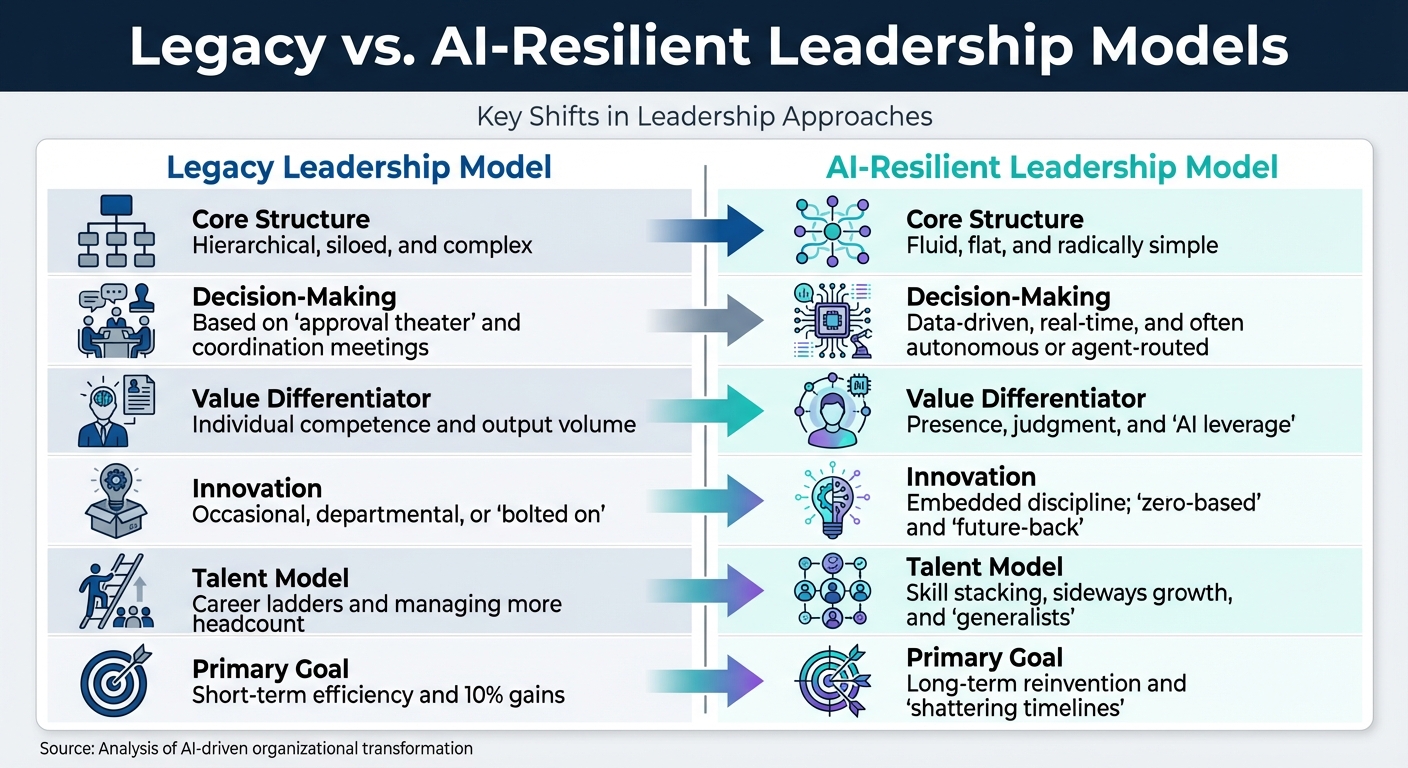
Legacy vs AI-Resilient Leadership Models Comparison
Key Shifts in Leadership Approaches
As the workplace transforms under the influence of AI, traditional leadership methods are being tested like never before. The shift from legacy leadership to models designed for an AI-driven world isn’t just about tweaking existing strategies - it’s about redefining them entirely. May Habib, CEO and co-founder of WRITER, captures this shift perfectly:
"Enterprises have spent decades promoting people who manage complexity... But in the agentic era, that model is fundamentally backwards. Complexity is exactly what suffocates scale." [3]
The following table highlights the key differences between legacy leadership and AI-resilient approaches:
| Dimension | Legacy Leadership Model | AI-Resilient Leadership Model |
|---|---|---|
| Core Structure | Hierarchical, siloed, and complex [15][3] | Fluid, flat, and radically simple [3] |
| Decision-Making | Based on "approval theater" and coordination meetings [3] | Data-driven, real-time, and often autonomous or agent-routed [15][17] |
| Value Differentiator | Individual competence and output volume [1] | Presence, judgment, and "AI leverage" [3][1] |
| Innovation | Occasional, departmental, or "bolted on" [16][4] | Embedded discipline; "zero-based" and "future-back" [3][16] |
| Talent Model | Career ladders and managing more headcount [3] | Skill stacking, sideways growth, and "generalists" [3] |
| Primary Goal | Short-term efficiency and 10% gains [3] | Long-term reinvention and "shattering timelines" [3][16] |
This table illustrates the dramatic departure from traditional leadership methods. While legacy models saw AI as a tool for incremental improvements, AI-resilient leadership treats it as a strategic capability requiring a complete overhaul of organizational design [15][3]. Instead of focusing on faster execution within outdated frameworks, leaders now prioritize outcomes by redesigning systems to eliminate unnecessary hierarchy [3][18].
A wave of C-suite turnovers highlights the consequences of clinging to legacy methods [3]. Leaders who rely on complexity, rigid approval chains, and top-heavy control are being replaced by those who embrace simplicity, speed, and autonomy. JD Meier, former Innovation Head at Microsoft, puts it succinctly:
"In the AI era, leadership advantage doesn't come from reacting faster. It comes from designing better." [16]
These shifts are at the heart of the Human Moat approach, which emphasizes the enduring value of human judgment and connection in an AI-dominated world. Leaders who succeed in this new landscape will be those with the vision to design systems that amplify human strengths while leveraging AI’s capabilities [1].
Conclusion
AI is already reshaping the landscape of leadership, challenging traditional models built on hierarchy, complexity, and individual expertise. Leaders who cling to outdated approaches are discovering that these methods no longer meet the demands of a rapidly evolving world. The shift calls for a complete overhaul of how organizations function and how leaders perceive their roles.
In today’s environment, competitive advantage doesn’t stem from outperforming machines - it comes from being present, exercising sound judgment, and maintaining composure in the face of constant uncertainty. Leaders who fail to adapt to this new reality risk becoming irrelevant. Those who succeed are the ones who cultivate balance, fostering collaboration between human ingenuity and machine capabilities. Instead of measuring their worth by productivity alone, they focus on strategic decision-making and navigating ambiguity with confidence.
To meet these challenges, leaders must develop what some call a Human Moat - a distinct set of human qualities that machines can’t replicate. This involves prioritizing skills like empathy, relational intelligence, and creative problem-solving. It’s not just about optimizing existing workflows; it’s about reimagining them entirely. As Seth Mattison aptly puts it:
"While machines might replicate the work, they'll never reflect the soul. They might take tasks, but they can't take heart. It's here, we find our edge" [14].
Organizations that thrive in this era of AI aren’t necessarily the fastest - they’re the ones that learn and adapt the quickest. They are setting measurable standards for AI fluency, focusing on results instead of mere efficiency, and creating spaces where experimentation and continuous learning are encouraged. These organizations understand that adaptability isn’t just a buzzword - it’s the cornerstone of survival in what some call AI Darwinism [2].
The strategies discussed - building the Human Moat, embracing flexible structures, and balancing efficiency with innovation - offer a roadmap for leaders navigating these changes. Success requires more than mastering AI; it demands a redesign of organizational frameworks to highlight human strengths and foster adaptability. AI will transform your organization; the only question is whether you’ll lead that change or be overtaken by it.
FAQs
What is the 'Judgment Gap Crisis' in AI-driven work?
The 'Judgment Gap Crisis' highlights a pressing concern: as organizations increasingly lean on AI for decision-making, there’s a real danger that human judgment and critical thinking could weaken. This overreliance on AI might result in what’s known as 'cognitive erosion' - where leaders and employees gradually lose their ability to assess situations and make independent decisions.
To address this, it’s crucial for organizations to invest in training programs and establish strong governance frameworks. These measures ensure that human oversight remains a priority, helping to preserve the quality of decisions in environments where AI plays a significant role.
How can leaders rebuild trust when AI changes who makes decisions?
Leaders can rebuild trust by prioritizing transparency and open communication while actively involving employees in the process of adopting AI. It's essential to clearly explain how AI tools will be used and to create an environment where employees feel their concerns and ideas are genuinely valued. This approach helps build a sense of psychological safety.
At the same time, leaders should emphasize the importance of distinctly human qualities like empathy, ethical decision-making, and relationship-building. As Seth Mattison points out, these traits not only foster trust but also set leaders apart in ways that AI simply cannot replicate. By focusing on these strengths, leadership can stay effective and credible even as technology evolves.
What does building a “Human Moat” look like in day-to-day leadership?
Incorporating a "Human Moat" into daily leadership means leaning into qualities that set humans apart - traits like trust, empathy, creativity, and judgment. These skills are irreplaceable and increasingly important as AI continues to take over tasks traditionally valued for knowledge and technical expertise.
By prioritizing these distinctly human abilities, leaders can stand out and drive lasting success. These qualities not only foster stronger relationships but also ensure adaptability in a world where technology is reshaping the workplace.