
Articles Mar 7, 2026 9:00:00 AM Seth Mattison 30 min read

In decision-making, should you rely on AI or your gut instinct? It depends on the situation. AI is great for analyzing large datasets, spotting trends, and providing objective insights. It’s ideal for tasks like risk analysis, resource allocation, and predictive modeling. On the other hand, gut instinct excels in ambiguous or high-pressure situations, especially when empathy, ethics, or creativity are involved. Leaders who combine both approaches - using AI for data-driven insights and intuition for human context - tend to make better decisions.
Key Takeaways:
- Trust AI: When data is abundant, tasks are repetitive, or decisions rely on measurable metrics.
- Trust Gut Instinct: When data is incomplete, situations are novel, or decisions involve human factors like emotions or ethics.
- Best Approach: Combine both for "informed intuition" - use AI to inform decisions and intuition to add context and foresight.
| Factor | AI Strength | Gut Instinct Strength |
|---|---|---|
| Speed | Processes massive data instantly | Quick in high-pressure scenarios |
| Bias | Can inherit algorithmic bias | Prone to personal bias |
| Adaptability | Limited by training data | Excels in new or ambiguous situations |
| Context | Focuses on measurable facts | Considers emotions and social dynamics |
The best decisions come from balancing AI’s precision with intuition’s human touch.
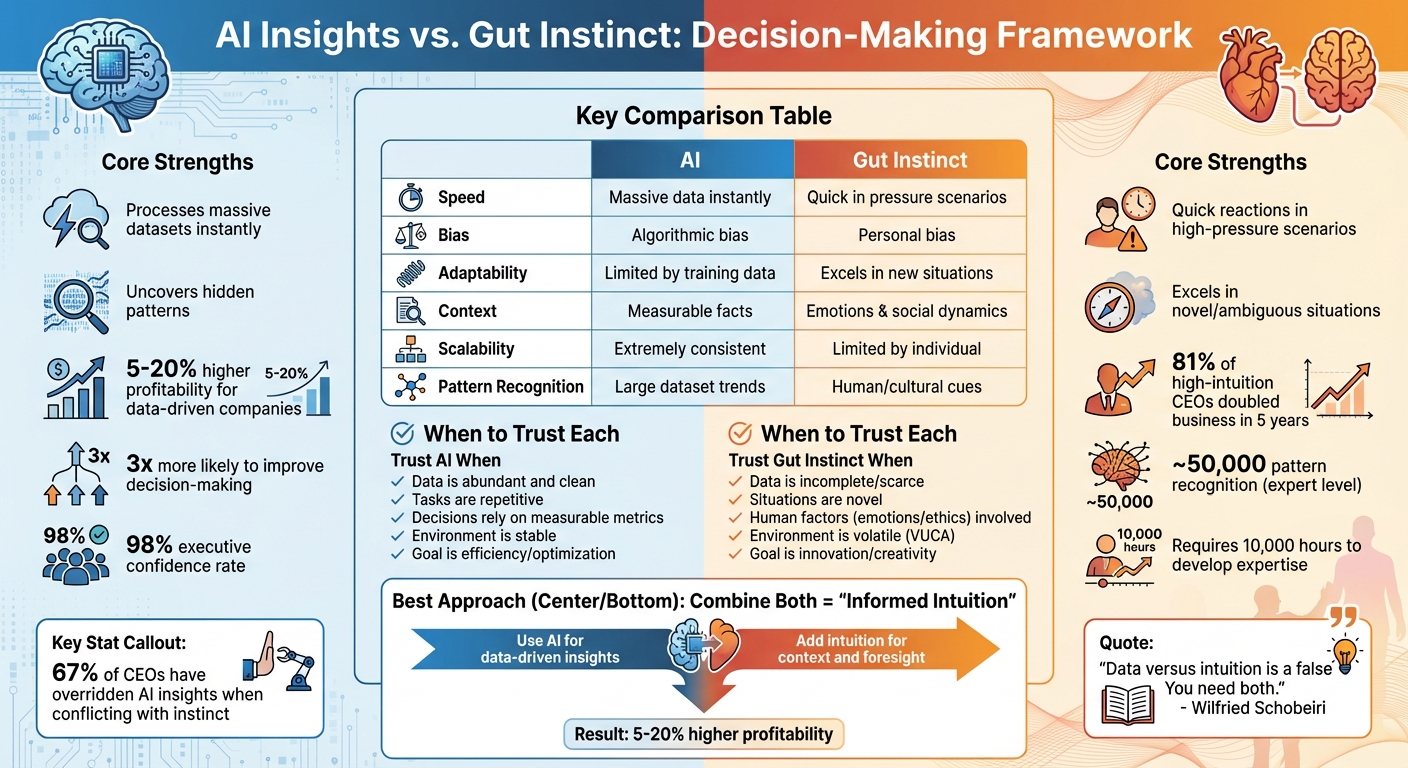
AI vs Gut Instinct Decision-Making Framework: When to Use Each Approach
AI Insights: Benefits and Drawbacks
AI has reshaped decision-making processes, offering powerful tools for organizations. However, it’s not a one-size-fits-all solution. Knowing where AI excels and where it struggles allows leaders to use it wisely rather than relying on it blindly.
What AI Does Well
AI’s standout strength is its ability to process enormous datasets at speeds impossible for humans. In today’s data-driven world, AI uncovers patterns that would otherwise remain hidden. This objectivity helps ground decisions in facts, reducing the influence of emotional or unconscious biases [3][10].
The impact is clear. Companies that embrace data analytics often outperform competitors by 5% to 20% in profitability [3]. Additionally, data-driven organizations are three times more likely to report improved decision-making compared to those that don't prioritize data [4]. Among executives already using AI, confidence in the technology reaches an impressive 98% [8].
AI also shines in scalability and consistency. Once trained, it can make thousands of decisions with the same logic and without fatigue. Predictive analytics allow businesses to foresee challenges and test scenarios before committing resources [10][6]. In data-heavy, predictable fields like supply chain management, fraud detection, or customer segmentation, AI delivers exceptional accuracy.
During the 2021 holiday season, Amazon used AI-driven predictive stocking to cut delivery times and boost sales by 15% [12].
These strengths highlight the areas where AI can be a game-changer in decision-making.
Where AI Struggles
Despite its advantages, AI has clear limitations. Its biggest shortfall is its dependence on historical data. As Kumar Srivastava, CTO of Turing Labs, explains:
"AI is extraordinary at exploiting the past. But competitive advantage comes from anticipating the future" [5].
When faced with new or unpredictable situations - like "black swan" events - AI models often falter.
AI also lacks the nuanced understanding that human judgment provides. For example, it struggles to interpret whether a customer is buying for themselves or as a gift, and it often overlooks cultural subtleties, team dynamics, and the unspoken factors that influence decisions [8][12]. Organizational psychologist Melissa Doman cautions:
"If you're only leaning on data, you're not taking into account human condition, experiences, and feedback" [8].
Another challenge is bias. AI can unintentionally reinforce systemic inequalities or outdated assumptions embedded in its training data - a phenomenon known as "backward-looking bias" [5]. In unpredictable or morally complex situations, AI’s inability to exercise empathy or ethical reasoning becomes a serious limitation [5][8].
Interestingly, 67% of CEOs have disregarded AI-generated insights when they conflicted with their own instincts [8]. This highlights the importance of balancing AI's capabilities with human intuition and judgment.
Comparison Table: AI vs. Gut Instinct
Here’s a side-by-side look at how AI and human intuition compare:
| Feature | AI Insights | Gut Instinct |
|---|---|---|
| Speed | Processes massive datasets instantly [8] | Quick reactions in new, high-pressure scenarios [4] |
| Objectivity | High; relies on measurable data [10] | Low; influenced by personal bias [10] |
| Scalability | Extremely consistent and repeatable [10] | Limited by individual capacity [8] |
| Pattern Recognition | Discovers trends in large datasets [6] | Detects subtle human and cultural cues [6] |
| Adaptability | Relies on past data; struggles with new contexts [5] | Excels in ambiguous, unprecedented situations [3] |
| Context | Views data as objective facts [2][12] | Considers empathy, culture, and social dynamics [2] |
Gut Instinct: Benefits and Drawbacks
Human intuition thrives on recognizing patterns built through experience. For leaders with years of expertise, this develops into what’s often referred to as "unconscious competence" - an almost automatic ability to sense the right course of action without deliberate analysis. But while this instinct can be a powerful guide, it’s not without its pitfalls.
What Intuition Does Well
Gut instinct proves invaluable when facing situations that lack precedent, clarity, or straightforward solutions. In environments marked by volatility, uncertainty, complexity, and ambiguity (VUCA), intuition bridges the gaps that data simply can’t fill. It also provides insight into aspects that defy measurement - like team dynamics, ethical dilemmas, or market sentiment - areas where algorithms fall short [7][10][11].
Take Jeff Bezos as an example. His decision to launch Amazon Prime was driven by instinct, even when financial models predicted failure. With no historical data on internet loyalty programs, his gut feeling about customer behavior turned Prime into one of Amazon’s most successful ventures [7]. Similarly, Starbucks introduced the Pumpkin Spice Latte by prioritizing brand identity over traditional metrics, creating a cultural phenomenon [11].
"If you can make a decision with analysis, you should do so. But it turns out in life that your most important decisions are always made with instinct and intuition, taste, and heart." - Jeff Bezos, Founder, Amazon [7]
Expert intuition also operates with remarkable speed. Chess grandmasters, for instance, rely on a mental library of around 50,000 patterns, allowing them to make split-second decisions [7]. Reaching this level of expertise takes about 10,000 hours of practice [7]. Beyond speed, intuition enables leaders to imagine future scenarios and foresee risks that data alone might overlook. A great example of this forward-thinking approach can be seen in the early 2000s when Kodak and Fuji faced the rise of digital photography. While Kodak stuck to its analog roots, Fuji used human judgment to diversify into cosmetics and digital technology, ensuring its survival [11]. However, intuition’s strength in navigating ambiguity can also become a liability when misapplied.
Where Intuition Fails
The same pattern recognition that makes intuition effective can also lead to errors. Our brains are wired to find patterns, but sometimes we see connections that don’t exist, resulting in faulty conclusions [7]. This becomes especially problematic when past experiences no longer align with present realities.
Cognitive biases are another major drawback. The snap judgments that make intuition fast can also introduce unconscious stereotypes and subjective interpretations shaped by personal history [7][10]. What feels like wisdom might actually be outdated assumptions that fail to address the current situation [5]. Solely relying on gut feelings can lead to oversimplified decision-making, especially when complex data contradicts instinct [1]. On the flip side, there’s also the risk of automation bias, where leaders place too much trust in AI and dismiss their own instincts, even when the evidence suggests otherwise [5].
Comparison Table: Gut Instinct vs. AI
| Feature | Gut Instinct | AI Insights |
|---|---|---|
| Processing Style | Pattern recognition from experience [7] | Probabilistic analysis of datasets [2] |
| Speed | Instantaneous (System 1 thinking) [7][13] | Rapid processing of massive data [7] |
| Flexibility | High; adapts to novel scenarios [13] | Low; limited by training data [7][5] |
| Bias Type | Cognitive, emotional, subjective [10] | Algorithmic, systemic, data-dependent [5] |
| Context Understanding | Deep grasp of social/ethical nuances [11] | Abstract; misses human factors [7][10] |
| Best Application | Strategy, ethics, innovation [7] | Optimization, prediction, scaling [7] |
When to Trust AI Over Gut Instinct
AI shines when decisions hinge on massive datasets, clear metrics, and repeatable processes. In fact, data-driven organizations are three times more likely to see meaningful improvements in decision-making [4]. These strengths make AI particularly effective in certain areas, as highlighted below.
Best Use Cases for AI
AI thrives in tasks requiring the analysis of large, complex datasets. These "slow intelligence" problems - ones that demand processing power beyond human capabilities - are where AI truly stands out [2][8]. For example, predictive analytics has shown impressive results, with AI tools improving risk identification accuracy by 94% [14]. Similarly, routine tasks like resource allocation, scheduling, and reporting benefit from AI's consistency. In agile projects, AI has boosted sprint completion rates by 18% [14].
Take Google's Project Oxygen as an example. By analyzing over 10,000 performance reviews, including qualitative data, the company identified behaviors linked to high-performing managers. This approach increased median favorability scores for managers from 83% to 88% [1][4].
AI also brings objectivity to decision-making by relying on measurable facts rather than emotions, helping to reduce unconscious bias [10]. With the staggering amount of data generated daily - roughly 2.5 quintillion bytes [1][4] - automated tools are indispensable for turning raw information into actionable insights.
How to Address AI's Weaknesses
While AI offers clear advantages, it’s not without flaws. Algorithms can inherit biases from their training data, making regular bias audits a must. Documenting model data and parameters ensures transparency and allows for critical evaluation before making high-stakes decisions [14].
A "human-in-the-loop" approach can also mitigate risks. Experts should review and validate AI recommendations, asking questions like, "What might this model overlook?" and "What do we know that the data doesn’t?" [14]. These checks ensure that human expertise complements AI's capabilities.
Recalibrating AI systems is equally important. By monitoring outcomes over time, businesses can adjust models to reflect changing market conditions. Additionally, investing in AI literacy helps teams understand both the technology's potential and its ethical challenges [14].
"AI can automate tasks, but it can't replace human leadership. The project manager's value now lies in interpretation and empathy" [14]. - Brett Harned, author and project management expert
The goal isn’t to replace human judgment but to enhance it - using data-driven insights where they make the biggest impact.
When to Trust Gut Instinct Over AI
AI is fantastic at crunching data, but sometimes intuition takes the lead, especially in areas where human insight and creativity shine. A study of C-suite executives found that 30% rely primarily on intuition and experience for critical decisions - nearly matching the 29% who lean on data and analytics [7]. This split highlights how some challenges simply can't be solved by algorithms alone. So, when does gut instinct outperform data?
Best Use Cases for Gut Instinct
Intuition often shines in "zero-to-one" situations where there's no historical data to guide decisions. Take Jeff Bezos' decision to launch Amazon Prime. Financial models predicted failure due to high shipping costs, but Bezos trusted his gut that a loyalty program could reshape customer behavior. He was right - Prime became one of Amazon's biggest successes [7]. Similarly, Netflix took a leap of faith with Stranger Things, betting on untested showrunners and a cast of newcomers [11].
In volatile, uncertain, complex, and ambiguous (VUCA) environments, human judgment becomes indispensable. When data is messy, incomplete, or even contradictory, intuition often provides a clearer path forward. This is especially true for decisions tied to empathy, team dynamics, and company culture, where emotional intelligence trumps spreadsheets. As Garry Kasparov, the former World Chess Champion, put it:
"Intuition is the bedrock of our decision-making, especially in the quick-fire decisions that make up our daily lives" [7].
Ethical and moral decisions are another area where intuition is essential. AI might calculate the most efficient solution, but it doesn’t account for societal norms, fairness, or organizational values. When decisions touch on these areas, human judgment has to take center stage [11][6].
| Decision Factor | Trust AI When... | Trust Gut Instinct When... |
|---|---|---|
| Data Quality | Data is abundant, clean, and relevant | Data is scarce, incomplete, or contradictory |
| Environment | Stable with clear historical precedents | Volatile, uncertain, or entirely novel |
| Human Element | Objective metrics (e.g., price optimization) | Subjective factors (e.g., team morale, ethics) |
| Risk Level | Errors are low-cost and easily reversible | High-stakes "unknowables" require bold calls |
| Goal | Efficiency and incremental improvement | Creativity, vision, and radical innovation |
How to Improve Your Intuition
Reliable intuition doesn’t just happen - it’s built through practice and experience. Research suggests it takes about 10,000 hours of deliberate practice to become an "intuitive expert" [7]. For example, chess grandmasters can recognize up to 50,000 patterns, allowing them to make quick, instinctive decisions [7]. Supporting this, a study by Professor John Mihalasky found that 81% of CEOs with high intuition scores doubled their businesses within five years, compared to just 25% of those with lower scores [3].
To sharpen your intuition, try "shadow decisions": before looking at AI recommendations or data, jot down your gut reaction and track how often you're right [15]. Another method is "speed drills" - make small, low-stakes decisions (like picking a restaurant) in under 30 seconds. This helps train your brain to recognize patterns and avoid overthinking [15].
The "pull test" is another tool. When weighing options, imagine moving toward each one and note any physical sensations of ease or resistance. These subtle signals can reveal preferences that logic might overlook [15]. You can also conduct "pre-mortems": imagine your gut-driven choice has completely failed and work backward to pinpoint potential blind spots [7].
Creating an environment where intuition is valued is equally important. Encourage your team to share hunches or challenge AI outputs without needing immediate justification [7][11]. This helps counter "automation bias", where people overly trust algorithms, even when their instincts suggest otherwise [5].
Lastly, embrace "genchi genbutsu", a Toyota principle meaning "go and see for yourself." By engaging directly with customers, employees, or operations, you gain firsthand insights that no dashboard can provide [11]. As Dame Angela Ahrendts, former CEO of Burberry, wisely noted:
"Intuition is a form of wisdom, the gift of knowing without reasoning. When you're not forced to overthink things, it's amazing the clarity that emerges" [7].
Combining AI and Human Judgment
The decision between relying on AI or human intuition doesn’t have to be an either-or scenario. Instead, combining the two creates a balance that brings out the best in both. Businesses that skillfully blend analytics with human insight tend to outperform their competitors, achieving 5% to 20% higher profitability [3]. This edge isn’t about automating everything - it’s about knowing when human judgment should take the lead.
Why Hybrid Decision-Making Works
AI and human judgment complement each other beautifully. AI can process vast amounts of data, identifying patterns and making predictions at a scale no human can match [16]. However, AI lacks the ability to interpret outcomes through the lenses of ethics, strategy, or empathy - it operates strictly within its programmed boundaries [9][16]. A great example of this synergy is Google’s "Project Oxygen." By combining data-driven retention metrics with human-led qualitative analysis, they pinpointed eight key behaviors of successful managers. This approach improved median favorability scores for managers from 83% to 88% [4].
Ultimately, accountability rests with humans. Boards, regulators, and customers hold leaders - not algorithms - responsible for decisions [16]. Netflix CEO Reed Hastings summarized this perfectly:
"We start with the data. But the final call is always gut. It's informed intuition." [3]
This hybrid approach also addresses a major shortfall of automation: bias. Human oversight is critical to counteract algorithmic bias and ensure decisions are fair [8]. Intuition adds an additional safeguard, allowing decision-makers to pause when AI outputs don’t align with real-world context [7].
By combining these strengths, businesses can create a system where AI insights and human intuition work together seamlessly.
How to Integrate AI and Intuition
To effectively merge AI and intuition, start by categorizing decisions. Automate repetitive, low-stakes tasks like scheduling or inventory restocking. Use AI-assisted tools for more complex decisions that require pattern recognition. For high-impact, irreversible choices - such as hiring senior leaders or navigating ethical dilemmas - rely on human judgment [16].
When AI and intuition clash, take a moment to dig deeper. Ask yourself if your hesitation stems from experience or an aversion to change [4]. This reflection can help clarify whether your instincts are pointing out a legitimate issue.
Feedback loops are another critical component. When intuition overrides AI recommendations, feed that information back into the system to improve both the AI model and the organization’s decision-making process [16][3]. At the same time, encourage teams to challenge AI outputs without requiring immediate justification - this helps prevent automation bias.
Building AI fluency is essential for leadership. Leaders should actively engage with diverse networks and participate in cross-industry discussions to understand how to adapt their organizations for AI-driven processes [9]. Hands-on experimentation with AI tools can also help leaders grasp the technology’s limits and inspire confidence in its use [9].
A practical integration framework might look like this: start by analyzing data to uncover patterns, use intuition to question whether the findings make sense, test intuitive hypotheses using the data, and finally, interpret the results within the broader human context [3]. As Wilfried Schobeiri, CTO at Banyan, puts it:
"Data versus intuition is a false choice. You need both. The best decisions tend to be those where data supports or enables instinct and intuition to come into play." [8]
This balanced approach is already shaping industry practices, as seen in the work of leadership expert Seth Mattison.
Seth Mattison's Approach to Leadership and AI
Seth Mattison focuses on helping leaders navigate the intersection of technology and human creativity. His keynote speeches and workshops provide actionable strategies for fostering collaboration between people and AI.
Mattison emphasizes that investing in AI tools alone won’t guarantee success. As researchers Herminia Ibarra and Michael Jacobides explain:
"AI will not deliver value simply because firms spend money on tools and infrastructure. It will deliver value when leaders develop the new competencies needed to transform their firms." [9]
Through his advisory services, Mattison works with organizations to build these competencies. He helps leaders cultivate AI fluency, redesign workflows for better collaboration, and empower teams to use both data and intuition effectively. His programs aim to eliminate the false divide between AI and human judgment, creating systems where both work together seamlessly. To explore his insights further, visit sethmattison.com.
Conclusion: Finding the Right Balance
Choosing between AI-driven insights and gut instinct isn't an either-or decision - it’s about understanding when each approach works best. Consider this: data-driven organizations are three times more likely to report major improvements in decision-making compared to those that rely less on data [1]. At the same time, 81% of CEOs with strong intuition doubled their businesses within five years, compared to just 25% of those with lower intuition scores [3]. The takeaway? Both play a critical role.
Leaders must decide strategically how to leverage each tool. The most effective decision-makers see AI and intuition as complementary. AI excels at analyzing massive datasets, handling repetitive tasks, and offering insights where historical data is reliable. Intuition, on the other hand, shines in unfamiliar situations, ethical considerations, or decisions involving complex human factors that numbers alone can't address. When these two approaches clash, use the tension to uncover potential biases in the data or challenge outdated assumptions.
Developing this balance takes effort. Stay connected to the day-to-day realities of your business while improving your understanding of AI tools. Keep track of moments where intuition led you to override AI recommendations and evaluate the results. These feedback loops help refine both your instincts and the systems you rely on.
The future belongs to leaders who can combine the accuracy of machines with the depth of human insight - a hybrid decision-making approach discussed throughout this article. Malcolm Gladwell puts it succinctly:
"Truly successful decision-making relies on a balance between deliberate and instinctive thinking" [3].
This balance isn’t a one-time achievement - it’s a skill honed with every choice you make. The ability to blend machine-driven precision with human judgment is what defines modern leadership success.
FAQs
How do I know if my gut instinct is biased or experienced judgment?
To figure out if your gut instinct comes from experience or bias, take a moment to evaluate its source. Is it rooted in the knowledge and patterns you've picked up over time, or is it influenced by emotions or stereotypes? Think back to past decisions - how often was your intuition accurate? Comparing your instincts with actual data can help you spot trends and confirm whether your judgment is on point.
What should I do when AI recommendations conflict with what I believe is right?
When AI suggestions don't align with your gut feeling, take a moment to weigh the recommendations against the broader context of the decision. Try testing the AI-driven insights, but remember that human intuition and judgment still play a critical role in the process. By considering both viewpoints, you can arrive at choices that are better informed and more balanced.
How can my team build a repeatable process for ‘informed intuition’?
To build a process that balances data-driven decisions with gut instincts, start by identifying the type of decision you're making. This helps determine whether data or intuition should take the lead. Collect relevant data to guide your choices, but don’t overlook the value of instincts and input from your team. Encourage a variety of viewpoints, experiment with smaller decisions, and use feedback to improve. By consistently applying these steps, you can create a system where data and intuition work together effectively.