
Articles Apr 4, 2026 9:00:00 AM Seth Mattison 31 min read

AI and human insight both play important roles in customer innovation, but they excel in different areas. AI is unmatched in speed, scale, and processing large datasets, enabling companies to deliver personalized experiences and streamline operations. However, it lacks emotional understanding, adaptability to complex contexts, and the ability to build trust - areas where humans excel. The key is not choosing one over the other but combining their strengths for maximum impact.
Key Takeaways:
- AI Strengths: Processes massive data quickly, ensures consistency, and automates repetitive tasks.
- Human Strengths: Empathy, judgment, and emotional connection critical for trust and loyalty.
- Challenges with AI: Lacks emotional intelligence, struggles with nuanced contexts, and risks commoditizing customer experiences.
- Challenges with Humans: Limited by scale, prone to bias, and slower in data analysis.
Quick Summary:
AI handles repetitive, data-heavy tasks, freeing humans to focus on relationship-building and strategic decision-making. Companies that balance AI's efficiency with human insight see better results, like IKEA’s approach of automating routine tasks while training staff for high-value roles. The future lies in blending AI’s capabilities with human strengths to deliver thoughtful, customer-focused experiences.
sbb-itb-9ceb23a
What AI Does Well in Customer Innovation
AI takes customer data analysis to a whole new level, turning countless interactions into actionable insights far beyond what humans can manage. While a human team might analyze hundreds of customer profiles, AI processes thousands of data points - like browsing habits, social media activity, purchase history, and demographics - to deliver personalized recommendations that would otherwise be impossible to achieve manually [7].
The numbers back this up. Companies using AI for personalization report a 40% boost in revenue compared to slower competitors, with customer acquisition costs dropping by up to 50% [5]. And it’s no wonder - 71% of consumers expect tailored content, and 67% feel frustrated when interactions don’t meet their personal needs [5]. This ability to create hyper-personalized experiences is reshaping how businesses engage with their audiences.
Scale and Data-Driven Personalization
AI takes personalization from targeting broad segments to delivering true one-on-one interactions. By using real-time data, it enables a seamless, consistent experience across different channels [5].
Take Starbucks, for example. Their predictive personalization program uses machine learning to suggest drinks to app users based on purchase history, time of day, weather, and even inventory levels - something human employees couldn’t achieve at scale. Similarly, Sephora’s app combines data from in-store trials and past purchases to create a smooth, tailored shopping experience [5].
AI also excels in customer success management by identifying subtle changes in customer behavior that humans might miss. While human managers handle dozens of accounts, AI picks up on things like shifts in usage patterns or offhand comments, ensuring these signals are acted on. Lincoln Murphy, co-author of Customer Success, sums it up well:
"AI does not replace the relationship that made the customer say the thing. It makes sure the thing actually gets heard, acted on, and the customer feels it" [6].
Jopwell, a career platform based in New York, showcases this capability. By using AI to organize audience data, they launched highly targeted campaigns resulting in email open rates nearing 30%, a significant jump from the recruiting industry’s average of 21% [4].
Speed and Efficiency
AI drastically shortens the time it takes to innovate. Tasks that used to take months can now be completed in days, giving brands a chance to spot customer needs and test solutions faster than their competitors [11].
The efficiency gains are clear across various areas. For example, AI-powered customer support agents handle 13.8% more inquiries per hour than traditional methods, and 90% of service professionals say AI helps them respond to customers faster [10]. In sales, AI can improve win rates by 30% or more by optimizing conversions at every stage of the sales funnel [12].
Danone used AI to rejuvenate its yogurt business by cutting market research timelines down to just weeks [10]. And it’s not just about data processing - AI tools also speed up content creation. Marketing teams can use AI to draft, refine, and optimize materials quickly, helping overcome creative blocks. For instance, MovingWaldo, a digital concierge service, uses AI to send over 100 targeted emails monthly in both French and English. The system segments audiences based on moving dates and referral behavior, employing automated A/B testing to improve vendor offers. This frees up human staff to focus on strategy [4].
Consistency and Automation
When it comes to customer innovation, consistency builds trust, and AI delivers on this by automating repetitive tasks with precision. Unlike humans, AI doesn’t get tired or make errors due to fatigue, ensuring reliability in customer-facing roles [9][10].
But AI’s automation goes beyond simple tasks. It handles what researchers call "work about work" - things like status updates, data synthesis, and coordination - allowing teams to focus on more strategic, creative efforts [8]. For example, sellers typically spend only 25% of their time actually selling. By automating administrative tasks, AI can free up significant time for core selling activities [12].
AI also improves operational efficiency with predictive maintenance and quality control. These algorithms can detect potential equipment failures or product defects faster than human inspectors, reducing downtime and improving reliability [9]. A 2024 study at Procter & Gamble showed that AI tools increased individual output quality by about 40%, effectively making one person as productive as a traditional two-person team [8].
This consistency doesn’t go unnoticed by customers. With 63% of consumers saying companies need to do better at listening to feedback [7], AI ensures every piece of input is captured and routed correctly - something human teams would struggle to manage across thousands of interactions daily.
Where AI Falls Short in Customer Innovation
AI's ability to analyze data is impressive, but it comes with critical limitations when it comes to customer innovation. While algorithms are great at spotting patterns and automating tasks, they lack the deeper understanding and emotional connection needed to build meaningful customer relationships. This highlights the importance of balancing AI's efficiency with human insight.
Missing Emotional Intelligence
No matter how advanced AI becomes, it cannot replicate genuine human empathy. It doesn't experience emotions and fails to pick up on the subtleties of human behavior [13]. This creates a significant gap in customer service. In fact, 56% of design and tech professionals cite "AI with no empathy" as the biggest challenge when integrating AI into customer interactions [16]. Lincoln Murphy, a customer success expert, emphasizes this point:
"The relationships your CSMs build. The trust they earn. The depth of engagement that makes a customer feel like a partner rather than a user. That is what cannot be replicated. That is what keeps customers." [6]
AI can analyze what a customer does based on behavioral data, but it struggles to understand why they make certain choices or how they feel in specific situations [16]. It also misses out on the subtle insights and offhand comments that arise during trusted human interactions.
Commoditization Risks
Another issue is that AI can lead to a lack of distinctiveness in customer experiences. When companies rely on the same AI tools for personalization and content creation, their customer interactions risk becoming overly similar. EY Studio+ highlights this concern:
"GenAI is democratizing. Its capabilities will become widely accessible and widely applied... finding the right use cases will become table stakes, and standing out from the crowd will become all the more difficult." [3]
This reliance on AI can create what some call an "uncanny valley" of customer experiences - interactions that, while technically flawless, feel impersonal and devoid of character [3]. Edwina Fitzmaurice, EY Global Chief Customer Success Officer, explains:
"Humans engaging with AI-led experiences may ultimately find the inauthentic perfection of them more alienating than endearing... Customer experiences are emotional - a factor often overlooked by engineering teams focused solely on measurable actions." [3]
The consequences are clear. While AI assistance boosted profits for high-performing entrepreneurs by 10% to 15%, low-performing entrepreneurs who followed generic AI advice saw an 8% drop in profits [14]. As AI-powered features become easier to replicate, building strong human relationships remains a critical way for businesses to differentiate themselves [6].
Context Errors in Complex Situations
AI's inability to grasp complex contexts further underscores the need for human judgment in customer innovation. AI often exudes confidence even when it's wrong. Sam Drauschak, a process scientist, describes this bluntly:
"AI is like a consultant when it's wrong. It may be incorrect, but it's never unsure of itself." [13]
Humans can admit uncertainty - sometimes saying they're only 60% sure - but AI lacks this self-awareness. It delivers incorrect information with full conviction, which can be risky in high-stakes scenarios. A Johns Hopkins University study highlighted how AI struggles with layered contexts due to its lack of a true "world model" [13]. Drauschak explains:
"AI has no world model. Anything that starts to require context, especially multiple levels of context, AI starts to fail more." [13]
This limitation has serious business implications. Around 85% of AI-related business projects fail, and only 10% of successful ones deliver a return on investment [16]. Helen Bentley, EY Global Digital Strategy, Innovation and Experience Leader, warns:
"AI might generate the wrong answer with commercial and reputational repercussions." [3]
Additionally, because AI relies on historical data, it struggles to adapt quickly to sudden changes or unexpected events - something humans handle instinctively [17].
What Human Insight Does Well in Customer Innovation
While AI excels in processing massive datasets, it often struggles to grasp emotional nuance and context. This is where human insight shines, offering empathy, judgment, and foresight that drive a competitive edge in customer innovation. These uniquely human traits play a crucial role in building trust and making thoughtful decisions.
Empathy and Trust Building
Human connection remains the cornerstone of customer loyalty, and the data backs this up. 54% of consumers prefer human interaction or assistance when making purchases, and 41% feel more comfortable sharing personal details with humans compared to only 21% who prefer sharing with AI [3]. This trust gap is significant because customers are 3.8 times more likely to return after a positive experience [3].
Humans are uniquely equipped to understand the "why" behind customer behavior - not just the "what." Lisa Lindström, EY Nordics Business Reinvention Leader, explains:
"Tech can inform decisions, but creative people need to interpret customer insights and turn them into the narrative and connection you want to build." [3]
Similarly, Edwina Fitzmaurice, EY Global Chief Customer Success Officer, emphasizes the emotional depth humans bring:
"Experiences are felt at an emotional level. This isn't something that is often considered by engineering teams who can focus more on an action to be achieved, rather than an experience to be felt." [3]
This ability to connect on an emotional level encourages customers to share valuable insights that algorithms can't capture - like candid feedback, hesitations, and aspirations. These details often reveal deeper customer needs, enabling businesses to create more meaningful solutions.
Judgment and Context-Based Decisions
Human judgment acts as the critical filter between AI's output and actionable business strategies. A study of Kenyan entrepreneurs highlights this perfectly: leaders who applied their judgment to AI recommendations saw profits rise by 10% to 15%, while those who blindly followed AI suggestions experienced an 8% decrease [14].
Effective leaders don't just accept AI's recommendations - they evaluate them within the broader context. For instance, while AI might suggest lowering prices to boost sales, a human leader might recognize that investing in a generator for a business operating in a blackout-prone area is a smarter, long-term solution. This ability to interpret the "why" behind data patterns is what separates successful innovation from costly missteps.
Take H&M Group as an example. Instead of relying solely on AI to reduce overstock, the company spoke directly with designers, suppliers, and logistics managers. This revealed a key issue: supply chain systems weren't communicating effectively - a nuance AI had missed. By addressing this, H&M achieved a 22% reduction in overstock and a 34% increase in sales [18].
Human judgment also mitigates the risks of AI errors, especially in complex situations that require multiple layers of context. Combining sound judgment with foresight allows leaders to navigate evolving markets with confidence.
Foresight and Differentiation
As AI capabilities become more accessible, human foresight is emerging as a critical differentiator. It allows businesses to spot trends and opportunities before they appear in historical data.
Ford's transformation under former CEO Jim Hackett is a great example. By conducting human-led experiments called "beacons", Ford identified mobility services as a future growth area. This led to a $100 million joint venture with ADT for connected security services, a move driven by human intuition rather than vehicle sales data [18].
Similarly, Ethiqly, an EdTech startup, co-designed an AI writing tool with teachers and students. Human insight revealed that students didn't want AI to write for them but needed help overcoming the challenge of starting their work. This understanding led to a tool that supports critical thinking rather than replacing it, a distinction AI alone wouldn't have uncovered [18].
Lisa Lindström sums it up perfectly:
"Achieving authentic and resonating experiences enabled by tech requires even more emphasis on connecting to emotions and imperfection to avoid feeling generic." [3]
In a world where AI levels the playing field, the ability to frame problems strategically, identify opportunities in uncertainty, and create experiences that feel deeply human sets true innovators apart in customer innovation.
Where Human Insight Falls Short in Customer Innovation
Human insight, like AI, has its own set of challenges - particularly when it comes to handling scale, overcoming bias, and keeping up with the speed demanded by modern customer innovation. Recognizing these limitations is crucial for designing strategies that balance human expertise with technological efficiency, without overloading teams or leaving critical gaps in customer understanding.
Scale and Resource Limits
Humans can only handle so much. Customer Success Managers (CSMs), for example, often manage up to 50 accounts at a time. As Lincoln Murphy, co-author of Customer Success, explains:
"CSMs are human. They juggle 50 accounts. They have good days and bad days. They catch things and they miss things... Because humans miss things. That is not a criticism. That is just the reality of asking people to hold everything in their heads across dozens of relationships at once." [6]
This isn't just about individual capacity. Across industries, knowledge workers spend 60% of their time on "work about work" - tasks like emails, meetings, and updates - leaving little room for the deep, high-value work they were hired to do. Collaboration time has surged by over 50% in recent years, further straining resources [8]. While AI can process millions of data points in seconds, human teams often take weeks to uncover similar insights [15]. This "collaboration tax" makes it harder for even the most capable teams to keep up with the pace of modern markets.
Bias and Subjectivity
Human judgment isn't immune to bias. Unlike AI, which analyzes data without emotion, humans bring subjective perspectives that can distort insights. A 2025 study by Harvard Business School and UC Berkeley involving 640 small business entrepreneurs in Kenya revealed a telling pattern: entrepreneurs who effectively combined AI recommendations with critical thinking saw profits increase by 10% to 15%, while those who relied on generic advice aligned with their biases saw an 8% drop in revenues [14].
James Forr, Head of Insights at Olson Zaltman, highlights the broader issue:
"Much of what passes for consumer insight is either confirmatory, too narrow, or too shallow to really be considered an insight... It is not necessarily wrong, it's just not fresh or interesting because it sits on the surface." [19]
The problem is compounded by corporate pressure to deliver results quickly with fewer resources. A 2025 survey found that over 50% of brands rated their ability to generate high-quality insights as 'poor' or 'very poor' [19]. This "insight atrophy" often leads teams to settle for surface-level findings rather than digging deeper. Unlike AI, which operates consistently based on data patterns, humans are influenced by factors like mood, personal stress, and even the weather - making their decision-making less reliable [19].
Slower Response Times
Speed is another area where humans face a steep disadvantage. AI can maintain consistent performance in high-volume environments without fatigue, while human output varies depending on factors like workload, energy levels, and competing priorities [15][6]. In predictive analytics and diagnostics benchmarks, AI outperformed human accuracy by over 100% [15]. This is why industries like healthcare and finance, where rapid pattern recognition is crucial, have seen AI adoption rates climb to 70–90% [15].
The fintech company Klarna provides a real-world example of this dynamic. In 2024, Klarna reduced its workforce from 5,500 to 3,400, crediting its AI assistant with handling the workload of 700 full-time customer service agents. However, by 2025, the company had to reassign employees to support roles because AI struggled with the nuances of complex customer interactions [8].
Matt Hopkins, a business strategist, sums up the dilemma:
"When people say 'AI can replace my team,' what they often mean is 'AI can replace all the meetings, handoffs, and status updates that make having a team so painful.'" [8]
The real issue isn't that humans are slow thinkers - it’s that they can’t process the overwhelming volume of data required for today’s customer innovation demands. These limitations highlight the growing need to combine AI’s efficiency with human insight to create a more balanced and effective approach.
AI vs. Human Insight: Direct Comparison
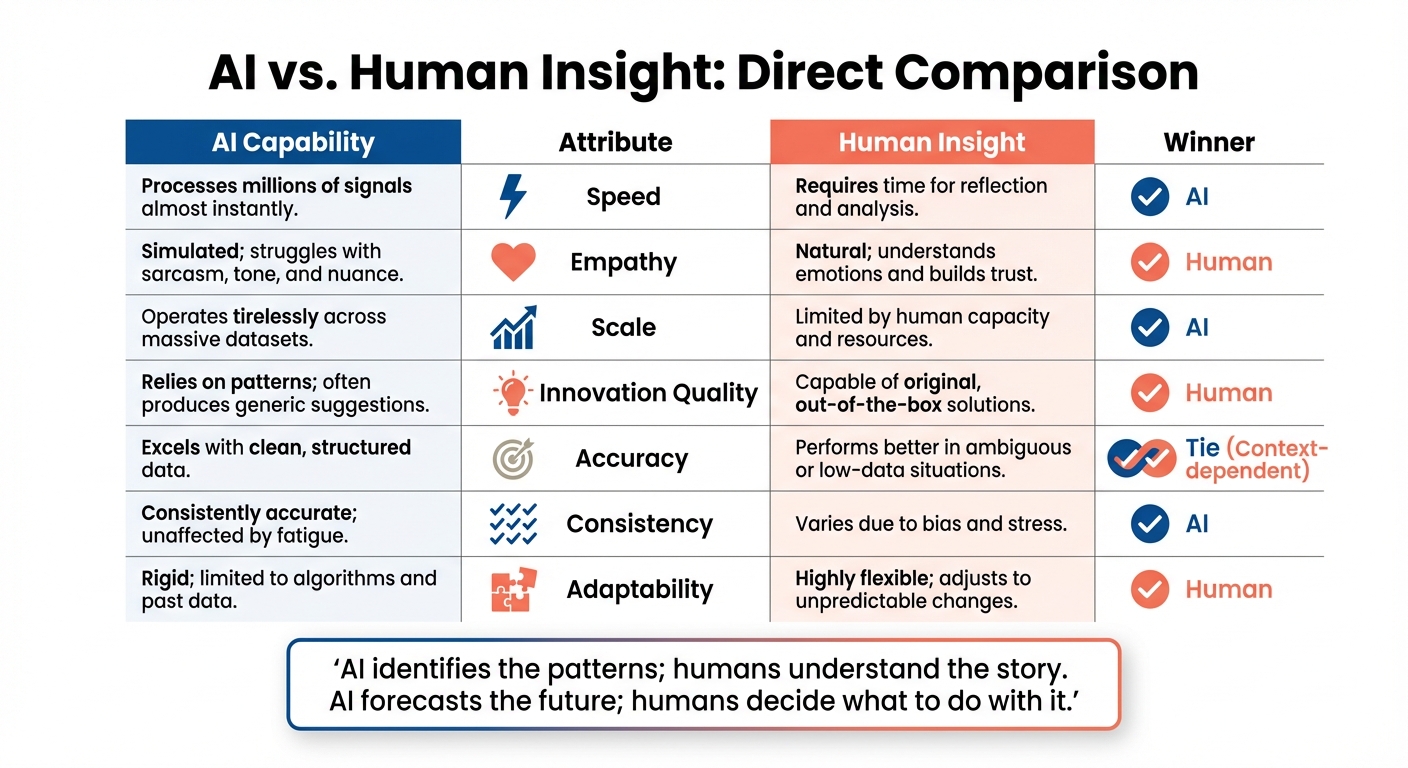
AI vs Human Insight in Customer Innovation: Direct Comparison
Looking at the strengths and weaknesses of both AI and human insight, it's clear they excel in different areas. A side-by-side comparison highlights key differences in speed, empathy, scale, and the quality of innovation.
Comparison Table
| Attribute | AI Capability | Human Insight | Winner |
|---|---|---|---|
| Speed | Processes millions of signals almost instantly [2][15] | Requires time for reflection and analysis [2] | AI |
| Empathy | Simulated; struggles with sarcasm, tone, and nuance [15][3] | Natural; understands emotions and builds trust [2][15] | Human |
| Scale | Operates tirelessly across massive datasets [2][15] | Limited by human capacity and resources [2] | AI |
| Innovation Quality | Relies on patterns; often produces generic suggestions [14][3] | Capable of original, out-of-the-box solutions [15][3] | Human |
| Accuracy | Excels with clean, structured data [15] | Performs better in ambiguous or low-data situations [2][15] | Tie (Context-dependent) |
| Consistency | Consistently accurate; unaffected by fatigue [2] | Varies due to bias and stress [2] | AI |
| Adaptability | Rigid; limited to algorithms and past data [2] | Highly flexible; adjusts to unpredictable changes [2][15] | Human |
This comparison makes it clear: AI shines in speed, scale, and consistency, while humans excel in empathy, creativity, and adaptability. The strengths of each complement the other, creating a powerful partnership when used wisely.
As Market Xcel aptly puts it:
"AI identifies the patterns; humans understand the story. AI forecasts the future; humans decide what to do with it" [15].
The takeaway? Success doesn’t come from choosing one over the other - it comes from knowing when to let AI handle the heavy lifting and when to rely on human judgment. Combining AI's efficiency with human insight is the key to delivering thoughtful, customer-focused solutions.
Combining AI and Human Insight: The Human Moat Approach
After examining the strengths of both AI and human insight, the next step is figuring out how to combine them effectively. One thing is clear: neither AI nor human judgment works best on its own. The real edge comes from blending AI's efficiency with human intuition to achieve results that neither could deliver independently. In a world where AI can replicate products, mimic marketing strategies, and automate creative tasks, trust and genuine connection become the ultimate differentiators - qualities that can't be mass-produced [23].
Frameworks for Hybrid Innovation
Hybrid innovation works when you know what to automate and what to enhance with human input. Automation takes care of repetitive tasks, while augmentation combines AI with human oversight for better results [22]. By automating low-value tasks, you free up time and energy for more meaningful human contributions.
Take IKEA, for example. In 2021, they retrained 8,500 call center employees to shift from answering routine questions to becoming interior design advisors. AI handled the simple queries, allowing employees to focus on high-value design consultations. This strategy added 3.3% to IKEA's global revenue in its first year of implementation, with projections to surpass 10% by 2028 [21].
The goal is clear: let AI handle the mundane so humans can focus on creative and impactful work. As Steve Steinberg, Co-founder of Responsum, puts it:
"When you remove the low-value, repetitive work that drains people of their energy, you actually give them the mental space to do the work that inspires them" [21].
Another example comes from a U.S. supermarket chain that partnered with a shipping company for digital grocery delivery. While AI handled logistics, the supermarket sent its own staff into customers’ homes to gather "small data" - personal preferences and service expectations that automation couldn’t capture [3].
Start small. Test AI in low-risk areas like automating routine emails or organizing feedback. Once those processes run smoothly, expand to more complex tasks that involve customer relationships [2][21]. Equip customer-facing employees with real-time insights and smart tools to deliver more empathetic, personalized service [1][20].
Leadership plays a critical role in making this integration successful.
Leadership at the Top of the Value Stack
As AI becomes a standard tool, leadership must focus on the areas where human qualities - judgment, direction, and meaning-making - can make a difference. Instead of asking, "What can AI do?" leaders should ask, "How can AI help humans do better?" [21].
Seth Mattison, an expert in this field, emphasizes that leaders need to use AI to amplify human insight, not replace it. His work provides organizations with actionable frameworks to implement what he calls a "Human Moat." Through workshops and advisory services, he helps leaders enhance decision-making, judgment, and strategic direction - skills that drive performance in a world flooded with intelligence.
Accountability remains vital. Leaders must ensure humans take responsibility for all outcomes, even those influenced by AI. Treating AI as a "black box" for decisions can erode trust within an organization [21]. As Guillaume Pajeot from Insigniam explains:
"AI may change the systems. But only humans can change the future" [21].
Data supports this approach. Teams that combine human creativity with AI are three times more likely to generate groundbreaking ideas than those working without AI [8]. While AI can improve individual output by about 40%, it’s the collaboration between AI and human teams that consistently leads to exceptional results [8]. Knowledge workers currently spend about 60% of their time on "work about work" - tasks like coordination and scheduling - rather than core responsibilities [8]. Leaders should use AI to reduce this "coordination tax", freeing people to focus on the creative problem-solving that drives innovation [8].
Building the Human Moat in Customer Innovation
A "Human Moat" is built on trust, operational efficiency, and human oversight [22].
Trust is the ultimate differentiator. In a world where almost everything can be replicated, trust is what sets businesses apart. This means being transparent about how AI is used and respecting customers' intelligence. For instance, 41% of consumers prefer to share personal information with humans, while only 21% feel comfortable sharing it with AI [3]. Additionally, 55% of people don’t trust product recommendations generated solely by AI [3].
David Hudson captures this sentiment perfectly:
"Trust isn't just a moral choice - it's a survival one. When everything else can be copied, being trusted is what sets you apart. It's the one thing left that can't be faked." [23]
The goal isn’t to reject AI or embrace it without question. Instead, businesses should design systems where AI enhances human strengths rather than replacing them. This means prioritizing authentic, meaningful interactions at key moments in the customer journey [3]. It also means ensuring that both employees and customers maintain a sense of control and the ability to validate outcomes [3][21].
Michael Fauscette, Founder & CEO of Arion Research, sums it up well:
"Augmentation strategies typically create stronger competitive moats because they leverage the unique strengths of both human intelligence and AI capabilities." [22]
The winning organizations won’t be those with the best AI or the most talented people alone. Success will belong to those who create systems where AI handles speed and scale, while humans bring empathy, judgment, and vision to transform raw data into meaningful customer experiences.
Conclusion
The real challenge isn't about picking sides between AI and human insight - it's about blending the strengths of both. AI stands out for its speed, ability to handle large-scale tasks, and data-crunching power. On the other hand, humans excel in empathy, judgment, and building trust. The organizations that come out ahead will use AI for repetitive tasks and data-driven insights, giving their teams the freedom to focus on creative, strategic, and relationship-driven work - areas that truly set them apart.
This balance isn't just theoretical; it's backed by evidence and strategic trends. As mentioned earlier, most consumers lean toward human interaction over AI-only solutions, and 63% of business transformations that used AI to predict customer needs surpassed expectations [3]. People want the efficiency AI brings but still crave the connection that only humans can provide.
Leaders, as Seth Mattison describes, need to work at "the top of the value stack" - a space where critical thinking, decision-making, and creating meaning take center stage. By letting AI handle routine tasks, leaders can redirect their energy toward building trust and fostering emotional connections. As Edwina Fitzmaurice, EY Global Chief Customer Success Officer, explains:
"Experiences are felt at an emotional level. This isn't something that is often considered by engineering teams who can focus more on an action to be achieved, rather than an experience to be felt." [3]
Creating a "Human Moat" requires thoughtful and strategic planning. AI can remove unnecessary friction and streamline services, but it’s equally important to add intentional friction - human touchpoints that make interactions memorable and genuine. By doing so, organizations can ensure both employees and customers feel empowered in AI-driven processes, avoiding the eerie "Uncanny Valley" effect where perfection feels lifeless [3].
FAQs
What should AI handle vs. people in customer innovation?
AI is great at managing tasks like data processing, automation, and generating insights. On the other hand, humans contribute qualities like creativity, emotional intelligence, and sound judgment. Seth Mattison emphasizes that traits like trust-building and a commitment to quality are key to creating meaningful connections with customers. By taking over repetitive tasks, AI frees up time for people to focus on developing genuine, customer-first strategies that inspire fresh ideas.
How do we prevent AI-driven experiences from feeling generic?
Combining the speed and precision of AI with human judgment can help avoid those generic, robotic interactions that people often associate with AI-driven experiences. While AI is great at crunching data and offering insights, it's the human touch that adds emotional depth and context, making interactions feel more genuine and personal.
By using AI to support rather than replace human connections, businesses can build trust and stand out. Leaders should prioritize qualities that only humans can bring to the table - like empathy and creativity - to craft customer experiences that are both memorable and emotionally meaningful.
Where are the must-have human touchpoints in the customer journey?
Key moments in the customer journey often revolve around judgment, trust, and context. These are the times when interpreting subtle signals, fostering relationships, and delivering a personalized touch truly matter. While these tasks rely heavily on human intuition, AI plays a supportive role by spotting important cues and amplifying them, ensuring no critical detail is overlooked.