
Articles Mar 19, 2026 9:00:00 AM Seth Mattison 24 min read

Want to make your team more effective and innovative? Start with human-centric leadership and feedback loops.
Feedback loops are systems that collect input, analyze it, take action, and follow up. They help organizations improve continuously by identifying what works and addressing what doesn’t. Without them, employee ideas often disappear into a "black hole", leading to disengagement and high turnover. Here’s what you need to know:
- Why it matters: Employees who feel heard are 4.6x more likely to perform well, and teams with regular feedback see nearly 15% lower turnover rates.
- Steps to success:
- Set clear goals tied to business outcomes.
- Use the right tools (e.g., surveys, AI, or open idea boards).
- Analyze feedback systematically to find actionable ideas.
- Take action and communicate results transparently.
- Measure progress and refine the process over time.
- Pro tip: Use frameworks like the RICE Model or Impact vs. Effort Matrix to prioritize ideas effectively.
The bottom line: Feedback loops aren’t just about fixing problems - they’re about creating a system where employees feel valued and empowered to contribute. When done right, they reduce turnover, boost engagement, and drive innovation.
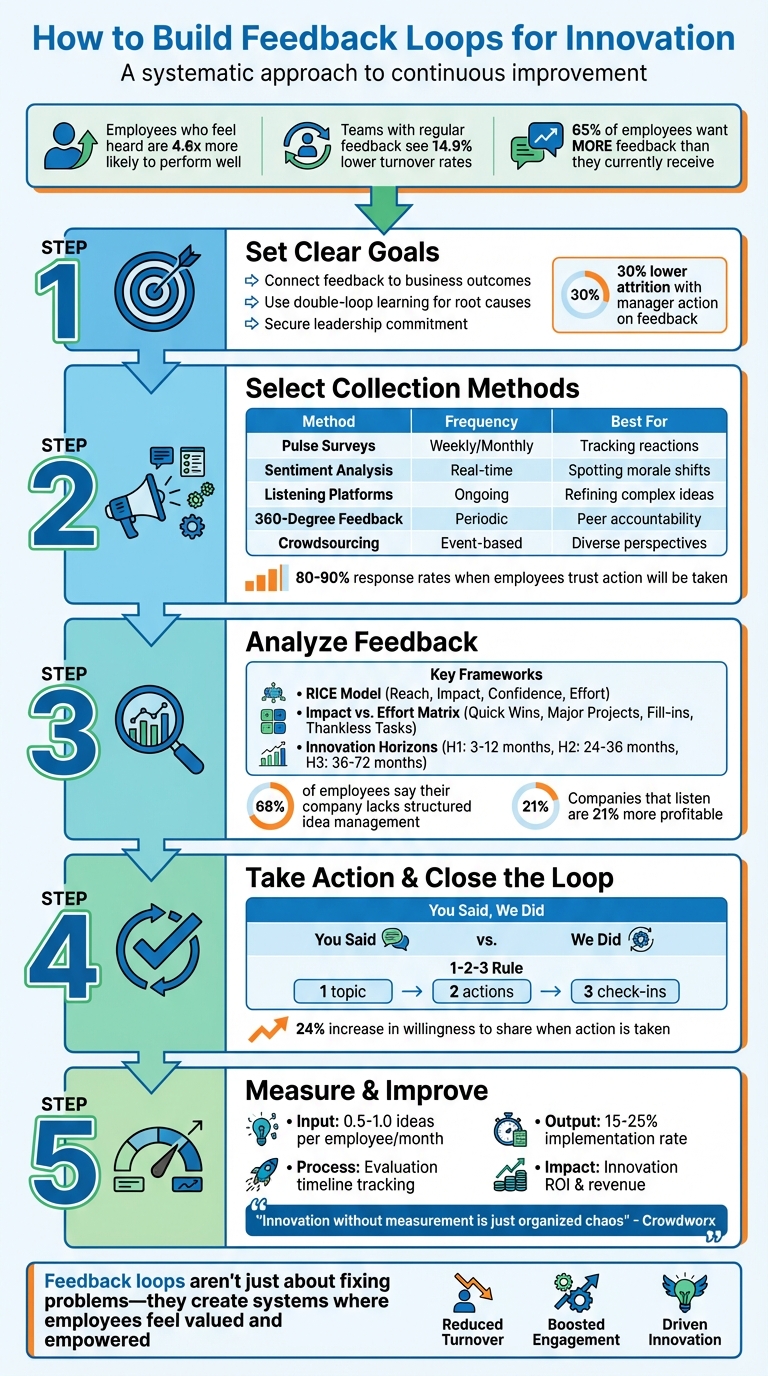
5-Step Process for Building Effective Feedback Loops for Innovation
Step 1: Set Clear Goals for Your Feedback Loop
Start with clear, measurable objectives - vague goals like "improve engagement" won't cut it. Instead, focus on goals tied to specific business outcomes, such as reducing new hire turnover. This clarity ensures your feedback loop has direction and the backing of leadership.
Connect Feedback to Innovation Goals
Effective feedback loops do more than gather opinions - they tackle real business problems. Organize feedback based on the challenges it addresses, not by department or seniority[7]. For example, if your aim is to boost customer retention, focus on identifying pain points, service issues, or product gaps. This targeted approach not only adds value but also helps leadership prioritize efforts based on real impact, not office politics.
Consider using double-loop learning to dig deeper into root causes instead of just patching surface-level issues[6]. For instance, if employees feel project timelines are unrealistic, single-loop learning might adjust deadlines, while double-loop learning could lead to rethinking the entire planning process. A great example of this is from January 2025, when a tech startup revamped its onboarding process using employee suggestions. They introduced buddy systems and interactive training, cutting new hire turnover by 20%[1].
Aligning feedback with strategic goals also means securing leadership commitment to follow through on meaningful change.
Get Leadership Support
Leadership support is critical - without it, even the best feedback system can fall flat due to a lack of accountability[3][5]. Teams with managers who act on feedback see 30% lower attrition rates, and employees are 24% more likely to share their thoughts when they believe their input will lead to action[3]. Support from leadership goes beyond budget approval; it’s about holding people accountable for turning feedback into results.
To gain executive buy-in, translate employee feedback into terms that align with business priorities. Don’t just present complaints - frame them as opportunities. For instance, instead of stating that employees want better career development, highlight how improving internal mobility could reduce recruitment costs and retain top talent. Assign a senior advocate to ensure feedback is integrated into the company’s strategy[3]. This ensures feedback is treated not as an afterthought but as a driver of growth and competitive edge.
Step 2: Select the Right Feedback Collection Methods
Once you've set your goals and gained leadership support, it's time to pick the best methods for gathering employee feedback. The tools you choose should make it easy for employees to share their ideas while ensuring regular input and maintaining security. It's important to create an environment where employees feel safe sharing raw, unfiltered thoughts without fear of judgment [3][10]. Using anonymous feedback options can encourage honesty, while transparent evaluation systems ensure every idea is judged on its merit alone [10].
For example, Warby Parker swapped out their old suggestion box for an open Google Doc where employees could post ideas, comment, and vote. This change led to a massive 20x increase in engagement [10]. Similarly, Li & Fung in Hong Kong introduced a transparent six-point scorecard for internal crowdsourcing. This approach resulted in 90% of solutions coming from junior and mid-level employees, with 30% originating from support teams like IT and Finance [10].
Review Feedback Tools and Channels
Different tools serve different purposes, and the right mix can make a big difference. Here are some options:
- Pulse surveys are great for quick, scalable feedback on specific changes, like a new software rollout. They're easy to use but may lack depth [9].
- Sentiment analysis uses AI to track emotional trends in emails, chats, and internal communications. It can spot early signs of resistance or excitement without overburdening employees with surveys [3][9]. Microsoft, for instance, relies on "listening teams" made up of data scientists and psychologists to ensure feedback is both valid and actionable [3].
- Digital listening platforms, integrated into tools like Slack or Teams, enable ongoing, transparent two-way conversations.
- 360-degree feedback offers peer-to-peer accountability and helps uncover blind spots, though it requires more resources to implement [6].
- Crowdsourcing platforms or open idea boards let employees share and vote on ideas, encouraging diverse input. However, these require careful moderation to avoid groupthink and ensure minority opinions aren't drowned out [10].
One example of success comes from M&H President Jeff Hagel, who reported that using the Matter app within Slack led to over 2,000 kudos being shared and achieved more than 80% employee engagement in less than two months [8].
Compare Methods by Suitability
Each feedback method has its strengths and is suited for different objectives. Combining multiple approaches - like using sentiment analysis for broad trends, listening platforms for ongoing dialogue, and pulse surveys for quick insights - can provide a fuller picture [6][9]. Companies that achieve survey response rates of 80% to 90% often find employees are 24% more likely to share their thoughts when they trust that management will act on their input [3].
| Method | Frequency | Ease of Use | Fit for Innovation |
|---|---|---|---|
| Pulse Surveys | High (Weekly/Monthly) | High | Best for tracking reactions to specific changes [9]. |
| Sentiment Analysis | Continuous (Real-time) | High (Automated) | Excellent for spotting early morale shifts [9]. |
| Listening Platforms | Ongoing | Medium | Great for refining complex ideas through dialogue [9]. |
| 360-Degree Feedback | Periodic | Low | Useful for peer accountability and reducing blind spots [6]. |
| Crowdsourcing/Open Docs | Event-based or Ongoing | Medium | Encourages merit-based, diverse perspectives [10]. |
| Focus Groups | Occasional | Low | Ideal for exploring root causes of specific problems [3]. |
Before collecting feedback, outline clear criteria for how ideas will be evaluated - such as scalability, commercial potential, or originality [10]. Additionally, consider providing "slack time" or paid hours for employees to participate in innovation challenges. This ensures frontline workers can contribute without compromising their regular responsibilities [10]. The key is to align your chosen methods with your broader goals for driving innovation.
Step 3: Analyze Feedback to Find Actionable Ideas
Once you've gathered feedback (as outlined in Step 2), the next challenge is turning that raw input into meaningful, actionable ideas. Without a clear process, valuable insights can easily get lost in the shuffle. This isn’t just speculation - 68% of employees believe their company lacks a structured way to capture and manage ideas [12]. The solution lies in systematically organizing feedback to identify patterns that can lead to real change.
Use Data Analysis Techniques
Start by grouping similar pieces of feedback to uncover recurring themes [11]. For instance, if "career advancement" keeps popping up in employee comments, dig deeper to find the root cause. What initially seems like a general complaint might point to a broader issue, such as limited internal mobility or insufficient professional development opportunities [3].
Some organizations are even leveraging generative AI to speed up this process. AI tools can summarize feedback across different employee segments, helping to extract insights faster [3]. Microsoft, for example, employs specialized listening teams made up of data scientists and psychologists to ensure feedback is analyzed in a way that’s both accurate and actionable [3].
A helpful tool to organize feedback is the Feedback Capture Grid, which categorizes input into four areas: Positive, Improvement, Questions, and New Ideas [11]. For quantitative data, focus on metrics like volume. For example, if "290 users reported duplicated charges", this statistic highlights the scale of the issue and helps prioritize it accordingly [13].
Once you’ve identified the key themes, the next step is deciding which ideas to act on first.
Create a Prioritization Framework
Not every idea will have the same level of importance or urgency. Tools like the RICE Model provide a structured way to evaluate ideas. By calculating a score based on Reach, Impact, Confidence, and Effort, you can prioritize ideas that offer the most value while avoiding the trap of catering to the loudest voices [14].
Another effective method is the Impact vs. Effort Matrix, which divides ideas into four categories:
- Quick Wins: High impact, low effort
- Major Projects: High impact, high effort
- Fill-ins: Low impact, low effort
- Thankless Tasks: Low impact, high effort
This visual tool is especially useful during team workshops, where reaching consensus quickly is important [14].
For a more strategic approach, consider the Innovation Horizons Framework:
- Horizon 1: Short-term improvements (3–12 months)
- Horizon 2: Medium-term business model extensions (24–36 months)
- Horizon 3: Long-term disruptive innovations (36–72 months)
This framework helps balance immediate needs with long-term goals, ensuring resources are allocated effectively [12]. At the same time, it’s essential to discard non-actionable feedback early to avoid wasting time and energy [12].
The payoff for this effort is clear: companies that actively listen to employees are 21% more profitable than those that don’t [12]. Additionally, teams with responsive managers experience 30% less attrition [3]. By refining feedback into actionable insights, you’re not just solving problems - you’re gaining a competitive edge.
Step 4: Take Action and Close the Loop
Once you've analyzed feedback and set priorities, it's time to act and communicate the results. This is where many organizations falter. When feedback seems to vanish without follow-up, employees can experience "inaction fatigue", leaving them less likely to share ideas in the future [3][15]. The fix? Show them you’re listening, explain the steps you’re taking, and highlight the progress being made.
Share Results and Build Trust
To build trust, transparency is key. If some suggestions aren’t feasible, explain why. Employees are much more likely to stay engaged when they understand the reasoning behind decisions, even if their input isn’t implemented [2][15].
"80% is framing the problem…it's a process. Here's what we heard, here's where we are, here's where we're going based on the feedback we received from you, and here's when we'll next perform a pulse [survey] with more results and an opportunity for more input" [3]
Using the "You Said, We Did" framework can make this process clear and effective. Outline the feedback theme, the specific actions being taken, the timeline for implementation, and how success will be measured [6].
"You told us cross team visibility was a challenge. We're piloting monthly standups across departments for the next quarter and will reassess engagement results in the next pulse survey" [6]
This method shows employees exactly how their feedback has influenced decisions, building credibility and encouraging future participation. By fostering this level of transparency, you lay the groundwork for sustained employee engagement.
Keep Employees Engaged
Maintaining engagement requires ongoing effort. The "1-2-3 Rule" is a simple yet effective approach: focus on one feedback topic, implement two specific actions, and check in three times to track progress [3]. This keeps things manageable while showing employees their input truly matters. Employees who feel their feedback is valued are 4.6 times more likely to perform at their best [1], and teams with responsive managers see about 30% less attrition [3].
Take the example of M&H in late 2025. Under the leadership of President Jeff Hagel, the company introduced a real-time recognition and survey system to revamp its culture. Within two months, employees exchanged over 2,000 "kudos", and engagement rates soared to over 80%. This initiative succeeded by integrating feedback and appreciation into everyday tools like Slack [16].
On the flip side, Dell's "IdeaStorm" program struggled when changes in strategic priorities weren’t communicated, leaving users frustrated and disengaged [15]. The takeaway? Closing the loop requires consistent, visible action to maintain trust and participation.
Step 5: Measure Results and Keep Improving
Creating a feedback loop isn't a one-and-done task - it’s a process that thrives on regular reviews and adjustments. The goal is to ensure your feedback loop drives real progress rather than just keeping people busy. As Crowdworx aptly states, "Innovation without measurement is just organized chaos" [18]. Here's how to define success and refine your feedback loop for continuous improvement.
Choose Success Metrics
To truly understand how well your feedback loop is working, track a mix of metrics:
- Input metrics: Measure participation, like 0.5–1.0 ideas per employee per month.
- Process metrics: Keep an eye on timelines, such as the average time it takes to evaluate ideas.
- Output metrics: Aim for an implementation rate of 15%–25% for submitted ideas.
- Impact metrics: Assess the bigger picture, like innovation ROI and revenue from new products [17][18].
These metrics act as a reality check, helping you confirm that every step in your feedback loop is contributing to measurable results. For example, survey response rates of 80%–90% suggest a strong feedback culture [3]. Additionally, tracking how many managers follow through with action plans after receiving feedback ensures accountability at the team level [6].
Adjust Feedback Loops Over Time
Once your metrics are in place, use them to fine-tune your process and keep it aligned with your organization’s evolving goals. Regular reviews are essential to identify and address potential issues. For example, if participation rates drop, it might not be "survey fatigue" but rather "inaction fatigue" - a sign that employees feel their feedback isn’t being acted upon [3]. Combat this by clearly communicating how input is being used.
Leverage double-loop learning [6]. If you notice recurring bottlenecks during idea evaluations, don’t just try to speed things up. Instead, ask deeper questions: Are your evaluation criteria outdated? Does the approval process need a complete overhaul? Assign clear ownership for each innovation metric to ensure someone is always accountable [17]. You can also use AI tools to analyze patterns in qualitative feedback, making it easier to spot trends and act on them effectively [3].
The key is to build a system that doesn’t just work - it evolves and improves with every cycle.
Using Seth Mattison's Leadership Strategies for Future-Forward Feedback Loops
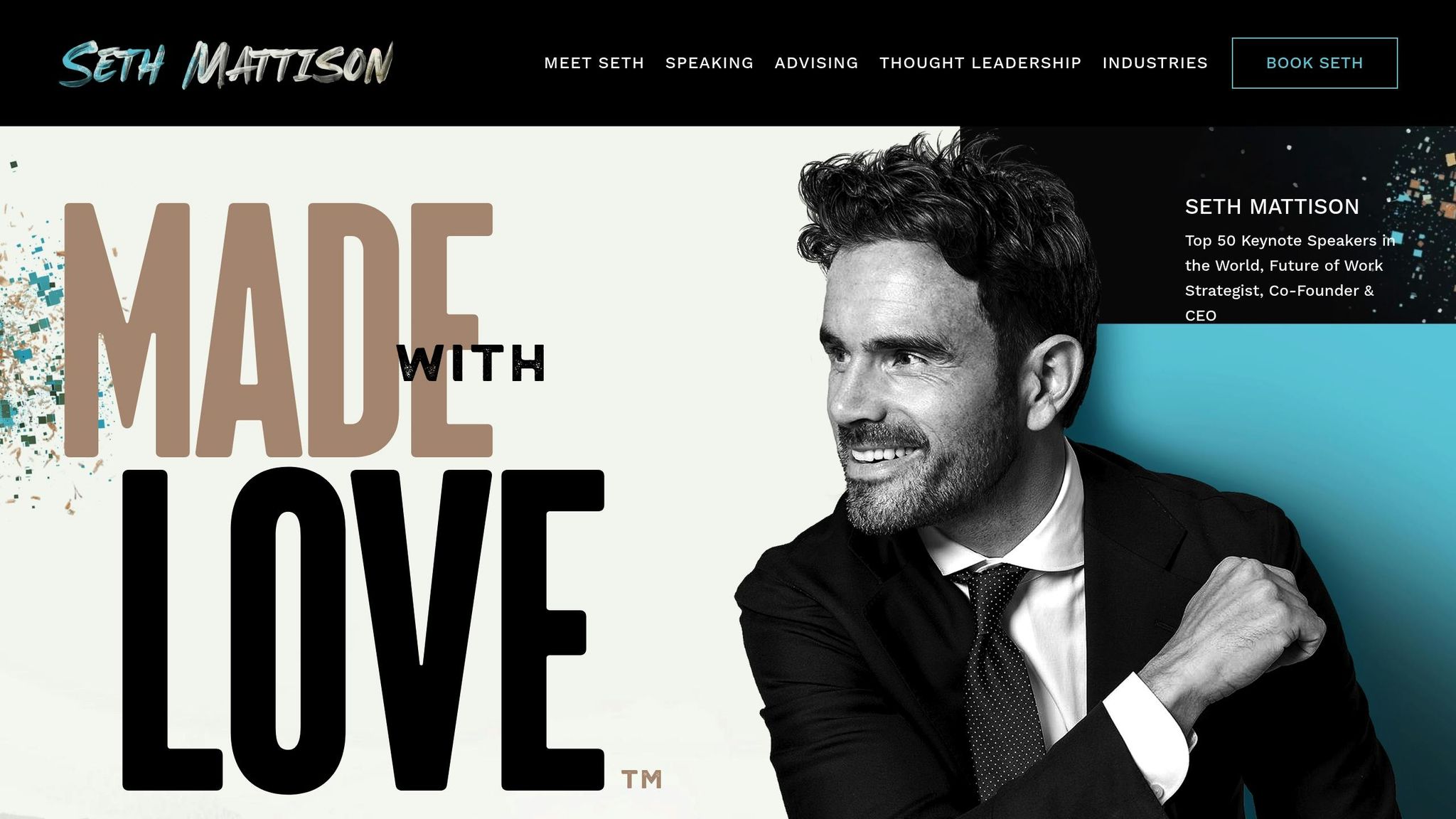
Seth Mattison's leadership strategies bring a fresh perspective to creating effective feedback loops. He emphasizes a shift from the outdated "Command and Control" model to a more modern "Connect and Empower" approach. This shift prioritizes psychological safety, encouraging employees to share honest and constructive feedback without fear.
Through his work with FutureSight Labs, Mattison focuses on uncovering what teams genuinely value. By using research-driven insights, he helps leaders design feedback systems that reflect employee priorities rather than relying on one-size-fits-all surveys. As Mattison puts it:
"Our overriding mission is to equip you and your teams with data-driven research and insights to confidently and courageously embrace your future and meet your moment of transformation with intention and impact." [19]
This method aligns feedback systems with an organization's broader vision, ensuring they support innovation and growth.
Mattison's strategies also tackle the challenge of breaking down silos within organizations. By fostering agile, cross-functional teams, he opens up new channels for lateral feedback, which accelerates innovation. His approach transforms rigid, opaque communication structures into authentic and transparent dialogues, making feedback more impactful and actionable.
For organizations looking to improve their feedback loops, Mattison offers a range of resources, including keynote speeches, executive workshops, and personalized coaching. His advisory services focus on co-creating strategies that align feedback systems with an organization’s unique goals. Reflecting on leadership in today’s fast-paced environment, Mattison highlights the importance of patience:
"In this relentless environment, patience becomes a vital leadership quality, allowing us to guide our teams through uncertainties with calm, measured, and steady progress." [19]
Conclusion
Creating effective feedback loops isn't just an HR task - it's a powerful strategy to unlock employee potential and fuel ongoing innovation [2]. These loops follow a simple yet impactful cycle: gathering input, analyzing insights, taking action, and communicating results [1][6]. When done right, this process fosters an environment where employees feel encouraged to share their best ideas.
The numbers back this up: employees who believe their feedback matters are 4.6 times more likely to perform at their peak [1]. Plus, teams that receive regular feedback see a 14.9% drop in turnover rates [2]. Yet, a striking 65% of employees say they want more feedback than they currently get [2]. This gap highlights a huge opportunity for organizations to step up their feedback game.
True innovation happens when feedback goes beyond solving immediate problems and shifts into what's called "double-loop learning" [6]. This approach turns feedback into a proactive tool for driving forward-thinking ideas. Preston Chandler sums it up perfectly:
"Feedback is the foundation of innovation. It helps teams learn what works, what doesn't, and what to do next" [4].
On the flip side, when feedback goes unanswered - disappearing into a "black hole" - trust erodes, and employees disengage [1][15]. But when organizations act on feedback, they see a 24% boost in employees' willingness to speak up [3]. Frameworks like "You Said, We Did" make it clear how employee input leads to real changes [6], strengthening trust and building momentum for a feedback-driven culture.
Building this kind of culture takes time, consistency, and openness. By making feedback a continuous conversation rather than a one-off task, organizations can tap into the collective intelligence of their teams. This approach not only sustains innovation but also helps businesses thrive in an ever-evolving world.
FAQs
How do feedback loops help reduce employee turnover?
Feedback loops play an important role in cutting down employee turnover by building a workplace where people feel listened to and appreciated. When companies take the time to hear what employees have to say and act on it in meaningful ways, it creates trust, boosts engagement, and strengthens employees' connection to the organization. When workers see that their feedback leads to real improvements, they’re more likely to stick around.
These loops also help catch and address problems early before they grow into bigger issues that might push someone to leave. By consistently gathering feedback, taking action, and following up, businesses show they’re serious about making things better. This approach not only increases job satisfaction but also encourages employees to stay for the long haul. A workplace built on trust and responsiveness leads to a more loyal and motivated team.
What are the best tools for gathering and analyzing feedback to drive innovation?
To gather and analyze feedback effectively for innovation, organizations can tap into digital tools like pulse surveys, polls, and feedback systems embedded in platforms such as Slack or Microsoft Teams. These tools make it easier to collect real-time input while simplifying communication and data organization.
Another strategy involves using continuous feedback loops. This means regularly testing ideas, gathering feedback, and making adjustments. By doing this frequently, feedback becomes more actionable, allowing for faster improvement. Additionally, turning raw data into compelling stories can help present insights in a way that grabs attention and encourages stakeholders to take action.
By combining these tools and methods, organizations can create an environment that prioritizes innovation and responsiveness, ensuring both employees and customers have a voice in driving meaningful progress.
What is double-loop learning, and how does it improve feedback for innovation?
Double-loop learning goes beyond simply solving immediate problems. It pushes both individuals and organizations to dig deeper - questioning the assumptions, norms, and goals that shape their decisions and actions. This kind of reflection isn't just about fixing what's broken; it's about uncovering root causes and addressing systemic challenges.
By promoting a culture of ongoing inquiry and improvement, double-loop learning helps organizations stay ahead of the curve. Instead of merely reacting to issues as they arise, it encourages proactive adaptation, paving the way for more meaningful feedback loops that spark long-term growth and fresh solutions.