
Articles Feb 13, 2026 9:00:00 AM Seth Mattison 20 min read

Groupthink happens when teams prioritize harmony over critical thinking, leading to poor decisions. To prevent this, leaders must foster human-centric leadership to create environments where dissent is encouraged, diverse perspectives are valued, and open communication thrives. Here's how:
- Psychological Safety: Foster trust so team members feel safe sharing ideas without fear of backlash.
- Encourage Dissent: Assign rotating devil’s advocates, use anonymous feedback tools, and build systems that make disagreement routine.
- Diverse Teams: Hire individuals with varied backgrounds and viewpoints to challenge assumptions.
- Rethink Failures: Treat mistakes as learning opportunities and focus on improving decision processes.
- Structured Discussions: Break into smaller groups, use brainstorming techniques like 1-2-4-All, and allocate time for deeper analysis.
- Review Decisions Regularly: Conduct post-decision reviews to identify blind spots and improve future outcomes.
Build Psychological Safety First
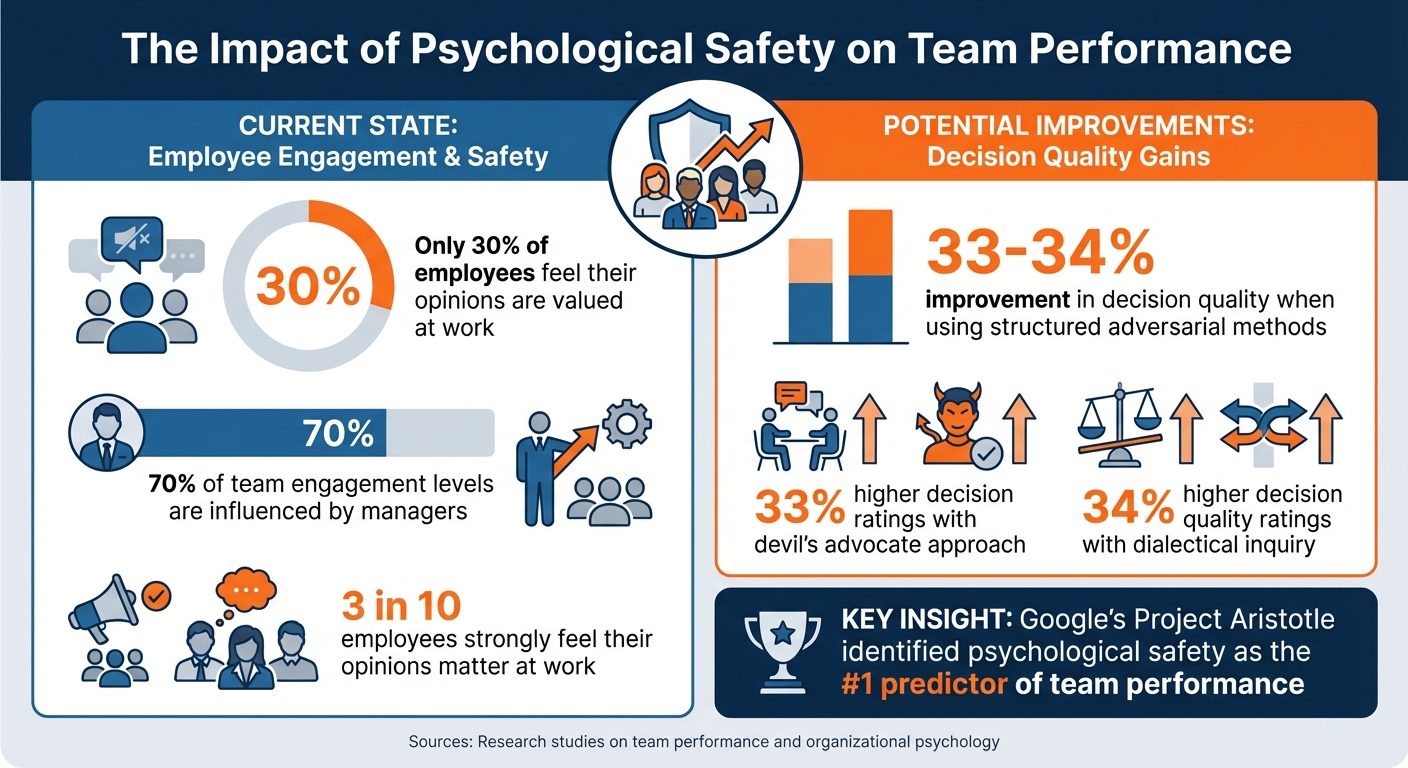
Groupthink Prevention Statistics: Psychological Safety and Decision Quality Impact
Psychological safety is the cornerstone of preventing groupthink. It’s the belief that individuals can voice their thoughts without fearing backlash or judgment [8]. Without this, people often stay silent, prioritizing harmony over truth. The result? Decisions based on incomplete data and unchecked assumptions.
Here’s a telling statistic: only 30% of employees feel their opinions are valued [1][8]. Google’s Project Aristotle underscores this, identifying psychological safety as the top predictor of team performance [6]. High-performing teams don’t shy away from conflict. Instead, they foster spaces where mistakes are seen as part of growth, and bold ideas are welcomed without fear of shame or punishment [1][3].
"Psychological safety isn't something you can do… it's only achievable through consistent action." - Mark Cruth, Modern Work Coach, Atlassian [1]
Creating this kind of environment means shifting from seeking total agreement (consensus) to focusing on consent - acknowledging that not everyone will agree but ensuring decisions align with team goals [1]. Since managers influence 70% of team engagement levels [4], leadership plays a critical role in establishing this sense of safety. When leaders model openness and encourage honest dialogue, they lay the foundation for a culture where communication thrives.
Promote Open Communication
To build trust, leaders must show that differing opinions are not just tolerated - they’re encouraged. Start by modeling vulnerability. Share your own missteps and what you learned from them. Then, ask for specific feedback, ideally one-on-one, to avoid group conformity [4][8]. Replace open-ended questions like “Any thoughts?” with more targeted ones like, “What could I have done differently?” or “Is there something you need from me?”
Novartis experimented with over 7,000 employees and found that specific manager behaviors significantly increased openness and participation [5].
Another strategy is structured brainstorming. The “1‑2‑4‑All” method is a great example. It begins with individuals generating ideas on their own, then sharing in pairs, followed by small groups, before finally presenting to the entire team. This ensures that everyone’s voice is heard [1].
Reframe Failures as Learning Moments
Encouraging open dialogue is just the first step. To truly prevent groupthink, teams must also rethink how they view failure. When mistakes are framed as opportunities to learn, teams become more resilient. Organizational psychologist Adam Grant puts it this way:
"If the result was negative but you evaluated the decision thoroughly, you've run a smart experiment." - Adam Grant, Organizational Psychologist, Wharton School [7]
This approach shifts the focus from outcomes to the decision-making process itself. A negative result from a well-thought-out decision can be celebrated as a learning opportunity, while a positive result from poor reasoning might just be luck [7]. This mindset encourages teams to take calculated risks and adapt quickly when things don’t go as planned.
When errors happen, start by checking your own reaction. Instead of showing frustration, focus on helping the team member correct the mistake and draw insights from it. Asking neutral questions like, “What perspectives might we have overlooked?” or “What blind spots can we address?” keeps the discussion constructive and solution-focused [6].
Leaders who openly embrace feedback and treat setbacks as experiments inspire their teams to view challenges as stepping stones rather than failures to avoid [7][2].
Create Systems That Encourage Dissent
Creating an environment where dissent is encouraged isn't just about psychological safety - it's about building systems that make disagreement an expected and valued part of decision-making. Without these formal structures, even the most well-meaning teams might default to quick agreement simply because it feels safer. By embedding dissent into the decision-making process, teams can ensure stronger, more thoughtful outcomes.
Assign a Devil's Advocate
One way to formalize dissent is by assigning a devil's advocate. This role is designed to uncover potential flaws in proposals, making disagreement a routine part of the process rather than a social risk [9][10]. To avoid labeling anyone as a "naysayer", rotate this responsibility among team members [2][10]. In larger teams - especially those with seven or more members where confirmation bias is more likely - appointing two devil's advocates can help ensure no one feels isolated in their dissent [9].
"Assign a rotating participant (or small 'red team') to challenge assumptions for each proposal... Makes dissent a role, not a social risk, and surfaces blind spots." - Austin Govella [10]
To make this process effective, provide prompts like "What if our assumption is false?" to keep the focus on the proposal rather than the individual [2]. You can also dedicate a short "red-team" session - just five minutes - to allow rebuttals without derailing the entire meeting [10]. Research shows that integrating adversarial roles into discussions can improve decision quality by 33% [11].
Use Anonymous Feedback Tools
In addition to structured dissent, anonymous feedback tools can encourage team members to share concerns or alternative viewpoints without fear of judgment. These tools are especially helpful for surfacing ideas that might differ from those of senior leaders or the majority [4]. Collecting anonymous input early in the process also prevents the group from being anchored by the first comments shared [10].
Anonymous surveys or submission platforms allow ideas to be evaluated on their merit, free from the influence of hierarchy or expertise [9]. For decisions with high stakes, you might ask team members to anonymously share the "cons" of a proposal. The goal here isn’t secrecy for its own sake but to ensure that all perspectives, particularly those that might otherwise go unspoken, are heard and considered [4][10].
Rotate Leadership Responsibilities
Just as diverse viewpoints help prevent groupthink, rotating leadership roles ensures that all voices have a chance to shape discussions. When one person consistently leads, their perspective can unintentionally become dominant. By rotating roles like meeting facilitator or agenda setter, you create opportunities for a variety of communication styles to influence the conversation. This also distributes accountability and encourages greater participation from the entire team.
Leaders should step back during brainstorming sessions, allowing others to drive discussions while they focus on evaluating ideas later [11]. Separating idea generation from evaluation ensures that no single person, including the formal leader, steers the group unintentionally. Rotating administrative tasks - such as deciding who participates or setting the agenda - further prevents any one individual from controlling the flow of information [9]. Similarly, rotating roles like the devil's advocate turns challenging the consensus into a shared responsibility, rather than a personal risk.
Seth Mattison (https://sethmattison.com) highlights how structured dissent strengthens decision-making and unlocks a team’s full creative potential. These systems, when implemented thoughtfully, empower teams to question assumptions and elevate the quality of their decisions.
Assemble Teams with Different Backgrounds
The makeup of your team plays a critical role in avoiding groupthink. When everyone on the team has a similar background or mindset, it’s easy to prioritize harmony over healthy debate. This can lead to the dangerous assumption that everyone agrees without fully exploring other options or perspectives [1].
What truly matters is intellectual diversity - bringing together individuals with different skills, experiences, and viewpoints. A mix of disciplines and life experiences allows teams to approach challenges in new ways [12]. As the HBR Editors explain:
"A choir can't perform well if it's made up of all sopranos; similarly, on an innovative team, you won't achieve good results with people whose strengths and styles are all the same." - HBR Editors [12]
Teams with diverse perspectives are better equipped to question the status quo and push back against premature consensus [13].
Hire for Varied Perspectives
Creating a team with diverse viewpoints starts with intentional hiring. Instead of focusing on candidates who mirror existing strengths, look for people with different skill sets, experiences, and ways of thinking [12]. Tools like CliftonStrengths can help identify gaps in areas such as analytical or strategic thinking, ensuring a well-rounded team [4].
One effective strategy is hiring by committee. When multiple interviewers contribute their evaluations, the combined insights are often more accurate than a single opinion [14]. Atta Tarki, Founder and Chairman of ECA Partners, highlights this approach:
"There is wisdom in crowds when it comes to spotting talent." - Atta Tarki, Founder and Chairman, ECA Partners [14]
To further avoid bias, ask team members to submit their feedback in writing before discussing candidates. This ensures that each perspective is considered independently [4]. Once you’ve built a diverse team, smaller group discussions can be a powerful way to uncover unique insights.
Break into Smaller Discussion Groups
Even within a diverse team, large group settings can stifle dissenting opinions. Breaking the team into smaller groups for initial discussions can ease the pressure to conform [1]. Techniques like 1‑2‑4‑All encourage participants to generate ideas independently before sharing them with the group, which helps surface fresh perspectives.
Another method is brainwriting, where team members write down their ideas individually before any group discussion begins. This approach often leads to more ideas - and better ones - compared to traditional brainstorming [1]. To ensure fairness, gather all input anonymously so ideas are evaluated based on their merit, not the status or personality of the person who proposed them [4].
As Seth Mattison emphasizes, encouraging diverse viewpoints doesn’t just prevent groupthink - it also fuels innovation and leads to stronger, more effective decisions. For more insights, visit Seth Mattison's website.
Allow Time for Thoughtful Discussion
Taking the time for meaningful discussion is key to building teams that question the status quo and avoid the trap of groupthink. When teams feel rushed, they tend to default to consensus, often stifling dissenting voices [1]. The trick lies in recognizing which decisions warrant deeper analysis and which can be handled more quickly. Not every choice carries the same weight. Decisions that impact strategy, budgets, or customer experience require thorough exploration and debate. In contrast, low-stakes decisions can often be made swiftly without much risk [1]. Leaders who fail to differentiate between these types of decisions either waste time on minor issues or make hasty choices on critical matters.
To counteract this, it’s important to build discussion time into project schedules. This ensures teams have enough room to explore alternatives and challenge assumptions, rather than simply settling for the first reasonable idea. A helpful approach is shifting from seeking "consensus" (everyone agreeing) to "consent" (ensuring an idea won’t harm goals, even if it’s not perfect). This framework encourages experimentation while maintaining thoughtful decision-making [1].
Allocating appropriate time for discussion is essential for questioning assumptions and improving the quality of decisions.
Know When to Slow Down
One of the most valuable leadership skills is knowing when to take your time and when to act quickly. Treating every decision with the same level of urgency can lead to burnout from overthinking or costly mistakes from rushing. To avoid this, categorize decisions by their impact. Slow down for high-stakes choices, while allowing low-risk decisions to move forward at a quicker pace [1].
For major decisions, extend the discussion phase by using structured methods that prevent rushing to judgment [15]. For example, require teams to develop a second solution before committing to the first. This forces deeper analysis and reduces the chance of premature decisions [15]. Research shows that teams using techniques like dialectical inquiry or assigning a devil’s advocate achieve decision quality ratings 34% and 33% higher, respectively, compared to those relying solely on consensus-building [11]. These deliberate processes help teams make more thoughtful and well-rounded choices.
Teach Teams to Ask Better Questions
Once you’ve carved out enough time for discussion, focus on improving the quality of debate by encouraging sharper questions. Teams often settle on unanimous decisions without meaningful conversation - a classic symptom of groupthink [13]. Teaching team members to ask probing questions can break this pattern and help uncover potential flaws before they escalate into larger problems. Prompt questions like "What are we missing?" or "What other options could work?" can open up new perspectives. Encourage proposers to explain their ideas by asking, "Why is this effective?" [13].
Art Petty highlights the risks of unchallenged agreement:
"The pursuit of consensus gives rise to the tyranny of mediocrity." - Art Petty [15]
Another effective question is, "Who is this NOT for?" This helps teams identify overlooked edge cases or risks. For example, when airbags were first developed, a team of seven men designed and tested them exclusively on men, resulting in injuries to women and children. Had they asked who the solution wouldn’t work for, they might have avoided this oversight [2].
To further enhance critical thinking, assign someone in every meeting to play the role of constructive critic. This person’s job is to ask challenging questions like "What if this assumption is wrong?" or "How could this plan fail?" [2]. Assigning this role reduces the social pressure of being the lone dissenter and ensures that critical evaluation becomes a standard part of the team’s process. This approach ultimately leads to stronger, more reliable decisions.
Review Past Decisions Regularly
Reflecting on past decisions isn't just about evaluating outcomes - it's about fostering a mindset of ongoing critical thinking and improvement.
Taking the time to revisit decisions helps teams break free from groupthink. By analyzing what succeeded and what fell short, teams can uncover recurring patterns in their decision-making. This process shines a light on blind spots that may have gone unnoticed during the initial discussions. Without this kind of regular reflection, teams risk repeating the same errors.
The trick is to make these reviews a routine part of your team's workflow, rather than something reserved for crisis moments. When reflection becomes second nature, teams can better recognize red flags, like rushing to consensus or stifling dissenting opinions. Over time, this builds a culture where critical thinking thrives.
Schedule Decision Reviews
Set aside time for 60-minute decision review sessions, either quarterly or after major project milestones. Use these sessions to examine key moments - whether they’re successes, challenges, or shifts in strategy - to better understand the context of each decision. Start by creating an open environment where learning is the priority. Remind everyone that decisions were made with the best intentions and the tools available at the time.
A useful framework for these discussions is the 4Ls Framework:
- Loved: What worked well and should continue?
- Loathed: What didn’t work and should stop?
- Learned: What valuable lessons came out of the experience?
- Longed For: What resources or support were missing?
Another helpful exercise is Alternative Path Analysis. Ask the team to recall and explain the alternative options they considered during the original decision-making process. Struggling to articulate why certain paths were dismissed might indicate that groupthink played a role. Similarly, a Risk and Tradeoff Re-evaluation can help identify overconfidence in past "foolproof" plans by examining overlooked risks or biases.
These structured approaches make decision reviews more than just a retrospective - they become a tool for continuous learning and improvement, reinforcing a culture that challenges conformity.
Build Feedback into Team Processes
Beyond scheduled reviews, creating a system for ongoing feedback strengthens the team's ability to adapt and improve. Anonymous feedback tools are particularly effective, as they allow team members to share concerns without fear of judgment or backlash [13]. This can help surface unspoken frustrations or highlight "loathed" practices that might otherwise go unaddressed. Anonymous input can also reveal if "mindguards" - team members who inadvertently block dissenting opinions - are influencing discussions.
Incorporate anonymous feedback into every review, and always conclude with a clear action plan. Assign responsibilities and set deadlines to ensure follow-through. Additionally, make it a habit to audit reviews for external perspectives, ensuring that a variety of viewpoints are considered.
Mark Cruth, Modern Work Coach at Atlassian, highlights the importance of fostering an experimental mindset:
"Consent allows a team to acknowledge that not everyone will (or should) agree with an idea, but focuses on ensuring an idea won't be detrimental to the team's goals. It helps a team build an experimentation mindset around their work." [1]
Conclusion
Preventing groupthink takes deliberate effort, starting with leadership that prioritizes critical thinking and team structures designed to support it. Establishing psychological safety - where team members feel comfortable sharing their thoughts - plays a huge role. Systems that actively encourage dissent make challenging ideas a natural part of the process rather than a personal risk. Bringing together diverse teams ensures a range of perspectives, and allowing for thoughtful discussion avoids rushed, shallow decisions. Regularly reviewing past decisions helps teams learn and improve over time.
Studies show that structured adversarial methods can improve decision quality by 33%-34% [11]. Yet, only 3 in 10 employees strongly feel their opinions matter at work [16]. That gap is an opportunity for leaders who are ready to make changes.
As mentioned earlier, psychological safety requires consistent effort [1]. These strategies can’t be one-off actions. Assigning a devil’s advocate once won’t shift your culture. Hiring one person with a different background won’t eliminate blind spots. These practices must become a core part of how your team operates.
When teams break free from groupthink, they don’t just avoid failure - they open the door to innovation, uncover hidden insights, and create meaningful engagement. Teams that embrace dissent as part of their culture thrive creatively and make smarter, less risky decisions. Leadership plays a key role in setting this tone, determining whether dissent is encouraged or shut down [4].
Start small and integrate these strategies gradually. Over time, these efforts will transform how your team makes decisions, ensuring the best ideas rise to the top.
FAQs
How can I tell if my team is falling into groupthink?
You might notice groupthink in your team when certain behaviors start to surface. For example, if team members shy away from expressing differing opinions or if there's an overwhelming push for agreement without much debate, these could be red flags. Other telltale signs include a noticeable lack of varied perspectives, a sense that people avoid disagreements to "keep the peace", or a general feeling that it's safer to go along with the majority than to speak up. Spotting these patterns is the first step toward fostering a culture where open dialogue and constructive criticism are welcomed.
What’s the fastest way to build psychological safety on a skeptical team?
The fastest way to build psychological safety in a skeptical team is to rely on evidence-based strategies that nurture trust and openness. Start by encouraging perspective-taking, which helps team members see things from others' viewpoints and decreases skepticism. Additionally, foster a culture of respectful dissent by inviting diverse opinions and supporting constructive debates. These actions make it easier for individuals to voice their thoughts without fear, paving the way for trust and stronger collaboration.
How do you encourage dissent without creating conflict or slowing decisions?
Leaders can promote healthy disagreement by creating an environment where differing opinions are respected and valued. One effective approach is assigning someone within the team to play a "devil's advocate" role, ensuring ideas are challenged in a constructive way. Keeping decision-making groups small - ideally between 3 to 5 members - also helps reduce bias and encourages open, meaningful conversations. Leaders themselves should set the tone by actively welcoming questions and opposing viewpoints. By fostering this kind of safe space for debate, teams can avoid groupthink and make stronger, more thoughtful decisions.