
Articles Aug 6, 2026, 12:57:17 PM Seth Mattison 14 min read
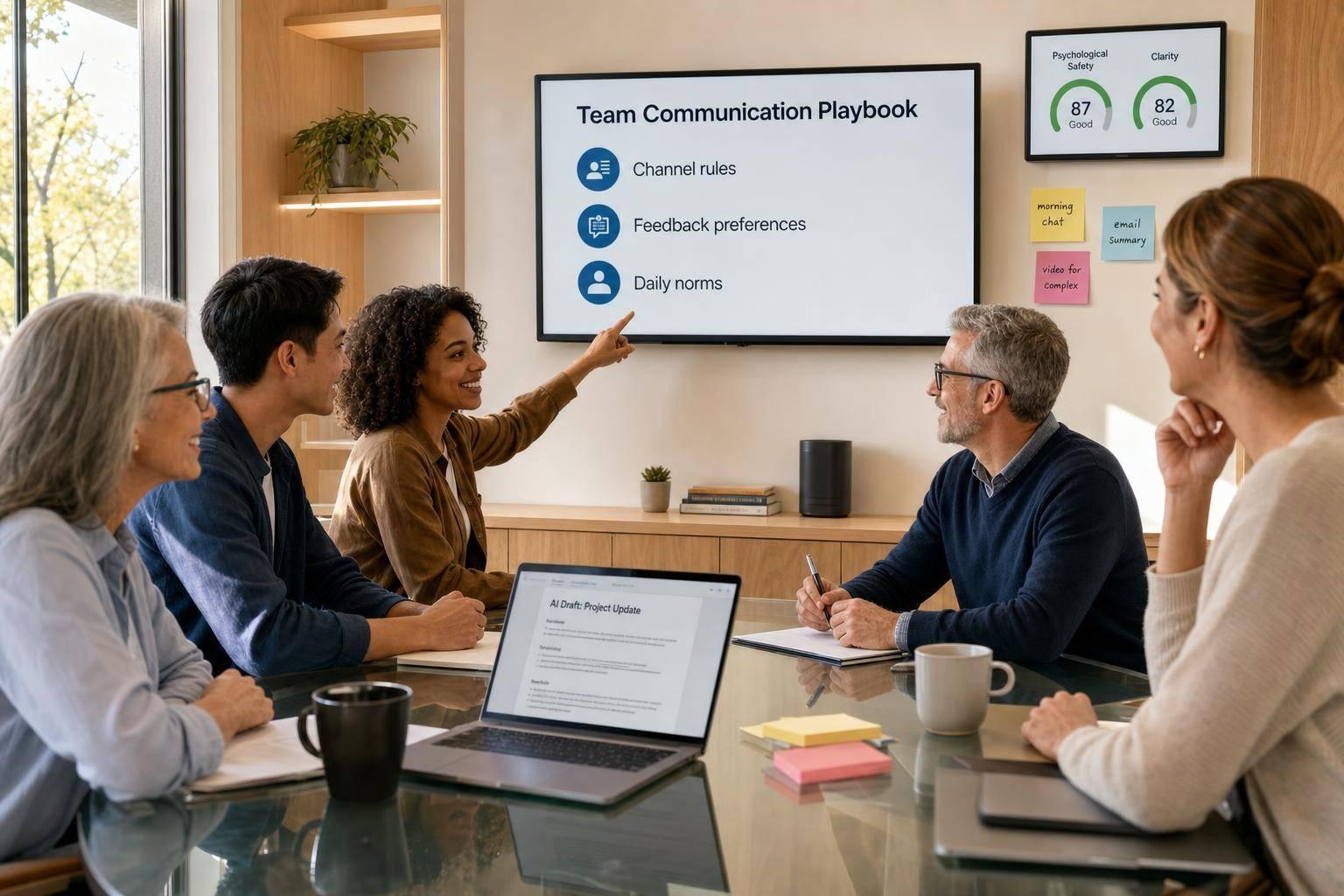
Four generations now work side by side, and when communication rules are unclear, trust drops and work slows down. If I want a multigenerational team to work well, I need to do three things: set clear channel rules, ask people how they want feedback, and model those rules every day.
Here’s the short version:
- Don’t guess based on age. Use generational patterns as a starting point, then ask each person what works for them.
- Set team rules in writing. Define when to use email, chat, calls, and meetings, plus reply-time expectations.
- Keep feedback clear and frequent. Some people want live, direct input. Others want more structure. I should know the difference.
- Use live conversation for high-stakes topics. AI can help draft messages, but leaders still need to add judgment, tone, and context.
- Track whether the system works. Look at psychological safety, clarity, information sharing, and channel use.
A few numbers make the point clear: digital natives made up 50% of the U.S. workforce by 2020, 75% of employees do not trust managers who withhold business information, and Google found that psychological safety was the top driver of team success.
In simple terms, this is not about age labels. It’s about building shared communication rules that cut confusion, reduce delay, and help people work well together.
5 Powerful Tips for Communicating Across Generations
sbb-itb-9ceb23a
Understand Communication Preferences Without Stereotyping
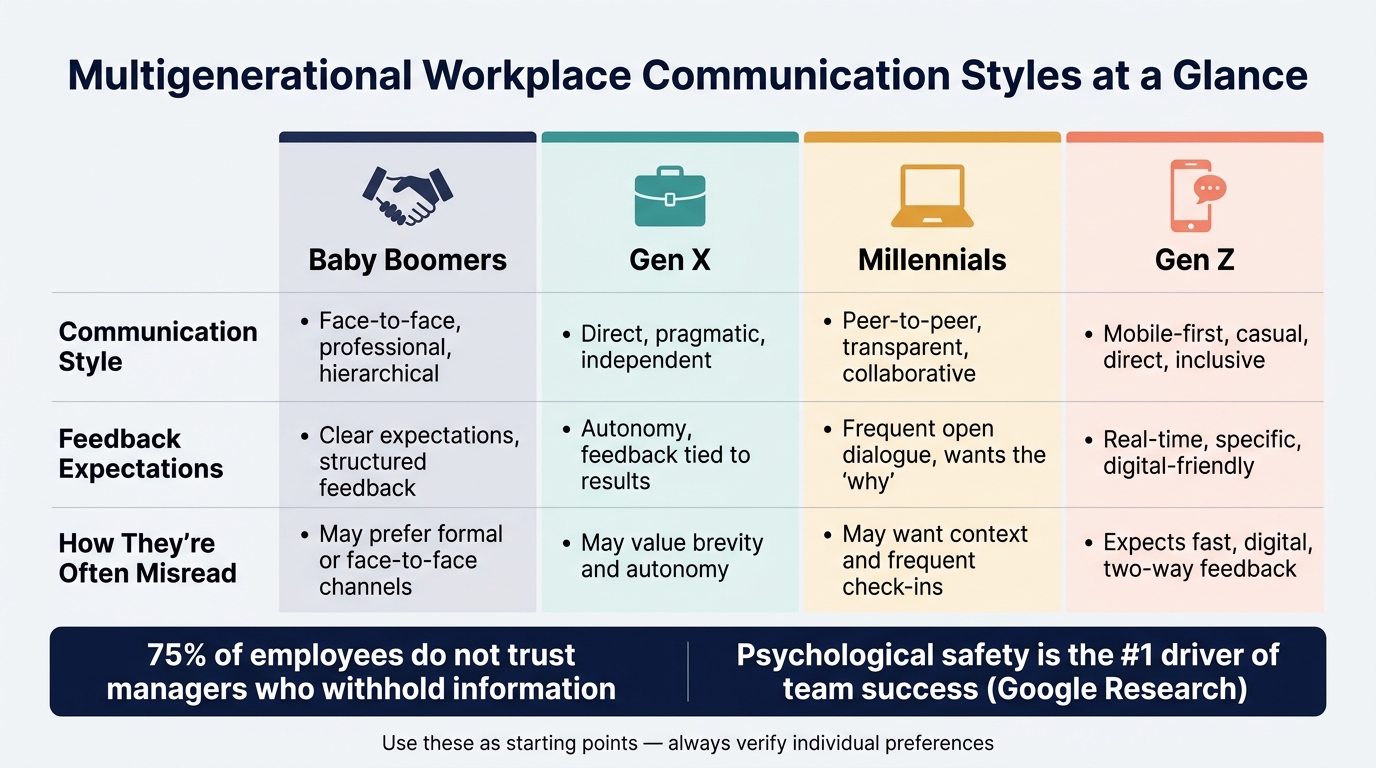
Multigenerational Workplace Communication Styles at a Glance
Use generational patterns as a starting point, then check what each person actually prefers. The goal is simple: replace assumptions with verified preferences.
Common Generational Patterns in Channel, Tone, and Feedback
The experiences people grow up with shape how they tend to communicate. But those patterns don't define any one person. As Seth Mattison puts it:
"In order to understand the generation, you have to go beyond age and look at events and conditions that took place during the generation's formative years." [2]
Here are some broad tendencies seen across generations in U.S. workplaces today:
| Generation | Communication Style | Feedback Expectations | How They're Often Misread |
|---|---|---|---|
| Baby Boomers | Face-to-face, professional, and hierarchical | Clear expectations and structured feedback | May prefer face-to-face or formal channels. |
| Gen X | Direct, pragmatic, and independent | Autonomy and feedback tied to results | May value brevity and autonomy. |
| Millennials | Peer-to-peer, transparent, and collaborative | Frequent, open dialogue and the "why" | May want context and frequent check-ins. |
| Gen Z | Mobile-first, casual, direct, and inclusive | Real-time, specific, digital-friendly feedback | May expect fast, digital, two-way feedback. |
These patterns can help you get your footing. They shouldn't do the thinking for you.
How Age-Based Assumptions Damage Trust and Inclusion
Labels may feel like a shortcut, but they can do real harm. The moment a manager moves from curiosity to judgment, trust gets harder to build.
"We have a tendency to immediately focus on the negative and areas where we're different, which is a huge mistake." - Seth Mattison [2]
Before you go into a tough conversation, pause for a second. Are you reacting to what the person did, or to a label you've attached to them? That small check can change the tone of the whole exchange.
A better move is to ask directly about communication preferences and expectations. That clears up guesswork and gives the team something much more useful: shared norms people can actually work with.
How Respect and Psychological Safety Improve Team Communication
Google's research found that psychological safety is the No. 1 driver of team success [1]. On a multigenerational team, that means people need room to ask questions, share ideas, and say "I'm not sure" without worrying they'll be judged.
Active listening and steady follow-through show respect in ways people can see. When team members notice that their input matters, they're more likely to keep speaking up. Trust comes first. Clear norms help turn that trust into day-to-day team behavior.
Build a Communication System That Works Across Generations
Once you know how people like to communicate, put those preferences into a shared system. That’s where the work starts. If expectations stay vague, people fill in the blanks on their own. And on a multigenerational team, those assumptions can be very different.
The goal is simple: replace guesswork with written rules the whole team can use.
Set Clear Channel Norms and Response Time Expectations
A lot of team friction doesn’t come from open conflict. It comes from mixed expectations.
One person expects a Slack reply within the hour. Someone else treats Slack more like email and checks it when they can. Neither person is automatically wrong. But if no one agrees on the rules, those small disconnects can wear down trust over time.
The fix is pretty simple: spell out which channel fits which kind of message, and define response windows. As Seth Mattison puts it, "The person who shares the most information is the most powerful." [3] When those expectations are written down and easy to see, people can work from the same playbook.
| Message Type | Primary Channel | Expected Response Window |
|---|---|---|
| Urgent Updates | SMS / Instant Chat | Within 15–30 minutes |
| Complex Decisions | Video Call / In-Person | Scheduled within 24 hours |
| General Feedback | 1-on-1 Meeting | Weekly or biweekly |
| Formal Reports | By the next business day |
Put this somewhere easy to find. A pinned document, team wiki, or shared workspace all work. Clear norms turn personal preferences into team rules.
Create a Team Communication Playbook
A communication playbook is a short, living document that puts unwritten rules into plain English. That matters because many team rules stay invisible until someone breaks them. And people from different age groups often walk in with very different ideas about what those rules are.
A good playbook shouldn’t micromanage people. It should set guardrails, explain the logic, and leave room for people to do their jobs. It also helps to explain the why behind each rule, especially for Millennials and Gen Z, who often want the reason before they buy in.
| Playbook Element | Default Rule | Approved Exceptions |
|---|---|---|
| Meeting Etiquette | Agendas sent 24 hours in advance | Emergency "war room" sessions |
| Turnaround Times | Internal emails: within 24 hours; Chat: within 2 business hours | Deep work blocks (marked on calendar) |
| Documentation | All project decisions logged in the shared project management tool | Informal brainstorming sessions |
| Escalation Path | Resolve at the peer level first | Safety violations or ethics concerns |
This kind of document doesn’t need to be long. It just needs to be clear, shared, and easy to update.
Design Meetings and Feedback Loops That Work for Every Generation
Meetings work better when people know what’s coming. For virtual meetings, send the agenda ahead of time, stay present, and skip multitasking. That sounds basic, but it sets a tone.
Weekly or biweekly one-on-ones also help. They give the team a steady rhythm and make feedback feel normal instead of random or reactive. When feedback does happen, keep it specific, tied to behavior, and linked to outcomes. That makes it easier to act on and less likely to feel personal.
Leaders have to follow the same rules they expect everyone else to follow. If managers ignore the norms, the system falls apart fast. If they model them every day, the rest of the team is far more likely to do the same.
Leadership Behaviors That Make Multigenerational Communication Work
Once the team playbook is in place, leaders need to model it every day. A communication system doesn’t work just because it’s written down. It works when people see it in action. In practice, behavior is what makes the norms stick. That’s when communication norms start turning into trust.
Adjust Delivery, Not Standards
Keep the standard steady. Change the delivery.
People still need to know what matters, what’s expected, and what happens next. But leaders should adjust the channel and tone based on how each person takes in information best. That might mean a quick Slack message for one person, a direct phone call for another, or a face-to-face talk when the issue has more weight. The expectation stays the same. The way you deliver it shifts.
When leaders are quiet or unclear, people don’t sit calmly and wait for more detail. They fill in the blanks themselves, and usually not in a good way. "The human psyche tends to fill open space with worst-case scenarios." - Seth Mattison, Founder of FutureSight Labs [5] Clarity isn’t just a style choice. It’s part of how trust gets built.
That matters even more when leaders use AI to help draft messages.
Build Communication Agility in the Age of AI
AI can speed up drafting and follow-up. It can help get the first version on the page fast. But leaders still have to bring the judgment, tone, and accountability.
A simple approach works best:
- Use AI for the draft
- Rewrite it in your own voice
- Review the wording
- Add the context only you know
- Adjust the tone based on the relationship
- Use a live conversation for anything sensitive, unclear, or high-stakes
That last part matters a lot. Some messages should never live only in email or chat.
"While machines can replicate tasks, they can never replicate the heart and soul behind the work." - Seth Mattison, Workforce Strategist [4]
It also helps to ask people how they want to receive information instead of guessing. That small check-in shows respect, and that lands well across every generation on the team.
The same idea shows up in mentoring too. People tend to improve their communication habits faster when they learn from each other across roles and age groups.
Use Cross-Generational Mentoring to Strengthen Communication Habits
Make mentoring a two-way street: senior to junior and junior to senior. Pair people who bring different communication strengths so both sides can teach and learn.
Younger employees often bring ease with digital tools, AI workflows, and network-based communication. Older employees often bring executive presence, institutional knowledge, and the kind of storytelling that builds trust over time. Put those strengths together, and the team gets better at communicating without slowing down.
| Program Dimension | Recommended Options | Generational Considerations |
|---|---|---|
| Feedback Skills | Shift from "no news is good news" to frequent, transparent updates. | Younger generations prefer "bad news" over "no news" to avoid worst-case scenario thinking [5]. |
| Digital Communication | Use AI for drafting and efficiency; keep live interaction for empathy. | AI can replicate tasks but cannot replace the heart and soul behind the work [4]. |
| Executive Presence | Move from command and control to influence and impact. | Different employees may respond to authority differently; explain the decision path and invite input. |
| Knowledge Sharing | Build open information sharing. | Some team members prefer controlled sharing; others expect open access. Set a clear default. |
The aim is to build shared habits that protect speed, trust, and clarity. Those habits become the baseline for how the team communicates day to day.
Roll Out, Measure, and Reinforce New Communication Norms
Audit Your Current Communication Environment
Once the playbook is set, compare it to how people actually communicate day to day. Look for the spots where generational differences lead to delays, confusion, or silence. Pay attention to which channels the team leans on, where messages get lost, and where unwritten rules are quietly shaping behavior.
Rules like "don't go above your boss's head" or "if you're not at your desk, you're not working" can sit in a company for years without anyone stopping to question them. Then those same rules run straight into employees who expect open, direct communication. A simple move can go a long way: remove one outdated rule and replace it with one clear expectation. That kind of swap shows the team this change isn't just talk.
Also watch where information gets stuck. When people don't hear anything, they usually fill in the blanks themselves. And that rarely helps.
Track Outcomes That Matter to Leaders
Use a small set of metrics to check whether the new norms are taking hold.
| Metric | What It Tells You |
|---|---|
| Psychological safety | Do people speak up, disagree, and ask questions? |
| Information transparency | Are leaders sharing enough context? |
| Clarity of expectations | Do people know the result, the why, and the standard? |
| Channel fit | Are email, chat, and calls used for the right message? |
Review these signals monthly or quarterly. If you spot a gap, update the playbook and tighten the standard.
Conclusion: Communication as a System for Trust, Alignment, and Advantage
Treat communication as an operating system, not a soft skill. Set norms, measure adoption, and reinforce them consistently to build trust, alignment, and speed. That is how communication becomes a source of trust and advantage, not friction.
FAQs
How do I avoid stereotyping by age?
Look past birth years and pay attention to the experiences and conditions that shaped each person. As Seth Mattison emphasizes, age is just one lens. If you want to understand people at work, empathy matters more than labels.
That means dropping snap judgments about work ethic or skill based on age. Instead, ask open-ended questions, make room for two-way communication, and treat people like individuals.
Each generation brings its own strengths to the table. The goal isn't to sort people into boxes. It's to see what each person can contribute and give that a fair hearing.
What should a team communication playbook include?
A team communication playbook should put clear communication front and center. That matters even more when people work across age groups, work styles, and a mix of remote, hybrid, and in-office setups. When expectations are plain, people spend less time guessing and more time doing the work. It also helps create psychological safety, because people know how to speak up, ask for help, and take part without worrying about hidden rules.
The playbook should spell out how the team communicates day to day, including:
- how and when people are expected to participate
- expected response times across channels
- what needs to be documented
- how collaboration works in hybrid and in-person settings
It should also set purpose-based AI rules. In plain terms, AI can help, but it shouldn't replace human judgment. The playbook should explain when AI use makes sense, where a person must review the output, and what kind of ethical checks need to happen before anything is shared or acted on.
Just as important, the playbook should make room for regular two-way feedback and open dialogue. That keeps communication from turning into a one-way broadcast from managers to everyone else. People need chances to ask questions, flag friction, and share concerns early. That kind of back-and-forth builds stronger connection, sharper accountability, and a clearer shared understanding of how the team works together.
How can I measure whether new communication norms are working?
Use a continuous improvement cycle that blends metrics with feedback. Track engagement in your collaboration tools, along with performance KPIs like decision-making speed and action-item completion.
At the same time, gather input through anonymous pulse surveys, one-on-one check-ins, and peer feedback. Review the results monthly or quarterly to spot patterns, fix bottlenecks, and refine norms that support transparency, trust, and alignment with organizational goals.
Related Blog Posts

Seth Mattison
Top 50 Keynote Speakers in the World | Future of Work Strategist | Co-Founder & CEO