
Articles Apr 10, 2026 9:00:00 AM Seth Mattison 22 min read

Crises demand more than just having a plan - they require teams equipped to act decisively under pressure. Despite growing risks like pandemics (30% of leaders expect another by 2026) and economic impacts (COVID-19 projected to cost the U.S. $7.9 trillion), many organizations fall short. About 30% of employees are unaware of any crisis plan, and 27% of crisis team members lack proper training.
Here’s what sets effective teams apart:
- Two-tiered structure: A quick-response layer and a long-term strategy layer.
- Key traits: Psychological safety, quick decision-making, and consistent practice.
- Leadership focus: Clear goals, decentralized decision-making, and leveraging both human judgment and AI tools.
This guide highlights how to build such teams, from assembling diverse skills to using AI for faster responses, while maintaining human-driven decision-making. Human-centric leadership is the cornerstone - your actions before and during crises shape outcomes.
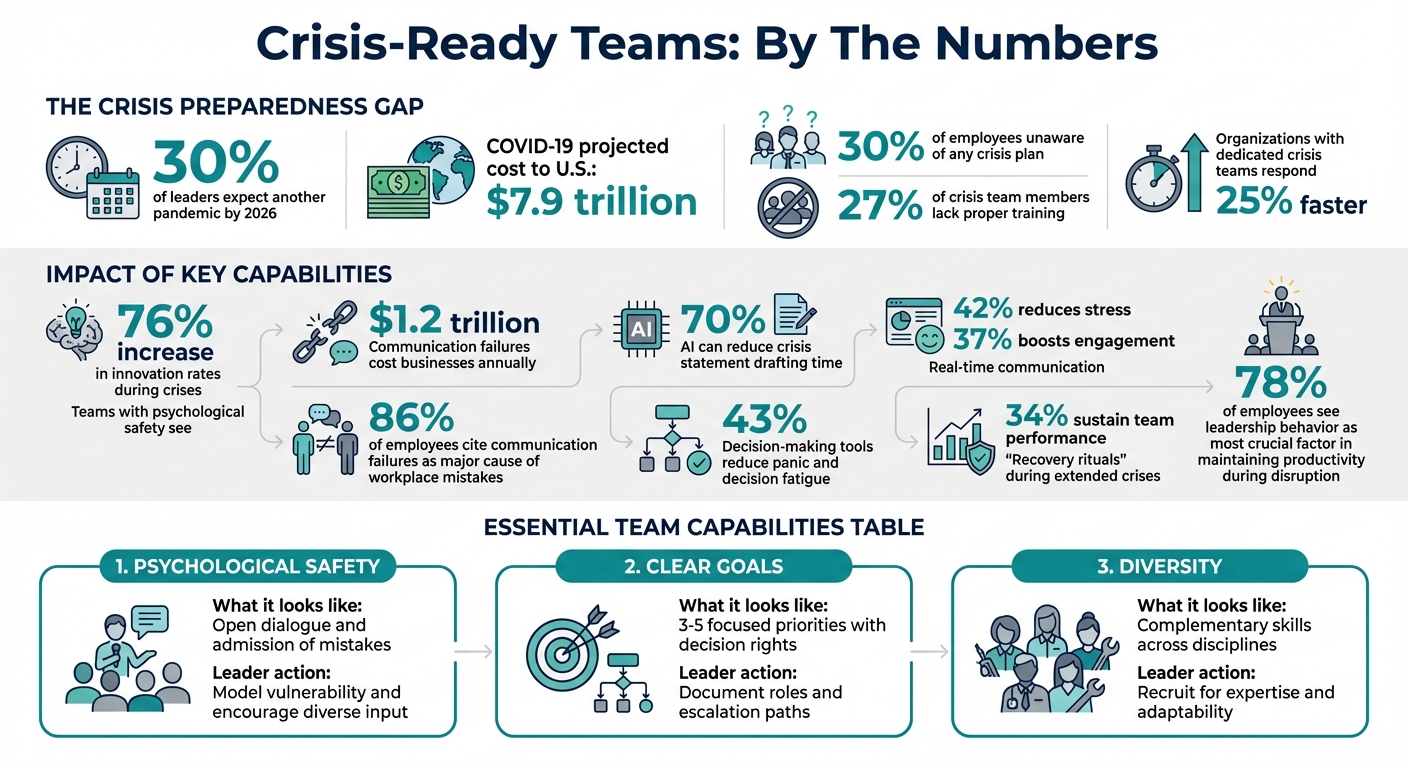
Crisis Preparedness Statistics and Key Team Capabilities
Core Strategies for Building Crisis-Ready Teams
Creating a team that can weather crises requires thoughtful planning in how it’s composed, how it collaborates, and the environment in which it operates.
Creating Teams with Varied Skills and Viewpoints
Teams that lack diversity - whether in skills or perspectives - are more likely to fall into groupthink, which can severely hinder effective crisis management. True diversity goes beyond demographics; it’s about assembling a range of expertise to tackle problems from different angles.
A great example of this comes from Mark Turner, Director of Commissioning for NHS England's London region. During the pandemic, he brought frontline physicians into the crisis leadership team alongside administrators. This collaboration led to the creation of "elective hubs", which focused on high-volume, low-complexity procedures. These hubs not only addressed backlogs but also prepared the system for future COVID-19 surges [1].
The composition of a crisis team is crucial. Wharton Executive Education likens it to assembling a puzzle:
"Building a crisis team is like putting together a puzzle. Each piece should play its role and fit well enough with the others to make a complete picture" [1].
When assembling teams, prioritize individuals with a mix of technical expertise (like IT, legal, or operations) and emotional intelligence. Studies show that organizations with dedicated crisis teams respond to emergencies 25% faster than those without [11].
To identify the right team members, focus less on past achievements and more on how candidates have navigated failure. For instance, asking, "Describe a time when everything went wrong and how you responded", can uncover the adaptability and composure needed during a crisis [6].
Once you’ve built a well-rounded team, the next step is to establish clear roles and responsibilities.
Setting Clear Goals and Responsibilities
Uncertainty can paralyze even the most skilled teams during a crisis. To avoid this, everyone must understand their responsibilities and decision-making boundaries. Without clear goals and decision rights, hesitation or miscommunication can derail progress.
Limit objectives to 3–5 core goals. Trying to juggle more can lead to what researchers call "whiplash", where constant shifts in focus cause decision fatigue [2][12]. Document who is responsible for each decision, what data is required, and when escalation is necessary. This clarity accelerates decision-making and ensures no critical tasks fall through the cracks.
Mutual accountability also plays a key role. When team members trust each other to fulfill their responsibilities, they can act decisively without second-guessing every move [7].
Here’s a quick breakdown of essential team capabilities and how leaders can support them:
| Capability | What It Looks Like | Leader Action |
|---|---|---|
| Psychological Safety | Open dialogue and admission of mistakes | Model vulnerability and encourage diverse input |
| Clear Goals | 3–5 focused priorities with decision rights | Clearly document roles and escalation paths |
| Diversity | Complementary skills across disciplines | Recruit for expertise and adaptability |
Equally important is creating an atmosphere where team members feel safe to voice concerns and experiment with new ideas.
Building Psychological Safety
Psychological safety is the cornerstone of innovation and adaptability during high-pressure situations. Google’s research highlights it as the most critical factor for high-performing teams [8][10].
Leaders can foster this safety by showing vulnerability themselves - admitting mistakes and encouraging constructive challenges to their ideas [6]. For example, in 2025, the CEO of ButterflyMX introduced controlled disruptions, like surprise shifts in priorities or simulating the absence of key team members. These exercises helped the team build confidence in handling unexpected challenges [6].
Treat failures as opportunities for learning. A practical approach is the "4 Ls" retrospective: after a challenge, ask the team what they Loved, Longed for, Lacked, and Learned. This method turns setbacks into valuable lessons [8][10].
Simple practices like starting meetings with quick “temperature checks” can also make a difference. Asking team members to rate their energy levels from 1 to 5 can help identify burnout risks early [9]. Research shows that teams with psychological safety see innovation rates jump by up to 76% during crises [12].
Keith Ferrazzi, Founder of Ferrazzi Greenlight, captures the essence of this approach:
"Resilient teams are able to speak truth to each other in order to collectively identify and solve for the challenges they face" [9].
Preparing Teams to Respond During Crises
When a crisis hits, the ability to act quickly and make confident decisions can mean the difference between success and failure for a team.
Reducing Bureaucracy for Faster Decisions
Bureaucracy can grind crisis response to a halt. If decisions require approval from multiple levels of management, valuable time is wasted, and small issues can spiral out of control. The key is to decentralize decision-making before the crisis even begins.
Take Mary Barra, for example. When she became CEO of General Motors, she faced a major product recall crisis head-on. She set up a dedicated team that met daily, sometimes for just 20 minutes and other times for hours, depending on the need. This team operated under guiding principles like "doing everything possible for the customer", empowering them to act quickly even with incomplete information [1][4].
Another approach is adopting "flexible leadership ranks," where decision-making authority shifts to those with the most relevant expertise instead of relying solely on hierarchy. This ensures progress even when key executives are unavailable [13][1][4].
To avoid rushing into poor decisions under pressure - a phenomenon called the "crisis compression trap" - leaders can use the 5-3-1 method: take five deep breaths, consider three possible responses, and choose one clear course of action. This simple pause can turn panic into focus. As Adam Grant explains:
"The ability to pause before responding is what separates exceptional crisis leaders from the rest" [12].
Tools like the 5-3-1 method and the Eisenhower Matrix help streamline decision-making, cutting down on panic and decision fatigue by up to 43%. These approaches allow teams to act decisively with the information they have and adjust as needed [12][5].
With decision-making processes simplified, the next step is leveraging the strengths of individuals and the team as a whole.
Using Individual and Team Strengths Effectively
Not everyone responds to pressure in the same way. In a crisis, composure often outweighs seniority [5]. The person who stays calm, actively listens, and makes sound decisions with limited information can be more effective than a high-ranking executive who freezes.
Before a crisis strikes, identify your "bridge builders" - those team members who excel at connecting departments, questioning assumptions, and focusing on details. These individuals may not always be the loudest voices or hold the most senior roles, so look beyond the obvious candidates [5].
Rather than rigid scripts, provide your team with context and intent. This "intent-based leadership" gives individuals the flexibility to adapt when plans inevitably go off track. Once decisions are made, avoid prolonged debates and focus on execution. As Adam Mendler puts it:
"Resilient organizations aren't built on heroics. They're built on clarity" [3].
Establishing a communication rhythm is also critical. Regular 15-minute check-ins and real-time communication channels can prevent information gaps and reduce stress by 42%, while boosting engagement by 37% [12]. To maintain performance during extended crises, consider implementing recovery rituals like "No-meeting Wednesdays" or weekly sessions to reflect on "wins and learns." These practices can sustain team energy and effectiveness by 34% [12].
Using Technology to Build Crisis Resilience
Technology doesn't replace human leadership during a crisis - it enhances it. By identifying critical patterns quickly, it allows leaders to focus on what truly matters: ethical decisions, genuine empathy, and building trust.
Applying AI to Improve Team Communication and Clarity
Technology plays a key role in streamlining team decision-making during crises. With AI, response times have dramatically improved. For instance, some platforms report cutting the time needed to craft initial crisis statements by up to 70% [14]. A striking example occurred in 2025 when a consumer goods company used AI to send a product recall notice to 4.7 million customers across 17 languages via email, SMS, and social media - achieving this feat in just 90 minutes after leadership approval. Without AI, this task would have taken over 48 hours [15].
But speed is just one part of the equation. AI also excels at real-time sentiment analysis, processing vast amounts of social media, news, and internal data to pinpoint stakeholder concerns and track misinformation [15]. By identifying over 85 distinct emotional states - like fear, anger, or confusion - AI enables leaders to craft messages that acknowledge emotions and build trust instead of escalating tensions [14]. This is crucial when you consider that 86% of employees cite communication failures as a major cause of workplace mistakes, collectively costing businesses over $1.2 trillion annually [14].
AI doesn't just help with messaging. It acts as a decision-support tool, analyzing historical crisis data to predict the ripple effects of certain actions and flagging gaps in response plans [15]. It also provides insights into team dynamics, such as identifying silent participants in meetings or revealing knowledge bottlenecks [16]. Henrik Challis, Vice President at Mannaz, sums it up well:
"AI doesn't replace human collaboration - it enables and enhances it" [16].
While AI can optimize clarity and speed, it’s the human touch that ensures responses resonate deeply.
Combining Technology with Human Judgment
The most effective crisis teams blend AI's analytical speed with the ethical and emotional depth of human judgment. AI acts as the "radar", detecting threats and trends, while human leaders serve as the "captains", making the final calls [17].
Take wildfire response as an example. AI can process satellite images, drone feeds, weather data, and terrain models to provide a comprehensive view. Commanders then use this information to decide within an eight-minute window - a decision that could determine whether a fire spreads across 40 acres or 4,000 acres [17]. AI provides the data, but only human leaders can weigh factors like community safety, resource strain, and environmental impact.
As the Moxie Institute puts it:
"AI can draft, but you must embody. Use AI to structure your message, but deliver it with the emotional intelligence, presence, and authentic concern that only you can provide" [15].
To ensure this partnership works, implement a "Human Check" protocol: no AI-generated crisis message should go out without a senior leader reviewing it for empathy and cultural sensitivity. Since AI often lacks the historical and relational context of specific regions, this step ensures messages remain authentic [15]. Additionally, run monthly micro-simulations using AI tools to build your team’s readiness for real-time crisis management [15]. Transparency is also key - develop a framework to disclose AI usage to stakeholders, presenting it as a tool to ensure comprehensive understanding and action [15].
This collaboration between technology and human insight strengthens crisis teams, making them more prepared and purpose-driven when it matters most.
The Human Moat: Maintaining Competitive Advantage
As AI continues to advance, it's becoming easier for organizations to level the playing field in terms of technology, processes, and outcomes. What remains irreplaceable, however, are the distinctly human abilities that shape how teams think, decide, and adapt when the usual strategies fall short. This is your Human Moat - those irreplicable qualities like judgment, empathy, creativity, and collaboration that technology simply cannot duplicate [19].
AI thrives on efficiency, but humans excel in navigating ambiguity and making ethical decisions under pressure. This difference is where your competitive edge lies, especially during crises. Seth Mattison captures it perfectly: "The winners of tomorrow need to be extremely fast or extremely human" [22]. The organizations that succeed will be those that bridge the gap between AI's capabilities and human decision-making, using technology to amplify - not replace - human ingenuity [19].
History provides clear lessons: organizations that suppress dissent and disregard human judgment often face disastrous outcomes. On the other hand, those that prioritize transparency, trust, and values emerge stronger [11][20]. Resilience, at its core, is a human challenge, not a technical one [3]. Leaders who focus on building crisis-ready teams understand that qualities like trust and adaptability are not just soft skills - they're strategic advantages.
Developing Core Human Capabilities
Building these human capabilities takes more than just policies; it requires deliberate practice. One way to prepare is through Red Teaming - a method of stress-testing plans to uncover vulnerabilities before a crisis unfolds [19]. These exercises encourage integrative thinking, helping teams connect the dots when traditional strategies no longer work [21].
Equally important is building trust during calm periods, often referred to as blue sky days [19]. This means empowering team members to make decisions, admitting your own mistakes, and fostering an environment where dissent is welcomed, not punished. For instance, a culture of duty to dissent allows a team member to challenge a decision - like flagging a statement that’s legally sound but emotionally insensitive - without fear of backlash [11]. Research shows that organizations with such cultures respond to emergencies 25% faster than those without dedicated crisis teams [11].
Crises should also be seen as opportunities to innovate rather than merely problems to contain. As Peter Drucker famously said, "The greatest danger in times of turbulence is not the turbulence itself, but acting with the logic of the past" [18].
Data plays a crucial role, but it’s not the whole story. Use analytics to clarify decisions, but always apply human judgment to ensure actions align with your organization’s values and mission [19]. Remember, flawed data leads to flawed AI - so start with reliable sources and keep humans involved in the loop [2]. Research shows that organizations centered on people are 2.3 times more successful in achieving business transformations because they recognize the power of combining human creativity with machine efficiency [21]. These practices strengthen the Human Moat, creating a competitive edge that technology alone cannot achieve.
Leading by Example to Build Resilience
To embed resilience into your organization’s culture, leaders must set the tone. Your team observes your reactions under stress, and your behavior influences theirs - a phenomenon known as emotional contagion. When you manage your emotions and maintain a positive outlook, it spreads throughout the team [11][13]. As Gene Klann from the Center for Creative Leadership puts it, "Leaders are dealers in hope" [13].
Acknowledging your own fallibility is also key. Admitting when you don’t have all the answers or when you’ve made a mistake isn’t a weakness - it’s a strategy. This openness fosters the psychological safety that high-performing crisis teams rely on [11][2]. Conducting blameless post-mortems after setbacks shifts the focus from assigning blame to learning collectively [11][2].
Providing context rather than rigid instructions is another hallmark of resilient leadership. By explaining the "why" behind decisions, leaders empower their teams to exercise judgment when plans inevitably fail [3]. A powerful example comes from the COVID-19 pandemic in 2020. Mark Turner, Director of Commissioning for NHS England’s London region, expanded the crisis leadership team to include frontline physicians. This approach led to the creation of "elective hubs" that cleared surgical backlogs while managing a second wave of COVID cases [1]. Turner didn’t micromanage; he trusted those closest to the problem to design the solution.
Decision discipline is another critical practice. Clearly define who makes decisions, what data is needed, and when escalation is required [2]. Weekly prioritization rituals can also help teams stay focused on the top three to five goals, reducing the chaos of constant shifts and preserving energy [2]. Adam Mendler describes this as the "real infrastructure behind resilience" - a foundation of trust that enables teams to act decisively even under uncertain conditions [3].
The Human Moat isn’t built overnight. It’s the result of daily choices that prioritize human judgment, creativity, and trust over rigid systems. Strengthening these human traits is essential for creating teams that not only survive crises but also turn them into opportunities to grow. In a world where technical advantages are increasingly easy to replicate, these human capabilities become the ultimate differentiator [22][23].
Conclusion: Leadership's Role in Crisis-Ready Teams
Creating crisis-ready teams goes beyond ticking off a list of tactics - it’s about leadership that fosters a resilient culture. The difference between teams that falter under pressure and those that adapt and thrive lies in the decisions leaders make well before a crisis unfolds. In fact, research shows that 78% of employees see leadership behavior as the most crucial factor in maintaining productivity during times of disruption [12].
As a leader, your influence determines whether your team perceives a crisis as a threat to fear or an opportunity to grow. This idea ties back to the strategies discussed earlier, where strong values and a supportive culture build resilience. Take Mary Barra’s turnaround at GM, for example - her proactive leadership, rather than reactive crisis management, made all the difference [1].
The strategies outlined in this guide - like fostering psychological safety, cutting through bureaucracy, embracing AI, and strengthening the Human Moat - highlight one key truth: leaders set the tone. By choosing transparency over perfection, empowering the people closest to the problem, and staying true to your organization’s values, you create an environment where resilience can flourish. The Center for Creative Leadership puts it best:
"Leaders are dealers in hope" [13].
Strong crisis leadership isn’t something you develop in the heat of the moment. It’s built during quieter times through consistent efforts to improve communication, empathy, and trust [13][19]. These same principles align with the proactive steps needed to prepare crisis-ready teams. Interestingly, the first six weeks of a crisis are a critical window - this is when teams are most open to new ideas and behavioral changes [18]. Leaders who act decisively during this period can drive much-needed operational improvements and spark innovation that might otherwise remain out of reach.
FAQs
How do I set up a two-tier crisis team?
To establish a two-tier crisis team, start by assembling a core team made up of experienced members with diverse skills and backgrounds. This group will serve as the primary decision-makers and leaders during a crisis. Next, create a support network consisting of individuals or teams who can offer specialized expertise or step in when additional resources are needed. Clearly define everyone's roles, promote a unified sense of purpose, and maintain flexibility to address shifting circumstances. This approach strengthens preparedness and ensures a well-coordinated response during critical situations.
What’s the fastest way to build psychological safety?
The fastest way to build psychological safety is by establishing clear communication rules, encouraging open discussions, and handling conflicts with empathy. Show leadership by actively listening and owning up to mistakes. These steps create a supportive space where team members feel comfortable sharing ideas and working together smoothly.
How should leaders use AI without losing trust?
Leaders can approach AI as a support system to improve transparency and assist in decision-making, rather than a substitute for human judgment. To build trust, it's crucial to involve team members in the adoption process, clearly explain AI's purpose, and offer training on its strengths and limitations. Creating an environment where people feel safe to share their thoughts - especially about ethical concerns - is equally important. By encouraging open dialogue and balancing AI's capabilities with human traits like ethical reasoning, leaders can maintain confidence and avoid an overdependence on technology.