
Articles Apr 6, 2026 9:00:00 AM Seth Mattison 12 min read
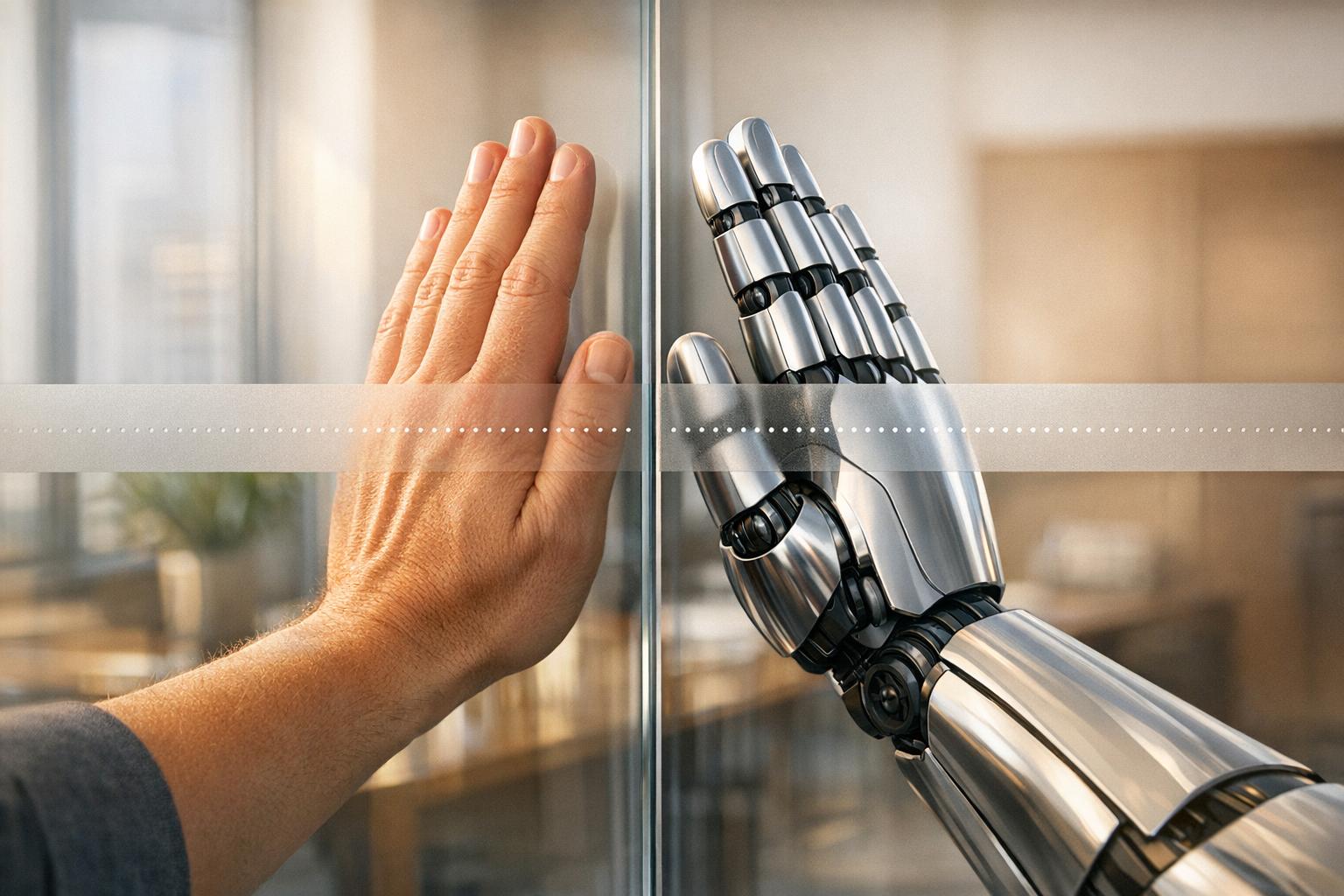
Automation is fast and efficient, but it lacks context. Human judgment thrives on context but can be slow and inconsistent. The key? Combining both effectively. Automation handles repetitive tasks and enhances speed, while human judgment ensures ethical, nuanced decision-making. Without balance, automation can amplify flaws, and judgment alone can create bottlenecks.
Key Takeaways:
- Automation answers "how"; judgment answers "why."
- Automation scales processes but mirrors flaws in systems.
- Human judgment excels in ambiguity and ethics but struggles with scalability.
- A balanced approach aligns processes with organizational values.
- Metrics like decision latency can help evaluate integration success.
To succeed, organizations should:
- Define clear boundaries for automation.
- Empower human judgment in ethical and complex decisions.
- Use frameworks like the Empowerment Triad to guide integration.
Quick Comparison:
| Feature | Human Judgment | Automation |
|---|---|---|
| Scalability | Limited; slows large-scale decisions | High; handles repetitive tasks fast |
| Contextual Use | High; ethical and nuanced decisions | Low; struggles with trade-offs |
| Bias Risk | Subjective but introspective | Amplifies existing biases |
| Primary Role | Defines "why" and ethical alignment | Executes "how" for efficiency |
Blending automation and judgment creates systems that are both efficient and aligned with values. Focus on trust, clear intent, and meaningful integration for long-term success.
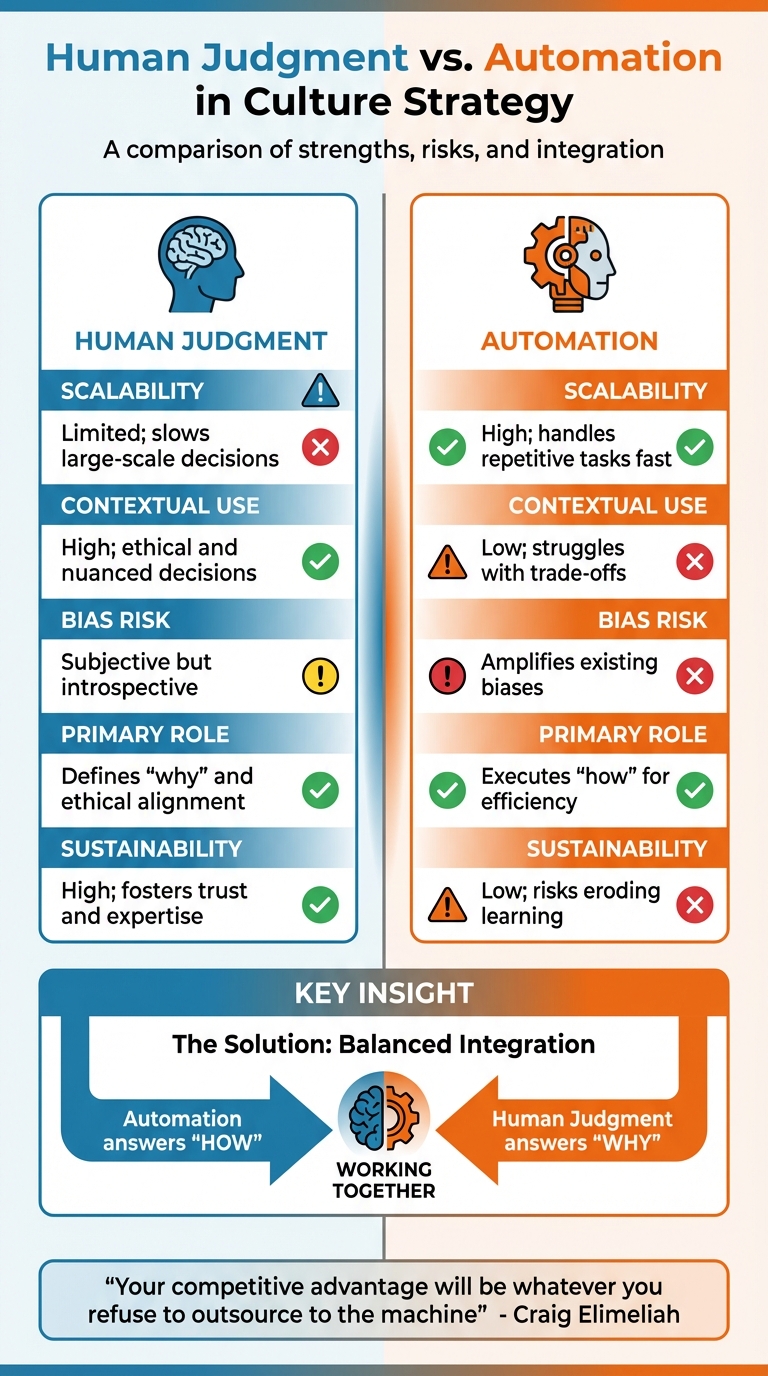
Human Judgment vs Automation: Key Differences in Decision-Making
Comparing Judgment and Automation: Strengths and Weaknesses
Understanding the strengths and limitations of human judgment versus automation can help organizations make better decisions about how to align with their values and goals. Human judgment shines in situations filled with ambiguity, where emotional intelligence and ethical reasoning are necessary. It’s particularly effective in interpreting emotional cues and making decisions that prioritize dignity, fairness, and long-term trust. However, it comes with a trade-off: human judgment doesn’t scale well. Without proper empowerment, decision-making can slow down significantly.
Automation, on the other hand, is built for scale. It’s incredibly efficient at handling repetitive tasks and ensuring consistency across processes. But this strength comes at a cost: it lacks the ability to understand context. As Isabella Galeazzi, COO of Eleven8 Staffing, points out:
"AI is confident - even when it's wrong."[6]
This confidence can be a double-edged sword. Automation mirrors the existing state of an organization, meaning it can amplify both strengths and flaws. For instance, if an approval process is already inefficient, automation won’t fix the underlying issue - it will just make the inefficiency faster and more pronounced, creating what’s known as bottleneck acceleration.
Bias is another area where these approaches differ. Human judgment, while subjective and shaped by personal experiences, can act as a safeguard when workflows clash with an organization’s stated values. Bruce Temkin refers to this as the "inner dialogue" that humans engage in to reconcile conflicts.[5] Automation, however, lacks this introspection. It blindly replicates unexamined defaults and presents errors with unwarranted confidence, which can lead teams to accept flawed outputs without question.[6]
Here’s a breakdown of the key differences:
| Criterion | Human Judgment | Automation |
|---|---|---|
| Scalability | Limited; can slow decisions without empowerment | High; quickly executes and handles repetitive tasks |
| Contextual Accuracy | High; adept at ethical and nuanced decision-making | Low; struggles with trade-offs and context |
| Bias Risk | Subjective; shaped by personal experience | High; amplifies existing defaults without scrutiny |
| Sustainability | High; fosters trust, expertise, and alignment | Low; risks eroding learning and engagement |
| Primary Function | Excels in ambiguity and "reading the moment" | Ensures consistency and speeds up routine tasks |
Ultimately, the choice between human judgment and automation isn’t just about efficiency - it’s about the kind of outcomes you want to build. The right mix can either create a system that grows in wisdom or one that becomes rigid over time.[1]
How to Combine Judgment and Automation for Better Alignment
The most effective approach blends human judgment with automation, allowing each to complement the other. Automation, while powerful, reflects the underlying realities of an organization. In environments with low trust or broken workflows, it can actually worsen existing problems. On the other hand, when trust drives decision-making instead of rigid protocols, AI becomes a "judgment multiplier", enhancing human insight rather than replacing it. This balance lays the foundation for structured integration, which is explored further through the Empowerment Triad framework.
To achieve this balance, organizations can rely on the Empowerment Triad: clear boundaries (defining what must not fail), competence (ensuring necessary skills), and safety (allowing room for failure) [1]. This framework protects the integrity of an organization’s culture while leveraging automation’s strengths. For instance, AI can thrive in systems where trust is treated as a guiding principle - like "protect customer trust" - rather than a rigid rule, such as "require manager approval for discounts over $500." In these cases, AI supports and augments human decision-making instead of undermining it.
Seth Mattison’s Human Moat framework offers additional guidance by helping leaders identify the uniquely human capabilities that set their organizations apart in an AI-driven world. His strategy equips leaders to focus on areas where judgment, ethical reasoning, and contextual understanding provide a competitive edge [2].
Another key to integration is tracking the right metrics. Instead of focusing solely on efficiency, organizations should measure decision latency - the time it takes to move from an idea to execution [1]. This metric often reveals more about cultural health than traditional engagement surveys. For example, long approval processes may indicate a culture of excessive control rather than collaboration. By monitoring these indicators, leaders can fine-tune the balance between automated efficiency and human insight. Hart Brown, President of AI & Transformation at Saxum, emphasizes this point:
"When leadership cannot articulate intent, people supply their own fears" [3].
Boston Consulting Group provides a compelling example of this principle in action. They achieved nearly 90% AI adoption among employees - not by imposing mandates, but by presenting the technology as a shared resource and investing in training across the workforce [3].
Ultimately, as Kumari suggests, the aim isn’t just efficiency but fostering wisdom over rigidity [1]. Organizations that integrate data with ongoing dialogue, establish clear guidelines for critical human decisions, and rethink expertise paths as automation evolves are creating systems that grow smarter over time. By combining thoughtful dialogue with robust data, these systems not only improve efficiency but also strengthen organizational culture. In contrast, relying on automation without addressing deeper cultural challenges risks amplifying dysfunction, making it faster and harder to undo.
Pros and Cons
Human judgment and automation each bring distinct advantages to shaping organizational culture. The table below highlights their roles, benefits, and potential pitfalls when applied to strategic decisions.
| Feature | Human Judgment (Pros) | Automation (Pros) | Risks/Cons |
|---|---|---|---|
| Cultural Impact | Provides contextual interpretation, ethical alignment, and "discernment with receipts." | Speeds up processes, removes administrative friction, and establishes trust through structured systems. | Automation: May create decision opacity and foster fears of replacement if not implemented transparently. |
| Role in Strategy | Serves as an "early warning system" for broken workflows and unexamined assumptions. | Highlights "decision debt" and streamlines execution. | Judgment: Can suffer from "decision latency" caused by excessive approval layers. |
| Complementarity | The "Logic": Offers the "why", trade-offs, and guiding principles. | The "Physics": Manages the "how" by optimizing flow and reducing operational burdens. | Combined Risk: Automation may amplify overly cautious decisions in a permission-heavy culture. |
This comparison highlights both the strengths and risks of relying on human judgment or automation. Striking the right balance is critical to avoiding inefficiencies or ethical blind spots.
Over-reliance on human judgment can create bottlenecks. Employees may spend too much time on repetitive administrative tasks - like navigating complex expense reports - leaving less energy for high-value work. On the other hand, over-reliance on automation can lead to what experts call "automated sameness", where AI accelerates existing inefficiencies instead of solving them.
The key is balanced integration, which requires thoughtful restraint. Craig Elimeliah, Chief Creative Officer at Code and Theory, captures this idea perfectly:
"The parts you protect from automation become your signature. They signal what you value, what standards you hold, where you believe human judgment matters more than machine speed" [7].
Automation should handle routine tasks to improve efficiency, while humans focus on decisions requiring ethical reasoning and creativity. This approach allows organizations to maximize both productivity and ethical alignment.
The impact of this balance is clear. High-performing entrepreneurs who selectively applied AI insights saw profits grow by 10%–15%. In contrast, those who blindly followed generic AI advice experienced an 8% drop in performance [4]. The difference? Effective use of human judgment.
Conclusion
Blending human judgment with automation is the key to unlocking their combined potential. Automation excels at managing routine, predictable tasks, giving people the freedom to focus on areas that require creativity, critical thinking, and building meaningful relationships - areas that drive long-term success.
As AI becomes more integrated into daily life, what sets humans apart will become your strongest advantage. These uniquely human qualities reflect your core values and standards more clearly than any mission statement ever could. Craig Elimeliah, Chief Creative Officer at Code and Theory, captures this idea perfectly:
"Your competitive advantage will be whatever you refuse to outsource to the machine" [7].
This perspective reshapes how we think about leadership. It’s no longer about lofty declarations but about creating systems that turn values into action.
The biggest mindset shift leaders need to embrace is treating company culture as a functional system rather than an aspirational ideal. Culture isn’t defined by what’s said in meetings or written on walls - it’s revealed in the day-to-day operations. For example, if your company values "Move Fast", but approval processes drag on for weeks, your systems are undermining your stated priorities. Aligning processes with values ensures that automation and human insight work in harmony.
To start, conduct a friction audit. Pinpoint a process or ritual that conflicts with your values, eliminate it within two weeks, and reinforce your culture by focusing on three key elements: clear boundaries (what must remain intact), competence (the skills to execute effectively), and safety (the freedom to experiment and learn from mistakes) [1]. This approach ensures that your culture and systems support your vision, rather than contradict it.
FAQs
What decisions should never be automated?
Decisions that hinge on human judgment - especially those tied to context, values, consequences, and accountability - should always remain in human hands. Automation simply cannot replicate these deeply human traits, which are crucial for navigating complex, critical choices.
How can we tell if automation is hurting our culture?
Signs that automation might be negatively affecting your workplace culture include a noticeable drop in human judgment, excessive dependence on automated systems, or workflows that feel disjointed. You might also observe a decrease in psychological safety or resistance from employees - both of which could point to underlying trust issues. To prevent these challenges, make sure automation supports open communication, actively involves employees in decision-making, and upholds ethical transparency. These steps can help safeguard a healthy and cohesive workplace culture.
How can we reduce decision latency without compromising ethics?
Reducing decision delays while maintaining ethical standards is about finding the right mix of speed, clarity, and human involvement. Human-in-the-loop systems play a key role by blending automated processes with human judgment, ensuring ethical oversight remains intact. Tools like explainable AI make decisions more transparent, allowing for faster validation of results. At the same time, strong frameworks and safeguards - such as bias detection and fairness checks - help uphold integrity even as decisions are made more quickly. This balance ensures efficiency doesn't come at the cost of ethical responsibility.