
Articles Jul 6, 2026 1:17:40 PM Seth Mattison 15 min read

AI can speed up work, but it still can’t handle trust, judgment, or team tension the way people do. That’s the core message here: as AI use grows, leaders who manage emotions well tend to make better calls, keep teams steady, and help people work with AI without losing confidence.
Here’s the short version:
- Human skills now predict business results more than anything else in AI-heavy work
- Only 41% of organizations say they are ready for current disruption
- 54% report constant change, up from 45% a year earlier
- EI links with transformational leadership (r ≈ 0.63) and team effectiveness (r ≈ 0.41)
- 85% of employees say clear AI use matters when choosing an employer
- Only 8% of HR leaders think managers have the skills to use AI well today
- 88% say their companies have not yet seen major business value from AI tools
If I boil the article down to a few points, it’s this:
- EI helps leaders stay calm under pressure
- EI helps teams trust AI without depending on it too much
- EI improves communication in hybrid and remote work
- EI supports better judgment when AI output is unclear or off
- EI can be taught through coaching, peer learning, and psychological safety work
In plain English, the article says one thing: AI changes how work gets done, but people still shape whether it goes well or badly. That means leaders need to build self-awareness, self-control, empathy, and people skills with the same focus they give AI training.
The rest of the piece backs that up with 2025–2026 research on leadership, team trust, stress, engagement, and human-AI work.
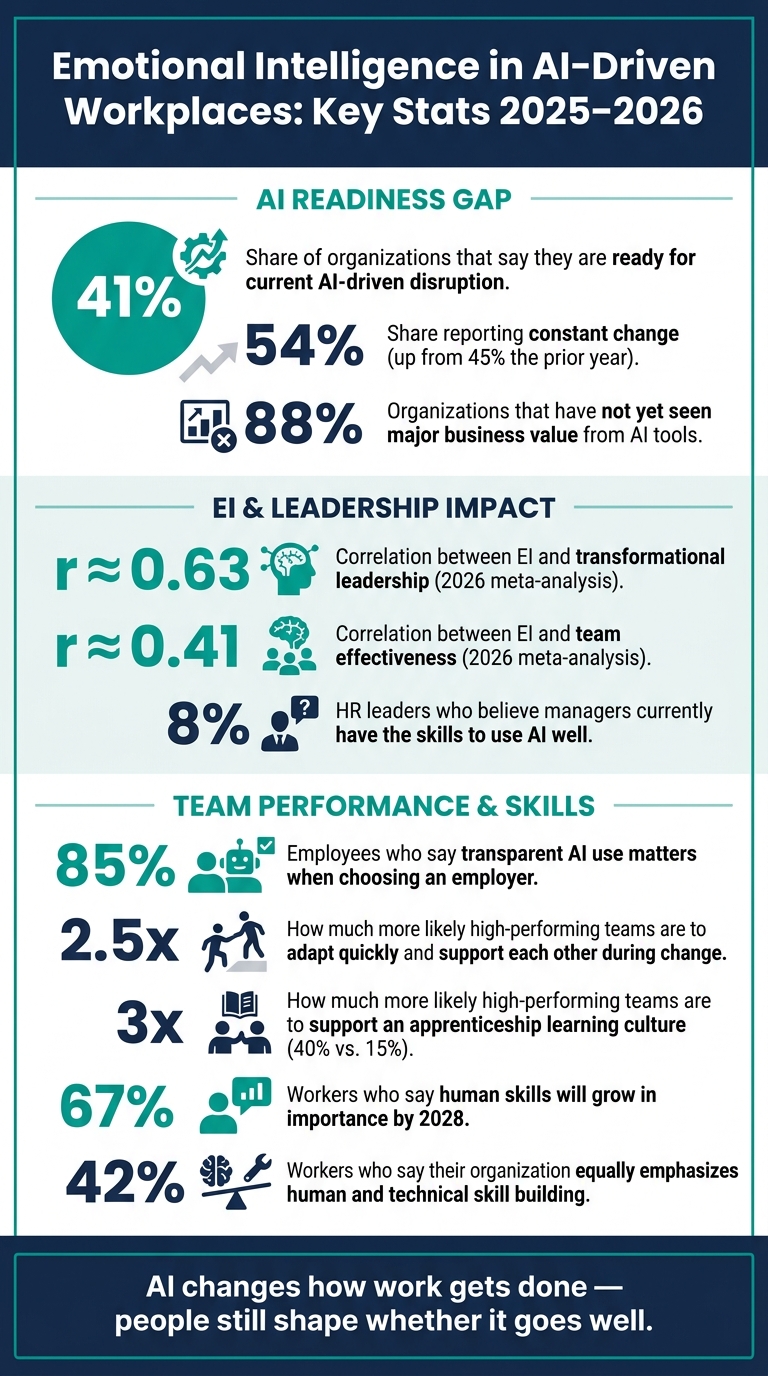
Emotional Intelligence in AI Workplaces: Key Stats & Insights 2025–2026
The Human Skills Renaissance: Why AI Makes Emotional Intelligence More Valuable
sbb-itb-9ceb23a
Defining Emotional Intelligence in AI-Driven Workplaces
Emotional intelligence (EI) in an AI-driven workplace comes down to four core domains: self-awareness, self-regulation, empathy, and social skills [7][4][8].
Self-awareness means noticing your reactions when AI output pushes against your assumptions. Self-regulation means responding with intention when AI-driven pressure kicks in. Empathy is the ability to read emotions in human-AI collaboration and use that understanding to build trust. Social skills are the day-to-day communication habits that help teams stay steady and make AI-driven choices easier to explain [7][4][8].
How Emotional Intelligence Supports Leadership
This matters because AI changes what leaders are there to do. AI can handle analysis. EI handles the human side that remains - interpretation, ambiguity, and alignment [7][8].
In AI-enabled organizations, EI helps steady team climate, protect decision quality, and maintain trust during periods of change. Leaders with strong EI are also better able to tell when to follow AI and when to lean on human judgment instead [5]. That kind of discernment lowers the risk of over-relying on algorithmic outputs when context and nuance matter most [5].
What Earlier Research Established
The connection between EI and leadership effectiveness isn’t new, but recent studies make it sharper. A 2026 meta-analysis found a strong positive correlation between EI and transformational leadership (r ≈ 0.63), along with a meaningful link between EI and team effectiveness (r ≈ 0.41) [9].
The point is simple: technical skill creates an edge only when EI helps leaders apply it well [3][9].
You can see those patterns most clearly in studies on performance and adaptability. The next studies show how EI shapes adaptability in fast-changing teams.
What Research Shows About Emotional Intelligence, Performance, and Adaptability
EI affects how leaders and teams handle pressure. A 2026 meta-analysis found clear effects: a positive correlation between EI and team effectiveness (r ≈ 0.41) and a strong link between EI and transformational leadership (r ≈ 0.63) [9].
Leadership Results in Fast-Changing Environments
You see the clearest test of EI when leaders have to keep teams steady as AI adds more uncertainty. In a hospitality study of 25 supervisors and 92 subordinates, stronger emotion perception and management were tied to lower burnout and stress, plus higher job satisfaction and cohesion [11].
There’s a catch, though. More emotion understanding can also increase subordinate stress when it turns into overreading emotions instead of using sound judgment [11].
That same gap shows up in AI readiness. Only 8% of HR leaders believe their managers currently have the skills to use AI well, and 88% say their organizations have not yet realized major business value from AI tools [14]. The problem isn’t the tech on its own. It’s whether leaders have the human skills to guide people through change.
Findings From Hybrid and Remote Teams
That pressure gets stronger in hybrid and remote teams, where emotional cues are thinner and trust is harder to hold onto [11]. Research shows that when a teammate is seen as an AI agent - even one performing at human-expert levels - team members show higher arousal, lower engagement, and weaker communication [13]. In plain English, people can react differently the moment they think they’re working with a machine instead of a person.
What seems to help is leader openness to learning and stronger AI self-efficacy. In a longitudinal survey of 497 employees, AI self-efficacy buffered the negative impact of human-AI task complexity on work engagement [12]. Leaders who stay open to learning and frame AI challenges as chances to grow can lower tech-learning anxiety and help teams stay engaged during transitions [12].
These findings lead straight to the next issue: how EI shapes trust and ethical leadership in AI-heavy organizations.
Emotional Intelligence and Leadership in AI-Intensive Organizations
As AI takes on more cognitive work, leaders have a different job now. They’re not just managing people. They’re also managing judgment, workflows, and AI output at the same time.
The goal is simple: create the right conditions for people and AI to work well together. That’s why trust and transparency have become the next big test for leadership.
Trust, Transparency, and Ethical AI Use
A recent survey found that 85% of employees rank transparent AI use as a top reason to choose an employer [4]. When AI use is unclear, people push back more. So transparency isn’t a nice extra. It directly shapes how well an organization can handle change.
Leaders with high EI tend to balance trust in AI with human judgment. They’re less likely to fall into automation bias or swing too far the other way into algorithmic aversion [5]. Leaders with lower EI often communicate in ways that feel detached, mechanical, and out of touch with employee concerns [5].
There’s also an ethical side to this. Researchers argue that EI supports ethical stewardship and lowers the risk of bias and overreliance [17].
This shows up in job redesign, too. When leaders talk about automation with an empathetic tone, employees report lower stress and higher engagement with new tools [4]. And when leaders use empathy to build psychological safety, teams are more likely to accept AI tools [16].
Those trust dynamics are what turn EI into something leaders can measure in practice.
Why Emotional Intelligence Becomes a Competitive Differentiator
EI sets some leaders apart because it builds trust in AI, which improves collaboration and adoption [15]. One study of 300 employees and 30 HR professionals found that EI levels are positively correlated with the perceived success of human-AI collaboration [15].
There’s another layer here. Employees who worked with AI every day reported higher well-being at work than non-collaborators - but only when they had high EI or positive attitudes toward AI [4]. In plain English, AI alone didn’t drive the outcome. The human side still mattered.
At scale, this shifts decision-making itself. Leadership is moving from making every call to coordinating human judgment with algorithmic input. Researchers describe this as "decision architecture" - where EI helps leaders integrate human judgment with AI output without losing team trust, requiring the relationship management, self-regulation, and social awareness that emotional intelligence supports [2].
That same skill shapes whether teams stay steady during AI-driven change.
Team Resilience and Emotional Intelligence Development in AI-Driven Work
How High-Emotional-Intelligence Teams Handle AI-Driven Change
Leadership sets the stage, but teams show whether that setup holds when AI starts changing how work gets done. At the team level, emotional intelligence often decides whether AI-driven change leads to tension or steady progress.
When AI disrupts workflows, the teams that adjust best tend to stay connected and communicate well. The data supports that: high-performing teams are 2.5 times more likely to say they can change direction fast and support one another during periods of change [6]. That kind of team adaptability depends on trust, psychological safety, and clear norms around when to lean on AI and when human judgment should take over.
A big part of this is trust calibration - a team's ability to judge when AI output should be used and when people need to step in with their own judgment [5]. Teams with strong EI usually handle this better. Teams with weak EI often swing to extremes: they either trust the algorithm too much or reject it outright. Both reactions create mistakes, tension, and drag on performance.
High-pressure AI work can also narrow attention and make complex reasoning harder [7]. EI helps teams stay steady. It works like a mental buffer, reducing panic and helping people avoid getting stuck when a workflow suddenly shifts.
That matters because EI isn't fixed. It's a skill teams can build.
What Research Says About Building Emotional Intelligence
Because EI can be developed, organizations can train for it on purpose.
One method with measured results is teaching leaders to pause between stimulus and response. That small gap can help restore decision quality under pressure [7][10]. And this isn't only about individual growth. Team development matters just as much. High-performing teams are nearly 3 times more likely to support a culture of apprenticeship - where people actively help each other learn and improve - than average teams (40% vs. 15%) [6]. Over time, that peer-to-peer structure strengthens EI across the group.
The most useful approaches include:
- apprenticeship culture
- behavioral coaching
- psychological safety training
Each of these is linked to stronger judgment, higher engagement, and faster adaptation during change [6][10][1].
Many organizations still don't put enough into human-skill development. 67% of workers say human skills will grow in importance by 2028, yet only 42% say their organizations place equal emphasis on building human and technical skills [6]. That's a problem. As AI use expands, that gap can show up in weaker decisions, shakier teams, and slower adjustment.
"Winning with an AI-enabled strategy requires real investment in both technical skills and the human capabilities that technology can't replicate." - Dave Rizzo, Chief Talent Officer, Deloitte [6]
The day-to-day payoff is simple: better judgment, steadier teams, and faster adaptation.
Conclusion: Key Takeaways for Senior Leaders
The research points to a clear idea: EI is a performance factor, not a soft side topic. Leaders with high EI build more trust, make better decisions under pressure, and create the psychological safety teams need to test, adjust, and improve. Teams with strong EI norms also deal with disruption more effectively and are more likely to use AI well without giving up human judgment.
For senior leaders, the priorities are straightforward. Put real investment into EI development with the same discipline used for technical upskilling. Build apprenticeship norms into team culture. Then track EI through behavioral signs like communication tone, trust calibration, and adaptability during change.
FAQs
Why does emotional intelligence matter more as AI use grows?
As AI handles more analytical and routine tasks, emotional intelligence matters more. It helps people build trust, show empathy, and deal with the human side of work that machines can't copy.
In AI-driven workplaces, leaders and teams with strong EQ make better decisions because they add a human lens to AI insights. That helps keep people engaged, steady under pressure, and well.
How can leaders tell when to trust AI and human judgment?
Leaders should trust AI with analytical work like data synthesis, routine reporting, and strategy planning. In these areas, speed and processing power give AI a clear edge.
But when a decision involves ambiguity, ethics, long-term effects on society, or the emotional side of leading people through change, human judgment matters more. As Seth Mattison emphasizes, those human strengths help leaders build trust, empathy, and motivation.
What are the best ways to build emotional intelligence at work?
Start with self-awareness. Get clear on what drives you, what gives your work meaning, and which values you won’t trade away. That kind of clarity helps you lead with more intention instead of running on autopilot.
From there, work on self-regulation. The goal is simple: create a little space between what happens and how you respond. That pause matters. It gives you room to think, steady yourself, and make better choices under pressure.
Trust and empathy matter too. To build both, take the time to understand what makes each team member tick. People are driven by different things, and you can’t lead them well if you treat everyone the same. At the same time, create psychological safety so people feel safe speaking openly, sharing concerns, and offering ideas without fear.
As Seth Mattison puts it, these human capabilities are what set people apart in AI-driven workplaces. They help teams build trust, stand out, and keep performing at a high level over time.
Related Blog Posts

Seth Mattison
Top 50 Keynote Speakers in the World | Future of Work Strategist | Co-Founder & CEO