
Articles Feb 26, 2026, 9:00:00 AM Seth Mattison 24 min read

The workplace is changing fast. By 2030, 39% of workers' core skills will shift, and nearly 44% of current skills will become outdated in just five years. Companies that prioritize continuous learning see clear benefits: 77% report increased productivity, and 70% note improved competitiveness. Employees are also 2.9 times more engaged when given growth opportunities.
Key takeaways:
- Short skill lifespans: General skills last less than five years; digital skills, under three.
- Learning drives retention: 86% of HR managers say training improves retention, yet only 35% of employees feel encouraged to learn.
- AI and automation: Over 1 billion people will need reskilling by 2030.
Organizations must integrate learning into daily workflows, support self-directed growth, and use tools like microlearning, mentorship, and AI-driven platforms to stay competitive. The future of work depends on embedding learning into every aspect of the workplace.
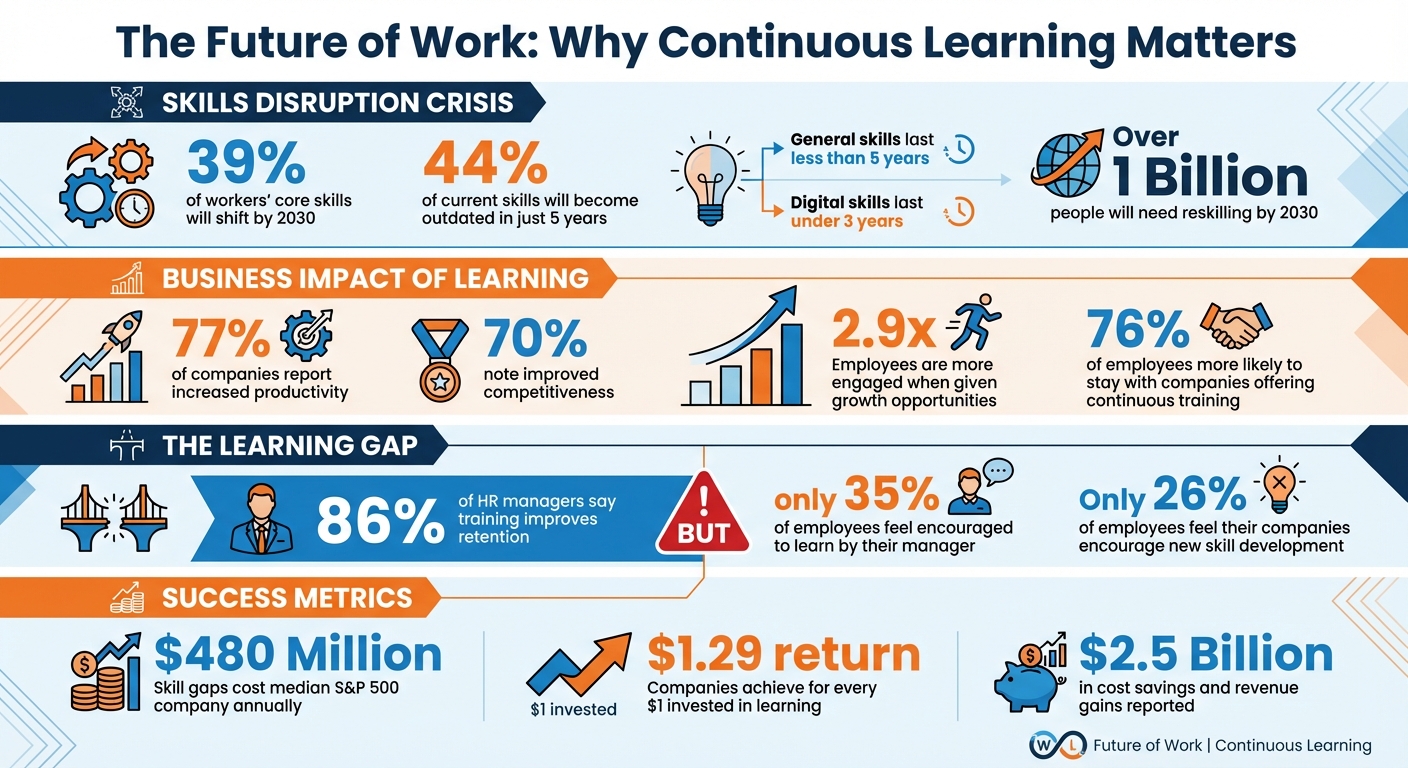
Future of Work Statistics: Skills Disruption and Learning Impact by 2030
What Defines a Continuous Learning Culture
A continuous learning culture makes learning as routine as checking your email. Organizations that succeed in this area manage to weave learning into the fabric of daily work life seamlessly [1].
At the heart of this culture is a growth mindset and genuine curiosity. Without these, even the most advanced training programs tend to fall flat. Psychologist Carol S. Dweck, known for her groundbreaking work on the growth mindset, explains it well:
"The fixed mindset doesn't allow people the luxury of becoming. They have to already be" [6].
The best learning cultures give employees the freedom to shape their own development paths. Instead of relying solely on top-down directives, these organizations provide tools, time, and autonomy for employees to develop skills that match both company goals and their personal career aspirations [5][7]. This approach is crucial, especially considering how rapidly skills are evolving - skill sets have changed by 25% since 2015 and could shift by as much as 65% by 2030 [5]. Rigid, centralized training programs simply can't keep up. Self-directed learning fits perfectly into the broader goal of embedding continuous learning into everyday work.
On-Demand Training and Microlearning
In today’s fast-paced work environment, employees can't afford to spend a week in training seminars. That’s where microlearning - short lessons lasting 15–20 minutes - comes in. These lessons are designed to deliver precise skills when employees need them most [7]. This "just-in-time" approach replaces outdated methods of scheduled training that may not align with immediate needs.
A great example of this shift is Tenable, a cybersecurity company that revamped its sales training in December 2021 under the guidance of Senior Director Jeremiah Fern. They moved to a "pull" model, offering microlearning resources accessible via desktop and mobile. Sales professionals could grab product brochures or watch short training videos while actively working, instead of sitting through long, disconnected sessions [10]. This strategy is especially critical as 58% of today’s workforce needs new skills to perform their jobs effectively [10]. With remote and hybrid work becoming the norm, mobile-friendly content ensures employees can engage with learning materials anytime - whether they’re between meetings or commuting.
However, on-demand training alone isn’t enough. Leadership support plays a key role in creating an environment where continuous learning thrives.
Leadership Support and Psychological Safety
Even the most accessible training tools need a strong foundation of leadership support. For learning to be effective, employees must feel safe admitting what they don’t know, asking questions, and making mistakes as they acquire new skills. This requires an environment of psychological safety, where individuals can take risks without fear of embarrassment or punishment [4][9].
Wendy Tan, Managing Partner at the Flame Centre, highlights this challenge:
"It also takes courage to explore new domains - to be naked in our ignorance as we start anew as beginners" [4].
Leaders must model this courage themselves. Adopting a "leader as learner" mindset - where managers openly share their own learning experiences - signals that growth is valued at every level. When leaders prioritize their own development and discuss it openly, it sets the tone for the team [6].
McKinsey & Company demonstrated this principle in June 2025 with the launch of an AI-enabled evaluation tool. Designed to improve coaching during performance reviews, the tool included features like an "antibias flag" and a chatbot to help draft feedback. By integrating learning directly into daily tasks like performance evaluations, McKinsey showed that development works best when it’s part of the regular work process [1].
The numbers back this up: 86% of HR managers say training improves employee retention [7], but only 35% of employees report being encouraged to learn by their manager in the past six months [5]. This gap highlights a major opportunity. When leaders actively support learning - by protecting time for it, recognizing growth efforts, and fostering an environment where mistakes are seen as part of the process - they create teams that adapt quickly and stay engaged for the long haul.
How to Build and Scale Continuous Learning
Once leadership is on board, the next step is embedding learning into day-to-day work and scaling it effectively. Start by evaluating your current learning setup with tools like the Learning Ecosystem Maturity Assessment (LEMA). This helps pinpoint gaps in strategy, structure, offerings, and integration, such as missing infrastructure, unclear ownership, or content that doesn’t align with business goals [12][2].
After identifying gaps, create a clear skill taxonomy. Organize skills into categories like technical, leadership, and functional, and define proficiency levels - Foundational, Experienced, and Advanced [13]. This framework makes it easier to track progress, address skill gaps, and expand learning initiatives across the organization. Without this structure, learning programs can feel disjointed and challenging to scale.
Scaling requires shared ownership. Learning shouldn’t be limited to the L&D department. The "Four Es" model - Education (formal training), Experience (on-the-job learning), Exposure (mentorship and networking), and Environment (tools and systems that support learning) - offers a balanced approach [14]. Companies that invest in all four areas create adaptable learning ecosystems that grow with the business. This is especially important as 44% of workers' skills are expected to face disruption in the next five years [15].
Mentorship and Coaching Programs
Mentorship is a powerful way to accelerate skill-building. AI-driven matching algorithms simplify mentorship programs by pairing participants based on skills, goals, and time zones, reducing bias and administrative work [16][17]. This allows programs to grow from dozens to thousands of participants without sacrificing quality.
For example, Visa launched "Visa University" in March 2020 using the Degreed platform, engaging 65% of its 20,000 employees within four months [2]. Walmart’s "Live Better U" (LBU) program invested $1 billion between 2018 and 2021 to cover tuition for 1.5 million associates. Participants were four times less likely to leave the company and twice as likely to get promoted [2].
Expanding mentorship also means offering diverse formats. Group mentoring, peer-to-peer learning, and reverse mentoring (where junior employees mentor senior leaders on emerging skills) ensure more employees benefit at once [16][17]. As Dave Wilkin, Cofounder of 10KC, puts it:
"Most organizations just rely on everyone to be a naturally amazing mentor or sponsor. Stop making people have to be naturally gifted... That's where platforms... provide them with the conversation guides, the nudges, all of those experiences so that you can now 10x or 20x the amount of people that are ready to do this because they're enabled" [16].
To ensure success, provide participants with structured tools like conversation guides, milestones, and goal-setting templates. For distributed teams, prioritize asynchronous mentorship - such as recorded video walkthroughs or written code reviews - to overcome time zone challenges [19]. Companies using structured mentorship report 40% faster onboarding and 30% faster project delivery [19].
Internal Knowledge-Sharing Platforms
Learning becomes second nature when it’s integrated into daily workflows. Embedding knowledge-sharing into tools like Jira or Linear provides in-context learning prompts during routine tasks. For instance, during sprint planning, employees might see suggestions for relevant training modules or developmental assignments [8].
ChargePoint demonstrates this approach well. By partnering with LearnUpon to deliver mobile-based training, the company saw a 28% increase in training completion rates and an 89% drop in support calls for "how-to" questions in just one year [2]. The mobile format ensured learning was accessible anytime - on-site, between tasks, or during downtime.
AI-powered real-time coaching takes this further by offering immediate feedback during live tasks. In fast-paced environments like call centers, AI tools analyze conversations in real-time, suggesting responses and offering empathy coaching on the spot [8].
BIC Group also adopted a data-driven approach to knowledge-sharing through BIC University. Between 2018 and 2021, they evaluated their 15 main learning programs rigorously, cutting underperforming ones from five to zero. Over three years, 12 programs outperformed industry benchmarks, proving the value of structured knowledge-sharing [2].
To make knowledge transfer seamless, integrate learning platforms with tools like Slack or Microsoft Teams. This ensures employees can access expertise without disrupting their workflow [17][18]. When learning fits naturally into daily routines, adoption rates climb, and knowledge-sharing becomes a habit.
Recognition and Rewards Systems
Acknowledging learning efforts is key to sustaining engagement. 76% of employees are more likely to stay with a company that offers continuous training [7], but participation drops when learning goes unnoticed. Recognition systems transform learning from a "nice-to-have" into a celebrated part of company culture.
Digital badges and internal credentialing systems provide visible proof of skills and accomplishments, motivating employees to complete development programs [12]. These credentials can be showcased on internal profiles, used during performance reviews, or referenced when applying for internal roles - boosting both personal pride and career growth.
Automated reminders, like emails prompting employees to schedule sessions or complete surveys, help reinforce learning habits [18]. Public recognition - such as spotlighting learners in newsletters, awarding gift cards, or issuing certificates - signals that the organization values professional growth [18]. Alicia Lopez, Head of Learning and Careers at Cisco, emphasizes:
"We know that people stay at Cisco if they feel invested in. When people leave Cisco, most of the time they haven't had an investment in their learning and development" [7].
Recognition works best when it’s specific. Instead of generic awards, celebrate concrete milestones: completing a tough certification, applying a new skill to a project, or mentoring a colleague through a challenge. This targeted approach encourages the behaviors that drive growth.
Experts like Seth Mattison highlight that weaving continuous learning into everyday operations not only accelerates skill-building but also strengthens long-term organizational performance in today’s fast-changing work environment.
Using Technology to Support Continuous Learning
Technology has transformed learning into a continuous, seamless process. AI-powered platforms now analyze employee data to evaluate current skills and predict future needs - no manual assessments required [20]. This process, called skills inference, provides leaders with real-time insight into workforce strengths and weaknesses, enabling personalized learning experiences tailored to individual and organizational needs.
With professional skills having a shelf life of less than five years - and digital skills even shorter [2] - organizations can't afford to rely on annual reviews to identify training needs. Modern systems integrate internal performance metrics with external labor market trends, helping businesses stay ahead of the curve and address skill shortages before they become critical [8].
AI-Driven Personalization and Microlearning Platforms
AI is revolutionizing training by creating customized learning paths based on individual goals and skill levels. Employees who set specific career objectives engage with learning materials four times more than those who don't [11]. This tailored approach ensures that training aligns with both personal aspirations and business strategies.
Take Johnson & Johnson’s Technology group as an example. Starting in 2020, they introduced a skills inference process for 4,000 technologists, later scaling it to 130,000 employees worldwide. Using machine learning, they evaluated proficiency (on a 0–5 scale) for 41 "future-ready" skills. By March 2024, over 90% of their Technology group had accessed "J&J Learn", an AI-powered ecosystem that boosted voluntary learning activities by 20% [20]. Jim Swanson, the company’s Executive Vice President and Chief Information Officer, explained:
"To be relevant and future ready, you for instance need to have your commercial expertise and digital expertise. Scientific expertise and digital. You can have the best technology, but without that integrated way of thinking, it won't transform anything" [20].
AI also enhances real-time learning during live tasks. For instance, in customer service, AI tools analyze conversations as they happen, providing instant feedback on tone, empathy, and communication style [8]. This immediate coaching helps employees refine their skills daily. Meanwhile, microlearning platforms deliver short tutorials and checklists directly within the tools employees use, making learning a natural part of their workflow [21].
Predictive Analytics for Skill Gap Identification
While AI personalizes training, predictive analytics ensures organizations prepare for future needs by identifying skill gaps. Leaders can use heat maps of workforce capabilities to pinpoint deficiencies by geography, department, or business line [20][8]. This data helps align talent development with long-term goals, preventing critical skill shortages.
The urgency is clear: 38% of the workforce will require fundamental retraining or replacement within three years, according to leaders [20]. Analytics tools track skill progression in real time, using project outcomes and feedback to measure how employees apply new capabilities in their roles [8]. This replaces outdated annual reviews with a dynamic, evidence-based understanding of workforce development.
BIC Group offers a compelling example. Over three years, they revamped their "BIC University" programs by analyzing 15 key learning initiatives. The result? Twelve programs outperformed industry benchmarks (up from four), while underperforming programs were eliminated [2].
For analytics to succeed, organizations need a clear skills framework developed with input from senior leaders and subject matter experts [20]. By integrating data from HR systems, recruiting databases, learning platforms, and project management tools, companies can build a comprehensive view of workforce capabilities [20]. Transparency is critical - employees must understand how their data is used. Leading organizations limit the use of skill proficiency data to career development and workforce planning, explicitly excluding it from performance reviews to build trust [20].
As Stephanie Conway, Senior Director of Talent Development at LinkedIn, explains:
"In a world awake to AI's impact, skill-building is no longer simply a perk for employees - it's a priority for organizational success" [11].
These technologies are redefining learning as a strategic asset. Thought leaders like Seth Mattison (https://sethmattison.com) emphasize that embedding learning into daily work isn’t just about acquiring skills - it’s a necessity for thriving in the ever-evolving world of work.
Measuring Results and Overcoming Implementation Challenges
Creating a culture of continuous learning isn't just about implementing programs - it’s about ensuring those programs deliver measurable impact and addressing the challenges that may arise along the way. Surprisingly, only 33% of organizations directly measure the ROI of their learning initiatives, even though skill gaps can cost the median S&P 500 company a staggering $480 million annually [23]. Clearly, relying on assumptions can be a costly mistake.
Key Metrics for Learning ROI
Measuring the success of learning programs requires a balance between leading metrics (early indicators like enrollment rates and course completion) and lagging metrics (outcomes such as employee retention and revenue growth) [22][24]. The Kirkpatrick Model is a well-established framework for this, focusing on four levels of evaluation: Reaction (learner satisfaction), Learning (knowledge acquired), Behavior (real-world application), and Results (business impact) [22][25].
Start by aligning metrics with your organization’s strategy. For instance, ask executives to define their top three business goals, then identify the skills your workforce needs to achieve them [22]. For high-stakes programs, consider A/B testing to determine the direct impact of learning. In 2024, a global energy company piloted a retail transformation training program for frontline leaders, comparing outcomes with a control group. The result? Upskilled leaders boosted profitability by 3%, leading to a full-scale rollout [24]. Similarly, a logistics company in 2025 found that trained employees outperformed their peers with 23% higher retention, 15% productivity gains, and 40% more internal promotions, delivering an estimated 3.2x ROI [23].
Another valuable metric is "speed to mastery", which tracks how quickly employees go from onboarding to full competency. For example, Smith University slashed new-hire training time by 50% after developing 250 custom courses in just seven months using the D2L Brightspace platform [25]. Organizations with mature learning and development strategies are also 3x more likely to retain top talent and hit financial targets compared to those with less-developed approaches [25].
These metrics not only validate the effectiveness of your learning programs but also provide critical insights for refining strategies. However, even with strong results, internal resistance can pose challenges to widespread adoption.
Overcoming Resistance to Change
Once you’ve established measurable outcomes, the next hurdle is addressing resistance to change. Often, resistance isn’t rooted in defiance but in a disconnect between leadership’s goals and employees’ day-to-day experiences [26]. Common barriers include fear of the unknown, loss of control, and fatigue from constant change [26].
To counter these challenges, tailor your communication strategies to resonate with different thinking styles. For example:
- Use data for analytical thinkers.
- Provide clear timelines for practical-minded individuals.
- Highlight human impact for relational thinkers.
- Share visionary goals for those who think experimentally [26].
Integrating learning into daily workflows is another way to ease resistance. When learning feels like a natural part of the workday rather than an extra task, adoption improves. Celebrate early successes to build momentum and validate the program’s value [26]. Incentives - both financial (like bonuses or subsidies) and non-financial (like public recognition or shout-outs) - can also help shift extrinsic motivation into intrinsic habits [2]. Managers play a critical role here, acting as coaches who provide mentorship, encouragement, and consistent feedback [26][2].
Finally, leaders must actively work to remove barriers that undermine trust and engagement. As Mark Marsen, HR Director at Allies for Health + Wellbeing, puts it:
"If learning isn't connected to the why, it won't stick" [7].
Connecting learning initiatives to a clear purpose is essential for fostering long-term change and ensuring that employees see the value in their development journey.
Conclusion: Making Learning a Core Priority
Organizations that overlook continuous learning risk falling behind. Here’s why: 44% of workers' skills are predicted to be disrupted by 2029–2030, and 72% of Fortune 500 CHROs expect AI to start replacing roles by 2027–2028. Yet, only 26% of employees feel their companies encourage them to develop new skills [15].
This paints a clear picture: learning isn’t just a one-time training session; it has to become a part of everyday work. As Allied OneSource aptly puts it:
"The companies positioned for success are not those with the newest technology alone; they are organizations that enable their workforce to learn continuously and adapt effectively" [15].
Leadership plays a critical role here. Leaders need to act as "learners-in-chief", actively demonstrating their commitment to personal growth [6]. By embedding continuous learning into daily workflows, mentorship programs, and team dynamics, leaders can safeguard institutional knowledge and spark innovation.
The financial argument is just as compelling. Companies that prioritize upskilling have reported $2.5 billion in cost savings and revenue gains, with some achieving $1.29 in returns for every $1 invested in learning [15][3]. Beyond the numbers, these initiatives equip organizations to handle constant change and reduce burnout [1].
Seth Mattison, a well-known expert on the future of work, highlights the necessity of lifelong learning to navigate today’s fast-changing business environment (https://sethmattison.com).
The future of work isn’t approaching - it’s already here. The real challenge isn’t deciding whether to make learning a priority, but figuring out how quickly you can embed it into your organization’s culture. Start small. Identify one daily process where learning can be integrated today - your organization’s future depends on it.
FAQs
What are the best ways to make continuous learning a natural part of daily work?
To make learning a natural part of daily work, companies need to weave it into everyday tasks. Instead of treating learning as an isolated event, it should feel like a seamless part of employees' regular responsibilities.
Some effective strategies include using technology to provide personalized learning experiences and tapping into AI tools to help employees develop relevant skills. Equally important is creating a workplace culture that emphasizes growth and continuous improvement. Leadership plays a huge role here - by championing learning initiatives and ensuring they align with the company’s goals, leaders can set the tone for success. This approach not only helps the workforce stay flexible but also ensures employees can apply new skills immediately to tackle real-world challenges.
How can leaders create a culture of continuous learning in the workplace?
Leaders have a powerful influence on building a workplace culture that values continuous learning. By demonstrating a growth mindset themselves and highlighting the importance of ongoing development, they encourage employees to stay curious and actively seek out new skills. Beyond setting an example, leaders can support initiatives like reskilling programs or professional development opportunities, embedding learning into the organization's core practices.
Strong leadership also ties learning to the company’s broader goals, enabling teams to navigate shifts such as advancements in technology, the rise of remote work, or the impact of automation. By creating an environment that prioritizes innovation and skill-building, leaders not only help the organization remain competitive but also empower employees to reach their full potential.
How can companies evaluate the success of their learning programs?
Companies can measure the success of their learning programs by examining how they influence key business outcomes like employee performance, productivity, and retention. Using data and analytics, organizations can assess how well these initiatives align with and support their strategic objectives.
Methods such as gathering employee feedback, conducting performance reviews, and tracking measurable improvements in skills or efficiency are valuable tools. Comparing metrics from before and after training sessions can also provide a clear picture of the program's return on investment (ROI). This outcome-focused approach ensures that learning continues to play a vital role in driving organizational success.