
Articles May 4, 2026, 9:00:01 AM Seth Mattison 22 min read

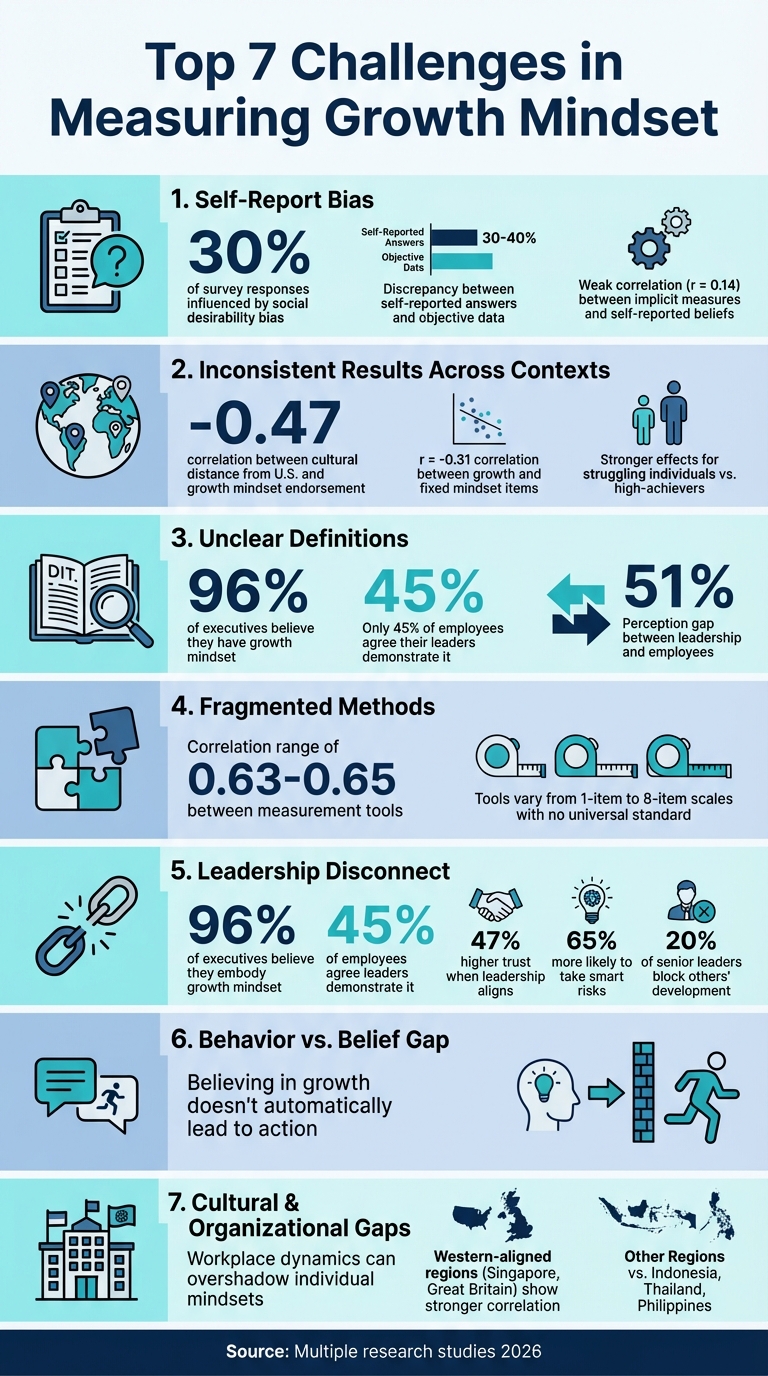
Measuring growth mindset is harder than it seems. Organizations know it's important, but turning beliefs into measurable actions is a challenge. Here's why:
- Self-Report Bias: People often say what they think they should, not what’s true. Up to 30% of survey responses may be influenced by this bias.
- Inconsistent Results: Growth mindset works differently across contexts. For example, it's more effective in Western-aligned regions than in others.
- Unclear Definitions: Without a shared understanding of growth mindset, teams measure different things, leading to unreliable data.
- Fragmented Methods: Tools like surveys and self-assessments don't align, making it hard to track progress or compare results.
- Leadership Disconnect: Leaders often think they model growth mindset, but employees don’t see it that way. Only 45% of employees agree their leaders demonstrate it.
- Behavior vs. Belief: Believing in growth doesn’t always lead to actions like taking risks or learning from failure.
- Cultural and Organizational Gaps: Workplace dynamics and local norms can overshadow individual mindsets.
To fix this, organizations need clear definitions, consistent metrics, and a focus on observable actions like seeking feedback or tackling challenges. Leadership alignment is also critical - leaders must "walk the talk" to build trust and credibility. Measuring growth mindset isn’t just about collecting data; it’s about understanding behaviors and making decisions that drive change.
7 Key Challenges in Measuring Growth Mindset with Statistics
Challenge 1: Self-Report Bias in Assessments
The Problem with Self-Reporting
Surveys are a common way for organizations to measure growth mindset, but there’s a catch: people often respond based on what they think they should say, not what’s actually true. This is where social desirability bias comes into play. It’s estimated that up to 30% of responses in such assessments are influenced by this bias [4]. Employees tend to tailor their answers to align with the values their organization promotes. For example, when asked about embracing challenges or learning from failure, their answers often reflect idealized behavior rather than real-life actions. Research comparing self-reported answers to objective data has revealed discrepancies as high as 30% to 40% [4].
This mismatch between what people claim and what they actually do creates a significant hurdle in accurately measuring growth mindset.
Behavior vs. Belief
The divide between words and actions is at the heart of the problem. Studies show that implicit measures - those assessing unconscious attitudes - have only a weak correlation (r = 0.14) with self-reported beliefs [5]. In other words, what people say they believe rarely aligns with how they behave.
"Most executives believe they have a growth mindset, but employees say they don't lead by example." - TalentLMS Research [1]
Leaders often declare their commitment to learning and growth, but their actions can tell a different story. For instance, they may shy away from challenges that could expose their vulnerabilities or undermine their image of being highly capable [8]. Employees notice these inconsistencies, which researchers refer to as a "false growth mindset" [6][1]. This disconnect fosters skepticism about whether the concept of growth mindset is truly being embraced. When assessments rely solely on self-reports, it becomes nearly impossible to separate genuine adoption of a growth mindset from surface-level claims.
sbb-itb-9ceb23a
Challenge 2: Inconsistent Results Across Different Contexts
Why Context Matters
Growth mindset interventions don’t deliver identical outcomes everywhere, and context plays a huge role in this variability. A large-scale study from February 2026, involving 409,287 participants across 48 countries, uncovered a -0.47 correlation between cultural distance from the U.S. and growth mindset endorsement. In simpler terms, the further a culture diverges from Western educational values, the less likely it is to embrace a growth mindset [10].
The performance data backs this up. In Western-aligned regions like Singapore and Great Britain, there’s a strong link between growth mindset and achievement. But in countries like Indonesia, Thailand, and the Philippines - where educational norms differ significantly from Western models - this connection nearly disappears [10]. For instance, mindset interventions in places like Argentina and South Africa improved self-reported beliefs but didn’t lead to measurable performance gains [10].
"The growth mindset of intelligence is not a universal belief system that uniformly characterises individuals' motivation to learn and predicts academic achievement." - Nature npj Science of Learning [10]
Context within organizations matters just as much as cultural differences. Workplace dynamics - like how peers behave, how feedback is delivered, and whether leaders encourage risk-taking - can completely overshadow an individual’s mindset. For example, an employee might sincerely value learning and growth, but if their workplace punishes mistakes instead of treating them as learning opportunities, their actions won’t align with their beliefs [7].
These cultural and organizational differences highlight the importance of understanding individual variability in mindset responses.
Understanding Variability
Cultural influences are only part of the story. Individual differences also play a major role in how people respond to growth mindset interventions. Interestingly, research shows that growth and fixed mindsets aren’t exact opposites - they coexist as separate dimensions. A study of 15,362 U.S. adolescents found that growth mindset and fixed mindset items were only moderately correlated (r = -0.31) [9]. In fact, it’s possible for someone to believe intelligence is both inherited and developable at the same time [9].
Individual experiences add another layer of complexity. For instance, prior academic or professional performance significantly shapes how people react to mindset initiatives. Research consistently shows that growth mindset interventions have stronger positive effects for individuals who are struggling or at risk, compared to those who are already high-achievers [11]. This suggests that a one-size-fits-all approach is unlikely to succeed. By identifying where and why interventions fall short, organizations can adapt their strategies to better meet the needs of diverse employee populations.
Challenge 3: Unclear Definitions and Shared Language
Defining Growth Mindset Clearly
One of the biggest hurdles in understanding and applying a growth mindset is the lack of a universal definition. Without a shared understanding of what the term means, teams end up measuring different things, making it nearly impossible to compare outcomes or track real progress.
The most effective way to define growth mindset is as a dual belief: first, that skills can be developed, and second, that improving these skills is central to the work being done. Researchers Heidi Grant, Mary Slaughter, and Andrea Derler emphasize this point:
"growth mindset - the dual belief that skills and abilities can be improved, and that developing your skills and abilities is the purpose of the work you do - is ripe for misunderstanding."[12]
This lack of clarity often leads to a disconnect between leaders and their teams. For instance, while 96% of executives believe they embody a growth mindset, only 45% of employees feel their leaders actually demonstrate such behaviors[14]. If measurement tools can't capture this gap, organizations risk overestimating the strength of their culture. Without a clear and consistent definition, the data collected can be misleading - a recurring issue when addressing growth mindset challenges.
Establishing a precise definition is essential, as ambiguity leaves room for common misinterpretations to take root.
Avoiding Misinterpretations
Having a clear definition is only half the battle. Misunderstandings about what growth mindset truly means can derail even the best measurement efforts. One frequent issue is what Stanford psychologist Carol Dweck calls the "false growth mindset." This occurs when people claim to embrace growth principles but continue to act in ways that reflect a fixed mindset - like discouraging mistakes or avoiding challenges. Reducing growth mindset to empty slogans or excessive praise for effort strips it of its deeper purpose.
Overemphasizing effort without considering effective strategies is a prime example of this "false growth mindset." Dweck’s research highlights the danger of this approach:
"Great effort became the consolation prize for children who weren't learning. So the very students who most needed to learn about developing their abilities were instead receiving praise for their ineffective effort."[15]
To measure growth mindset accurately, it’s important to separate genuine effort from strategic, effective learning. As Dweck explains:
"Effort is important, but it's in the service of progress and learning. There are other equally important things - like finding successful strategies and seeking input."[13]
Another common misinterpretation is equating growth mindset solely with productivity. This narrow view misses the bigger picture. Growth mindset is about valuing development as the purpose of work - not just a way to boost output[12]. Measurement tools that focus only on productivity metrics fail to capture whether employees are genuinely committed to learning or just feeling pressured to perform.
These misconceptions can undermine the accuracy of measurement tools. For example, surveys that only include "growth-oriented" questions may overlook fixed-mindset beliefs that still influence behavior. To avoid this, balanced-keyed inventories - featuring both forward-keyed (growth) and reverse-keyed (fixed) items - are essential for reducing acquiescence bias[7].
Challenge 4: Lack of Standardized Measurement Methods
Current Measurement Practices
Organizations rely on a mix of tools - like surveys, reviews, and self-assessments - that often fail to align. These tools frequently assess different aspects of mindset, even when claiming to measure the same concept.
A study involving 15,362 adolescents highlights just how fragmented these practices are. For example, two items from a commonly used scale - one focusing on growth beliefs and the other on fixed beliefs - had a correlation of only -0.31[7]. This suggests that growth and fixed mindsets might not be polar opposites but instead separate dimensions that can coexist. In fact, correlations between them have been found to range from 0.63 to 0.65[9].
Adding to the confusion, the tools themselves vary significantly. Some organizations use single-item scales, like those developed by OECD/PISA, while others employ more detailed inventories with 2, 3, or even 8 items[7]. Without a universal standard, comparing results across teams or benchmarking against other organizations becomes nearly impossible. Worse, outcomes can shift dramatically depending on how questions are phrased[7]. As researchers Yan and Schuetze note:
"The pathway linking the adoption of a growth mindset to academic achievement remains a black box and has not been clearly defined."[6]
This inconsistency highlights the need to rethink what we measure. Without linking beliefs to behaviors, organizations risk relying on vague metrics that fail to provide actionable insights. The fragmented state of measurement practices underscores the importance of developing more consistent, behavior-focused tools.
The Need for Behavioral Metrics
To address these gaps, organizations need to move beyond abstract beliefs and focus on measurable actions. Current tools tend to emphasize stated beliefs, but these don't always translate into observable behaviors. For example, believing in the ability to grow doesn’t automatically mean someone will take on challenges or adjust their strategies after setbacks. To truly gauge a growth mindset, organizations should measure behaviors that demonstrate it in practice - like seeking feedback, embracing challenges, and learning from mistakes.
At present, most instruments separate cognitive factors from behavioral ones, ignoring the connection between thought and action[6]. This creates what researchers describe as a "black box": while we can measure beliefs about mindset and track achievement outcomes, the behavioral mechanisms linking the two remain unclear[6]. Without understanding these mechanisms, it’s difficult for organizations to identify which practices actually improve performance.
Behavioral indicators offer a clearer path forward. Instead of asking whether someone believes skills can be developed, organizations could track actions like how often team members take on new projects, adjust their strategies after feedback, or pursue stretch assignments. These kinds of metrics reveal whether individuals are truly applying growth mindset principles.
To improve measurement practices, researchers recommend "analytical transparency"[9]. This involves reporting results for growth-oriented and fixed-oriented items separately rather than combining them into a single score. Balanced-keyed inventories, which include both types of items, can help address biases like the tendency to agree with statements regardless of their content[9]. Most importantly, organizations need to clearly define the specific behaviors they aim to measure before choosing or designing any assessment tools. By focusing on observable actions, they can create a more reliable foundation for evaluating and fostering a growth mindset.
Challenge 5: Leadership-Employee Mindset Disconnect
How Leadership Modeling Affects Organizations
A major challenge arises when leaders' self-perception doesn't align with employees' experiences. For example, while 96% of executives believe they embody a growth mindset, only 45% of employees agree their leaders exhibit such behaviors [16]. This disconnect raises an important question: how can organizations accurately assess and cultivate a growth mindset if leaders and employees view leadership behaviors so differently?
This gap often shows up in daily workplace interactions. Leaders may talk about the importance of learning from failure but then reward only short-term results. Employees quickly notice these contradictions. Alec Loeb, VP of Growth Marketing at ecoATM/Gazelle, highlights this issue:
"Leaders break culture when they only reward short-term execution and ignore the value of iteration or experimentation. It signals that hitting today's number matters more than learning how to build next quarter's win." [16]
When leadership actions align with a true growth mindset, the benefits are clear. Employees in such organizations report 47% higher trust in their company and are 65% more likely to feel encouraged to take smart risks [16]. However, when leaders act in ways that contradict these principles - such as the 20% of senior leaders who have seen colleagues block others' development to maintain power [1] - it undermines the credibility of any growth mindset initiatives. Closing this gap requires leaders to take visible, consistent actions that reinforce their commitment to these principles.
Bridging the Gap
To address this disconnect, organizations need to turn abstract commitments into tangible, measurable actions. A powerful example comes from Microsoft, where CEO Satya Nadella spearheaded a cultural shift in 2015. By moving the company from a "know-it-all" to a "learn-it-all" mindset, Microsoft experienced remarkable growth, eventually surpassing a market value of $4 trillion [16].
Identifying gaps in leadership mindset starts with combining leadership assessments with employee perception surveys [16][1]. But measurement alone won't solve the problem. It takes actionable steps to bridge the divide. At ecoATM/Gazelle, for instance, leaders introduced daily stand-up meetings to openly discuss project failures without fear of punishment. This created a safe environment for sharing both setbacks and successes. Similarly, Amazon encourages learning by publicly sharing failed experiments and promoting calculated risks through practices like the "Two Pizza Rule" [16].
Solutions: How to Overcome Growth Mindset Measurement Challenges
Standardizing Definitions and Metrics
The first step in addressing growth mindset measurement challenges is to establish consistent definitions and metrics. Research shows that forward-keyed (growth) and reverse-keyed (fixed) survey items measure distinct dimensions (ρ = 0.63–0.65) [9]. This highlights the need for organizations to move beyond simplistic, binary assessments and adopt a more nuanced approach.
Successful companies often develop shared language and consistent measurement frameworks that align with their organizational culture. For instance, under Satya Nadella's leadership, Microsoft implemented survey prompts that directly link actions, such as tackling challenges, to learning outcomes [3]. Similarly, integrating both growth-oriented and fixed-mindset questions can help reduce bias [9]. Companies like Google have taken this further by incorporating 360-degree feedback systems, offering a well-rounded perspective on how employees embrace challenges and support each other's growth [3].
Focusing on Behavioral Indicators
Once standard definitions and metrics are in place, the focus should shift from measuring beliefs to observing actions. Concrete behaviors often provide a clearer link between a growth mindset and performance outcomes. Research identifies two key behavioral categories: Proactive Practices (such as goal-setting, challenge-seeking, and effort regulation) and Reflective Practices (like perseverance, metacognitive reflection, and feedback integration) [6]. These behaviors act as tangible indicators of a growth mindset in action.
Organizations are increasingly prioritizing behavioral tracking over self-reported beliefs. For example:
- IBM monitors learning engagement through program enrollment and completion.
- Amazon evaluates innovation by tracking new project launches aligned with its "Disagree and Commit" principle.
- Accenture has transitioned to performance reviews that focus on learning agility and adaptability [3].
Here's how some behavioral indicators can be tracked:
| Behavioral Indicator | What to Track | Example Metric |
|---|---|---|
| Challenge-Seeking | Preference for difficult tasks and high-risk projects | Count of high-risk projects launched |
| Self-Regulated Learning | Goal-setting, strategy selection, and development participation | Enrollment and completion rates in L&D initiatives |
| Metacognitive Strategies | Self-monitoring and strategy adjustments based on feedback | Frequency of strategy changes after setbacks |
| Proactive Coping | Reframing failures as learning opportunities and seeking support | Instances noted in 360° feedback |
| Perseverance | Sustained effort despite obstacles | Completion rates of challenging programs |
Leadership Alignment and Visibility
Leadership is the cornerstone of embedding a growth mindset within an organization. As Jessica Choo, Founder & Chief Strategist at ILS, puts it:
"To embed a growth mindset successfully, companies need unwavering support from the top echelons of leadership" [3].
For this to work, leaders must actively model growth mindset behaviors. This includes openly sharing their learning journeys, acknowledging their mistakes, and demonstrating how they adapt and grow from setbacks.
To ensure alignment, companies can combine leadership assessments with employee perception surveys. This approach helps identify gaps between how leaders perceive their own behaviors and how employees experience them. Moving from static annual reviews to dynamic, goal-focused tracking - centered on learning agility and willingness to take on challenges - can establish accountability and set clear behavioral expectations across the organization [3].
Conclusion
Key Takeaways
Measurement is about turning data into insights that drive action. As Kirkpatrick Partners explains:
"The goal of evaluation was never to count - it was to learn" [2].
Successful organizations understand that effective measurement combines numbers with deeper, qualitative insights. Instead of just tracking surface-level activities like course completions, they focus on real behavioral changes - how teams approach challenges, manage risks, and adapt to setbacks [3].
To achieve this, organizations need clear definitions, consistent metrics, and leadership alignment. Without these, measurement efforts risk becoming disjointed and ineffective. Jessica Choo, Founder & Chief Strategist at ILS, emphasizes:
"There's no cookie-cutter approach to measuring the adoption of a growth mindset within an organisation. It's a complex blend of direct measurements and indirect indicators" [3].
The Path Forward
Now, the challenge is turning these lessons into actionable strategies. In 2026, mastering the art of sense-making will be critical. As Kirkpatrick Partners puts it:
"Sense-making is the strategic superpower of 2026. It requires curiosity, courage, and a willingness to pause long enough to connect the dots before chasing the next shiny metric" [2].
Organizations need to move beyond proving impact through compliance and instead focus on improving through constant learning and adaptation.
A key question to ask is: "What decision does this data inform?" [2]. If the answer isn’t clear, it’s time to refine your purpose rather than collecting more data. Use tools like 360-degree feedback, behavioral tracking, and open conversations to gain a complete view of cultural changes. Monitor initiatives like new project launches, participation in voluntary learning programs, and the dynamics of feedback during performance discussions [3].
Evaluation should always link intentions to outcomes, serving as a tool for ongoing improvement. It’s not just about understanding what’s happening, but also why it’s happening and identifying any obstacles in the way. Organizations that adopt this mindset will foster cultures where growth becomes second nature, leading to sustained performance in a world that demands constant adaptability. By aligning beliefs with behaviors, they’ll create an environment primed for lasting success.
Carol Dweck on "Developing a Growth Mindset Culture in Organizations" | Talks at Google
FAQs
What behaviors best prove a growth mindset at work?
Viewing mistakes as opportunities to learn, staying resilient when challenges arise, and welcoming difficulties as paths to personal and professional growth - these are the hallmarks of a growth mindset at work. These behaviors highlight a dedication to ongoing development and the pursuit of improvement.
How can we reduce self-report bias in mindset surveys?
To get more reliable results in mindset surveys, it's important to address self-report bias. One way to do this is by using implicit measures like the Implicit Association Test (IAT), which can help reduce the influence of social desirability. Another option is to use alternative assessments, such as forced-choice questions or scenario-based methods. These techniques limit the chance for socially desirable answers, giving organizations a better picture of growth mindset compared to traditional self-report surveys.
How do we measure growth mindset across different cultures and teams?
Measuring a growth mindset across different teams and regions involves factoring in diverse cultural norms, organizational principles, and individual perspectives. To get a clear picture, you can focus on specific indicators like leadership support, employee engagement, and learning behaviors.
Cultural differences, such as whether a group prioritizes collective goals or individual achievements, can influence how you approach this. For example, tools like surveys, feedback sessions, and observations may need adjustments to align with these cultural nuances. By employing methods that are sensitive to these differences, you’ll gather more accurate and meaningful insights into how growth mindset is embraced across various teams.