
Articles Mar 12, 2026 9:00:00 AM Seth Mattison 29 min read

Building trust in teams with diverse backgrounds is both challenging and rewarding. Trust is the key to collaboration, problem-solving, and innovation, but cultural differences in communication, feedback, and relationships can create barriers. To succeed, leaders must:
- Understand biases: Recognize affinity bias and how it impacts trust-building.
- Learn trust dynamics: Identify how trust is built differently across cultures (e.g., task-based vs. relationship-based trust).
- Set communication norms: Clarify expectations to prevent misunderstandings and improve collaboration.
- Build connections: Strengthen trust through personal relationships and consistent one-on-one check-ins.
- Address conflicts: Resolve disagreements with awareness of cultural differences in conflict styles.
- Commit to fairness: Recognize contributions, include all voices in decisions, and reduce bias in processes.
- Use feedback systems: Regularly collect input to ensure continuous improvement and maintain trust.
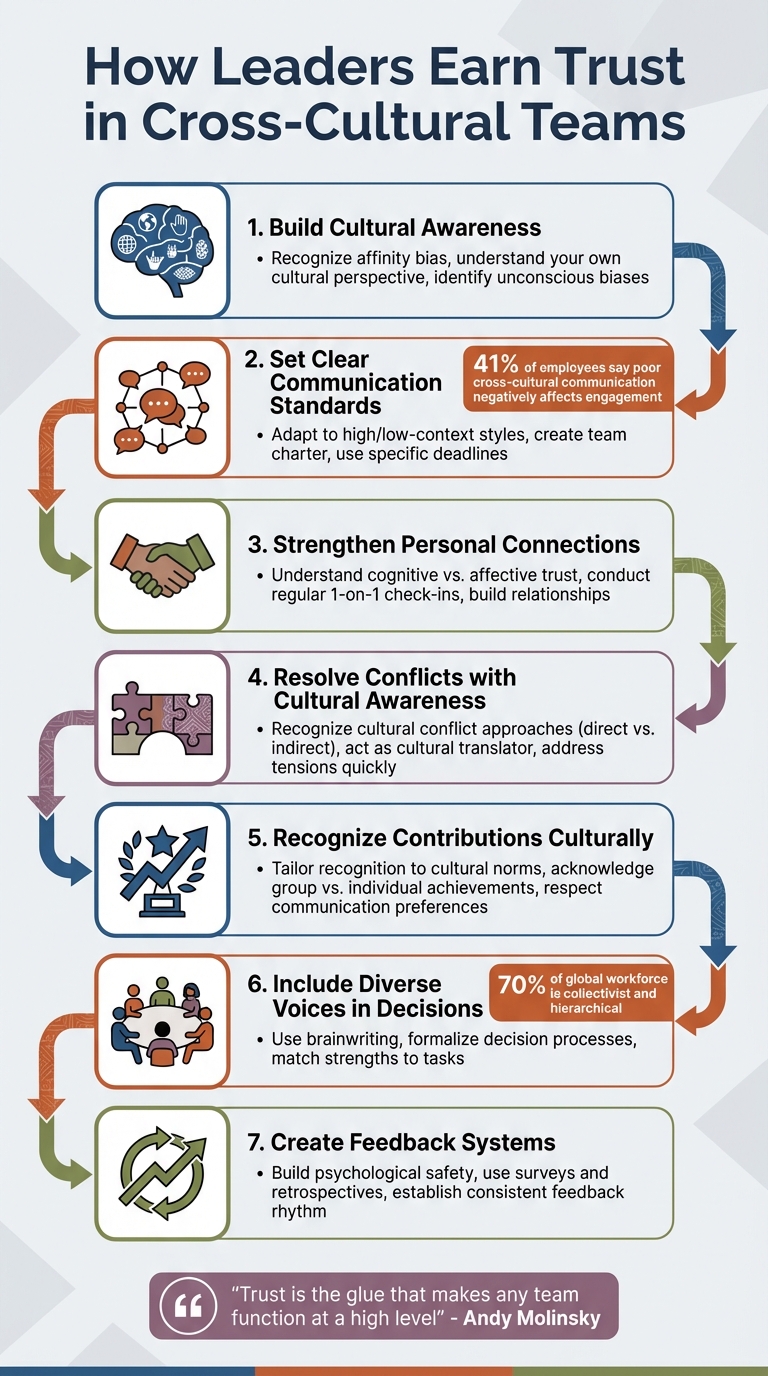
7 Steps Leaders Use to Build Trust in Cross-Cultural Teams
Building Trust Across Cultures| GNBCC Webinar with Alette Vonk
Build Cultural Awareness as Your Starting Point
To earn trust across cultures, start by examining your own cultural perspective. Research highlights that adopting the right mindset is essential for building trust in diverse environments [1][5].
One challenge lies in our natural inclination toward people who remind us of ourselves. This affinity bias can lead you to instinctively trust individuals who share your communication style, background, or work habits. Recognizing this tendency is a crucial first step in forming authentic connections with those who differ from you. This self-awareness sets the stage for the actionable steps outlined below.
Identify and Address Your Cultural Biases
Unconscious biases influence how we interpret behaviors like punctuality or directness. For instance, in your culture, showing up a few minutes late might seem disrespectful, while in another, it could be perfectly normal. Similarly, what you view as straightforward feedback might come across as overly harsh to someone from a different background.
To avoid misunderstandings, map out potential "fault lines" in your team. For example, German colleagues may prefer direct feedback, while Korean team members might lean toward a more indirect approach [4].
"The cultivation of trust necessitates leaders to adopt a mindset characterized by curiosity, respect, and a genuine desire to comprehend and learn from diverse cultures." – Aaron Hall [3]
Practice active listening to fully grasp each speaker's perspective, which can help bridge gaps caused by cultural or language differences. Be upfront about your own communication style and background to give team members better insight into your perspective. At the same time, avoid reducing individuals to cultural stereotypes - while cultural norms provide context, they don't define a person's unique personality [4].
Once you acknowledge your biases, you can expand your understanding by exploring how trust is perceived across different cultures.
Learn How Different Cultures View Trust
Cultures vary in how they build trust, often relying on either consistent performance or strong social bonds. While both factors are important globally, the emphasis on each can differ. Understanding these nuances allows you to adapt to the expectations of team members from various backgrounds [1][5].
For example, in some regions like the UK, trust may develop gradually over time. In contrast, in places like Brazil, forming a rapport can happen more quickly [4][5].
Use Self-Assessment Tools to Improve Cultural Understanding
While self-reflection is valuable, structured tools can offer deeper insights into your cultural intelligence. Unlike fixed personality traits, Cultural Intelligence (CQ) is a skill you can actively develop [6]. The CQ® Assessment from the Cultural Intelligence Center measures your CQ and provides a personalized roadmap, highlighting your behavioral tendencies and comparing them to global benchmarks [6].
"Measuring your CQ® is the first step to building more adaptable, high-performing teams - and becoming a more effective leader in any environment." – Cultural Intelligence Center [6]
Other tools, like GlobeSmart® and Andy Molinsky's Global Dexterity, offer strategies to adjust your behavior without compromising your identity [4]. These assessments can help you refine your leadership and communication styles to better meet the needs of your diverse team. The goal isn’t to change who you are but to understand how your natural tendencies are perceived by others - and adapt accordingly. Use these tools to fine-tune your approach and strengthen trust within your team.
Set Clear Communication Standards
Once you've cultivated a sense of awareness about different perspectives within your team, the next step is setting clear communication standards. Miscommunication can erode trust and disrupt productivity. In fact, 41% of employees say poor cross-cultural communication has negatively affected their engagement or output [8]. When team members aren’t sure how information will be shared or what’s expected of them, they often second-guess their actions. The goal isn’t to force everyone into a single communication style but to establish shared norms and human-centric leadership practices that work across varying approaches. Let’s explore how adjusting communication styles and implementing clear guidelines can rebuild clarity and trust.
Adapt to High-Context and Low-Context Communication Styles
A good starting point is understanding how your team communicates. In low-context cultures - such as the U.S., Germany, and Scandinavia - communication tends to be direct, and trust is built through clear tasks and explicit messages. In contrast, high-context cultures - like Japan, China, and many Latin American countries - rely more on relational cues and unspoken signals to build trust [8][9].
"In a high-context culture, communication is more like a slow dance; subtle, coordinated, and full of unspoken signals. In a low-context culture, it's more like a clear set of instructions." – Erin Meyer, Author of The Culture Map [8]
Flexibility is essential here. When working with high-context team members, soften direct feedback to maintain harmony and avoid causing embarrassment. For low-context members, be straightforward and specific in your communication [8][9]. Also, remember that silence doesn’t always mean agreement - particularly in high-context cultures. A pause might signal disagreement or careful consideration instead. To avoid misunderstandings, ask follow-up questions to confirm alignment [8].
"The best global leaders aren't neutral, they're flexible. They know when to adapt and when to clarify." – Erin Meyer, Author of The Culture Map [8]
Once you’ve adapted to these communication styles, the next step is to establish clear, actionable guidelines.
Create Communication Guidelines for Clarity
Unclear expectations often lead to confusion. One simple fix? Use specific deadlines, like “by Friday at 2:00 PM EST,” to eliminate ambiguity [10]. This approach respects everyone’s time, especially in monochronic cultures where punctuality is tied to respect [10].
Draft a team charter - a concise document outlining shared norms. Detail things like the preferred tone for feedback, whether decisions need written confirmation, and which communication tools to use for various scenarios. For example, you might decide that WhatsApp is for emergencies during work hours, while email is reserved for routine updates [10]. Clear norms like these can reduce up to 80% of predictable friction in multicultural teams [10].
"With multicultural teams, clarity is not a 'nice to have' but the operating system." – Talaera [10]
Follow verbal meetings with written summaries to ensure everyone is on the same page, regardless of their communication style [8]. Summarize key decisions, ownership, and next steps immediately after discussions. This habit is particularly useful for teams where successfully managing diversity can lead to profitability gains of up to 36% [8].
Use Tools to Bridge Language and Cultural Differences
Language barriers are more than just vocabulary - they influence who feels comfortable speaking up and when. To help non-native speakers, share meeting agendas in advance so they have time to process ideas. Avoid idioms and culturally specific phrases that may confuse or exclude team members [10].
Encourage input through multiple channels, such as chat, written notes, or follow-up emails, to ensure everyone has a voice [10]. When asking for commitments, replace yes/no questions with open-ended ones. For example, instead of saying, “Can you finish this by Monday?” try, “What’s a realistic timeline for completing this?” [10]. This approach moves beyond surface-level agreement to genuine understanding.
Additionally, define levels of “alignment.” Clarify what requires full consensus, what simply needs a heads-up, and what decisions can be made independently [10]. For remote teams, establish a predictable cadence for video calls, email updates, and one-on-one check-ins. This consistency helps provide context and stability for all members, no matter where they are [11].
Strengthen Relationships Through Personal Connection
Once clear communication standards are in place, the next step in building trust within teams is creating personal connections. These connections are especially important in cross-cultural settings, where trust can be the glue that holds diverse teams together. Pia Kähärä, Founder of InCultures, highlights this point:
"The moment I turned my attention to better leadership of my multicultural team and focused on building trust with the individuals, our efficiency and creativity soared." [2]
It’s important to remember that trust isn’t a one-size-fits-all concept. Some people need to see your competence in action, while others need to feel a personal bond. Let’s explore how to nurture these connections effectively.
Understand What Builds Trust for Each Team Member
Trust can be divided into two categories: cognitive trust and affective trust. Cognitive trust is based on confidence in someone’s abilities, reliability, and achievements, while affective trust stems from emotional closeness, empathy, and personal relationships [12].
"There are two basic types of trust: cognitive trust and affective trust. Cognitive trust is based on the confidence you feel in another person's accomplishments, skills and reliability. This is trust from the head. Affective trust on the other hand, arises from feelings of emotional closeness, empathy or friendship. This type of trust comes from the heart." – Erin Meyer, Author of The Culture Map [12]
In task-focused cultures like the U.S., Denmark, and Germany, trust is often earned through consistent performance and professional reliability. Work and personal lives remain separate. On the other hand, relationship-focused cultures - such as China, Brazil, and Saudi Arabia - prioritize personal bonds. Here, trust is built through shared experiences and emotional connections, with personal relationships often serving as the foundation for business [12].
Take the example of Karl Morel, an acquisitions expert at Nestlé. In June 2016, Morel faced challenges negotiating a joint venture in China because his team emphasized transparency and data without considering the importance of personal relationships. Acting on a consultant’s advice, Morel hosted a dinner featuring live music and local cuisine for the Chinese executives. This gesture of building "guanxi" (personal connections) helped break the impasse and led to significant progress in negotiations [12].
"In relationship-based cultures, trust is like an insurance policy: – it's an investment you need to make up front, before the need arises." – Erin Meyer, Professor, INSEAD [12]
It’s also important to avoid making assumptions based solely on cultural norms. Many individuals blend task-based and relationship-based approaches to trust, so flexibility in your interactions is key.
Conduct Regular One-on-One Check-Ins
Personal interactions are essential for reinforcing trust and creating a safe environment where team members feel comfortable sharing their thoughts. One-on-one meetings are particularly effective for fostering this sense of psychological safety, especially in hierarchical cultures where open dialogue might be limited in group settings [2].
For team members who value relationship-based trust, consider incorporating informal activities like shared meals or social outings. During one-on-one meetings, take a moment to connect on a personal level - share stories, discuss common interests, and build rapport before diving into work topics [12].
For those who lean toward task-based trust, focus on demonstrating reliability and delivering high-quality work. Keep meetings concise and respect their time by sticking to the agenda.
Setting a consistent schedule for these check-ins - whether weekly, biweekly, or monthly - creates a reliable structure that can be especially helpful for remote or multicultural teams. Transparency and authenticity during these interactions go a long way in reducing skepticism and fostering openness. These meetings can also help identify cultural differences, such as varying preferences for feedback styles [4].
"Multicultural team members benefit from knowing what type of information they will receive when, and from having a regular rhythm for... one-on-one discussions." – Andy Molinsky, Professor of International Management and Organizational Behavior [4]
sbb-itb-9ceb23a
Resolve Conflict with Cultural Awareness
Trust lays the groundwork for any successful team, but in cross-cultural settings, handling conflict with an awareness of cultural differences can take team cohesion to the next level. Conflict is unavoidable - especially in diverse teams where misunderstandings can arise quickly. The key is to address tensions promptly while respecting the unique ways people from different backgrounds approach disagreements. A study involving over 400 managers and executives from regions like America, Asia, Latin America, and the Middle East found that learning about colleagues' backgrounds ranks among the top three behaviors for building trust across cultures [1]. Recognizing cultural triggers for conflict is the first step toward resolving them effectively.
Recognize How Culture Shapes Conflict Approaches
Cultural norms heavily influence how people handle disagreements. One of the most common differences lies in communication styles - direct versus indirect. For example, German professionals often value straightforward feedback as a sign of respect and efficiency. On the other hand, Korean professionals may avoid direct confrontation unless a clear hierarchy exists, prioritizing group harmony instead [4]. Similarly, while some cultures perceive openly disagreeing with a manager in a group setting as disrespectful, Western business practices often view such confrontation as constructive. In many cultures, however, direct conflict can be seen as disruptive or even humiliating, making it essential to approach such situations with care [13].
"Conflict is inevitable in any team, let alone a multicultural one. If tension arises, address it quickly so that a small conflict doesn't balloon into something impossible to manage."
– Andy Molinsky and Ernest Gundling [4]
Apply Frameworks for Respectful Conflict Resolution
Once you understand the cultural dynamics at play, the next step is to use structured approaches to resolve disagreements. As a leader, your role is to act as a cultural translator, bridging the gap between different perspectives [4]. Tailor your conflict resolution strategies to fit the communication preferences of your team members. For example, team members from direct-communication cultures may appreciate open group discussions, while those from indirect-communication cultures might feel more comfortable with private, one-on-one conversations. Setting clear team norms can also minimize misunderstandings and create a sense of predictability [4].
"Leaders need to be capable of understanding multiple cultural perspectives and serving as a cultural bridge between parties in conflict situations."
– Andy Molinsky, Professor of International Management and Organizational Behavior [4]
Seth Mattison (https://sethmattison.com) often highlights in his speeches that turning conflict into a learning opportunity is a powerful way to strengthen trust in cross-cultural teams.
To de-escalate tension, rely on active listening and avoid using overly technical or confusing language [3]. Visual aids can also help overcome language barriers [3].
A study of 1,500 senior executives revealed that thriving as a global leader goes beyond technical skills - it requires a deep understanding of cultural differences and emotional intelligence [7]. Building personal relationships before conflicts arise can also act as a safety net, making it easier to navigate disagreements. When trust exists, team members are more likely to give each other the benefit of the doubt during challenging moments [4].
Show Commitment to Diversity Through Your Actions
Actions are where trust takes root, especially in teams with diverse cultural backgrounds. Leaders demonstrate their commitment to diversity by actively recognizing team contributions, including a variety of voices in decision-making, and establishing processes that minimize bias. A study of over 400 managers and executives from regions like America, Asia, Latin America, and the Middle East highlights that trust emerges from a mix of mindset, cultural understanding, and a focus on both results and character [1]. When team members see you fostering a fair and inclusive environment, trust naturally follows. Building on earlier efforts to improve communication and personal connections, your actions now need to translate understanding into impactful change.
Recognize Contributions in Ways That Resonate Culturally
Recognition isn’t universal - what works in one culture might fall flat in another. Different cultures approach trust-building differently. For instance, in task-oriented cultures like the US, Denmark, and Germany, trust is built on competence and reliability (cognitive trust). Meanwhile, relationship-based cultures such as China, Brazil, and Saudi Arabia emphasize emotional bonds and personal connections (affective trust) [12].
In relationship-focused cultures, prioritize building personal ties before diving into performance metrics. Organize informal gatherings like shared meals or social events where the focus is on connection rather than work [12]. When it comes to formal recognition, tailor your approach to cultural expectations. For example, American team members might give high numerical ratings in surveys but accompany them with blunt written critiques, while Japanese teams may rate lower numerically but balance it with positive written feedback [14]. In collectivist cultures, shift from highlighting individual achievements to acknowledging group efforts [4]. For cultures with indirect communication styles, offer praise privately or through hierarchical channels, as public recognition might cause discomfort [4].
Include Diverse Voices in Decision-Making
Trust thrives when people feel their perspectives truly matter. However, many leaders unintentionally stifle diverse input by sticking to decision-making methods that favor dominant personalities or Western communication norms. To counter this, formalize your decision-making processes for consistency and fairness [15]. This could mean setting clear routines for meetings, gathering feedback, and making final decisions.
"Decisions are often best made by those closest to the work."
– Jennifer Colosimo, President of FranklinCovey's enterprise division [14]
One practical approach is brainwriting - have team members jot down their ideas independently before sharing them with the group. This prevents louder voices from overshadowing quieter ones and ensures a broader range of perspectives [15]. Actively manage discussions to give everyone a chance to contribute, and empower local teams to decide how best to achieve their goals within their specific cultural contexts [14]. Match individual strengths to the challenges at hand - for example, involve collectivist thinkers in consensus-building and analytical minds in data-driven tasks [15]. Tools like StrengthFinders or Cultural Values Profiles can help identify team strengths objectively, allowing you to assign roles based on skills rather than unconscious biases [15].
Reduce Bias in Organizational Processes
Once diverse perspectives are included in decision-making, the next step is to tackle systemic bias. Bias in hiring, promotions, and assignments can quickly erode trust. Leaders often lean toward Western ideals like autonomy and egalitarianism, but it’s worth noting that 70% of the global workforce operates within collectivist and hierarchical frameworks [16].
"70% of the world's workforce is collectivist and hierarchical."
– David Livermore, Social Scientist and Author [16]
To address this, formalize cultural intelligence protocols in hiring, promotions, and project assignments [15]. Replace ad-hoc decisions with standardized procedures for performance reviews and team formations. When building teams, prioritize candidates who bring cultural intelligence alongside their technical expertise to reduce friction [4]. Establish team-specific norms for punctuality, communication, and feedback that everyone follows, regardless of their cultural preferences [4]. Instead of ignoring in-group bias, use it to your advantage by fostering a strong team identity through shared goals and experiences, which can help bridge cultural gaps [15]. Finally, implement diversity and inclusion training programs aimed at reducing stereotypes and ensuring fair decision-making processes [3]. The goal is to move beyond intentions and create systems that actively prevent bias from influencing key decisions.
Create Feedback Systems for Continuous Growth
Building trust isn’t a one-time effort - it’s an ongoing process that requires regular attention and adjustments. Once you’ve established systems to minimize bias and include diverse perspectives, feedback loops become essential. These loops help prevent minor misunderstandings from growing into larger issues. The goal is to design feedback systems that respect different cultural norms while ensuring open, continuous communication.
Build Psychological Safety for Open Feedback
Psychological safety is the backbone of honest communication, especially in teams with diverse cultural backgrounds. It allows individuals to share ideas without fear of judgment or repercussions. In some cultures, particularly hierarchical ones, silence or agreement might not indicate true consent but rather a norm of deferring to authority [2]. Similarly, in high-context cultures, indirect communication styles can unintentionally stifle open expression [17][18].
"Psychological safety is one of two fundamental elements that affect whether employees feel comfortable bringing up those concerns; the other is an employee's relationship with their front-line manager."
– Chris Rider and Antoine Ferrère, Behavioral Scientists at Novartis [19]
A 2021 randomized controlled trial by Sandoz, a division of Novartis, involving over 7,000 individuals from more than 1,000 teams, revealed a key insight: managers who focus on "individuation" - holding regular one-on-one meetings that go beyond task updates to offer personal support - can significantly improve psychological safety [19]. Leaders can take this approach by treating employees as individuals and fostering private, confidential discussions, especially in cultures where public disagreement is discouraged [4].
To further reinforce psychological safety, clear communication norms are vital. Instead of enforcing a rigid style, create universal guidelines, such as setting expectations for email response times, establishing turn-taking protocols in meetings, or developing a shared project glossary. These measures provide structure while allowing flexibility for cultural preferences [4][18][11]. For instance, Western cultures might favor direct feedback, while some Asian cultures lean toward more indirect, mitigated styles [4].
Virtual safety initiatives can also be highly effective. In 2025, Google launched a program for its remote teams in Asia that combined asynchronous communication tools with role-playing workshops. These initiatives encouraged active listening and open dialogue, showing how structured feedback exercises can bridge cultural and geographic divides [17].
This strong foundation of psychological safety sets the stage for transparent and ongoing feedback.
Use Surveys and Retrospectives to Track Trust
Once psychological safety is in place, structured feedback systems help maintain and grow trust. Since feedback styles vary across cultures, it’s important to establish a consistent rhythm - whether through scheduled one-on-ones, video calls, or email updates - to ensure clarity and accountability [4]. Tools like the Global Team Success Indicator, combined with regular check-ins, can quickly pinpoint communication gaps and trust issues [2][18]. For teams with a collectivist mindset, assigning group retrospective tasks can capture insights without putting individuals on the spot [4].
Anonymous feedback tools are another powerful option, especially for team members in hierarchical cultures who may hesitate to voice concerns openly. In 2025, Microsoft introduced trust-building programs for its European teams to improve collaboration with Asian partners. These programs included virtual team-building exercises and shared goal-setting sessions, which led to measurable improvements in team cohesion and the openness of feedback across cultural boundaries [17].
| Method | Consideration | Benefit |
|---|---|---|
| Individuation (1-on-1s) | Focuses on personal support to bridge power distance | Boosts psychological safety and encourages ethical reporting [19] |
| Asynchronous Tools | Reduces pressure in high-context or non-native language settings | Supports virtual safety in remote teams [17] |
| Facilitated Role-Play | Bridges communication gaps between low- and high-context styles | Enhances feedback flow and active listening [17] |
| Shared Goal-Setting | Aligns motivations in individualistic and collectivist cultures | Strengthens team trust and bonds [17] |
By creating predictable and transparent feedback processes, you encourage honest participation. When team members know when and how to provide input, trust naturally grows. Feedback transforms from a task people dread into a chance to improve and strengthen relationships.
"Where there's trust, there's less likelihood of misinterpreting the intentions of others, which often arises from cultural misunderstandings."
– Pia Kähärä, Founder, InCultures [2]
Conclusion
Building trust within cross-cultural teams requires consistent effort and intentionality. As Andy Molinsky, Professor of International Management, and Ernest Gundling, Managing Partner at Aperian Global, explain:
"Trust is the glue that makes any team function at a high level, but it doesn't happen magically, especially in the case of a team composed of culturally diverse members" [4].
This guide has highlighted how fostering cultural awareness, setting clear communication standards, and encouraging proactive feedback can serve as the building blocks of trust within diverse teams. By applying these strategies - ranging from improving cultural understanding to creating effective communication channels and feedback systems - leaders can tap into the benefits of diversity. With trust in place, teams can leverage their differences to drive collaboration, innovation, and productivity [2][3].
Achieving these outcomes requires leadership that is curious, humble, and committed to understanding each team member. Strong leaders establish clear expectations, follow through on promises, and prioritize integrity. Since people often feel more comfortable trusting those who resemble them, successful leaders take deliberate steps to bridge gaps and foster inclusivity when differences arise.
Take action today by implementing these strategies and building on small wins. Invest in regular training to enhance cultural awareness, and address conflicts promptly. Rather than viewing diversity as a challenge, see it as an opportunity. With trust as a foundation, diverse teams can achieve exceptional results and spark meaningful innovation [2][3].
FAQs
How can I tell if my team is task-trust or relationship-trust oriented?
To figure out whether your team leans toward task-trust or relationship-trust, pay attention to how trust develops within the group. Task-trust thrives on factors like competence, dependability, and achieving results. On the other hand, relationship-trust is built on personal connections, emotional bonds, and shared experiences. Ask yourself: Does trust emerge from delivering consistent performance and showcasing expertise? Or does it stem from meaningful conversations and genuine care for one another? Recognizing these patterns can help you adjust your leadership style to encourage stronger teamwork and collaboration.
What communication rules prevent most cross-cultural misunderstandings?
Effective communication in teams with diverse backgrounds hinges on clarity, openness, and respect for differences. Establishing clear guidelines - such as setting expectations for response times - helps minimize confusion. Shared glossaries for frequently used terms can bridge language gaps, while promoting open conversations allows team members to navigate language challenges or varying feedback styles more effectively. Recognizing differences in norms related to time management, conflict resolution, and social interactions ensures everyone feels included and safe to share their views and intentions.
How do I get honest feedback from people who won’t speak up in meetings?
Creating an environment where team members feel safe to share their thoughts starts with building psychological safety. When people know their opinions are valued and won't lead to negative consequences, they're more likely to speak up.
To encourage input from those who might be hesitant, consider using anonymous surveys. These allow team members to share their thoughts without the fear of being judged. Another approach is scheduling one-on-one check-ins, which can provide a more private and comfortable space for open dialogue.
Leaders play a key role in this process by promoting openness, addressing concerns about potential conflicts, and - most importantly - actively listening. When trust is established, everyone feels more confident sharing their perspectives, creating a healthier and more collaborative team dynamic.