
Articles Apr 9, 2026, 9:00:00 AM Seth Mattison 20 min read

Most companies struggle to connect innovation with their long-term goals, leading to wasted resources and missed opportunities. Here's the key: aligning innovation efforts with your organization's vision (long-term goal) and mission (current purpose). When done right, this approach transforms scattered projects into a focused strategy that drives meaningful growth.
Key Takeaways:
- Why It Matters: 84% of executives prioritize innovation, but only 6% are satisfied with results. Misalignment is often the issue.
- The Problem: Disconnected innovation leads to wasted resources, "zombie projects", and employee disengagement.
- The Solution:
- Define clear vision and mission statements that guide decisions.
- Audit current projects to ensure alignment with business goals.
- Tie innovation directly to measurable outcomes using frameworks like OKRs and the 70-20-10 rule.
- Build collaboration across departments and make leadership accountable for innovation.
By linking innovation to your vision and mission, you ensure every effort contributes to your organization's future success.
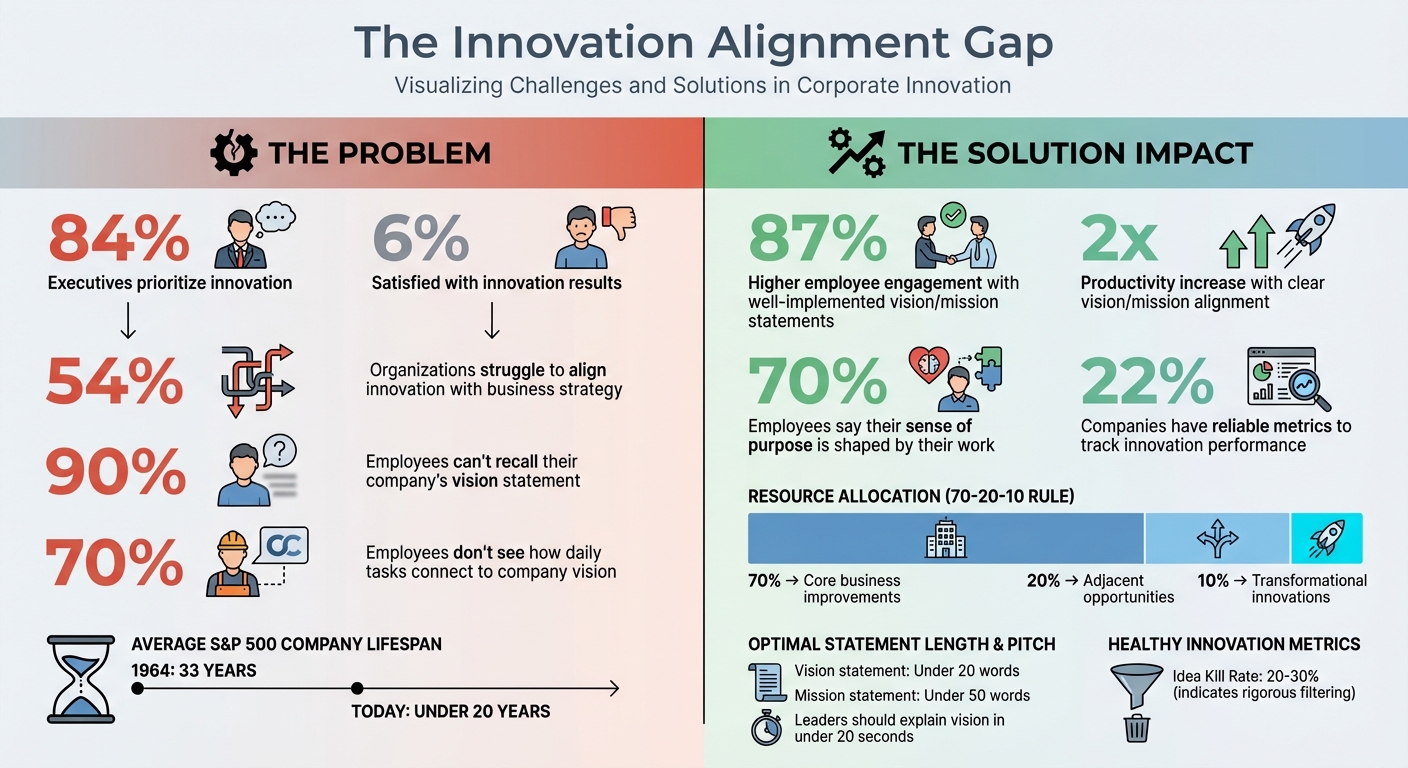
Innovation Alignment Statistics: The Gap Between Priority and Results
Step 1: Define Your Vision and Mission Clearly
To avoid the common trap of disconnected innovation, start by crafting a clear vision and mission. Studies reveal a striking issue: 90% of employees can't recall their company's vision statement, and 70% don't see how their daily tasks connect to it [9]. This disconnect highlights a need for clarity. If leaders can't explain the vision in under 20 seconds, it's too complicated to guide meaningful innovation [9].
Your vision defines the long-term destination, while your mission outlines the actions needed to get there. Take Tesla as an example. Through collaborative workshops involving cross-functional teams, the company developed a vision that resonates across the organization: "To create the most compelling car company of the 21st century by driving the world's transition to electric vehicles." This clarity has informed every decision Tesla makes, from battery innovation to manufacturing [2][7].
What Makes Vision and Mission Statements Effective
The best vision and mission statements are specific, memorable, and actionable. Avoid vague phrases like "to be the best." Instead, use clear, concrete language that reflects your organization's purpose. For instance, Google's mission - "To organize the world's information and make it universally accessible and useful" - is a straightforward yet impactful description of what the company does and why it matters [2][5].
To ensure your statements are practical tools for guiding work, keep your vision statement under 20 words and your mission statement under 50 words [2][8]. A helpful formula includes:
- Vision: Define the End State, Impact, and Scope.
- Mission: Focus on Action, Value, and Audience.
Nike’s vision, "To bring inspiration and innovation to every athlete in the world," is a great example of how simplicity can drive clarity [2][5][6]. Organizations with well-implemented vision and mission statements report 87% higher employee engagement and double the productivity [2]. Furthermore, 70% of employees say their sense of purpose is shaped by their work [8].
How to Involve Leadership Teams in the Process
Creating vision and mission statements isn’t just about a quick brainstorming session. It requires a thoughtful, multi-step approach:
- Gather input from stakeholders, including executives, team leads, and even customers.
- Use strategic tools like SWOT analysis or market positioning to align the statements with your broader goals.
- Refine the language through collaboration and testing drafts with diverse stakeholder groups [9].
Avoid drafting these statements in isolation [3][4][6]. Instead, organize cross-functional workshops where department leaders define the "North Star" that will guide innovation. Test draft statements with representative groups to ensure they resonate before finalizing [9][10].
Leadership involvement is critical. As Collins and Porras emphasize:
"Truly great visions are instilled through personal example rather than passed down through manuals and guidelines" [4].
Leaders must actively integrate the vision and mission into everyday decisions - whether it's allocating resources, setting budgets, or conducting performance reviews. Explicitly tying hiring and spending priorities to these guiding principles ensures alignment across the organization. When leaders "walk the talk", the rest of the team follows. With clear, collaboratively developed statements in place, you’re ready to evaluate how your current innovation efforts align with these core principles.
Step 2: Review Current Innovation Projects for Alignment
With your vision and mission clearly established, the next step is to ensure that your ongoing innovation efforts align with these principles. Here's the challenge: 54% of organizations struggle to align their innovation and business strategies [1]. This misalignment often results in scattered projects that consume resources without driving meaningful progress toward strategic goals.
During this process, you might encounter "zombie projects" - initiatives that continue to drain budgets despite having little chance of success [13]. Without a structured review, these misaligned projects can linger indefinitely, wasting both time and money.
How to Audit Your Innovation Efforts
Start by creating a centralized inventory of all active innovation projects [11]. This step eliminates silos and provides a clear view of how resources are being allocated.
Next, evaluate each project using a strategic framework like the Innovation Ambition Matrix. This tool divides projects into three categories:
- Core: Enhancing existing products or services.
- Adjacent: Expanding into new markets or product areas.
- Transformational: Developing entirely new markets or groundbreaking innovations [11][12].
Many successful organizations follow the 70-20-10 rule: 70% of resources go to core projects, 20% to adjacent opportunities, and 10% to transformational efforts [12]. To identify gaps, plot your projects on this matrix. If the transformational quadrant is empty while leadership expects significant breakthroughs, you've pinpointed a major issue.
Strategic advisor Cris Beswick emphasizes this point:
"An innovation strategy that isn't explicitly designed to advance specific business goals is not a strategy - it's an aspiration." [1]
To ensure objectivity, score projects based on their strategic fit, potential risk/reward, and technical feasibility [11][12]. For high-risk projects, consider using "metered funding." This approach, borrowed from venture capital, releases funds incrementally as teams validate key assumptions [13]. It’s a practical way to avoid overcommitting to ideas that haven’t been fully tested.
Another critical step is the "zombie scan." This involves identifying projects that have consistently missed milestones or failed to deliver results [13]. Often, these projects persist due to the sunk cost fallacy rather than genuine potential. Set clear "kill criteria" - such as performance benchmarks or economic thresholds - so decisions to stop projects are driven by data, not office politics [13].
Finding Gaps and Opportunities
Your audit will likely reveal two key issues: projects that don’t align with your mission and areas critical to your mission where no innovation is happening. Addressing the first issue means making tough calls to terminate certain projects. The second highlights where you need to focus new investments.
Be on the lookout for the "ambition gap." This occurs when leadership expects transformational growth but continues to prioritize budgets and metrics that favor safe, incremental improvements [13]. Ask yourself: If your current portfolio succeeds as planned, would it truly reshape your company’s future? If the answer is no, your ambition level needs adjustment [13].
To maintain balance, use "strategic buckets" to allocate funding across different time horizons:
- Horizon 1: Core business needs.
- Horizon 2: Emerging opportunities.
- Horizon 3: Transformational ventures [11][13].
This approach ensures that short-term pressures don’t overshadow the long-term innovation required to achieve your vision.
Finally, establish a quarterly review process with a cross-functional innovation board [11][15]. This team should make data-driven decisions to "kill, pivot, or persevere" based on the latest insights. Recognize and reward teams that shut down underperforming projects early and return unused budgets. This helps to remove the stigma around failure and fosters a culture of honesty and learning [13].
Step 3: Build Innovation into Your Plans
Once you've evaluated your current innovation efforts, the next step is to weave these initiatives into your central business strategy. Instead of treating innovation as an optional add-on, it should be a core part of how your organization operates. Businesses often struggle here because they isolate innovation from their primary goals, which creates a disconnect between ideas and execution.
Connect Innovation Goals to Business Results
To make innovation meaningful, tie it directly to measurable business outcomes. The Objectives and Key Results (OKR) framework is a great tool for this. It allows you to break down big-picture goals into specific, trackable innovation targets. For example, if your goal is to enter new markets, your OKR might focus on launching new products in underserved areas with clearly defined revenue objectives.
You can also use the Three Horizons Model to manage your innovation portfolio. This framework divides efforts into three categories: Horizon 1 focuses on improving existing products, Horizon 2 explores adjacent markets, and Horizon 3 takes on transformative projects. A common approach is the 70-20-10 rule: allocate 70% of resources to core business improvements, 20% to adjacent opportunities, and 10% to bold, transformational ideas.
Take Siemens AG as an example. In 2017, they began tracking and publicly reporting revenue from digital platforms and solutions, generating around $4 billion that year. By linking innovation directly to financial results, they created accountability and showcased the value of their efforts.
To ensure long-term success, consider using strategic buckets and metered funding. For early-stage projects, release funding in phases as teams validate their ideas and hit key milestones. This approach minimizes the risk of overcommitting to unproven concepts while keeping promising projects alive.
Measuring progress is equally important. Track input metrics like R&D spending as a percentage of revenue and resource allocation across the three horizons. Process metrics such as time-to-market and project kill rates can help refine your approach, while output metrics like revenue from new products and Return on Innovation Investment (ROII) show the tangible impact. Companies using structured innovation management platforms often report faster decision-making and higher implementation rates [11].
Build Collaboration Across Departments
"Innovation isn't a capability problem - it's a strategic clarity problem!" - Cris Beswick, Strategic Advisor [1]
When departments operate in silos, innovation efforts can become fragmented, making it harder to align with broader organizational goals.
To address this, form a cross-functional innovation committee with representatives from areas like R&D, marketing, finance, operations, and legal. This team acts as a portfolio manager, ensuring diverse perspectives are considered in innovation decisions. Regular meetings, such as monthly reviews, help the team decide whether to continue, pivot, or halt projects based on strategic data.
Avoid relying solely on isolated innovation labs. As Leslie Grandy, a Lead Executive in Residence at the University of Washington, points out:
"Innovation strategy that is run through an innovation lab is not really an innovation strategy." - Leslie Grandy [18]
Instead, involve key departments - like legal and operations - early in the process to align everyone involved in bringing products to market. Hold quarterly workshops where leaders from different teams come together to create frameworks for tackling business challenges. Online collaboration tools can also speed up innovation by leveraging existing expertise and reducing duplication of effort.
This combination of top-down priorities and bottom-up idea generation ensures that creative energy is directed toward meaningful goals.
Make Leadership Responsible for Innovation
Once collaboration is in place, it's time to embed innovation responsibilities at the leadership level. The CEO and executive team should actively champion innovation, with accountability cascading across the C-suite. For example, the CFO could oversee resource allocation, the COO might manage process innovation, and the Chief Customer Officer could focus on improving customer experience.
To reinforce this commitment, include innovation-related KPIs in executive scorecards and performance reviews. This ensures leaders stay focused on innovation, even when other business pressures arise.
Consider the example of Microsoft under CEO Satya Nadella. In 2014, Nadella shifted the company's focus to a "learn-it-all" mindset, emphasizing cloud innovation and AI. This leadership-driven change helped Microsoft achieve a $3 trillion market cap by 2024. Similarly, BMW Group launched BMW i Ventures in 2011, a corporate venture capital fund that has since raised over $900 million to invest in startups across mobility, sustainability, and manufacturing [11].
To maintain momentum, establish a structured governance process. Conduct monthly portfolio reviews to evaluate projects, make quarterly adjustments to resource allocation, and refresh your innovation strategy annually to align with evolving business goals. This disciplined approach keeps innovation tied to your organization's purpose and avoids the trap of "innovation theater."
Finally, protect long-term innovation efforts, especially those in Horizon 3, by guaranteeing funding. Without this protection, the core business - focused on efficiency - may resist the uncertainty that comes with transformative ideas. By safeguarding these projects, you ensure that bold innovations have the space to thrive, even under short-term business pressures [17].
Step 4: Create Systems to Maintain Alignment
Bringing innovation into your organization is just the beginning; the real challenge lies in keeping it aligned with your goals. While 84% of executives see innovation as essential for growth [20], only 22% of companies have reliable metrics to track its performance [23]. This disconnect often explains why many organizations struggle to turn innovative ideas into tangible results.
The key isn't working harder but working smarter. By setting up structured systems - like feedback loops and clear metrics - you can ensure that innovation efforts stay on track and contribute meaningfully to your mission.
Use Feedback Loops to Adjust and Improve
Once you've woven innovation into your strategic plans, feedback loops become essential for staying aligned. These mechanisms allow you to spot problems early and make necessary adjustments. For example, a multi-layered review process can help maintain momentum and focus:
- Monthly reviews: Decide whether to stop or scale specific projects.
- Quarterly reviews: Adjust resource allocation based on new findings.
- Annual strategy refresh: Ensure your innovation roadmap reflects market changes and aligns with your broader goals [15].
It’s also crucial to define criteria for when to kill, pivot, or scale a project. For instance, if a project’s validation rate drops below 20% after three sprints, it might be time to terminate it. This kind of data-driven decision-making removes emotional bias and keeps teams focused on learning rather than defending underperforming ideas [16].
Another tool to consider is innovation accounting, which helps track progress in early-stage projects. Traditional financial metrics often fail in uncertain environments, so instead, focus on "validated learning" - measuring how many key business assumptions your teams have tested and confirmed. This approach provides a clearer picture of whether a project is moving in the right direction [16][21].
With these systems in place, your innovation efforts remain closely tied to your strategic vision.
Track Metrics That Show Alignment
Feedback loops are just one piece of the puzzle; you’ll also need metrics to measure progress and alignment. The metrics you choose reflect what your organization values most. For example:
- Strategic Alignment Score: Tracks the percentage of new ideas and projects that align with your defined strategy. A low score may signal wasted efforts on irrelevant initiatives [21].
- Strategic Investment Alignment: Measures whether your innovation budget supports your mission by calculating the percentage of funds allocated to projects tied to core goals [22].
For a well-rounded view of your innovation health, consider tracking these five categories of metrics:
- Input metrics: For example, R&D spending as a percentage of revenue shows your level of commitment.
- Process metrics: Metrics like time-to-market and idea conversion rates highlight pipeline efficiency.
- Output metrics: Include tangible results, such as the number of new products launched or patents filed.
- Outcome metrics: Tools like the New Product Vitality Index (NPVI) reveal what percentage of your revenue comes from products introduced in the last three to five years.
- Cultural metrics: Employee participation rates and psychological safety indexes indicate whether your team feels empowered to innovate [19][21][22].
Another valuable metric is the Rate of Learning, which tracks how many critical business assumptions your teams validate per sprint. This is a better approach for high-uncertainty projects than traditional metrics like "percent complete." Additionally, a healthy Idea Kill Rate - typically between 20% and 30% - ensures rigorous filtering at stage gates. A rate near zero might indicate that teams aren’t being critical enough in evaluating ideas [21].
Conclusion: Building an Organization Ready for the Future
Making a lasting impact happens when every effort to innovate aligns with your organization's vision and mission. This discipline is what sets thriving companies apart from those that fade into irrelevance. Consider this: the average lifespan of S&P 500 companies has dropped from 33 years in 1964 to under 20 years today - often because these organizations failed to innovate with purpose [14].
Key Principles to Remember
Start with a clear foundation. Your vision defines where you’re headed, and your mission outlines how you’ll get there. Without these guiding principles, innovation risks becoming unfocused and ineffective. To keep efforts on track, build accountability into your leadership structure. As Cris Beswick, a strategic advisor, wisely notes:
"An innovation strategy that isn't explicitly designed to advance specific business goals is not a strategy - it's an aspiration" [1].
Establish a formal approach to innovation governance. This could mean scheduling regular check-ins, such as monthly portfolio reviews to evaluate projects, quarterly resource adjustments, and an annual refresh of your strategy [15]. Use meaningful metrics to track progress, celebrate lessons learned from setbacks, and always connect daily efforts to the broader purpose.
What Leaders Should Do Next
Once these principles are in place, focus on actionable next steps.
Start by auditing your current portfolio to ensure your resources align with your strategic goals [15]. From there, create a consistent review process - don’t wait for the "perfect" time to begin. Strategic realignment, when driven by clear intent, can significantly enhance both your performance and market position [14].
Incorporate innovation-focused KPIs into executive scorecards and middle-management evaluations [14][4]. Keep your mission and vision front and center by tying them to major decisions, ensuring they remain active in daily operations rather than becoming forgotten documents [4].
Above all, foster a culture of psychological safety. Share stories of experiments that didn’t succeed to highlight the value of learning and reduce the fear of failure [14]. Innovation thrives when teams feel free to test ideas, adapt quickly, and learn without fear of blame. As a leader, it’s your responsibility to champion this mindset and make it part of your organization’s DNA.
For more advice on aligning innovation with your purpose, check out insights from Seth Mattison at https://sethmattison.com.
FAQs
How do I know if our innovation projects truly fit our vision?
To make sure your innovation projects serve a meaningful purpose, connect them directly to your organization's long-term goals and mission. Think of your vision as the ultimate destination and your mission as the roadmap guiding you there.
Take time to regularly evaluate whether your projects actively support your strategic objectives and contribute to the bigger picture. This way, your innovation efforts remain focused and tied to your overarching goals, ensuring they drive progress in the right direction.
What should we do with 'zombie projects' that won’t die?
To tackle "zombie projects", the key is spotting them early and assessing whether they still align with your organization's goals. Regular check-ins on progress are essential - ask tough questions and dig into potential problems like outdated technology or changes in the market. If a project no longer supports your strategic objectives, it’s important to make the tough call to stop funding it. This way, you can redirect resources toward initiatives that truly push innovation forward and align with your mission.
Which innovation metrics matter most in the first 90 days?
Key metrics to watch during the first 90 days include speed to impact, which measures how quickly ideas translate into tangible results. Early indicators like the number of ideas generated, projects initiated, or prototypes created also play a big role. It's important to balance these short-term milestones with broader indicators like customer satisfaction or market influence. This approach keeps efforts aligned with strategic goals, justifies investments, and allows for quick adjustments when necessary.