
Articles Feb 12, 2026 9:00:00 AM Seth Mattison 25 min read

Why do most tech changes fail? Simple: companies focus on tools, not human-centric leadership. Research shows 67% of digital transformations fail because leaders treat them as technical upgrades, ignoring employee mindsets and workplace dynamics. However, organizations that prioritize people over tech see 12x ROI and are 10x more likely to hit revenue growth targets of 20% or more.
Here’s the key takeaway: Instead of asking, “How do we get employees to use this technology?” successful companies ask, “How can this technology help our employees?” This people-first approach makes change stick.
What Works:
- Empathy: Understand employee needs and concerns.
- Co-Creation: Involve employees in designing solutions.
- Feedback-Driven Testing: Refine tools based on real-world input.
Common Pitfalls:
- Low adoption due to lack of training or preparation.
- Resistance from employees feeling overwhelmed or excluded.
- Ignoring trust issues, especially with new AI tools.
By focusing on employees’ psychological needs - like autonomy, growth, and clarity - companies can reduce resistance, boost engagement, and ensure long-term success. It’s not just about upgrading systems; it’s about upgrading how people work together.
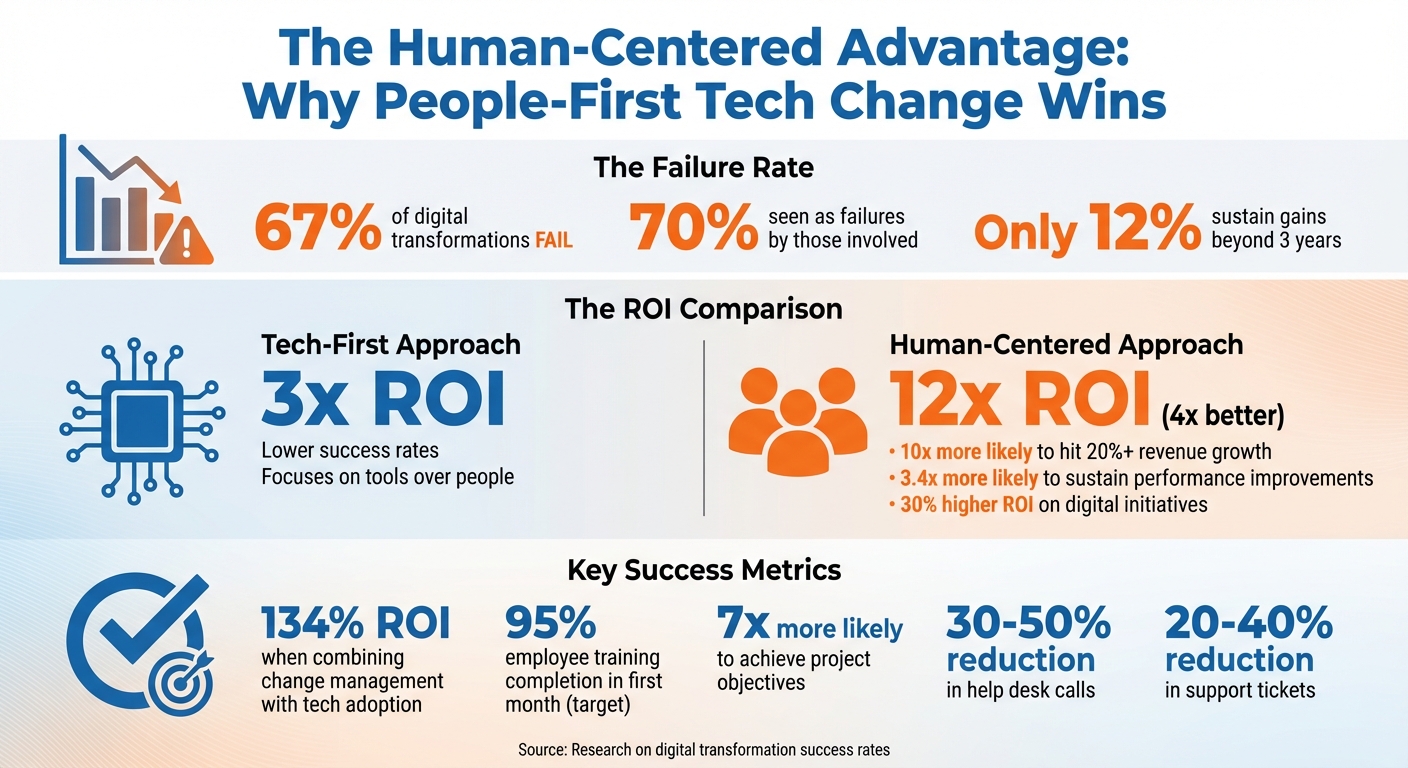
Human-Centered vs Tech-First Digital Transformation: ROI and Success Rates
Why Technology Change Initiatives Fail
When Technology Comes Before People
Companies across various industries often pour significant resources into implementing state-of-the-art software, expecting it to transform their operations. Yet, many of these initiatives face a common hurdle: low adoption rates. The problem isn’t the technology itself - it’s the disconnect between upgrading the Digital OS (tools and platforms) and leaving the Human OS (beliefs, behaviors, and workplace dynamics) untouched. Essentially, organizations are asking people to operate new tools with outdated mindsets and habits[2].
Here’s the crux of the issue: employees are handed new systems without proper preparation, training, or the cultural framework needed to make those systems work. Leaders often approach these rollouts as purely technical projects, neglecting the human side of the equation. Even if the tool is objectively better in every way, it’s doomed to fail if the people using it aren’t ready or convinced of its value. And when that happens, the investment - no matter how cutting-edge - ends up wasted[10].
This disconnect between technological advancements and human readiness is at the heart of why so many change initiatives falter. To understand this better, it’s important to look at how employees respond to change on a psychological level.
How Employees React to Change
When organizations introduce new technology without addressing the human element, employees often react with resistance. This isn’t just stubbornness - it’s a psychological defense mechanism. Researchers describe this as threat rigidity: under stress or uncertainty, people instinctively hold on to familiar habits, even when the situation clearly calls for something new[8]. It’s a way of protecting their sense of competence and control, but it also creates a significant barrier to adopting new tools effectively.
Three key psychological needs fuel this resistance:
- Autonomy: Employees push back when they feel changes are being forced on them without their input or involvement[1].
- Growth: Veteran employees may worry that new systems will make them feel like novices again, putting their professional identity at risk[3].
- Meaning: Without a clear understanding of why the change is happening, it’s hard for employees to see the value in disrupting their established routines[1].
When these needs go unmet, emotions take over - and not in a good way. Negative emotions are a natural part of any transformation, but the degree matters. During successful initiatives, negative emotions might increase by 25%. However, in struggling projects, they spike by more than 130%[8]. This emotional overload creates a vicious cycle: employees feel pressured to adopt new tools, the stress leads to resistance, and the resistance ultimately derails the project. Considering that 45% of employees already feel stressed or burned out at least once a week[8], it’s no surprise that many lack the emotional capacity to embrace additional challenges, like learning new systems.
Trust also plays a critical role. Between May and July 2025, trust in company-provided generative AI tools dropped by 31%, while trust in independent, decision-making AI systems plummeted by a staggering 89%[7]. Employees who have seen previous initiatives fail - or simply fizzle out - are understandably hesitant to invest effort in what they perceive as just another fleeting project[1][3].
Mark Marone, PhD, from Harvard Business Publishing, sums it up well:
"When people feel uncomfortable or threatened by change, they often experience threat rigidity, which is a tendency to resort to familiar behaviors even in situations that demand others"[8].
To break this cycle, organizations need to rethink their approach. Instead of prioritizing technology, they must focus on people - engaging employees in the process from the very start and addressing their concerns head-on. That shift from a technology-first mindset to a human-centered approach can make all the difference.
sbb-itb-9ceb23a
Core Principles of Human-Centered Technology Change
To avoid the pitfalls of failed technology rollouts, organizations need to move away from a tech-first mindset and focus on people. This approach ensures that tools are designed to support employees effectively. Three principles form the backbone of this strategy: empathy, co-creation, and testing based on real feedback. Companies embracing these principles are 10 times more likely to achieve revenue growth of 20% or more[4]. These principles tackle both emotional and practical barriers to adopting new technology.
Empathy: Understanding Change from the Employee's Perspective
Empathy is about seeing the workplace through employees' eyes. A helpful method is an empathy map, which captures employees' expressions, behaviors, thoughts, and emotions[11]. This can reveal that resistance to change often stems from protecting core psychological needs: autonomy (control over decisions), growth (opportunities to develop), and meaning (understanding the purpose of the change)[1].
Take Frito-Lay, for example. They teamed up with IBM Garage to create mobile-responsive tools for frontline workers. This effort involved 1,500 hours of user research, including ride-alongs with employees, ensuring the tools addressed real needs instead of assumptions[11]. Similarly, a European bank used sociometric data from employee badges to uncover how office layouts were stifling communication and trust. By redesigning the workspace and tying bonuses to team efforts, they boosted overall performance by 10%[1].
Empathy also means addressing employees' emotions during different stages of change. Early on, during the "Denial" phase, clear and open communication about the need for change is critical. As frustration sets in, quick wins can show immediate value. Finally, during the "Acceptance" stage, tailored training and peer support become vital[9]. As psychologist Ron Friedman explains:
"When people are empowered to make their own decisions at work, they naturally feel motivated to excel for one simple reason: Autonomy is a basic psychological need"[1].
Co-Creation: Designing Solutions Together
Co-creation shifts the traditional dynamic. Instead of HR and IT designing systems in isolation, employees become active participants in the design process. This partnership fosters trust and reduces resistance.
For instance, IBM revamped its performance management system, Checkpoint, by involving roughly 100,000 employees in a hackathon-style process. This collaborative effort resulted in a system that resonated with employees and improved performance development[13]. Similarly, Smith+Nephew, a medical device company, used surveys and focus groups between 2021 and 2022 to overhaul its travel and expense reimbursement system. The streamlined process saved employees 20,000 hours of productivity[13].
The most impactful co-creation happens when job security concerns are addressed. At Kaiser Permanente, management and unions representing 50,000 workers co-designed a new patient registration system between 2018 and 2019. By involving unions early and offering a one-year redeployment program for displaced workers, they eased fears of job loss. Hal Ruddick, Deputy Executive Director of the Alliance of Health Care Unions, highlighted the importance of this approach:
"When you take the fear of being unemployed off the table, that really helps unleash the engagement of employees in technology issues"[12].
Testing and Refining Based on Feedback
Testing tools in real-world settings ensures they meet employees' needs for autonomy, growth, and clarity. Instead of launching a finished product, organizations develop a Minimum Viable Product (MVP) and refine it based on feedback.
For example, in June 2023, SAP and Schaeffler ran a boot camp to test prototypes over brief sessions. This process improved productivity and reduced multitasking costs. Andreas Spahn, Principal Business Innovation Architect at SAP, emphasized:
"The real value of the boot camp is the pure focus that's achieved within that short timeframe... This allows us to boost productivity and avoid the switching costs of multitasking"[14].
The resulting tools enhanced decision-making with real-time insights and minimized cognitive strain for change managers.
Expedia takes this iterative approach further, conducting 1,750 A/B tests annually to understand how changes impact users. This data-driven strategy ensures updates are guided by actual user behavior. To keep feedback flowing, organizations can also use gamified tools like QR code surveys in common areas. These quick surveys capture employee sentiment in real time without causing survey fatigue[6]. The goal is to treat feedback as an ongoing dialogue, not a one-off event.
Adding Human-Centered Approaches to Existing Frameworks
Organizations don’t need to throw out their existing frameworks to adopt human-centered principles. Instead, these principles can complement established methods like Agile or ADKAR, making transitions smoother and more engaging for employees.
Improving Agile with Human-Centered Methods
Agile teams often treat human-centered design (HCD) as a checklist rather than embracing its mindset. This can lead to development sprints moving forward while user research lags behind, resulting in features based on assumptions instead of validated employee needs[15].
To address this, tools like a Research Roadmap or Research Runway can help teams plan user research tasks one to two sprints ahead of development. This prevents mid-sprint disruptions for designers and ensures that coding starts with clear user insights. Some organizations now rely on a Shared Services HCD Team to support multiple Agile squads, creating a more cohesive approach to user research[15].
Simple steps like HCD orientations and informal sessions can also help establish a shared vocabulary and break down barriers between teams. As the Agile Alliance puts it:
"HCD isn't just a set of activities and artifacts, but like Agile, it is a mindset"[15].
The combination of HCD and Agile has shown impressive results. For example, organizations using Enterprise Design Thinking - a structured approach to blending HCD with Agile - have reported a 300% return on investment, a 75% boost in team efficiency, and products reaching the market twice as fast[16].
These enhancements to Agile also set the stage for adapting other frameworks, such as ADKAR, to be more people-focused.
Making ADKAR More People-Focused
The ADKAR model (Awareness, Desire, Knowledge, Ability, Reinforcement) provides a step-by-step approach to guiding individuals through change. However, on its own, it can sometimes feel rigid or mechanical. By incorporating elements of positive psychology and behavioral design, organizations can make ADKAR more engaging and effective[17][18].
Here’s how organizations are rethinking ADKAR:
- Use it as a diagnostic tool to identify which phase - Awareness, Desire, Knowledge, Ability, or Reinforcement - needs attention.
- For Awareness, leverage early adopters to share authentic stories.
- For Desire, involve employees in co-creation efforts.
- Replace traditional, lengthy training with personalized microlearning for the Knowledge phase.
- Set up dedicated "war rooms" to support employees in building Ability.
- Focus Reinforcement efforts on celebrating individual achievements[17][6][20].
These adjustments ensure that the framework prioritizes employee engagement and aligns with the broader goal of making technology work for employees, not the other way around.
For instance, NorthStar Insurance tackled low Awareness and Desire by showcasing customer stories and hosting regional roadshows. They followed this with a war room to address technical issues and on-the-job shadowing opportunities. The results? Digital quote-to-bind rates jumped from 41% to 79%, and cycle times dropped by 27% within just six months[20].
Similarly, the Colorado Department of Transportation (CDOT) began using ADKAR in 2010 to implement lean process management. By creating a Change Agent Network and coaching leaders to guide teams through incremental change, CDOT achieved a 55% reduction in error rates for its oversize permit division and cut contract review times from five days to three[19].
Tools and Methods for Implementation
After adjusting your frameworks to focus on people, the next step is to bring in the right tools and strategies. These practical steps are designed to guide employees through technology changes with clarity and support.
Customizing Communication for Different Groups
Not everyone reacts to change the same way. To address this, tailor your messaging to the five Diffusion of Innovation groups: Innovators (2.5%), Early Adopters, Early Majority, Late Majority, and Laggards [9]. Innovators and Early Adopters are typically eager to try new technology, while the Early and Late Majority need evidence of benefits and clear instructions. Laggards may require extra patience and assurance that their current systems won’t be abruptly replaced [9].
Salesforce uses a structured management process called V2MOM (Vision, Values, Methods, Obstacles, and Measures) to ensure alignment across the organization. CEO Marc Benioff highlights its importance:
"Success depends on constant communication and complete alignment. We've been able to achieve both with the help of a management process I developed a number of years ago called the V2MOM" [21].
Start by communicating early, using straightforward language without jargon, and emphasizing benefits across multiple platforms [9][21][22]. Begin with senior managers, preparing them to address employee concerns before rolling out communications to a broader audience [22].
Once communication is tailored for each group, the focus shifts to equipping employees with targeted training.
Training and Mentoring Programs
Standard vendor training often falls short of addressing real-world challenges. Conduct a training needs assessment to identify user roles and align training with specific workflows [23].
A blended learning approach is most effective. For example:
- Frontline staff benefit from hands-on simulations.
- Managers gain insights through scenario-based workshops.
- Executives appreciate concise walkthroughs [23].
Digital Adoption Platforms (DAPs) also play a key role, offering on-screen, step-by-step guidance within the application itself, allowing employees to learn as they work [24].
It’s worth noting that employees retain only 20% of training content if they don’t apply it immediately [9]. To combat this, organizations are turning to microlearning tools like quick refreshers, drop-in "office hours", and embedded help widgets to reinforce skills and prevent regression to old habits [23][24].
"Digital adoption platforms put the user first, giving people the tools they need to effectively perform their jobs" [24].
These efforts can deliver impressive results. Companies that combine effective change management with technology adoption have seen a 134% ROI [6].
To further support learning, peer groups can provide an informal yet powerful way to share knowledge.
Building Peer Learning Groups
Peer-to-peer learning is a proven way to encourage technology adoption. Start by identifying super users who can act as early champions. Form small groups of about four people who meet weekly to share tips, coach one another, and document successes [26].
Keith Ferrazzi, Chairman of Ferrazzi Greenlight, emphasizes this approach:
"People adopt what their respected peers are using, not what management dictates; it's how grassroots movements begin" [26].
To expand this method, rotate group members regularly and encourage them to share insights with other teams. This allows best practices to spread naturally [26]. A simple practice like beginning meetings with an “energy check-in” - where members rate their energy on a scale from 0 to 5 - can foster transparency and build team resilience, something only 14% of teams achieve [26].
Additionally, create accessible knowledge bases for documenting peer group successes. Using a "You Said, We Did" approach, where leadership visibly acts on feedback, can further build trust and encourage participation [25]. These peer groups not only help employees adapt to new technology but also promote a culture of collaboration and continuous improvement.
Measuring Success of Human-Centered Change
Once you've implemented a human-centered approach, the next step is to assess its impact. Success isn't just about installing new technology - it's about whether people are actually using it and if that usage is delivering measurable business value. As Emily Rich explains:
"Success is not the go live. Success is the sustained human adoption and usage that realises benefits" [27].
Tracking Engagement and Adoption
To measure success, it's essential to track four key areas: Engagement (awareness and sentiment), Learning (comprehension and readiness), Behavior (observable adoption), and Business Outcomes (impact) [29]. Engagement and learning act as early indicators, helping predict future behavior, while business outcomes confirm the results after the fact [29][31].
Start by setting baseline KPIs such as error rates, cycle times, and productivity metrics to measure improvement [31]. Post-launch, monitor metrics like support ticket volume and resolution time to identify and address any friction points [28][29].
Organizations that closely monitor these adoption metrics report up to 30% higher ROI on digital initiatives [30]. For instance, successful transformations often aim for 95% of employees to complete digital skills training within the first month [31]. Beyond numbers, qualitative insights - like quotes from focus groups or community discussions - can provide valuable context. Partnering with Finance, IT, and HR early ensures access to critical data like system logs, productivity reports, and employee sentiment tools, offering a comprehensive view of progress [27][29][31].
Once engagement metrics confirm the success of the change process, you can move on to calculating ROI to quantify the financial benefits.
Calculating Return on Investment
ROI can be calculated using the formula:
(Benefits from change management – Change management cost) / Change management cost [32].
Typically, ROI ranges from 3:1 to 7:1, meaning every dollar invested in change management can return $3–$7 [32]. For example, in June 2025, a manufacturing company saved over $1.2 million in implementation costs by investing in change management, which minimized rework and sped up employee adoption [32]. Similarly, a healthcare organization implementing an electronic medical records (EMR) system achieved $3.2 million in annual savings. High adoption rates led to a 32% reduction in duplicate tests and a 28% decrease in administrative workload [32].
To estimate ROI, ask stakeholders to determine what percentage of a project's benefits depend on employees adopting the new technology - this is often 80% to 100% [32]. Then, apply different adoption scenarios:
- Conservative: 10–15% productivity gain
- Realistic: 20–25% gain
- Aggressive: 30–40% gain [33].
Effective change management can significantly reduce productivity dips during transitions. Without structured support, productivity losses can range from 45–65%, but with proper management, this can be limited to just 15% [32]. Additionally, organizations with strong human-centered practices often see a 30–50% drop in help desk calls and a 20–40% decrease in support tickets [32]. Overall, projects backed by effective change management are 7 times more likely to achieve their objectives [32].
Conclusion
Driving meaningful change in technology depends on transforming the people who use it. Digital tools only reach their full potential when guided by human leadership. Research shows that transformations led by people yield a 12x return on investment (ROI), compared to just 3x for tech-only initiatives. Organizations that prioritize people are also 3.4 times more likely to sustain performance improvements [2][34].
The real hurdle is maintaining these gains. While many organizations meet their short-term transformation goals, only 12% manage to sustain them beyond three years without focusing on the human element [34]. This data highlights the importance of creating enduring change instead of chasing quick wins. As discussed earlier, technology should complement and empower the human side of operations. Businesses operate on two systems: the Digital OS (platforms, tools, and AI) and the Human OS (employees' mindsets and behaviors). Neglecting the Human OS often leads even the most advanced tech projects to fall short [2].
To succeed, organizations need to upgrade the Human OS first. This involves helping employees let go of outdated mindsets and embrace new approaches [2]. It also requires identifying internal champions who can connect with their peers and model the desired behaviors [34]. Regular post-implementation check-ins are crucial to address issues early and prevent burnout from change fatigue [5]. Additionally, involving employees in the design and implementation process not only speeds up adoption but also fosters stronger engagement [4][6].
The stakes couldn’t be higher. Around 70% of digital transformations are seen as failures by those involved [5]. However, companies that take a human-centered approach are 10 times more likely to achieve revenue growth of 20% or more [4]. Ultimately, the difference between success and failure doesn’t lie in the complexity of the technology - it’s in the investment made in the people who bring it to life.
FAQs
What is the “Human OS” vs. the “Digital OS”?
The term “Human OS” represents the mix of skills, behaviors, and emotional awareness people need to successfully collaborate with AI and other technologies. It emphasizes qualities like leadership and the ability to adjust to change. On the other hand, the “Digital OS” refers to the technological systems, platforms, and AI frameworks that support digital transformation in organizations. Together, these concepts underscore the importance of balancing human expertise with digital tools to navigate and manage change effectively.
How can we reduce employee resistance to new tech?
Reducing resistance to new technology in the workplace starts with open communication, empathy, and building trust. Employees need to understand how the new tools align with both the company’s goals and their own day-to-day tasks. Clearly explain the benefits - whether it’s saving time, simplifying processes, or improving results - so they can see what’s in it for them.
It’s also important to address the emotional side of change. Fear of the unknown or concern about job security can create pushback. Involve employees early in the process, listen to their feedback, and make them feel part of the decision-making journey. Offering hands-on training and real-life examples of how the technology can make their work easier can go a long way in easing concerns.
At the core of this approach is human-centered leadership. Leaders who demonstrate emotional intelligence and foster trust can turn skepticism into enthusiasm. When employees feel heard and supported, they’re much more likely to embrace change and engage with the new tools.
What metrics prove tech adoption is actually working?
Key metrics to track when evaluating the success of tech adoption include user engagement, adoption rate, time-to-competency, and support ticket trends. These metrics help gauge how actively the technology is being used, how efficiently users are onboarding, and how well the tool integrates into daily workflows.