
Articles Apr 15, 2026 9:00:03 AM Seth Mattison 13 min read

In a crisis, are you making decisions that secure your organization's future - or just reacting to survive? The article explores how structured judgment can help leaders innovate during uncertainty, bypassing fear-driven instincts like "amygdala hijack." Key takeaways include:
- Structured Decision-Making: Frameworks like the OODA Loop, Cynefin Framework, and Eisenhower Matrix can transform reactive choices into deliberate, forward-focused actions.
- Focus on Transformational Projects: During crises, shifting 15–20% of resources to high-impact initiatives can yield disproportionate innovation value.
- Human-Centric Leadership: Traits like empathy, ethical reasoning, and emotional intelligence are critical for navigating ambiguity and building trust.
- Avoiding Pitfalls: Techniques like setting clear exit criteria and identifying low-risk experiments can help avoid the "sunk-cost trap" and uncover growth opportunities.
The ability to combine structured frameworks with human judgment is becoming the ultimate advantage in today's fast-changing world. Leaders who prioritize clarity, bold decisions, and human strengths will turn crises into opportunities for long-term success.
Decision-Making Frameworks for Crisis Innovation
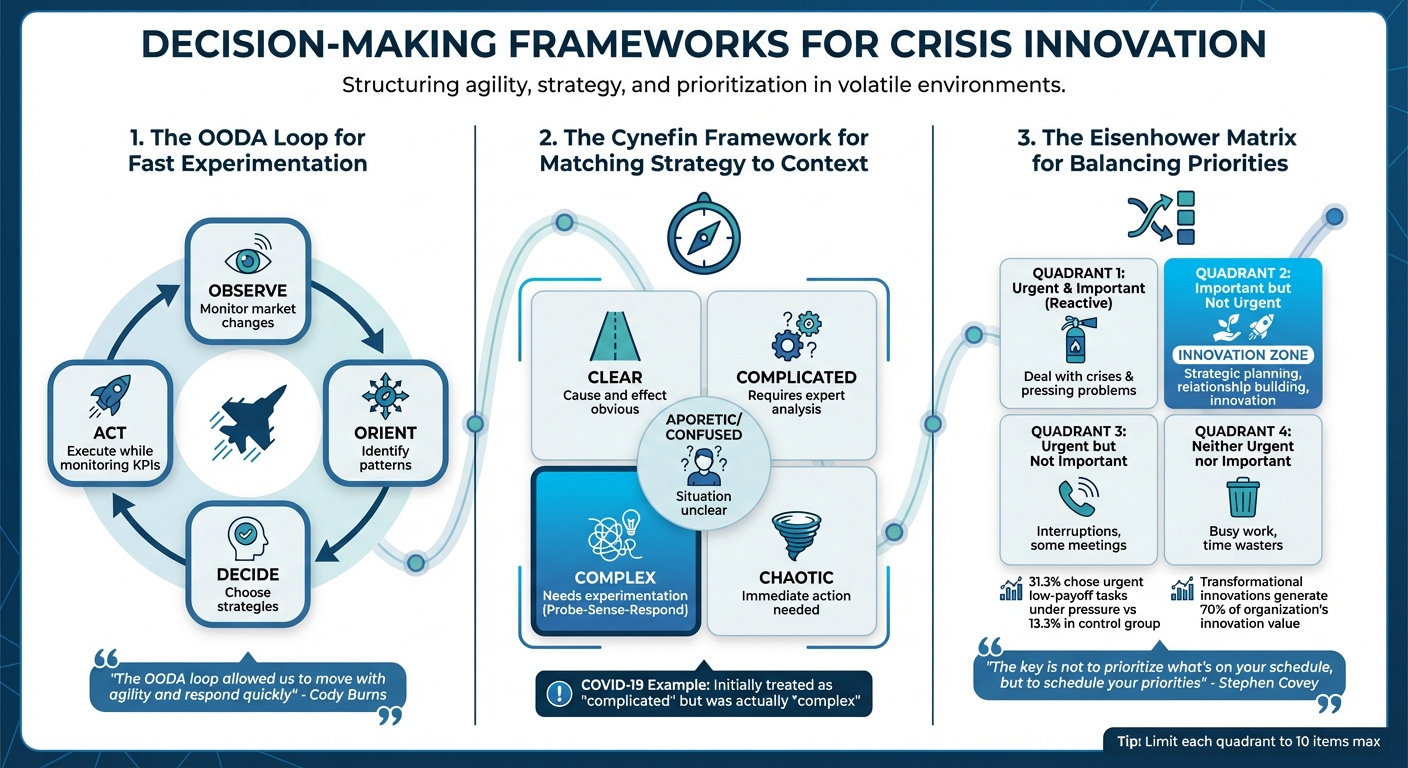
Three Decision-Making Frameworks for Crisis Innovation: OODA Loop, Cynefin, and Eisenhower Matrix
When navigating a crisis, having a structured way to make decisions can mean the difference between chaos and clarity. These frameworks provide practical tools to guide innovation under pressure, helping leaders transition from reactive responses to deliberate, impactful actions. Below are three methods that have proven effective in high-stakes scenarios.
The OODA Loop for Fast Experimentation
Originally designed by US Air Force Colonel John Boyd, the OODA Loop - Observe, Orient, Decide, Act - was created for high-speed aerial combat, where every second counts [9,10]. This iterative process uses feedback from each step to refine actions in real time.
Cody Burns, an Emerging Technology Visionary and former US Marine, highlights its effectiveness:
"The OODA loop allowed us to move with agility and respond quickly to both decentralized threats and opportunities." [6]
Similarly, technology leader Gaurav Jain emphasizes the challenge of decision-making under pressure:
"The hardest part isn't the decision itself, but the time pressure that comes with it. You're trying to make a call while inputs are still flying in." [5]
The OODA Loop thrives on action-driven learning. Start by observing market changes, orienting to identify patterns, deciding on strategies, and acting while closely monitoring key performance metrics. This approach ensures rapid adaptation, even in high-pressure situations. For more nuanced crises, a framework that categorizes the type of challenge can offer further clarity.
The Cynefin Framework for Matching Strategy to Context
Crises come in many forms, and the Cynefin Framework helps leaders understand the nature of a situation before deciding how to respond. It categorizes challenges into five domains: Clear (cause and effect are obvious), Complicated (requiring expert analysis), Complex (emerging patterns need experimentation), Chaotic (immediate action is needed), and Aporetic/Confused (when the situation is unclear) [3,12].
The COVID-19 pandemic is a prime example of why this framework matters. Initially, many governments treated the crisis as a "complicated" problem, relying on static expert models. In reality, it was "complex", requiring adaptive strategies and decentralized decision-making [2]. Steven Quest, Director General at the European Commission's Joint Research Centre, noted:
"The COVID pandemic has demonstrated that we need to find new & better ways of reacting." [7]
In complex scenarios, the Probe-Sense-Respond approach works best. Safe-to-fail experiments reveal opportunities while avoiding sudden shifts from stability to chaos [8]. For crises that demand balancing immediate needs with long-term goals, another framework offers guidance.
The Eisenhower Matrix for Balancing Priorities
In the heat of a crisis, urgent tasks often overshadow important ones. The Eisenhower Matrix helps leaders distinguish between urgent tasks (time-sensitive and reactive) and important tasks (those that drive long-term success and require thoughtful action) [15,17]. True innovation often resides in Quadrant 2 - important but not urgent - but it's easy to overlook this area during stressful times.
Research highlights this challenge. Under pressure, people tend to focus on urgent, low-impact tasks - a phenomenon known as the "mere-urgency effect." In a 2018 study, 31.3% of participants chose an urgent but low-payoff task when facing a deadline, compared to only 13.3% in a control group [9]. This bias can be costly, especially since transformational innovations, while often underfunded, typically generate 70% of an organization's innovation value [4].
To combat this tendency, schedule time for innovation and use tools like color-coding to prioritize effectively. As Stephen Covey wisely said:
"The key is not to prioritize what's on your schedule, but to schedule your priorities." [10]
Keep each quadrant manageable - limit it to 10 items max - and develop systemic solutions for recurring crises in Quadrant 1 (Urgent & Important). By addressing these issues proactively, you can shift them into Quadrant 2 and prevent future emergencies from spiraling out of control.
The C.R.I.S.I.S. Model: Human-Centered Decision-Making
Frameworks can provide a roadmap, but navigating a crisis requires something deeper: human judgment. The C.R.I.S.I.S. Leadership Model offers a research-based approach that equips leaders with vital skills like empathy, resilience, and data-driven decision-making. These traits are essential for guiding teams through uncertainty, especially when psychological pressure and ambiguity threaten sound judgment. Unlike machines, humans bring unique capabilities to the table - capabilities that are critical for avoiding pitfalls like decision paralysis or "groupthink" [11][12].
Creating Trust and Alignment During Disruption
Harvard Business School Professor Amy Edmondson highlights the importance of transparency during a crisis:
Transparency is 'job one' for leaders in a crisis. Be clear about what you know, what you don't know, and what you are doing to learn more [12].
When information is incomplete or constantly shifting, being upfront about uncertainties is key to maintaining credibility. Without honest communication, stakeholders may fill in the blanks with assumptions or rumors, which can erode trust [12].
A powerful example of this principle in action comes from Marriott International CEO Arne Sorenson. In March 2020, as COVID-19 caused a nearly 75% revenue drop across most markets, Sorenson released a candid video message. Despite undergoing chemotherapy for pancreatic cancer, he announced that he and the chairman would forgo their salaries for the year, while the executive team took significant pay cuts. His transparency and personal sacrifice inspired similar actions by other leaders and reinforced trust among Marriott employees worldwide [12].
But trust alone isn't enough - alignment is also crucial. Psychologists refer to "holding" as the practice of managing distress while clarifying uncertainty, which helps teams move forward together. Gianpiero Petriglieri, Associate Professor of Organizational Behavior at INSEAD, explains:
Being held as we work through a crisis... is more useful than being told how bright the future is [13].
This means addressing practical concerns - like salaries, health insurance, or shifting work priorities - before focusing on aspirational goals. By creating this sense of psychological safety, leaders can foster an environment where innovation thrives.
Leading with Human-Centric Traits
Once trust and alignment are established, leaders need to lean into distinctly human qualities to drive progress. Agility, for example, is critical in volatile and complex environments. Unlike resilience, which focuses on recovery, agility is about pivoting quickly and seizing opportunities during disruption [12].
New Zealand Prime Minister Jacinda Ardern provided a masterclass in agility during the early days of the COVID-19 pandemic. Her "stay home to save lives" message offered a clear purpose, while her casual, empathetic communication style - broadcast from her home, complete with visible children's toys - helped build trust and a shared national narrative. This approach unified the country and strengthened public confidence during a time of uncertainty [12].
Effective leaders also balance the reactive, fear-driven part of the brain with the creative, problem-solving side. Asking forward-looking questions like "What would doing this make possible?" shifts the focus from merely managing risks to exploring new opportunities. As leadership coach Silvia Christmann puts it:
The real differentiator now isn't speed, access, or output. It's judgment and discernment [14].
While AI can process data and execute tasks at incredible speed, it lacks the nuanced judgment that humans bring. In moments when information overload threatens clarity, it’s human discernment that cuts through the noise, enabling leaders to act with purpose [14].
Building a Human Moat for Lasting Competitive Advantage
Focusing on High-Value Human Capabilities
In times of crisis, success hinges not just on speed but on sound judgment. This is where the concept of a Human Moat becomes vital. Coined by Seth Mattison, the idea highlights the importance of uniquely human abilities that foster differentiation and trust in a world increasingly shaped by AI. As artificial intelligence minimizes the impact of traditional strengths like knowledge and expertise, the focus shifts to how we interpret and apply information rather than merely possessing it.
Human judgment stands out because it integrates three essential qualities that machines lack:
- Emotional intelligence: Managing team morale and navigating complex social dynamics.
- Ethical reasoning: Weighing moral trade-offs and making principled decisions.
- Strategic foresight: Anticipating societal and cultural changes to stay ahead.
During crises, when data can be overwhelming or even contradictory, these human traits provide the clarity and stability organizations need. They enable leaders to act thoughtfully and decisively, rather than simply prioritizing speed. These strengths form the foundation for practical strategies that can guide decision-making under pressure.
Applying Human Moat Principles to Crisis Decisions
To put the Human Moat into action, leaders must adopt practices that reinforce sound judgment. These approaches ensure that human insight remains central to decision-making, even during challenging times. Here’s how:
- Create decision rituals: Build in moments to pause, test assumptions, and clarify objectives before taking action. Protect emotional energy by minimizing frequent context shifts, which can drain focus and hinder creativity during critical moments.
- Make trade-offs clear: Trust in human judgment grows when leaders transparently outline the compromises involved, rather than relying solely on AI-generated "perfect" solutions. For example, Netflix’s decision to greenlight Stranger Things or Amazon’s bold moves into new markets were driven by strategic human insight, not just data.
- Model accountability: Unlike AI, which can obscure responsibility, leaders must openly own the outcomes of their decisions - whether they succeed or fall short. This builds trust in human leadership that no algorithm can replicate.
Leadership coach Silvia Christmann captures this idea perfectly:
AI is expanding what we can do, but it still can't tell us what matters. Only humans can make sense of context, understand people, and choose the path that's right instead of just fast [14].
In a world where machines amplify cognitive capabilities, it’s human discernment, context, and adaptability that transform crises into opportunities for lasting competitive advantage.
Conclusion: Converting Crisis into Opportunity
Crises often strike without warning, demanding leaders who can act decisively while maintaining a thoughtful, structured approach. The organizations that thrive during such times aren't just the fastest to react - they're the ones that make smarter, more deliberate decisions.
To navigate these moments effectively, focus on three key commitments:
- Redesign decision-making: Separate exploration from decision closure, incorporate dissent through practices like Red Teams, and maintain decision logs to ensure transparency and learning.
- Rebalance your innovation portfolio: While it's tempting to gravitate toward safer, incremental projects during uncertainty, bold leadership involves increasing transformational innovation efforts from 10% to 15–20% during disruptions.
- Preserve human strengths: Prioritize qualities that machines can't replace, such as clear reasoning, ethical decision-making, and accountability. These human-centric capabilities are essential for building a resilient foundation, often referred to as a "Human Moat."
As Pearl Zhu insightfully observed:
Sagacious innovation management is not about conservative inertia nor reckless boldness; it's about calibrated, evidence‑informed judgment - knowing when to leap, when to hold, and how to structure choices so the organization learns and scales with minimal regret and amplified impact [3].
This ability to make sound, scalable decisions is becoming the defining advantage in what some strategists call the "Intelligence Decade" [1].
By following these steps, you can turn crises into opportunities for growth and innovation. Adaptive decision-making - where human judgment complements technology, dissent strengthens outcomes, and challenges spark innovation - becomes the ultimate edge. Organizations that master this balance don't just weather disruptions; they emerge stronger, with strengths that are difficult for competitors to replicate.
Start now by making two impactful decisions within the next 60–90 days. Use tools like backcasting to reframe challenges, implement structured dissent practices, and create a clear path forward. The reality isn't whether another crisis will come - it's whether you'll be ready to turn it into a lasting advantage.
FAQs
Which framework should I use first in a crisis?
When facing a crisis, the Command-and-Control Leadership framework offers a structured approach to guide teams through uncertainty. This system is built to transform chaos into actionable steps, enabling leaders to make quick and effective decisions under pressure. By focusing on clear directives and decisive actions, it ensures teams maintain high performance when every second counts.
How do I fund innovation without hurting core operations?
To drive progress while keeping essential operations steady, it’s important to find the right balance in how resources and risks are managed. The majority of resources should go toward core innovations that keep the business running smoothly. At the same time, smaller portions can be allocated to adjacent and transformative projects that push boundaries.
Using decision-making frameworks can help prioritize projects that deliver the most value and evaluate risks more effectively. This approach ensures that innovation supports, rather than disrupts, core activities, paving the way for steady growth and long-term stability.
How can I prevent fear and groupthink from driving decisions?
Clear communication is key to minimizing fear and avoiding groupthink. Leaders should encourage open dialogue and invite diverse perspectives to ensure no single viewpoint dominates the conversation. Ethical considerations should also be front and center during decision-making processes.
As Seth Mattison points out, strong leadership hinges on leveraging human strengths such as ethical judgment and emotional intelligence. By prioritizing transparency and valuing a range of input, leaders can navigate high-pressure situations with balanced and thoughtful decisions.