
Articles Feb 22, 2026 9:00:00 AM Seth Mattison 18 min read

Organizations often fail to maintain the results of change initiatives, with nearly 70% of transformations falling short. The reasons? Leadership disengagement, inadequate training, poor communication, and a lack of tracking systems. But here's the good news: companies that actively plan for long-term success are 81% more likely to achieve their goals.
Key Takeaways:
- Leadership matters: Active involvement and role modeling from leaders double the chances of success.
- Training isn't one-and-done: Continuous skill-building and reinforcement keep employees aligned with new practices.
- Communication is critical: Clear, two-way communication reduces resistance and builds trust.
- Track progress: Early indicators and feedback loops help identify and address issues before they escalate.
To ensure lasting results, focus on leadership accountability, consistent training, open communication, and measurable outcomes. Companies that invest in these areas see higher success rates and avoid costly rework.
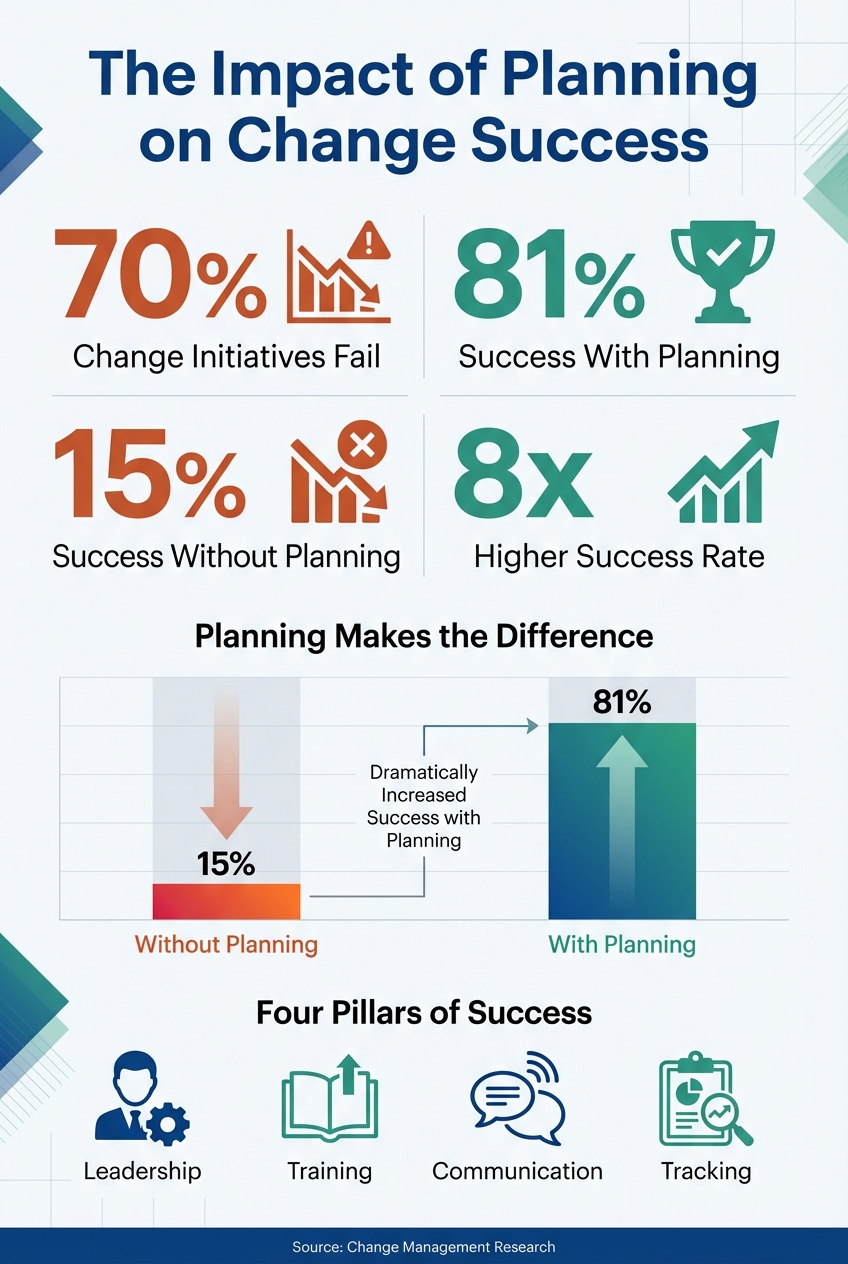
Change Management Success Statistics: Planning vs No Planning
Common Barriers That Prevent Lasting Change
Even well-planned transformations can falter. Recognizing these barriers is essential to crafting solutions that stick.
Leadership Gaps and Accountability Problems
Leaders often misjudge the complexity of change, launching disconnected initiatives that overwhelm teams already juggling day-to-day responsibilities. This "scope naïveté" can make change feel more like an added burden than a necessary evolution. Worse, when executives fail to embody the new behaviors they're advocating for, the initiative comes across as shallow or insincere. Research shows that top-tier managers engage 77% of employees, compared to just 1% for those at the bottom [3].
Credibility takes a hit when employees perceive change as a leader's personal agenda rather than an organizational priority. Without visible, consistent behavior changes from leadership, efforts can feel like "all sizzle, no steak" [7]. As Ron Carucci, Co-founder and Managing Partner at Navalent, puts it:
"Public commitments to personal change are a leader's signature of integrity on changes they commission" [7].
When leaders fail to lead by example, it undermines trust and the broader transformation effort.
Insufficient Training and Reinforcement
One-off training sessions rarely stick. Without consistent reinforcement, employees often return to their old ways [8]. The real problem lies in confusing single training events with ongoing capability building. Effective change requires continuous support and tools to help employees balance new responsibilities with their existing workload [9].
In 2023, Dr. Lynn Kelly demonstrated the importance of early progress checks during a multi-location rollout. This approach allowed for on-site adjustments, avoiding costly rework [9].
The numbers tell the story: 81% of organizations that plan for sustainment meet or exceed their objectives, compared to just 15% of those that don’t [8]. Michelle Haggerty, COO and U.S. President at Prosci, highlights the stakes:
"If a change is not sustained, there may be a need to redo change management activities such as training, communication and sponsor messaging, which can be less effective. And doing anything twice is more costly" [8].
Communication Failures and Resistance
Resistance to change often stems from status quo bias and fear of loss. Leaders, caught in the "curse of knowledge", may struggle to explain changes that seem obvious to them. This gap contributes to the 44% of employees who don’t understand the changes and the 38% who actively disagree with them [10]. Compounding the issue, 65% of executives cite "change fatigue" as a major hurdle [10]. A study on the curse of knowledge revealed that people overestimate how well others understand their messaging - predicting a 50% success rate when, in reality, it’s less than 5% [4].
IBM tackled this challenge between 2003 and 2006 with a 72-hour "values jam" on their corporate intranet. More than 150,000 participants from 104 countries contributed 46,000 posts, which leadership used to refine the company’s core values and strategies [10]. This type of two-way communication can significantly reduce resistance by involving employees in the process, rather than imposing changes from the top down.
Missing Measurement and Feedback Systems
Without proper tracking, progress becomes invisible, and issues can go unnoticed until they spiral out of control. The lack of feedback loops undermines the lasting impact of change, making it harder to sustain.
Many organizations skip the critical step of setting up early indicators and adjustment mechanisms. However, Dr. Lynn Kelly cautions against making these measurements permanent:
"Don't use early indicator measurement tools forever... these early measurements shouldn't become permanent as they can add bureaucracy" [9].
The trick is to find a balance - track enough to catch problems early without creating unnecessary administrative burdens that slow progress. By doing so, organizations can maintain momentum while staying agile.
Practical Solutions for Maintaining Change Over Time
Organizations that actively plan for sustaining change see much better outcomes - 81% achieve or exceed their goals compared to just 15% without a sustainment plan [8]. This difference isn’t random; it comes down to applying proven strategies that tackle challenges directly. Here are some effective approaches to ensure long-term success.
Build Strong Leadership Support and Visibility
Leadership gaps can derail even the best plans. To avoid this, leaders need to stay actively involved throughout the process. Research shows that projects with strong sponsors are twice as likely to succeed [8].
One of the most impactful things leaders can do is lead by example. Employees often mirror the actions of their leaders, even subconsciously. When executives adopt new processes themselves - before expecting others to follow - they send a clear message: this change is serious, not just another fleeting initiative. Pair this role modeling with sufficient resources like budget, time, and personnel dedicated to the sustainment phase, and you create a solid base for lasting transformation.
Governance structures also play a critical role. Setting up oversight committees with defined roles and responsibilities ensures that initiatives stay aligned with organizational goals. Without this structure, change efforts risk losing focus or being sidelined when other priorities arise.
Create Ongoing Training and Support Programs
A single training session won’t cut it. Real change requires continuous reinforcement. Ethan Nash from Nash Consulting explains this well:
"If the initial training is the 'download,' then all the follow up learning activities are the 'updates' that ensure the software not only remains functional but improves and adapts over time" [5].
Programs like Communities of Practice and Change Ambassador initiatives help maintain momentum by fostering ongoing learning and improving communication between leadership and teams [5][11]. A gradual transfer of responsibility - from the core project team to local managers and supervisors - ensures that the initiative doesn’t falter when the original champions move on [11]. In fact, transformations are nearly 8 times more likely to succeed when they include skill-building and formal reinforcement mechanisms [4].
Improve Communication and Adapt Your Culture
Frequent and open communication has become a top factor in successful change efforts, especially between 2015 and 2023 [9]. People need to understand not just what is changing, but also why it’s important to them personally.
As Dr. Lynn Kelly puts it:
"Employees deserve to know their purpose within change" [9].
Skipping this step can lead to resistance and fear of loss, often tied to a natural preference for the status quo. To counter this, organizations should establish feedback loops - using tools like pulse surveys, check-ins, and digital platforms - to gather real-time insights on how the changes are being received. This enables quick course corrections before small issues escalate.
Publicly celebrating short-term wins can also build momentum. Highlighting these successes fosters a sense of accomplishment and creates a "fear of missing out" for those still hesitant [13]. The ultimate goal is to create an environment where employees feel like they’re part of the change, rather than having it imposed on them.
Set Up Tracking Systems and Adjustment Processes
Measurement gaps can undermine change efforts, so it’s critical to tie metrics directly to outcomes. As Dave Ulrich, a professor at the Ross School of Business, explains:
"Unless desired work changes translate into specific, quantified, and tracked actions, they are nice to contemplate but not likely to get done" [1].
Incorporating sustainability metrics into existing scorecards - or creating dedicated ones - provides transparency without adding unnecessary complexity [1][6]. Tim Creasey, Chief Innovation Officer at Prosci, highlights the importance of timing:
"We are intentional with our choice of words; we don't start 'planning' sustainment, we 'activate' it. The seeds for success are sown early in the change process" [2].
Using portfolio management approaches connects project outcomes to broader strategic goals, offering detailed insights into value, ROI, and risk [12]. However, tracking alone isn’t enough. Organizations must document lessons learned throughout the project and formally transfer ownership to operational teams who will handle long-term management [2][12]. This ensures that when the project team wraps up, the knowledge and accountability don’t vanish along with them.
Creating a Long-Term Change Model with Expert Help
Managing leadership, training, communication, and measurement during major transitions can overwhelm internal teams. While these teams have a deep understanding of their company’s dynamics, they often lack the tested strategies needed to navigate complex transformations effectively [17]. This is where bringing in external experts can make all the difference.
Building on earlier strategies for addressing leadership and communication challenges, external consultants can step in where internal resources fall short. Specialists in organizational change and the future of work offer an outsider’s perspective that can uncover blind spots often overlooked by internal teams [14]. For example, Seth Mattison has worked with major global brands like IBM, Microsoft, GE, and Chevron to shift from rigid hierarchies to more agile, networked structures [16]. His approach frames change as an ongoing transformation, embedding new behaviors and redefining leadership along the way [16].
Sustaining change requires clear metrics and consistent reinforcement. External experts complement these efforts by customizing their methods to align with your organization’s specific goals. Many use structured approaches, such as the "Align, Equip, Sustain" framework, which ensures employees understand the new direction, gain the necessary skills, and receive ongoing support through formal systems [17]. Notably, experts emphasize activating sustainment strategies from the start, rather than treating them as an afterthought once the project concludes [8].
Expert-Led vs. Internal Change Management
When comparing internal change management to guidance from external experts, key differences emerge in terms of approach and effectiveness.
| Feature | Internal Management | External Expert Guidance |
|---|---|---|
| Cultural Knowledge | Deep familiarity with internal politics and history [14]. | May need time to understand specific organizational nuances [15]. |
| Objectivity | Can be influenced by internal biases or blind spots [14]. | Offers an impartial, outside perspective on resistance [14]. |
| Specialization | Often lacks expertise in advanced change management models [16]. | Brings proven frameworks and insights into global trends [8][16]. |
| Credibility | May suffer from "change fatigue" or past internal failures [8]. | Provides external authority and fresh energy to drive momentum [16]. |
| Cost | Lower upfront costs, utilizing existing staff salaries. | Higher initial investment for workshops and consulting services [8]. |
| Focus | Frequently pulled into day-to-day operations [8]. | Fully dedicated to transition and sustainment efforts [8]. |
Combining the deep institutional knowledge of internal teams with the structured frameworks of external experts creates a powerful foundation for successful change. Organizations that proactively plan for sustainment activities achieve their objectives 81% of the time, compared to just 15% for those that don’t [8]. This blend of internal insight and expert methodology is key to navigating change effectively.
Conclusion: Main Points for Maintaining Change Results
Sticking with change over the long haul requires dedication across four key areas: leadership, training, communication, and tracking. Leadership needs to stay visible and accountable, not just during the launch but throughout the process. Ongoing training and reinforcement are essential to keep employees from falling back into old habits. Pairing this with coaching and hands-on practice makes it even more effective. Open, two-way communication shifts resistance into commitment by replacing one-sided announcements with meaningful conversations. And, of course, tracking progress and establishing feedback loops make success measurable, connecting actions to tangible results.
The numbers speak for themselves: companies that plan for sustainment hit their goals 81% of the time, compared to just 15% for those that don’t [2][4]. It’s a staggering difference - organizations are nearly eight times more likely to succeed when they embrace all four of these pillars. As Dave Ulrich from the University of Michigan aptly says:
"You get what you inspect and not what you expect; you do what you are rewarded for (and so does everyone else)" [1].
These insights highlight the importance of expertise in driving meaningful change. While internal teams bring valuable knowledge of their organization, they often lack the structured frameworks needed for complex transitions. This is where external advisors come in. Their experience and proven methods don’t replace internal efforts - they enhance them, offering fresh perspectives and specialized tools.
For companies ready to move beyond quick fixes, Seth Mattison offers keynote speeches, workshops, and advisory services designed to help leaders tackle the future of work. His programs address the real challenges of sustaining change, from blending traditional hierarchies with modern networks to balancing AI with human innovation. He also focuses on building leadership practices that prioritize long-term health over short-term wins.
Achieving lasting transformation is possible when internal dedication meets expert strategies. Start building sustainment from day one with a focus on simplicity, accountability, and consistent reinforcement. When leadership, training, communication, and tracking align with expert guidance, long-term success becomes not just a goal but a reality.
FAQs
What can leaders do to successfully drive and sustain change?
Leaders play a key role in guiding and maintaining change within an organization. By leading by example, they set the standard for the behaviors they want their teams to adopt. This visible commitment not only builds trust but also motivates others to embrace the change.
Strong leaders also create a shared sense of urgency and purpose by connecting the change to the organization’s values and objectives. They actively involve employees in the process - helping them understand the reasons behind the shift, addressing their concerns, and ensuring everyone feels included in the journey. Rallying a group of supporters who advocate for the change can further strengthen its momentum and encourage broader acceptance.
To ensure the change becomes permanent, leaders need to communicate consistently and implement formal structures like revised policies, updated processes, and recognition programs. These steps help solidify new habits and make the change an integral part of the organization’s culture.
What are the best ways to ensure employees stay engaged in training during organizational change?
To keep employees engaged during training amidst organizational change, it's crucial to blend formal learning with hands-on coaching and teamwork. Regular practice paired with constructive feedback helps employees incorporate new skills into their daily routines, while peer collaboration encourages positive reinforcement and shared growth.
Maintaining engagement goes beyond initial enthusiasm - it’s about transforming that energy into lasting habits. This can be done through follow-up sessions, personalized coaching, and creating a workplace environment that prioritizes continuous learning. Transparent communication about the training's benefits and actively involving employees in the change process can also help minimize resistance and foster a sense of ownership.
Leadership plays a key role in making this process work. By delivering consistent messages and monitoring progress, they can demonstrate commitment to the initiative. A people-focused strategy that highlights flexibility and teamwork can make long-term change efforts far more effective.
What are the best ways to track and sustain the outcomes of organizational change?
To keep track of and maintain the results of organizational change, start by setting specific, measurable metrics that align with your objectives. Metrics like employee engagement, implementation speed, team safety, and adherence to company values can offer meaningful insights into both how well the change is being adopted and its lasting effects.
Taking a step-by-step approach to measurement works well. In the early stages, focus on tracking readiness and adoption. As the change progresses, shift to evaluating its broader impact. This method not only promotes accountability but also ties everyday actions to larger business goals.
Regularly monitoring performance and linking efforts to outcomes can strengthen trust with stakeholders and guide smarter decisions. By following these strategies, organizations can establish a solid system for managing and measuring the success of change initiatives