
Articles Jul 6, 2026 10:24:08 PM Seth Mattison 16 min read

Diverse teams do not win by default. They win when leaders set up debate, decision-making, and follow-through the right way. In the source article, the main point is simple: if you want better ideas and better calls, you need meeting habits that make room for different thinking styles, clear decision rules, and team norms that keep disagreement focused on the work.
Here’s the article in plain English:
- Cognitive diversity means people think in different ways, use different decision rules, and have different risk views.
- That mix can help teams do better work. One stat in the article stands out: companies with stronger diversity report innovation revenue 19 percentage points higher than peers with below-average diversity.
- But different thinking styles can also lead to silence, friction, or stalled decisions if the leader speaks too soon or pushes the team to agree too fast.
- The article argues for an integrator style of leadership: ask questions first, surface options, protect dissent, and separate idea generation from final choice.
- It also gives clear team habits: silent starts, rotating dissent roles, written input before discussion, pre-mortems, blameless reviews, and decision logs.
- The goal is not less tension. The goal is useful task friction instead of personal conflict.
- And the article says leaders should track whether this is working by looking at things like innovation revenue, time to solution, number of options considered, felt belonging, contribution patterns, and team reflection.
If I had to boil the full piece down to one line, it would be this: different minds help only when the team has a system for thinking well together.
A quick comparison helps show the shift the article pushes leaders to make:
| Leadership style | What it looks like | Likely result |
|---|---|---|
| Hero-expert | Leader signals the answer early and moves the group toward it | Fewer options, less pushback, more blind spots |
| Integrator | Leader asks for options, written dissent, and debate before commitment | Better judgment, more input, cleaner execution |
So if you’re leading this kind of team, the article’s advice is direct: start small, change one meeting habit, and make better thinking a weekly practice.
How diversity makes teams more innovative | Rocío Lorenzo | TED
Leadership Mindsets That Unlock Diverse Thinking
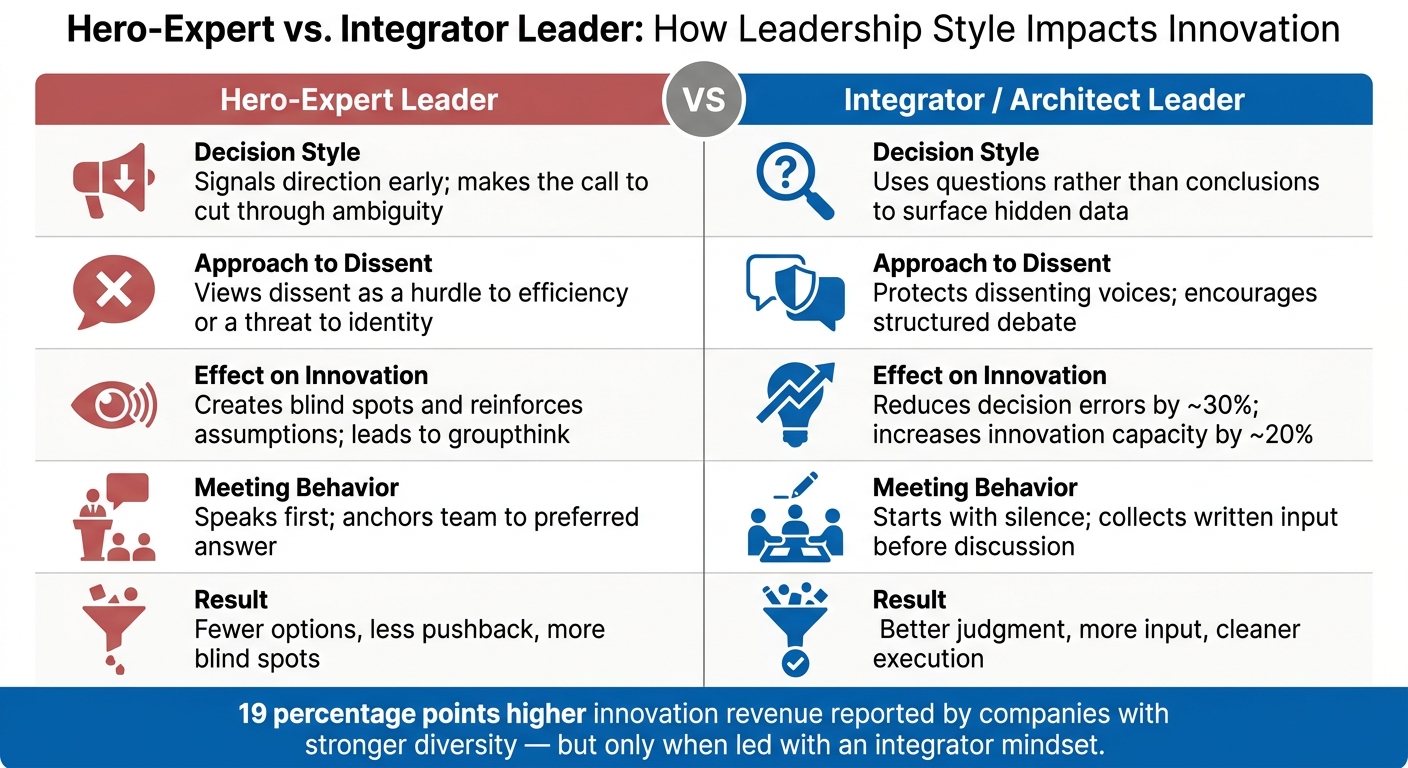
Hero-Expert vs. Integrator Leader: How Leadership Style Impacts Innovation
From Expert Leader to Integrator Leader
The old hero-expert model can shut down cognitive diversity without anyone noticing. Once a leader shares their preferred answer too early, the team starts lining up behind it. Pushback gets quieter. Assumptions stay in place. What looks like alignment is often just an echo.
Integrator leaders take a different path. They design the decision before they make it. That means putting outcomes, options, evidence, risk, process, and people on the table before choosing a direction [7]. As Dr. Juliet Bourke puts it:
"The leader who makes every call is the biggest risk in the room." [7]
The gap between these two mindsets is pretty clear:
| Leadership Mindset | Decision Style | Approach to Dissent | Effect on Innovation |
|---|---|---|---|
| Hero-Expert | Signals direction early; makes the call to cut through ambiguity [7] | Views dissent as a hurdle to efficiency or a threat to identity [6][7] | Creates blind spots and reinforces assumptions; leads to groupthink [2][7] |
| Integrator / Architect | Curious; uses questions rather than conclusions to surface hidden data [7] | Protects dissenting voices; encourages structured debate [2][7] | Reduces decision errors by approximately 30%; increases innovation capacity by around 20% [7] |
Those differences don’t stay at the mindset level. They show up in how meetings are run and how decisions get made. A shift in mindset only counts when it changes how the team debates, decides, and commits.
Day-to-Day Behaviors That Raise Innovation Quality
A mindset shift means little if it doesn’t show up in day-to-day behavior. One of the most useful moves is to separate divergence from convergence. In plain English: keep idea generation open first, then narrow toward a decision later [3]. That keeps teams from locking in too soon on a short list of options.
A few habits help a lot:
- Rotate the dissent role. Give someone the job of devil’s advocate or curator of quiet voices in meetings. That makes dissent part of the process instead of turning it into a personal clash [1].
- Model vulnerability first. When leaders admit mistakes or uncertainty, they show the team that intellectual risk is safe [2].
- Use structured idea generation. Silent brainstorming or the Nominal Group Technique helps ideas surface before louder voices screen them out [3][2].
Sharing airtime and making space for non-dominant voices to challenge assumptions are not side issues. They’re part of how better decisions happen. Done week after week, these habits build the trust and judgment that help diverse teams perform at a higher level.
Building a Human Moat in Team Leadership
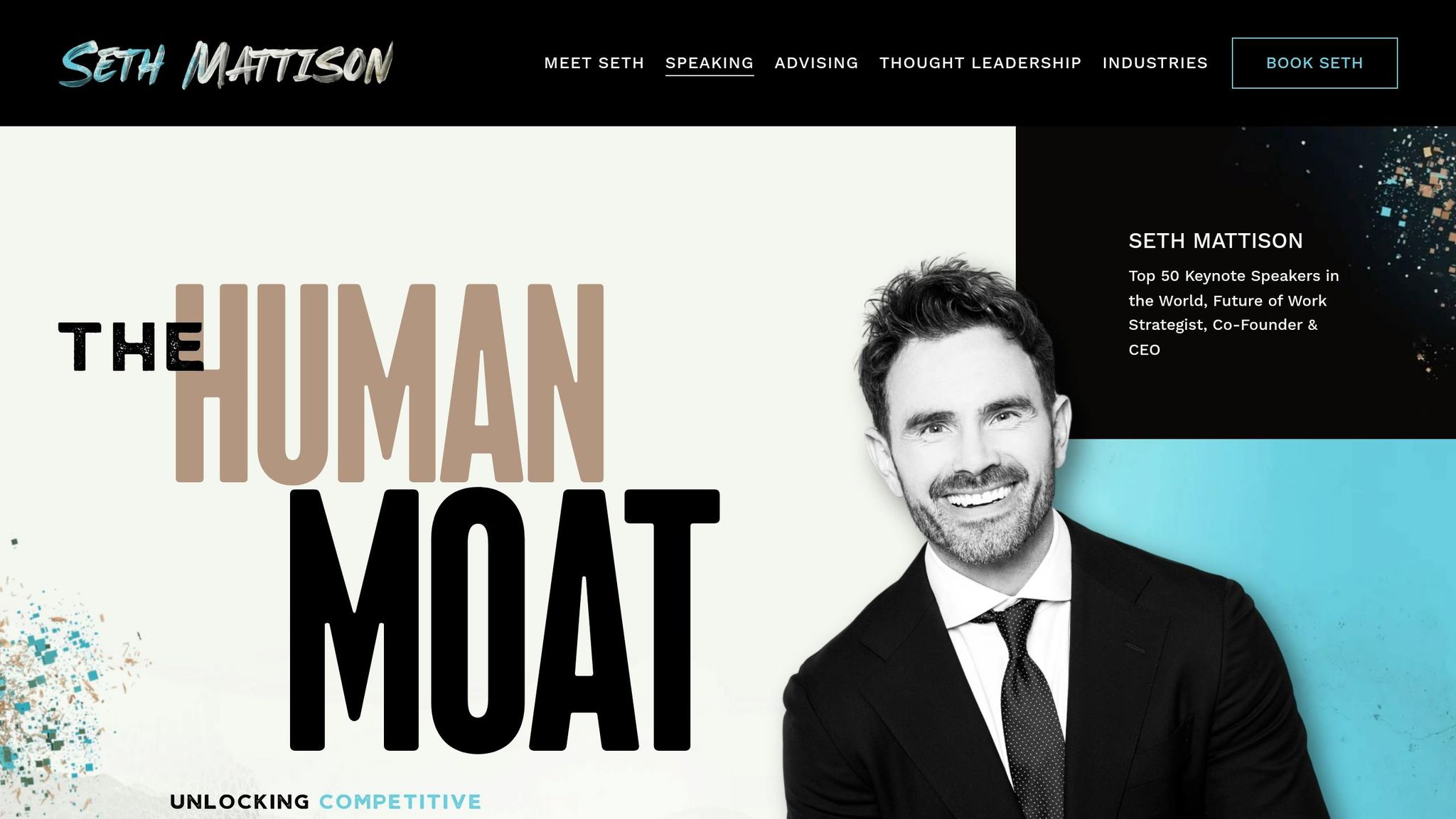
These practices last when they become part of weekly team routines. In diverse innovation teams, human moat behaviors turn difference into a repeatable edge. Seth Mattison’s Human Moat framework points to judgment, synthesis, trust, and sustained performance as leadership disciplines built through steady routines, not one-off events.
Judgment gets better through team reflexivity: taking time to step back and look at how the team is thinking, not just what it is deciding [8]. Synthesis improves when leaders bring different mental models into contact and name the outcome those behaviors produce: better judgment, faster synthesis, and lower social friction. Trust lowers the social cost of speaking up [3], which frees more mental energy for idea generation instead of self-protection.
This works as a weekly operating discipline, not a one-time training. A team’s ability to think well together grows when these behaviors are built into the way the team works every single week.
Core Practices for Leading Cognitively Diverse Teams
The next step is to turn those mindsets into team rules people can use again and again.
Create Psychological Safety Without Lowering Standards
Build safety by making dissent, uncertainty, and mistakes open for discussion while keeping the performance bar plain. The goal isn't to go easy on people. It's to make it safe to tell the truth.
A good place to start is this: treat mistakes as system problems, not personal failures. When teams run blameless post-mortems, people learn that honesty is safer than blame.
Cognitive differences should also be treated as something the team is expected to use, not work around.
The table below shows the leader behaviors that matter most and how to put them into practice:
| Leader Behavior | Innovation Benefit | Implementation Step |
|---|---|---|
| Modeling Vulnerability | Encourages smart risk-taking and admission of errors | Share a recent "lesson learned" from a personal mistake |
| Structured Debate | Prevents groupthink and surfaces hidden risks | Assign a rotating Devil's Advocate for every major decision |
| Silent Brainstorming | Ensures internal processors and junior members contribute | Use 10–15 mins of silent writing before any speaking begins |
| Blameless Post-Mortems | Focuses the team on process improvement over ego | Review failed projects by focusing only on systemic factors |
Use Decision Structures That Separate Debate from Commitment
Teams need clear gates: generate options, test them, then commit. That may feel slower up front, but it pays off because different kinds of thinkers help most at different points.
Ask for at least three distinct, viable options before any final vote. Use pre-mortems by asking, "what would have to go wrong for this to fail?" before the team commits to a plan. Require a written dissent before the final vote too. That step matters. It gives people room to surface concerns that might not come out in the room.
Once the decision is made, log it. Write down the reason behind the decision, the alternatives the team looked at, and who owns execution. Decision logs cut down on circular debates and make execution clearer [3].
Turn Conflict Into Useful Task Friction
Not all conflict is the same. Task conflict - disagreement over ideas, methods, and priorities - often leads to better decisions when it's handled well. Relationship conflict - personal irritation, distrust, or status competition - breaks team cohesion and shuts down contribution [9]. The leader's job is to keep friction tied to the work, not the people.
In practice, that means framing disagreement around the issue, not the person. For example:
"the data suggests X, but the risk model points to Y - how do we reconcile that?"
It also means using turn-taking in high-stakes discussions so one voice doesn't take over. And it means summarizing the competing views out loud before moving to a decision. That simple move helps people feel heard, even when the team goes another way.
Then document why the team chose what it chose, not just what it decided. Otherwise, the same argument tends to come back every quarter.
Those habits stick only when team roles, meeting cadence, and metrics back them up.
These practices hold when roles, meeting cadence, and metrics reinforce them.
sbb-itb-9ceb23a
Team Design, Operating Cadence, and Measurement
These practices only stick when the team setup, meeting rhythm, and metrics all point in the same direction. That’s what turns different ways of thinking into a repeatable way to produce new ideas. Start with role clarity. Then shape how meetings run. Then check whether the system is helping the team come up with better ideas.
Structure Cross-Functional Teams Around Clear Roles and Shared Goals
A common reason cross-functional innovation teams struggle is simple: nobody is fully sure who gets to decide what. When roles blur, different points of view can create friction instead of better judgment.
Start by spelling out the team’s mandate, who owns each decision, and what success looks like. From there, build the team with a mix of thinking styles - analytical, practical, relational, and experimental - and pull in people from nearby fields so the group isn’t made up of the same type of person [2][9]. Deliberate bridge-building across subgroups helps forge connections, surface shared ground, and bring all members into key team decisions [9]. When teams handle different professional languages well, they tend to surface better options in less time.
Once roles are clear, meeting design needs to keep those differences useful instead of messy.
Design Meetings and Workflows for Different Thinking Styles
Meetings should make room for both fast talkers and people who need a bit more time to think.
Amazon does this with a "Silent Start" method: meetings begin with 15 minutes of silent reading of a pre-distributed memo before discussion begins, which levels the playing field between different processing styles and keeps the loudest voices from anchoring the conversation too early [10].
A simple setup works well:
- Share a pre-read
- Start with silence
- Gather written input before open discussion
Using both written and verbal input can spread participation more evenly and reduce power gaps [3]. After each sprint or project, a structured review can help the team answer three questions: What worked? What didn't? What can we improve? [1]
When the workflow is doing its job, the team should generate more options, make decisions in less time, and spend less time circling back to dead ends.
Track Whether Diversity Is Improving Innovation Results
You don’t need a huge scorecard here. A small set of metrics is enough if it covers both outcomes and team behavior. That way, you can see whether diversity is shaping better decisions, not just showing up as attendance.
At the outcome level, track innovation revenue. At the process level, measure time to solution - the time from problem identification to a viable solution - and the number of viable options explored before a final decision [2]. To see whether the team’s cognitive range is showing up in day-to-day work, track the range of terms and frameworks used in team communication [2].
A few people-side signals matter too. Felt inclusion shows whether people feel they can contribute task-relevant points of view while still belonging to the group [5]. Workload distribution shows whether different voices are contributing, not just sitting in the room [11]. Team reflection is also worth tracking because it shows whether the team is stepping back to think about its objectives, strategies, and processes [4].
If results stall, fix decision rights and meeting design before you reshuffle the team.
Conclusion: What Leaders Should Do Next
Cognitive diversity only pays off when leaders turn it into better decisions and better follow-through.
As AI squeezes routine expertise, human judgment, empathy, and synthesis matter more. That’s the Human Moat: the set of human strengths AI can’t copy. Seth Mattison’s work centers on building that moat through integrator leadership, cognitive inclusion, and productive friction. At this point, the need isn’t more theory. It’s team habits you can repeat week after week.
Start small. Change one thing at a time.
Try a Silent Start in your next meeting. Rotate a Designated Dissenter role right away. And track how many distinct solution pathways your team comes up with before a major decision. If that number is low, groupthink is probably already in the room.
The edge that lasts comes from helping different minds work well together - and making the system better over time.
FAQs
How do I lead as an integrator?
Leading as an integrator means bringing people together on purpose so the team moves with more alignment and a shared sense of direction.
That starts with making connections between people who may think, work, or communicate in different ways. Look for common ground. Point it out. Help people see where their ideas overlap, where they support each other, and where one person’s strength can fill another person’s gap.
In practice, that means you’re not just listening to different points of view - you’re helping combine them. You create space for people to work together, smooth out disconnects, and keep the group focused on a solution everyone can help shape.
Your job is to make sure ideas don’t sit in separate corners. They should come together into one shared answer that reflects the team’s range of thinking and turns it into action.
What meeting habit should I change first?
Start with silent starts or structured idea generation. Silent brainstorming and the Nominal Group Technique give people space to think before anyone jumps in with opinions.
That matters more than it might seem. When idea generation and evaluation happen at the same time, the loudest people often steer the room. Split those two steps apart, and more ideas get aired out before they’re judged.
The result is a more open process. People who are quieter, newer, or less likely to interrupt still get their input on the table, and dominant communication styles have less power to shape the discussion too soon.
How can I measure if team diversity is helping innovation?
Look past the usual KPIs and pay attention to signals that diversity is making your team think better.
Watch how many distinct, workable options the team considers before landing on a final call. Notice whether the time it takes to solve problems starts to drop. And listen to how people talk with each other: when team communication includes a broader mix of metaphors and mental models, that can be a strong sign the group is bringing more angles to the table.
Related Blog Posts

Seth Mattison
Top 50 Keynote Speakers in the World | Future of Work Strategist | Co-Founder & CEO