
Articles Mar 28, 2026 9:00:00 AM Seth Mattison 21 min read

AI is changing how leaders build their personal brands. By automating tasks like content creation, scheduling, and data analysis, AI frees up time for leaders to focus on sharing their experiences and connecting with their audience. However, with AI-generated content flooding platforms, standing out now requires a personal touch and unique insights.
Key Takeaways:
- AI's Role: AI helps leaders create, analyze, and distribute content faster, but generic, automated material is becoming common.
- Challenges: Engagement on platforms like LinkedIn has dropped (50% fewer views, 25% less interaction), making originality critical.
- What Works: Posts with personal stories, failures, or exclusive data get 3x more engagement than generic content.
- AI Tools: Platforms like NoimosAI, Taplio, Flick, and Highperformr simplify branding tasks while maintaining a leader's voice.
- Balance Is Key: Leaders should use AI for efficiency but rely on their own voice and experiences to build trust and credibility.
AI is a powerful tool, but it works best when paired with human creativity and authenticity. Leaders who combine AI's efficiency with their unique perspective will thrive in this evolving landscape.
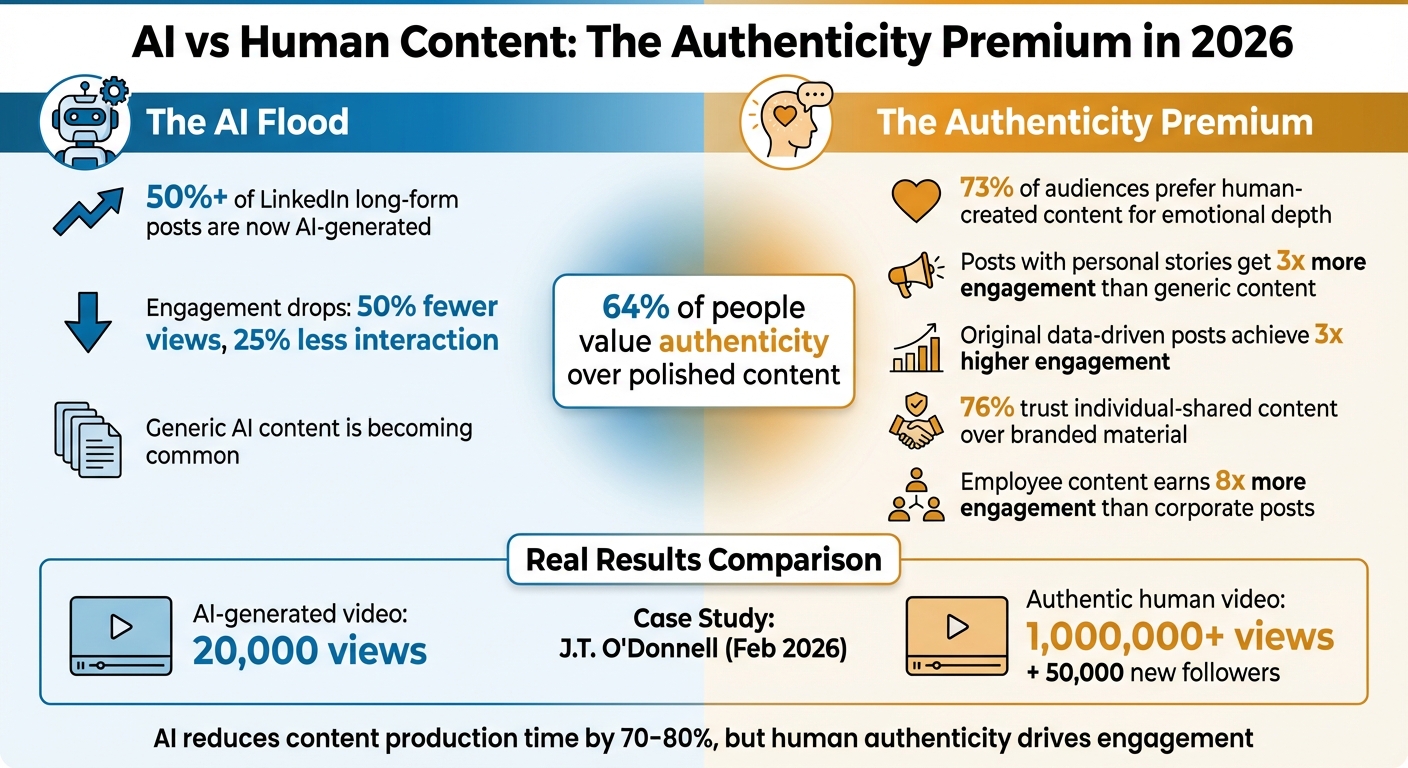
AI vs Human Content Performance: Key Statistics for Personal Branding in 2026
Systematizing Personal Branding in an AI World With Marina Byezhanova
sbb-itb-9ceb23a
Core Elements of AI-Powered Personal Branding
As concerns grow over the repetitive nature of AI-generated content, leveraging AI tools effectively can transform personal branding without losing individuality. By focusing on three key areas - consistent voice, authentic human connection, and platform-specific content adaptation - leaders can elevate their digital presence while knowing where AI excels and where human input is indispensable. Let’s dive into how these elements work together to strengthen leadership branding.
Creating a Consistent Digital Presence
Imagine being able to "teach" AI your personal communication style. By uploading writing samples, tone preferences, and core values, leaders can ensure every post mirrors their personality, whether it’s on LinkedIn or Instagram [1][7]. Visual consistency is equally important. Tools like Midjourney V6 allow users to apply "Style References" to maintain a uniform aesthetic across all brand materials. For example, a leader might choose a "Minimalist Bauhaus" design and have it applied seamlessly to LinkedIn banners, presentation slides, and more.
AI also shines when it comes to repurposing content. Using a "Pillar Content" strategy, leaders can create one impactful piece and let AI spin it into multiple formats: TikTok clips, LinkedIn carousels, and text posts [5][7]. This approach ensures a recognizable brand presence without hours of manual effort. Consistent posting not only builds visibility but also aligns with algorithms that favor "topic authority." By focusing on 3–5 core themes rather than scattered topics, leaders can strengthen their credibility [8].
Maintaining Genuine Human Connection
In February 2026, J.T. O'Donnell, CEO of Work It DAILY, put AI-generated content to the test. She created an AI-powered video with a cloned voice and avatar in under 10 minutes, which garnered 20,000 views. However, a real video she posted during the same period hit over 1,000,000 views and brought in 50,000 new followers across four platforms [10]. The key difference? The energy and authenticity that only human presence can deliver.
"The more content becomes easy to create… the more people will crave what's real. AI is about to flood the market with 'good enough.' Which means authenticity is about to become premium." - J.T. O'Donnell, CEO, Work It DAILY [10]
Leaders can use AI for routine tasks like scheduling and drafting, but for high-impact moments, their personal touch is irreplaceable [9]. A practical tip is the "Rant" Draft Method: record a raw 5-minute voice memo of your thoughts, transcribe it, and let AI refine it into a polished post. This keeps your natural tone intact [7]. With 64% of people valuing authenticity over polished content, sharing personal challenges and lessons - not just successes - builds trust [9].
Tailoring Content for Each Platform
Authenticity builds trust, but tailoring content to fit each platform’s unique style is what amplifies reach. Each social media platform has its own vibe: LinkedIn thrives on professional insights, Instagram focuses on visual storytelling, and X (formerly Twitter) rewards real-time, conversational posts. AI tools can analyze these nuances and adjust a single message accordingly. For instance, a thoughtful LinkedIn post can be reworked into a casual, story-driven Instagram caption while maintaining the leader’s voice [2][11].
The efficiency gains here are massive. AI reduces content production time by 70-80% [11]. Tools like OpusClip and Canva's Magic Studio can transform long-form videos into platform-optimized formats: vertical clips for TikTok, horizontal thumbnails for YouTube, and LinkedIn carousels [7]. These tools also adapt design elements to match each platform’s preferred aspect ratios.
Platform-specific optimization is more critical than ever. Algorithms now prioritize credibility signals - content backed by original data or real-world experience gets three times more engagement than generic posts. Employee-generated content also performs exceptionally well, earning eight times more engagement than corporate posts on similar topics. Additionally, 76% of people trust content shared by individuals over branded material [4][8]. By understanding these dynamics, leaders can let AI handle the heavy lifting while ensuring their authentic perspective drives meaningful engagement.
AI Tools for Personal Branding
Specialized AI tools have become a game-changer for leaders looking to refine their personal branding. These platforms can take tasks that once took weeks and condense them into just a few hours. From audience research to optimizing posts, these tools allow leaders to focus on strategy rather than juggling multiple platforms and content calendars. Let’s take a closer look at four platforms making waves in personal branding for 2026.
NoimosAI: Automated Social Media Management
NoimosAI functions like a 24/7 marketing team, managing everything from content research and creation to audience engagement. Its standout feature, "Connect & Personalize", helps the tool adapt to your unique voice. For instance, Kosuke Yokoyama, Founder & CEO, leveraged NoimosAI to support bilingual market strategies, achieving impressive results: over 10,000 monthly visits, a 10× ROI, and a reach of more than 20 million in just one month. Influencer Yui Takahama shared her experience:
"It gives me fresh perspectives without losing my unique tone. Saves and DMs have surged. Social media no longer feels like 'work' - it's now a place where I truly enjoy connecting with my community."
NoimosAI is accessible with a free starter option for those wanting to explore its capabilities [12].
Taplio: LinkedIn Growth and Authority
Taplio is designed specifically for LinkedIn, using AI trained on a database of over 500 million successful posts to create high-impact content. Its "Auto-Plug" feature automatically adds links to the first comment a minute after publishing, ensuring posts remain clean while maximizing reach. Influencers like Amanda Goetz have seen massive growth, expanding her LinkedIn following from 8,000 to 30,000 in just 10 months. Similarly, Emil Sterndorff experienced a surge in post views from 15,000 to 1 million within six months. With over 6,200 LinkedIn professionals using the platform, Taplio offers a 7-day free trial and a 30-day refund policy for new users [14][15][16].
Flick: Visual Content for Instagram and TikTok
Flick is a go-to tool for visual platforms, thanks to its Iris AI feature. This tool helps brainstorm content ideas, create on-brand captions, and boost reach using advanced hashtag research. Its Hashtag Tool, supporting over 20 languages, provides key metrics like reach and popularity to fine-tune hashtag selection. Instagram Coach and YouTuber Benjamin Leavitt praised the platform:
"Whether it's planning my posts ahead of time, or finding niche hashtags quickly, Flick helps me achieve my goals faster than ever before - it's a must-have platform for any business or brand."
Flick is trusted by over 100,000 content creators and offers subscription plans ranging from $14 to $67 per month, complete with a 7-day free trial and round-the-clock support [13][17].
Highperformr: Analytics and Brand Insights
Highperformr focuses on providing data-driven analytics and insights to fine-tune digital strategies. By visualizing real-time performance metrics and engagement trends, it allows users to adjust their approach based on what’s working. Instead of simply filling a content calendar, every post can be crafted to build authority and resonate with the audience.
| Tool | Primary Platform Focus | Key AI Feature | Pricing |
|---|---|---|---|
| NoimosAI | Multi-platform / General Marketing | Autonomous AI agents that learn your personal voice | Free starter available |
| Taplio | AI trained on over 500 million posts | 7-day trial, 30-day refund | |
| Flick | Instagram, TikTok, Facebook | Iris AI assistant for strategy and hashtag optimization | $14–$67/month, 7-day trial |
| Highperformr | Analytics across platforms | Data-driven insights and engagement tracking | Varies by plan |
These tools demonstrate how AI is revolutionizing personal branding, helping leaders balance efficiency with a personal touch. From content creation to data insights, they’re paving the way for more strategic and impactful branding efforts.
Combining AI Efficiency with Human Expertise
In 2026, the most effective personal brands seamlessly integrate the speed of AI with the creativity of human ingenuity. Successful leaders treat AI as a supporting tool, not a substitute for their own ideas. The division is straightforward: let AI manage the repetitive tasks - like editing, formatting, scheduling, and data analysis - while you focus on strategy, emotional resonance, and the core purpose of your message [7]. This approach can save over 10 hours a week for less than $200 a month [5]. However, the real skill lies in knowing where to draw the line. As Valiant3 Communications aptly puts it:
"AI should enhance your message, not become your message" [1].
By clearly defining these roles, you can ensure both AI and human input work together to strengthen your brand's story.
Using AI for Routine Tasks While Maintaining Control
The smartest way to leverage AI is through "passive content harvesting" [7]. For instance, record voice notes while commuting or transcribe client calls (with permission) to capture the valuable insights you naturally share. AI can then sift through these conversations to find key takeaways that might otherwise slip through the cracks.
The "Rant" method is another great example: record a raw voice note, transcribe it, and let AI organize your thoughts into a coherent structure. This method keeps your authentic voice intact while sparing you the tedium of editing [7].
AI is also perfect for repurposing content across platforms. Imagine recording a video or podcast and then using AI to break it down into multiple formats - short clips, carousel posts, or Twitter threads - tailored for different channels [7]. However, always add your personal touch to AI-assisted drafts before sharing them publicly [1].
Showcasing Your Expertise Through AI Tools
AI isn't just about efficiency - it can also help you highlight what makes you stand out. In a world where AI-generated content is becoming the norm (over 50% of long-form LinkedIn posts are now AI-generated [4]), your unique insights and experiences are what truly resonate.
One way to differentiate yourself is by sharing original data that AI can't replicate. Conduct small surveys, analyze internal trends, or share personal findings like, "I interviewed 30 managers and discovered..." [4]. Posts featuring proprietary research tend to achieve three times more engagement than generic content [4].
AI can also help you analyze your personal brand. By reviewing years of career feedback, testimonials, and reviews, it can identify the strengths people consistently associate with you [1]. Once you’ve gathered these insights, let AI handle the formatting and distribution, while you focus on delivering the perspective only you can provide.
Take entrepreneur Dylan Vanas as an example. In February 2026, he shared how he nearly lost his entire staff due to a challenging partnership. By openly documenting the systems he built to recover, he demonstrated resilience and leadership. This transparency helped him grow his agencies to eight-figure revenues [5]. His vulnerability was deeply human, but AI played a key role in refining and spreading his message.
It’s worth remembering that 73% of audiences prefer human-created content for its emotional depth [4]. People can sense the difference between genuine emotion and "artificial warmth." Your role is to bring the authenticity, spontaneity, and raw honesty that build trust, while AI takes care of the finishing touches.
Seth Mattison's Approach to Leadership Branding with AI
Seth Mattison blends the efficiency of AI with the irreplaceable power of human expertise, offering a fresh perspective on leadership branding. His philosophy is both straightforward and impactful: "The winners of tomorrow need to be extremely fast or extremely human" [18]. While AI delivers speed, Mattison emphasizes the importance of human connection and vulnerability, redefining "love" as the energy that drives creative strategy rather than just a simple emotional connection [18].
"Love isn't soft. Love is the strategy." [18]
This mindset directly addresses the challenge of standing out in a world where AI-generated content often feels repetitive. Through his workshops and advisory services, Mattison equips leaders with tools to maintain their human edge in an increasingly AI-driven landscape.
Keynotes and Workshops on AI and Leadership
Mattison’s workshops, such as "The Human Advantage: Unleashing the Power of People in the Age of Machines" and "Made with Love: The Strategy for Unlocking the Ultimate Competitive Advantage," focus on practical strategies to reintroduce human value in a world dominated by technology [18].
His work has made a lasting impression on major organizations. For example, Tim Ryan, US Chairman at PwC, reflected on the impact of Mattison’s insights:
"Seth created a paradigm shift for the way we think about leading the next generation of talent." [18]
Similarly, Jane Datta, Chief Human Capital Officer at NASA, credited Mattison with influencing their approach to leadership in the digital age:
"the way we think about digital transformation and the future of leadership." [18]
These sessions guide leaders in finding the balance between leveraging technological advancements and maintaining a human-centered approach.
Advisory Services for Brand Development
In addition to his workshops, Mattison offers advisory services through FutureSight Labs, helping leaders build organizations that seamlessly integrate AI with human creativity [18]. His approach treats AI as a tool for efficiency while ensuring that the core brand message remains rooted in authenticity and human insight. The focus is on using both AI and human potential in tandem, rather than favoring one over the other [18].
Mattison’s consulting services provide leaders with a roadmap for distinguishing between tasks suited for AI and those requiring the nuanced understanding of human experience. For those feeling lost in the sea of AI-generated content, his approach emphasizes standing out through original data, vulnerability, and insights drawn from personal expertise. His ultimate aim is to ensure that every interaction with a brand feels personal and genuine, reflecting the voice of a real human rather than an algorithm. By keeping human insight at the forefront, Mattison ensures that leaders can create meaningful, lasting connections with their audiences.
What's Next for AI-Driven Personal Branding
AI is transforming how personal branding works. Those who stay ahead of these changes will be better equipped to maintain their credibility and visibility in a world that’s becoming increasingly automated. New trends are shaping how AI handles search and verifies identities, creating fresh opportunities and challenges for leaders.
Conversational AI and Search Optimization
Search is shifting from simple keywords to full-on conversations. Platforms like ChatGPT, Perplexity, and Google AI Overviews are now delivering AI-curated answers, changing how audiences find and connect with thought leaders. This means leaders need to rethink their digital presence.
To stay relevant, adopt generative search optimization. A clear, consistent, and credible online presence ensures AI platforms represent your expertise accurately. Tools like Peec AI are stepping in to help leaders monitor how conversational AI models reference their brand, ensuring their expertise is portrayed correctly in AI-generated content [1][5]. As Valiant3 Communications puts it:
"Visibility in 2026 relies on both human intention and algorithmic understanding" [1].
AI can also be a powerful research tool. Leaders can use its ideation features to brainstorm and refine ideas, but the final message should always carry a personal touch. This approach allows for personalization at scale - adjusting messages for various industries or roles without losing the essence of their unique voice [1].
Verified Human Identity in the Age of AI Content
With AI-generated content flooding social media, audiences are now prioritizing authenticity more than ever. This has led to what’s being called an authenticity premium. A survey found that 73% of audiences prefer human-created content because it resonates emotionally [4]. Amanda Garner of The Brand Leader highlights:
"Audiences aren't opposed to AI as a tool: they're opposed to shortcuts that undermine quality" [3].
Credibility still hinges on measurable outcomes, client results, and firsthand experiences - things AI simply can’t replace [4]. For instance, LinkedIn posts featuring original data earned three times more engagement than standard text posts as of February 2026 [4]. Leaders are also leaning more into video and audio content, which convey personality and conviction better than text and are much harder for AI to replicate authentically [4].
Conclusion
Throughout this discussion, one thing stands out: combining the efficiency of AI with the depth of human insight is the key to impactful leadership branding. AI is transforming how leaders shape and sustain their personal brands, but its true potential lies in enhancing human creativity - not replacing it. By 2026, the most effective leaders will see AI as a tool for tasks like research, formatting, and data analysis, while keeping control over their strategy, voice, and final messaging. Amanda Garner from The Brand Leader sums it up perfectly:
"AI should increase clarity and capability. It should not compromise character." [3]
Consider some key stats: AI now generates over half of LinkedIn’s long-form content. Yet, posts with original data and a personal voice outperform others. Content featuring proprietary research drives three times higher engagement, and 73% of audiences still prefer human-created content for its emotional depth [4]. These numbers emphasize the need for a human-first approach.
This balanced approach allows leaders to focus on what AI can’t do - sharing lived experiences, offering unique insights, making strategic decisions, and showing the courage to be vulnerable about both wins and losses. While AI handles repetitive tasks, leaders can dedicate their energy to meaningful interactions and moments that foster trust.
Looking ahead, humans will continue to bring emotional depth, ethical judgment, and strategic purpose to the table, while AI takes care of formatting, scheduling, and other logistical details. This "cyborg" model - where humans and AI work together - enables leaders to scale their reach without losing their personal touch [7]. With so few leaders willing to embrace this balance, the bar for authentic thought leadership remains low [6]. Those who adopt AI as a creative ally while staying true to their unique perspective will stand out, earning trust, attention, and influence in a world increasingly shaped by automation.
FAQs
How do I use AI without sounding generic online?
To stand out online, combine AI tools with your personal touch to create content that feels genuine and unique. Use AI to spark ideas or streamline processes, but ensure your voice remains front and center. Incorporate personal insights, original research, and your own experiences to add depth and individuality. Think of AI as an assistant, not the main creator, and steer clear of relying too heavily on templates. By customizing your work, you’ll showcase your personality and expertise, making your personal brand shine in a busy digital world.
What types of posts still get high engagement in 2026?
Posts that drive high engagement in 2026 emphasize a fresh perspective, genuine connections, and content that offers true value. Examples include AI-crafted personal stories designed to spark emotion and posts that prioritize quality, depth, and trust over churning out a high volume of content. Meaningful storytelling and a sense of authenticity continue to be at the heart of what captures attention and fosters interaction.
Which branding tasks should I keep human vs automate with AI?
For personal branding, focus on keeping activities such as storytelling, forging connections, and sharing genuine experiences driven by human effort. These tasks rely on emotional insight and a distinct personal touch. On the other hand, let automation handle tasks like brainstorming ideas, drafting initial content, repurposing existing posts, and scheduling. By blending AI's efficiency with the personal touch of human creativity, you can build a brand that's engaging and credible while freeing up time for strategic planning and nurturing relationships.