
Articles Jul 7, 2026 9:51:07 PM Seth Mattison 14 min read

If I had to boil this down to one point: NLP-based learning only works when I tie it to job performance, set clear rules for data use, and keep people in charge of high-stakes calls.
Most training still tracks who finished. But leaders need to track what changed. In the article, the big message is simple: NLP helps learning systems understand employee questions, tailor support by role and skill level, and shift learning paths based on need. But the payoff comes only when trust, data rules, and business goals are in place from day one.
Here’s the short version:
- Why leaders should care: Skills gaps are slowing change, and AI is reshaping work fast.
- What NLP does: It reads what employees mean and returns answers, coaching, or practice in real time.
- What changes with personalization: Learning can skip known material, add practice where gaps show up, and link development to role goals.
- What gets in the way: Employee fear, weak data rules, bias in recommendations, and pilots that never connect to revenue, retention, or productivity.
- What leaders should do: Start with one business problem, run a 90-day pilot, set guardrails early, involve managers, and keep “human-only” zones for sensitive cases.
- What to measure: Skill-gap closure, time-to-proficiency, internal mobility, recommendation use, and total cost of ownership.
- What the numbers say: Some AI-based learning programs report 443% three-year ROI, 40% lower time to productivity, and in one case, 300% more learning-path completions in three months.
I’d frame the article this way: personalized learning is not about serving different content to different people. It’s about using NLP to help employees get the right support at the right time without losing trust or control.
That’s the lens I’d use for the rest of the piece.
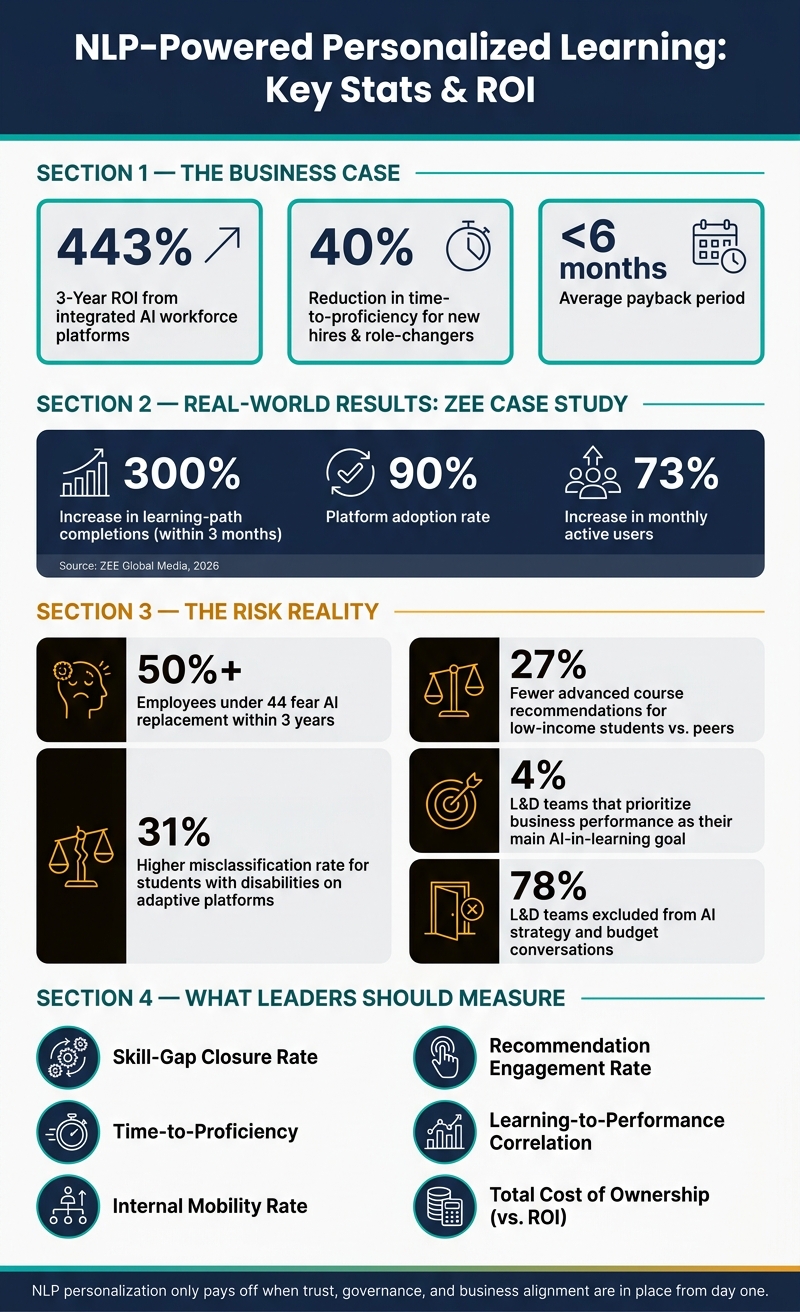
NLP-Powered Personalized Learning: Key Stats & ROI at a Glance
AI-Powered Personalization: Transforming Education
sbb-itb-9ceb23a
How NLP Powers Personalized Learning at Work
NLP helps learning systems understand what employees mean and reply in real time. When that works well, people spend less time hunting for answers and more time on judgment, coaching, and problem-solving. That matters because the quality of the reply often decides whether employees come back to the system or ignore it.
What NLP Does Inside a Learning System
NLP has two main jobs. Natural Language Understanding (NLU) reads the intent behind an employee’s question, even when the wording is vague or off target. Natural Language Generation (NLG) then gives back a relevant response in real time.
In practice, that means a few things. NLP powers AI learning assistants that answer questions on demand [4]. It also supports virtual coaches that let employees rehearse hard conversations [3]. In enterprise knowledge tools, NLP can pull answers from verified internal documents and show citations so employees can check the source for themselves [3].
This changes the learning experience in a simple but important way: help is tied to the learner’s goal, not just the exact words they typed. So if someone asks how to handle a sales objection, they can get a coaching scenario that fits the situation instead of a basic keyword search full of article links.
The harder leadership question isn’t just what the system can answer. It’s how far the learning path should shift based on what the system learns about the employee.
How Personalization Changes the Learning Path
NLP-powered systems can change what a person learns, how fast they move, and what type of support they get based on role, goals, and performance data. If a learner has already mastered a prerequisite, the system skips it. If a gap appears, it adds practice aimed at that gap.
The impact can show up fast. In 2026, global media company ZEE rolled out AI-powered learning goals that helped employees connect development plans to career aspirations. Within three months, the company reported a 300% increase in learning-path completions, 90% platform adoption, and a 73% increase in monthly active users [1].
Leaders also need to separate personalization from adaptive learning. Personalization matches content to the learner. Adaptive learning changes the path in real time based on performance. That sounds like a small difference, but it affects what the system does, what teams expect from it, and what leaders are paying for.
Those distinctions set up the next set of leadership issues: trust, governance, and adoption.
Leadership Challenges Blocking NLP-Powered Personalization
The biggest blockers to NLP-powered personalization aren't technical. They're leadership issues: trust, governance, and business alignment. And that's the catch. The same flexibility that makes NLP useful can also create risk in those three areas.
Trust, Adoption, and Automation Anxiety
People push back when personalized learning starts to feel like surveillance - or like the first step toward being replaced. That fear isn't abstract. Over 50% of employees under 44 fear being replaced by AI within three years [2].
Managers often feel a version of that same unease. Their concern is less about direct replacement and more about control. Can they explain the system's recommendations? Can they defend them? That gets harder when the system starts shaping development decisions. The safer position is simple: use AI as decision support, not decision replacement.
Privacy, Bias, and Governance Gaps
NLP learning systems depend on employee data: what people ask, how they respond, and where they get stuck. If governance isn't in place before launch, that creates real exposure. More than 50% of organizations now put AI-powered learning tools through formal enterprise AI governance reviews [6]. Even so, many still don't have clear rules for data ownership, retention, or whether learning data can be used in performance decisions.
Bias is an even tougher problem because it can hide in the system. NLP models take on patterns from their training data. A 2025 study found that adaptive learning platforms showed a 31% higher misclassification rate for students with disabilities, and low-income students received 27% fewer recommendations for advanced courses than their peers [7]. That means bias can become systematic without being obvious.
This is why governance can't sit with L&D alone. Leaders need a cross-functional approach. IT, Legal, and Finance should all help decide:
- how data is used
- how fairness audits are handled
- what the system is allowed to do
Disconnected Pilots and Low Leader Fluency
Most NLP learning pilots stall for a simple reason: they never tie back to business priorities. Fewer than 4% of L&D teams prioritize business performance as their main reason for using AI in learning [8]. Executives, meanwhile, are looking for movement in revenue, retention, and productivity. That mismatch kills momentum. It also reinforces a core point: personalization has to build capability, not just drive course completion.
Low leader fluency makes the issue worse. Only 15% of learning professionals feel prepared to manage the ethical implications of AI [8], and 78% of L&D teams are left out of AI strategy and budget conversations [8]. If leaders can't explain how recommendations work, they can't guide adoption - and employees notice fast.
The fix is a clear operating model. Align AI to business priorities, set guardrails, and assign owners. Without that, these risks don't turn into adoption. They turn into drift.
Leadership Practices That Make NLP Personalization Work
These risks are manageable when leaders use a clear operating model. The teams that move from awareness to action - fast and with intent - are the ones that turn NLP personalization from a pilot into a business driver.
Anchor AI Learning in a Human Moat Strategy
Before you deploy NLP, get clear on one thing: which human capability should it protect and strengthen?
Seth Mattison (sethmattison.com) calls this building a Human Moat. The idea is simple. Use NLP to handle routine learning work so people can spend more time on judgment, trust, context, and setting direction.
In practice, that means letting NLP take on skill-gap scanning, content sequencing, and routine feedback. Then use the time saved for coaching, mentorship, and strategic thinking. That's where people do their best work.
But none of this works if employees don't trust the system.
Build Adoption Through Transparent Design and Clear Guardrails
Trust starts with visible guardrails. Employees need to know what data is being used, how recommendations are made, and when a human steps in. Without that clarity, even well-meant personalization can feel like surveillance.
A smart way to start is with a 90-day pilot in one high-impact group. Set success metrics before launch, not after. Bring managers in early too. Manager involvement is one of the strongest predictors of whether learning transfers to job performance [1].
Keep assistants grounded in verified content, and cite every answer. That helps prevent inaccurate responses that quietly chip away at credibility [3].
It also helps to define "never-automate" zones before launch. Sensitive performance interventions, conflict resolution, and other high-empathy moments should stay human [9]. Drawing that line sends a clear message: the system is a tool, not a replacement.
Connect Personalization to Priority Skills and Business Outcomes
Personalization needs to connect to role profiles, mobility goals, and priority skills. That's where the value starts to show up. When NLP learning paths tie directly to role profiles, internal mobility goals, and business outcomes you can measure, the case gets much stronger.
In 2026, ZEE - a global media company - put AI-powered learning goals in place so employees could align development with their own career aspirations. Within three months, the company saw a 300% increase in pathway completions and 90% platform adoption [1].
The metrics that matter here aren't course completions. They're skill-gap closure, time-to-proficiency, and internal mobility. Organizations using AI-driven adaptive learning report up to a 40% reduction in time-to-proficiency for new hires and role-changers [1][5]. In a budget meeting, that number lands a lot harder than completion rates ever will.
Those metrics show whether personalization is improving performance or just driving more activity. That's the baseline for measuring impact, not just usage.
Measuring Impact and Managing Risk
What to Measure Beyond Completion Rates
Completion rates show who finished the training. They do not show who actually improved.
The metrics that matter more are skill gap closure rate, time-to-proficiency, and internal mobility rate - in other words, how often active learners move into open roles from inside the company [1]. Two more are worth close attention: recommendation engagement rate, which tracks how much of the AI-suggested content people use, and the connection between learning and job performance, which ties skill gains to performance records [1][9].
Those numbers help leaders make a plain decision: scale the program, fix it, or shut it down.
On the cost side, track total cost of ownership. That includes platform fees, AI processing costs, and the time people spend on governance. Then compare that with returns such as lower external hiring costs and fewer compliance penalties. One study projected a 443% three-year ROI for organizations using integrated AI workforce platforms, with payback in under six months [1].
These measures show whether NLP is building capability, not just producing activity.
How to Monitor Privacy, Bias, and Overreliance
The same system that improves learning can also create risk that stays out of sight for a while. One common problem is simple: employees start optimizing for the system instead of building the skill itself. That’s a warning sign.
The table below turns the trust and governance concerns from earlier into day-to-day operating terms. It shows each risk, how it tends to appear, and what teams can do about it.
| Risk Type | How It Shows Up | Mitigation Practice |
|---|---|---|
| Model Bias | AI recommends paths that favor certain demographics based on historical data | Cross-functional ethics boards; automated and human algorithm testing [3] |
| Privacy/Data Leakage | Employee data is used without clear visibility [1] | Transparent data governance; employees can see how recommendations are generated [1][3] |
| Overreliance | Learners or managers accept AI suggestions uncritically | Human-in-the-loop models; define "never automate" zones for sensitive decisions [9] |
| Hallucinations | AI generates inaccurate answers inside learning content [3] | Ground AI responses in verified, organization-owned documentation with citations [3] |
Run integrity audits on a set schedule. Use a cross-functional team to review AI outputs for accuracy, fairness, and relevance. Employees should also be able to see how their data is used and how recommendations are produced.
Conclusion
NLP can make workplace learning more relevant, but it only pays off when leaders get three things right: trust, governance, and alignment to real outcomes.
The strongest results came from organizations that tied personalization to measurable business goals, kept humans involved in high-stakes decisions, and put guardrails in place before scaling.
In a world where intelligence is abundant, the leaders who build lasting advantage are the ones who use AI to strengthen what humans do best - judgment, context, trust, and direction. That is the core of building a Human Moat, and personalized learning, done well, is one of the clearest ways to get there.
FAQs
How is NLP different from adaptive learning?
Personalized learning is the broader approach. It lines up the learning experience with each person’s goals, interests, and aspirations.
Adaptive learning is one part of that approach. It changes content difficulty, pace, and sequence based on real-time performance.
NLP makes these systems more useful by interpreting free-text responses, supporting dialogue, and giving more nuanced, conversational feedback.
What data should leaders avoid using?
Leaders should avoid data with too little context. A good example is terminal assessment scores that show nothing but raw percentages. On their own, those numbers often create noise, not insight.
They should also be careful with data that repeats old bias or reflects system-level disparities. And they shouldn't lean too hard on automated conclusions. Data needs human judgment. Digital systems can miss too much about a learner’s home life or social setting, and that gap matters.
How do you prove ROI from personalized learning?
To prove ROI from personalized learning, leaders need to look past completion rates and focus on business results tied to job performance. That means tracking things like reduced time-to-proficiency, which can reach 40%, along with gains in internal mobility and succession planning.
When you combine data from performance, work outcomes, and learning progress, it becomes much easier to link training to strategic KPIs. Metrics such as engagement, retention, and skill-gap closure help show that learning can serve as a measurable source of business intelligence - not just a cost center.
Related Blog Posts

Seth Mattison
Top 50 Keynote Speakers in the World | Future of Work Strategist | Co-Founder & CEO