
Articles Mar 22, 2026 9:00:00 AM Seth Mattison 26 min read

Regenerative supply chains go beyond reducing harm - they aim to restore and improve ecosystems while boosting business performance. Companies are rethinking the "take-make-waste" model by adopting practices that enhance soil health, biodiversity, and natural resources. This approach not only reduces risks but also increases profitability, with reported operational cost savings of 10–30% and higher margins for circular operations.
Key shifts for implementing regenerative practices include:
- Long-term Supplier Partnerships: Multi-year agreements (5–10 years) allow for ecosystem restoration.
- Shared Investments: Companies and suppliers co-fund regenerative initiatives like soil restoration and water management.
- Outcome-Based Goals: Focus on long-term metrics like carbon sequestration and biodiversity, rather than short-term targets.
- Systems Thinking: Address interconnected challenges across the supply chain for lasting improvements.
- Regeneration as Value: Treat restoration as a growth opportunity rather than a cost.
With 90% of environmental impact coming from supply chains, transitioning to regenerative models helps businesses stay competitive, protect resources, and meet growing consumer demand for accountability.
What Is Regenerative Supply Chain Management?
Regenerative Supply Chain Management (RSCM) focuses on creating positive impacts on environmental, social, and economic systems influenced by supply chains [5][8]. Unlike traditional supply chains that follow a "take-make-dispose" model or green supply chains that emphasize recycling and reuse, RSCM actively works to restore ecosystems. It's a fresh way to think about sustainability in supply chains.
At its core, RSCM asks a bold question: "How can we leave things better than we found them?" This means focusing on actions like improving soil health, capturing atmospheric carbon, boosting biodiversity, and supporting local communities [8][5].
This approach also builds resilience into supply chains, helping them adapt and thrive during disruptions [9]. By closing material loops and restoring ecosystems, companies reduce their reliance on distant, finite resources and shield themselves from climate-related risks [9]. Consider these facts: Scope 3 emissions make up about 75% of an industrial company's greenhouse gas footprint, global resource extraction drives over 90% of biodiversity loss and water stress, and companies adopting regenerative practices have reported operational cost savings of 10–30% [5][10][1].
These principles are not just theoretical - they translate into real, actionable strategies for transforming supply chain management.
Core Principles of Regenerative Practices
Regenerative practices revolve around three main ideas: restoring soil health, improving biodiversity, and enhancing ecosystem services.
- Soil Health Restoration: Healthy soils are better at retaining water and capturing carbon. Companies can work with agricultural suppliers who use methods like cover cropping, reduced tillage, and composting instead of chemical-heavy farming. This creates more robust crops capable of withstanding extreme weather conditions [8][5].
- Biodiversity Improvement: Encouraging diverse ecosystems rather than monocultures is key. For example, manufacturers can source from suppliers who plant native vegetation around facilities or maintain wildlife corridors. These efforts help stabilize the supply chain by supporting ecological balance [5].
- Ecosystem Services: Nature provides critical benefits like clean water, pollination, and climate regulation. Regenerative supply chains aim to enhance these services by collaborating with suppliers who restore watersheds or create wetlands to filter runoff and improve water quality [8].
Moving from Linear to Circular Leadership
Adopting regenerative practices requires a shift in leadership style. Circular leadership emphasizes nurturing systems rather than commanding them, likening leaders to gardeners who cultivate growth [3]. This approach fosters collaboration and ensures regenerative principles are applied effectively.
Circular leaders focus on long-term partnerships rather than short-term gains. Instead of squeezing suppliers with annual contracts, they create multi-year agreements - often 5 to 10 years long - that provide the stability suppliers need to invest in ecosystem restoration. These efforts, like improving soil carbon or recovering watersheds, take time to show results.
This leadership style also moves beyond reactive strategies. By adopting systems-based thinking, leaders can anticipate and address disruptions. For instance, a drought affecting a raw material supplier can be offset by regenerative practices elsewhere in the network, such as improving soil's water retention capacity [3].
Finally, circular leadership treats regeneration as an opportunity for growth, not just an expense. With 70% of executives expecting circular operations to deliver higher profit margins compared to traditional models [4], the business case for this approach is clear. It drives innovation, strengthens supplier relationships, and creates competitive advantages that transactional models simply can’t achieve.
5 Changes Needed for Regenerative Supply Chains
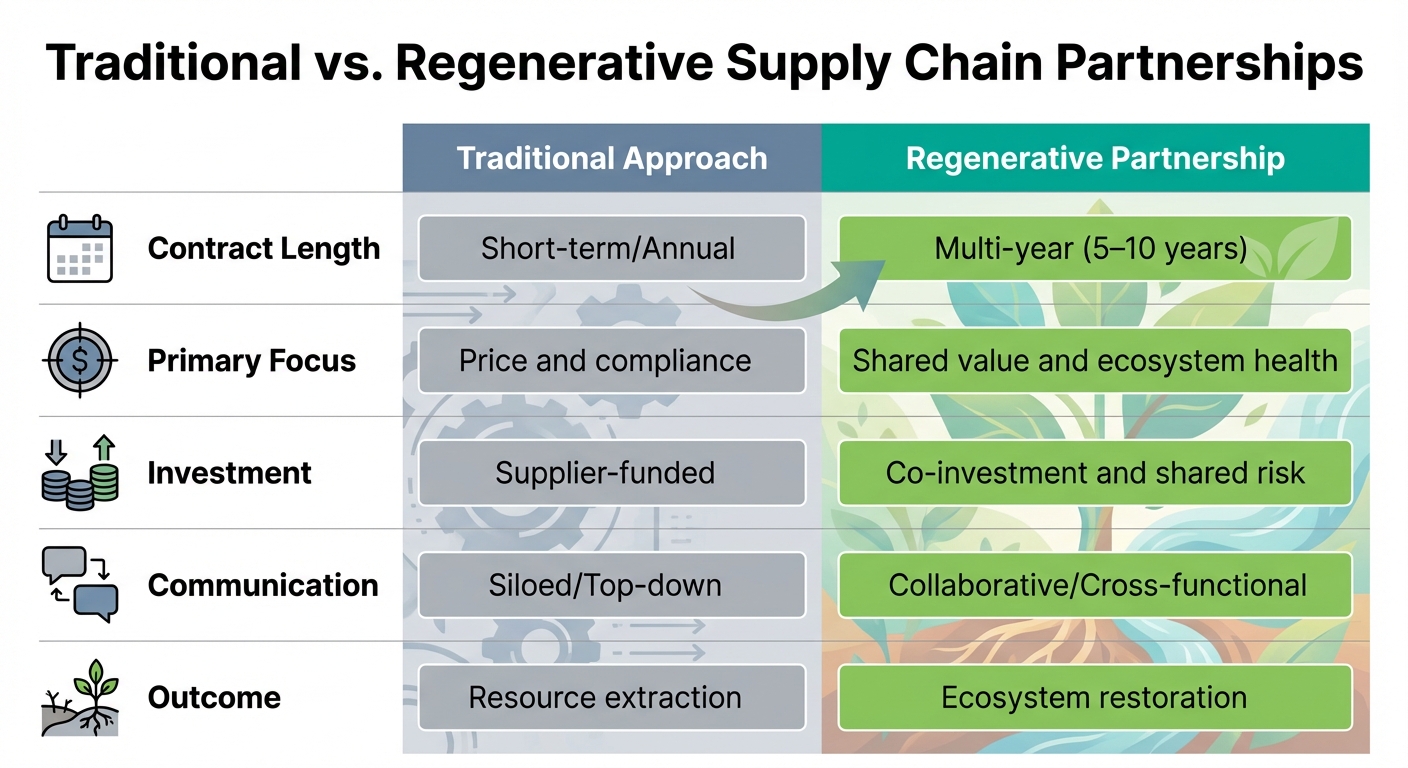
Traditional vs Regenerative Supply Chain Partnerships Comparison
Transitioning to regenerative supply chains isn’t just about small adjustments - it’s about rethinking how partnerships, resources, and success metrics are approached. These five key shifts provide a roadmap for evolving from traditional supply chains to ones that prioritize restoration and resilience.
Build Long-Term Partnerships Instead of Transactional Relationships
Short-term contracts don’t support the long timeframes needed for regenerative efforts. For instance, rebuilding soil health can take 5–7 years, while restoring watersheds may take decades [8]. Multi-year commitments - spanning 5 to 10 years - give suppliers the stability to invest in long-term ecosystem restoration.
Take multi-year collaborations as an example - they allow suppliers to adopt regenerative practices across larger areas [6]. To make this work, cross-departmental collaboration is essential. Nearly 70% of companies now share responsibility for sustainability initiatives across multiple teams, rather than isolating it within one department [11].
"Getting key stakeholders together throughout the value chain is really important. And more of that is needed…it takes both sides. It's not a one-way street." - Vaughn Duitsman, Director of Sustainability, Bartlett [11]
Beyond individual relationships, consider partnerships at a regional or "landscape-level." By working with other brands or stakeholders sourcing from the same area, companies can tackle shared environmental challenges and spread the financial burden. Currently, 80% of companies are engaging with supply chain and customer partners to co-develop and scale regenerative agriculture programs [11].
These long-term partnerships naturally lead to shared investments, creating a stronger foundation for regenerative supply chains.
Invest Together Rather Than Minimize Costs
Traditional procurement often focuses on cutting costs, but regenerative supply chains take a different approach - treating suppliers as true partners. Transitioning to regenerative practices comes with high upfront costs, and shared investment is crucial.
Co-investment models help cover these costs, providing funding for things like composting systems, water retention infrastructure, or training in practices like rotational grazing and agroforestry [8]. This collaborative approach not only supports suppliers but also aligns incentives.
The benefits are clear: regenerative farming has been shown to boost profitability by 78%, even with yield reductions of up to 29% [1]. Companies adopting circular economy initiatives also report operational cost savings of 10–30% [1]. Profit-sharing agreements could further align goals, offering suppliers guaranteed premiums or a share in brand value growth tied to measurable regenerative outcomes.
| Feature | Traditional Approach | Regenerative Partnership |
|---|---|---|
| Contract Length | Short-term/Annual | Multi-year (5–10 years) |
| Primary Focus | Price and compliance | Shared value and ecosystem health |
| Investment | Supplier-funded | Co-investment and shared risk |
| Communication | Siloed/Top-down | Collaborative/Cross-functional |
| Outcome | Resource extraction | Ecosystem restoration |
Set Outcome-Based Goals Instead of Short-Term Metrics
Short-term metrics like quarterly performance indicators don’t reflect the full value of regenerative efforts. Instead, success should be measured through long-term, outcome-based goals that focus on ecosystem health.
For example, track metrics like soil organic matter, water retention, biodiversity, and carbon sequestration [6]. Instead of measuring "tons of material recycled", aim for metrics like "percentage increase in soil carbon over three years" or "number of native pollinator species supported."
Maker’s Mark offers a great example. In November 2023, they filled their first Certified Regenified barrel of whiskey after their corn and wheat farm partners achieved Regenified certification. This milestone highlights how outcome-based goals can tie directly into premium product offerings [6].
"Regenerating ecosystems takes time. Soil health rebuilds over years. Watersheds restore over decades... Regenerative partnerships create the stability, resources, and shared incentives needed for genuine ecosystem restoration." - Sheri Hinish, Global Leader for Sustainability Services, EY [8]
Set clear timelines for implementation but remain flexible as conditions evolve. The focus should be on meaningful progress toward ecosystem improvements, not arbitrary quarterly targets that could undermine the long-term work required.
Use Systems-Based Approaches Instead of Isolated Practices
One-off interventions rarely lead to lasting change. Regenerative supply chains demand integrated strategies that address multiple environmental and operational challenges at once. For instance, combining rotational grazing with agroforestry can simultaneously improve soil health, biodiversity, and water filtration [6].
This approach requires viewing the supply chain as an interconnected network rather than a series of isolated transactions. Healthy ecosystems depend on a variety of factors - like habitat quality, crop diversity, and pesticide management - that need to be tackled together.
Start by mapping your supply chain’s environmental and social footprint. Identify key points where regenerative practices can have the greatest impact [1]. Partner with universities or NGOs for technical expertise and supplier training. This systems-based approach builds resilience, creating backup solutions if one part of the network faces disruptions.
By integrating multiple methods, regeneration becomes a strategic advantage rather than just a sustainability goal.
Treat Regeneration as a Value Driver, Not a Cost Center
The biggest mindset shift is understanding that regeneration isn’t just an expense - it’s an opportunity to create value. Regenerative practices can lead to price stability, higher product quality, and stronger brand reputation [4].
Consider these numbers: 70% of executives expect higher profit margins from circular operations compared to traditional models [4]. Circular funding globally reached $400 billion in 2024, up from $230 billion in 2021 [4]. In industries like heavy equipment manufacturing, remanufacturing programs have improved margins by 10–30% [4].
Regenerative practices also reduce reliance on limited resources and ensure supplier continuity. They make supply chains more resilient to climate-related disruptions and cost volatility by restoring value across materials and regional networks [5][6]. With Scope 3 emissions accounting for roughly 75% of a company’s total greenhouse gas emissions [5], addressing supply chain impacts is not just smart - it’s essential.
Approach regeneration as you would any growth initiative. Evaluate returns in terms of fewer supply disruptions, lower long-term input costs, premium pricing opportunities, and enhanced brand positioning. This isn’t about corporate responsibility - it’s about staying competitive.
Business Benefits of Regenerative Supply Chains
Regenerative supply chains, rooted in the practices discussed earlier, offer businesses clear advantages, delivering both financial and operational returns. Companies implementing these systems often see measurable gains in three key areas: resilience against disruptions, cost predictability, and improved market positioning.
Protection Against Disruption
The unpredictability of climate-related events and resource shortages has made supply chain disruptions a growing concern. In 2024, global supply chain disruptions surged by 38%, with extreme weather events alone causing a 119% increase in disruptions [14]. Companies with resilience frameworks in place fared significantly better, experiencing revenue losses of just 3–4% during disruptions, compared to 8% for those without such measures [14].
The benefits of regenerative practices are evident in yield protection. For instance, during the 2012 Midwest drought, using cover crops increased corn yields by 9.6% [13]. Similarly, no-till cotton systems in the U.S. Southeast achieved 22% higher yields during unusually wet periods [13], while diversified crop rotations reduced drought-related yield losses by 14% to 90% [13]. These practices not only safeguard yields but also promote healthier ecosystems.
Unilever's experience highlights the value of regenerative programs. In Spain, the company avoided a 40% loss in mustard seed yield through a two-year regenerative initiative. In contrast, in France, where such programs were not yet implemented, floods led to a complete loss of mustard production [12].
KIND's collaboration with Beewise Technologies offers another compelling example. By introducing AI-driven "BeeHomes" on its almond ranch in 2023, the company reduced honeybee colony losses from 40% to just 10% within a year [12]. This stabilized the pollination process, ensuring almond production in a region heavily affected by colony collapse disorder.
Cost Stability and Quality Improvements
Regenerative supply chains help businesses break free from the volatility of commodity and resource markets, providing greater cost predictability. Farmers using regenerative practices report achieving 70–120% higher profitability and a return on investment of 15–25% over a decade [12]. In the heavy equipment sector, circular and regenerative models have delivered margin improvements of 10–30% through remanufacturing and component recovery [4].
Water management is another area where regenerative systems shine. Intel's Ocotillo facility in Arizona, for example, treats nearly 10 million gallons of water daily via an on-site reclamation facility. This allows the company to return over 100% of its freshwater usage to the local watershed, ensuring operational continuity in an area facing severe water stress [12]. By 2050, regions responsible for nearly one-third of global GDP ($70 trillion) are expected to face high water stress [12].
Siemens has also demonstrated the cost-saving potential of regenerative practices. In India, the company retrofitted and refurbished electrical switchgear, retaining 70% of the original materials. This approach cut customer costs by 50% and extended equipment lifespan by over a decade [4].
Nestlé's Nescafé Plan 2030 offers another example of the financial and environmental benefits of regenerative supply chains. By February 2025, the program had achieved 32% regenerative sourcing for coffee, surpassing its 20% target. This shift led to a 20–40% reduction in greenhouse gas emissions per kilogram of coffee and mitigated potential climate-related costs estimated at CHF 11 billion [14]. Additionally, 200,000 farmers were trained in climate-smart practices, ensuring both supply stability and product quality.
| Performance Metric | Unprepared Organizations | Regenerative Framework |
|---|---|---|
| Revenue Loss During Disruption | ~8% [14] | ~3–4% [14] |
| Corn Yield (2012 Drought) | Baseline | +9.6% with cover crops [13] |
| Cotton Yield (Wet Climate) | Baseline | +22% with no-till [13] |
| Farmer Profitability | Baseline | +70–120% at steady state [12] |
| Recovery Time | >30 days | <7 days (leaders) [14] |
Stronger Brand Reputation and Market Position
Adopting regenerative practices doesn’t just improve operations - it also enhances a company’s market position. These commitments create a competitive edge, with 70% of surveyed executives anticipating higher profit margins from circular and regenerative approaches compared to traditional models [4]. Companies like Unilever and Nestlé have tied 15% of executive compensation to sustainability and supply chain resilience metrics, emphasizing their dedication to these goals [14].
Certifications further boost brand value. In November 2023, Maker's Mark introduced its first Certified Regenified barrel of whiskey, after achieving regenerative certification for all its corn and wheat farm partners [6]. This move established a new category for sustainable spirits and positioned the brand as a leader in this space.
Unilever’s €1 billion Climate & Nature Fund has also delivered tangible results. Between 2020 and 2024, the company transitioned 270,000 hectares to regenerative practices across 46 supplier projects. By 2024, it had achieved 97% deforestation-free sourcing for key commodities and reduced operational emissions by 70% since 2020 [14]. These initiatives resonate with consumers who increasingly demand transparency and accountability in environmental practices.
"At their core, regenerative value chains acknowledge that the best way to thrive in an uncertain future is to take care of the systems that support you." - Earth Finance [12]
As climate change continues to pose risks, with up to 25% of corporate profits potentially at stake by 2050 [12], regenerative supply chains offer a pathway to safeguard businesses while maintaining access to the $125 trillion in annual ecosystem services nature provides [12]. These strategies not only protect resources but also ensure resilience in an unpredictable world.
How to Implement Regenerative Practices
To bring circular leadership principles into action, implementing regenerative practices involves a structured approach. This can be broken down into three key phases: assessment, strategy, and execution [1].
Identify Your Supply Chain Impact Areas
Start by mapping out critical areas in your supply chain where environmental or social harm is most severe. Tools like Material Flow Analysis and remote sensing technology can help you pinpoint these "hotspots." These might include raw material sourcing, manufacturing processes, transportation, or end-of-life product management. These are the areas where regenerative practices can make the most difference [1][2].
Remote sensing tools and satellite imagery are particularly useful for monitoring ecosystem health. They not only provide baseline metrics but also allow for ongoing verification of improvements, such as increases in carbon sequestration or biodiversity [2]. Focus your efforts on regions where production has exceeded the capacity of local ecosystems, and prioritize initiatives like restoring native species and replenishing natural resources [17].
"Circular thinking and regenerative approaches make fiscal sense, shifting us toward restorative processes and designing for zero waste in end-to-end supply chain orchestration." - Sheri Hinish, Global Sustainability Services Lead, EY [2]
Once you've identified these impact areas, the next step is to build strong, cooperative relationships with your suppliers.
Develop Supplier Partnerships
Shifting to regenerative practices often requires long-term commitments with suppliers. For example, in April 2024, Danone established extended contracts with dairy farmers, providing them with financial stability to transition to regenerative farming methods despite market fluctuations [15].
These partnerships should focus on shared goals rather than just cutting costs. A good framework for this is transitioning from "Total Cost of Ownership" (TCO) to "Total Value of Ownership" (TVO). TVO includes factors like the recovery or resale value of materials at the end of their lifecycle. Siemens applied this approach in India by retrofitting and refurbishing electrical switchgear, retaining up to 70% of the original materials, cutting customer costs by up to 50%, and extending product lifespans by over ten years [4].
Another crucial step is working with product designers to ensure items can be easily disassembled for reuse or recycling. Reverse logistics systems, such as regional collection hubs for used products, can further support this process by feeding recovered materials back into the supply chain [9][15].
With partnerships and processes in place, the final phase is tracking and reporting your progress.
Measure and Report Your Progress
Traditional metrics don't cut it when it comes to regenerative systems. Instead, use circular metrics like asset return rates, reverse logistics efficiency, and material recovery percentages. These metrics reflect the ongoing value cycles inherent in regenerative systems. Technologies like Digital Product Passports, blockchain, and IoT sensors can provide transparency into material compositions and carbon footprints [9][15].
A notable example comes from Brambles/CHEP, which, by September 2021, sourced 100% of its pallet wood from sustainably managed forests. They took it a step further by committing to grow two trees for every one used in production [16].
"The question is no longer if your supply chain should be sustainable, but how quickly you can make it circular." - Circular Economy Alliance [9]
Designing products for durability and repairability is another essential aspect. These practices reduce the need for extracting new resources and extend product lifespans [5]. With global circular funding reaching $400 billion in 2024 - up $170 billion from 2021 [4] - investors are increasingly drawn to companies that demonstrate measurable regenerative success. Transparent reporting not only showcases environmental progress but also highlights financial benefits. In fact, 70% of executives surveyed believe circular operations will deliver higher profit margins than traditional linear models [4].
Conclusion
The move from traditional linear supply chains to regenerative ones isn't just about doing what's right for the environment - it's about ensuring businesses stay viable in the long run. Around 90% of a company’s environmental impact and 75% of its greenhouse gas emissions come from its supply chain [1][5]. With resource scarcity and tighter regulations becoming the norm, sticking to outdated models simply isn't sustainable anymore.
Regenerative practices go beyond minimizing harm - they actively work to restore environmental, social, and economic systems [1][5]. This approach fosters what experts call "antifragility", where supply chains not only endure disruptions but actually improve by closing material loops and reducing reliance on unstable virgin resources [9]. This resilience doesn’t just protect operations; it creates a competitive edge. Abe Eshkenazi, CEO of the Association for Supply Chain Management, highlights this perfectly:
Building a circular economic model is the best way to deliver resiliency, ensuring our supply chains withstand and bounce back from inevitable shocks - whether it is disease, disaster or war [7].
The benefits of regenerative initiatives are clear. Companies report cutting operational costs by 10% to 30% [1], and 70% of executives anticipate greater profit margins from circular operations compared to linear ones [4]. Additionally, with 73% of global consumers willing to adjust their habits to reduce environmental impact [1], businesses can enhance both their brand reputation and their position in the market.
Achieving this transformation requires a shift in leadership perspective. Success must be measured through the lens of Total Value of Ownership, prioritizing restoration over extraction and fostering long-term partnerships rather than short-term transactions. Steps like conducting a Material Flow Analysis to identify key areas for improvement, collaborating with suppliers as innovation partners, and adopting transparent tracking systems are essential to making meaningful progress. Businesses that take action now will set the standard for tomorrow.
As Seth Mattison, a keynote speaker and advisor, aptly puts it:
The future belongs to leaders who understand that sustainable excellence is rooted not in extraction, but in regeneration [3].
FAQs
How do you measure “regenerative” results in a supply chain?
To measure "regenerative" outcomes, it's crucial to evaluate both environmental recovery and social impact. On the environmental side, key indicators include soil health improvements, increased biodiversity, better water quality, and lower emissions or waste production. These metrics provide a clear picture of how well ecosystems are being restored.
Social impact is equally important. Metrics here often focus on supporting local farmers, enhancing livelihoods, and building stronger, more resilient communities. These measures ensure that the benefits of regenerative practices extend beyond the environment to the people directly involved.
To keep everything on track, comprehensive tools like circularity metrics are often used. These frameworks help monitor how materials and energy flow through supply chains, ensuring that every step contributes to ecological restoration and community well-being.
What’s the first step to start a regenerative supply chain program?
To start, it's essential to develop a well-defined strategy that moves past the usual ideas of sustainability. The goal should be to establish regenerative systems - systems designed to maintain and even increase the value of products and resources over time. This method prioritizes durability and aligns closely with the principles of circular leadership, fostering a forward-thinking and resilient approach.
How can long-term supplier contracts still work with price volatility?
Long-term supplier contracts can weather price volatility by incorporating flexible terms like price escalation clauses, index-based pricing, or specific renegotiation periods. These tools allow both parties to adjust to market shifts without undermining the partnership.
Adopting regenerative supply chain practices - like joint risk management and open communication - further strengthens resilience and trust. These approaches ensure contracts remain fair and beneficial for everyone, even when the market landscape becomes unpredictable.