
Articles Jul 6, 2026 12:18:38 PM Seth Mattison 11 min read

The short answer: change works better when I pair a clear direction with what people on the ground are seeing and feeling. If I lean only on top-down vision, people may comply without buying in. If I lean only on feedback, teams can lose focus.
Here’s the core idea in plain English:
- Leadership vision sets the destination, the reason for change, and what success looks like.
- Stakeholder input shows the day-to-day concerns: jobs, skills, cost, timing, customer impact, and team friction.
- Both matter at once. One gives direction. The other keeps the message tied to what people will face.
- The risk of imbalance is high: one cited stat says transformations are 5.8x more likely to succeed when senior leaders tailor the change story to different audiences.
- A better change story is simple: listen first, tighten the message, translate it into plain actions, and keep a steady update rhythm.
A few examples make this clear:
- Nokia: the “burning platform” memo named the crisis, but it did not give each audience a clear reason to stay with the change.
- Microsoft under Satya Nadella: one vision, but different wording for employees, investors, and developers.
Resolve Stakeholder Conflict & Gain Strategic Clarity Like Top Leaders
sbb-itb-9ceb23a
Quick Comparison
| Area | Leadership Vision | Stakeholder Perspectives |
|---|---|---|
| Main job | Set direction | Show ground truth |
| Focus | Future state, trade-offs, timing | Daily impact, concerns, blockers |
| If used alone | Polite agreement, low buy-in | Drift, slow choices, mixed signals |
| Best use | Explain where and why | Explain how it lands for people |
| What I should do | Keep the message clear | Test and sharpen the message |
If I had to sum up the article in one line, it would be this: the strongest change story is not just clear from the top - it also sounds true to the people living it.
Leadership vision and stakeholder perspectives: what each brings to change communication
Leadership vision and stakeholder perspectives work best together. One sets the course. The other makes that course believable. In change communication, the strongest story is both clear in direction and grounded in what people will actually experience.
Leadership vision defines the future state
Leadership vision points to where the organization is headed. It explains where the business is going, why the change needs to happen now, and what success should look like. Leaders usually see the bigger picture: strategic trade-offs, market position, and budget limits that frontline employees may not have access to. Vision gives people that missing context.
It also acts as a decision filter. Transformations are 5.8 times more likely to succeed when senior leaders communicate a change story tailored to different audience stakes [4]. Without that kind of clear vision, change can slide into quiet resistance or simple compliance without commitment [1].
Still, clarity on its own isn’t enough. It has to connect with what people care about day to day.
Stakeholder perspectives surface real concerns and motivations
The other part of the story comes from the people affected by the change. Stakeholder perspectives show what employees, customers, investors, and other groups are actually worried about: job security, skill gaps, costs, returns, and product alignment.
Stakeholder mapping does its job when it spots the gap between what leadership intends and what people on the ground see. When stakeholders help shape the narrative, the change feels shared instead of handed down. Change is more likely to stick when employees are invested in the story [5].
The contrast gets easier to see when you put both side by side.
| Leadership Vision | Stakeholder Perspectives | |
|---|---|---|
| Primary focus | Target future and strategic "why" | Real concerns and personal impact |
| Key benefit | Gives the organization direction and alignment | Builds trust, ownership, and adoption |
| Risk if ignored | Lack of strategic clarity; "suggestion box" chaos | Quiet resistance; compliance without commitment |
| Narrative role | Direction | Lived experience |
When one side takes over, the story starts to fall apart. The next section shows where that imbalance tends to show up.
Stakeholder perspectives vs. leadership vision: a direct comparison
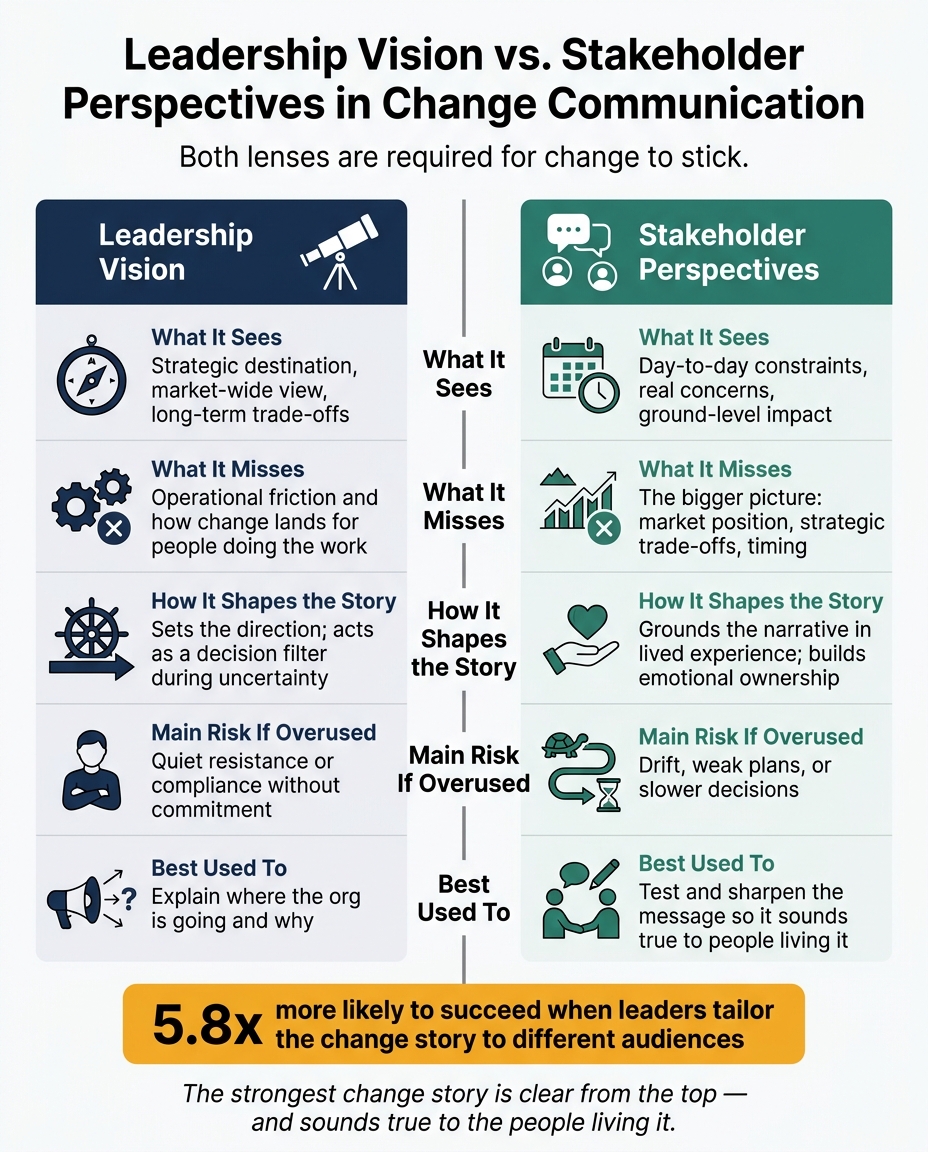
Leadership Vision vs. Stakeholder Perspectives in Change Communication
Leadership vision points the way. Stakeholder perspectives pressure-test that direction against what people face each day. In change communication, one lens sets the path; the other keeps the message grounded. You see the difference most clearly in how each one shapes the story.
Comparison table: direction vs. reality in change communication
| Leadership Vision | Stakeholder Perspectives | |
|---|---|---|
| What it sees | Strategic destination, market-wide view, and long-term trade-offs | Day-to-day constraints, real concerns, and ground-level impact |
| What it misses | Operational friction and how the change lands for people doing the work | The bigger picture: market position, strategic trade-offs, and timing |
| How it shapes the story | Sets the direction and acts as a decision filter during uncertainty | Grounds the narrative in lived experience and builds emotional ownership |
| Main risk if overused | Quiet resistance or compliance without commitment | Drift, weak plans, or slower decisions |
What goes wrong when one side dominates
Trouble starts when one lens pushes out the other.
If leadership vision takes over without enough stakeholder input, the story can drift into lofty language that sounds good but gives people little they can use. Employees may nod in meetings while checking out in private. That isn't alignment. It's compliance.
Nokia's 2010 "burning platform" memo shows how this can play out when a change story leans too hard on internal problems and not enough on stakeholder perspective. CEO Stephen Elop focused on leadership gaps and collaboration failures, but the message did not give shareholders or customers a clear story to act on [2].
The other side has its own problem. If stakeholder concerns take over without a clear directional vision, the organization can lose its way. Each team starts reading the change through its own lens, and the work no longer moves in a shared direction. As Kristin Arnold notes:
"When vision is delivered from on high, what you often get is compliance, polite nodding, or worse… passive-aggressive resistance." [1]
The point isn't to choose one lens over the other. It's to turn both into a story people can use. That starts with listening, then tightening the narrative.
How to balance both in one change story
Balance takes work. First, you listen. Then you tighten the story. Stakeholder feedback should help sharpen the message, not push leaders to give up the direction.
Start with listening, then sharpen the narrative
Before broad messaging goes out, leaders need to know what different groups are worried about losing, what they hope to gain, and what still feels unclear before they can commit. The goal is simple: find the gaps between the message and what people are seeing day to day. Use that input to tighten the story. Don’t let it steer the strategy off course.
Pay close attention to informal conversations too. That’s often where the real story shows up - the one people are already telling each other. Informal conversations shape change outcomes as much as formal top-down communication from senior leaders [6]. If there’s a gap between the official message and what people believe, treat that as feedback on the narrative, not a cue to water down the vision.
One practical move is to ask a small cross-section of employees to explain the change in their own words [7]. If their answers are fuzzy, scattered, or all over the map, the narrative hasn’t landed yet. That usually means the message needs to be sharpened.
Translate the vision into language people can act on
Make the vision concrete. A clear destination doesn’t help much if people can’t tie it to the work sitting on their desk today. So move from abstract intent to plain, observable language.
A good test is this: if a camera can't film it, it's too vague [4].
“Driving operational excellence” doesn’t pass. “Your team will own the client onboarding process end-to-end by Q3” does. One sounds polished. The other tells people what will actually change.
Build shared ownership through participation and trust
Once the story is clear, bring people into shaping how it lands. People are more likely to back a change when they’ve had a hand in making sense of it. When stakeholders help shape how the change is framed and communicated, they absorb the direction instead of just hearing it. That’s alignment. It’s not a vote on strategy.
Trust also grows when leaders are upfront about what’s hard. A clear reality statement before the vision helps here. Name what’s difficult, what’s uncertain, and what may take longer than expected. That honesty builds the credibility leaders need when asking people to follow a path they can’t fully see yet [3].
Steady communication rhythms help keep that trust in place. A short weekly update can do more than polished announcements that show up out of nowhere [7]. That rhythm gives leaders a way to catch confusion early and keep the story tied to what people are actually experiencing.
Conclusion: balanced storytelling as a leadership advantage
This balance doesn't lead to softer messaging. It leads to better execution. Leadership vision sets the direction, and stakeholder perspectives keep that vision grounded and believable.
That kind of consistency is what turns a change story into a shared way of working. Leaders who do this well don't treat storytelling like a one-off announcement. They treat it as an ongoing discipline [2]. And that discipline builds trust through change.
As AI makes polished content easier to produce, people are getting more skeptical of messages that don't feel lived-in or real. In that setting, stories rooted in stakeholder reality stand apart. Trust comes from honest reality, shaped by human judgment - the part machines can't copy.
"Data explains what is happening; narrative explains why it matters and what comes next." - Zoë Arden, Fellow, University of Cambridge Institute for Sustainability Leadership [8]
Seth Mattison's Human Moat framing lands here in a simple way: the edge comes from trust, alignment, and steady performance. Balanced storytelling is the moat.
FAQs
How do I know if our change story is too top-down?
Your change story is probably too top-down when it lands like a done deal instead of a process people can help shape. In that case, teams often read it as manipulation or denial, and they push back.
It can also feel cut off from day-to-day work when it skips over limits that front-line teams already know well, or when it leaves out the people who are supposed to carry the work forward. If employees see it as a “poster on the wall,” that’s a strong sign you missed co-creation.
Who should be included in stakeholder input first?
Start with a broad mix of stakeholders, including executives, team leads, customers, and people on the front lines.
Bringing them in early helps leaders spot blind spots, test assumptions, and tie the vision to day-to-day work instead of keeping it abstract. External partners, donors, and community members can add helpful perspective too.
How often should leaders update people during change?
Leaders should treat updates as a steady drumbeat, not a one-time announcement. A vision needs to be reintroduced and grounded again and again as conditions change.
To keep trust and momentum in place, communicate with clarity and consistency. Pair bold goals with honest progress updates, and stay focused on what can be done now before rolling out later phases.
Related Blog Posts

Seth Mattison
Top 50 Keynote Speakers in the World | Future of Work Strategist | Co-Founder & CEO