
Articles Mar 27, 2026 9:00:00 AM Seth Mattison 18 min read

Storytelling isn't just for entertainment - it's a leadership tool that connects with emotions, simplifies complex ideas, and motivates teams to act. Research shows stories activate more brain regions than data alone, making them 22 times more memorable. Leaders can use storytelling to build trust, clarify goals, and overcome resistance during times of change.
Here are five techniques leaders can use:
- Share Personal Stories: Build trust by sharing your own experiences, including failures that led to growth.
- Paint a Clear Future: Use narratives to describe a shared vision, connecting current challenges to future success.
- Connect Emotionally: Relate to your team by sharing real challenges and how they were overcome.
- Create Shared Ownership: Involve your team in crafting the narrative, turning it into a collective journey.
- Address Resistance: Use relatable stories to reframe fears and inspire action.
These methods help leaders replace disengaging data-heavy presentations with stories that resonate emotionally, making change more relatable and actionable.
Storytelling for Leaders: How to Connect, Influence, and Drive Change [Frameworks Reimagined]
sbb-itb-9ceb23a
1. Share Personal Stories That Build Trust
Sharing personal stories can bridge the gap between leaders and their teams, creating a sense of connection and understanding. When leaders open up with a "Who Am I" or "Why I'm Here" narrative, they allow their team to see them as individuals with values, motivations, and purpose. This is especially impactful when meeting a new team or during moments of change. By sharing the pivotal experiences that shaped their leadership style, leaders make their decisions feel more personal rather than simply corporate directives.
Being vulnerable is key to building trust. Take Microsoft CEO Satya Nadella, for example. He has shared heartfelt stories about his son's disabilities, tying those experiences to his vision for accessible technology. Similarly, during Motorola's tough turnaround, former executive Greg Brown openly discussed his own mistakes and the lessons he learned along the way, fostering trust in a high-pressure environment. As Brené Brown wisely notes:
"Vulnerability is where genuine trust and connection begin."
These examples highlight how vulnerability can transform leadership into something relatable and trustworthy. The most effective personal stories often focus on failures that led to growth. Sharing those "Lesson I'll Never Forget" moments - times when things didn’t go as planned - shows that setbacks are part of the journey and that learning from them is invaluable. Steve Jobs famously spoke about being fired from Apple in 1985, reframing it as an opportunity for reinvention. His story inspires others to see challenges as opportunities rather than roadblocks.
What matters most is being genuine. Research shows that 86% of consumers value authenticity when deciding which leaders to support. People can quickly sense when a story feels forced or insincere, and that can do more harm than good. To build trust, focus on real-life moments, include vivid details, and keep your stories short and to the point.
2. Describe a Clear Picture of the Future
Personal stories build trust, but a clear vision channels that trust toward a shared future. A well-defined vision does more than outline goals - it generates what experts call "creative tension", the driving force that helps people push through the challenges of change [9]. This vision connects today’s struggles with tomorrow’s possibilities, creating a roadmap for transformation. Without it, employees may feel disconnected, unsure of how their daily efforts contribute to a larger purpose.
Leaders often rely on "Growth Stories" or "Transformation Stories" to connect the present with future aspirations, making ambitious goals seem achievable rather than intimidating [7][3]. Instead of overwhelming teams with endless data, they paint a vivid mental picture of what success looks like [8]. Think of Steve Jobs’ iconic phrase, "a thousand songs in your pocket." With just a few words, he made the iPod’s value instantly clear and relatable [2]. This kind of vision fosters a shared narrative, turning individual contributions into part of a bigger mission.
Science backs this up: while data and logic activate only two areas of the brain, a compelling story lights up seven regions, making facts 22 times more memorable [1][3]. Despite this, only 22% of employees strongly feel their leadership has a clear direction for the organization’s future [7].
To make your vision resonate, try using the "Imagine" prompt. Ask your team to envision a future where today’s frustrations are gone [9]. Describe specific scenarios: a colleague completing a task without hitting roadblocks, a customer receiving their product seamlessly, or a meeting where everyone is aligned and motivated. As Peter Senge wisely put it:
"Few, if any, forces in human affairs are as powerful as a shared vision."
The real magic happens when individuals see how their work contributes to the bigger picture. When employees can connect their daily tasks to the broader mission, they feel empowered to make a difference [6].
Striking the right balance between optimism and realism is essential. Acknowledge the challenges ahead, but keep the focus on actionable solutions [6]. Lay out clear steps with measurable outcomes to keep the vision grounded [6]. Framing change as a collective movement - something bigger than just hitting targets - engages not only minds but also hearts [7].
3. Build Emotional Connections Through Relatable Challenges
Using real challenges to connect emotionally with your team can make a huge difference. While personal stories and clear visions are powerful, sharing honest accounts of struggles adds another layer of relatability. These aren’t polished success stories - they’re about failed projects, frustrated customers, or inefficient processes. Why? Because when people recognize their own experiences in those stories, they feel understood. And that emotional connection clears the way for deeper engagement and openness to change.
This approach isn’t just about creating a feel-good moment; it’s backed by neuroscience. Storytelling activates neural coupling and releases oxytocin, which strengthens trust and empathy [10][2]. It’s why stories are remembered far better than raw data - retention rates for stories hit 65–70%, compared to a mere 5–10% for statistics alone [3].
One effective way to frame these challenges is by using the "Somebody Wanted, But, Then, So" method. This technique highlights the obstacle - the "But" - that stood in the way of success [10]. By tapping into universal emotions like fear of failure or the need for growth, leaders can create the kind of vulnerability that fosters genuine trust [2].
A simple yet powerful way to prepare for these moments is to maintain a "Story Bank." Keep track of authentic moments from meetings, customer feedback, or even your own career lessons [1]. When the time comes to lead a change initiative, you’ll have relatable, real-world examples ready to go. Focus on characters your team knows - whether it’s a colleague, a customer, or even yourself in a non-glorified role [1]. Sharing stories about past missteps can not only help avoid repeating those mistakes but also promote psychological safety [2].
As Sharon Podobnik Peterson, Founder of The Center for Conscious Leadership, aptly says:
"Facts inform. Stories transform." [10]
The key is showing growth alongside vulnerability. When you share a challenge, pair it with the insights or progress it led to. This contrast between "then" and "now" inspires your team. They don’t just hear about change - they believe it’s achievable because someone they trust has lived it. These authentic reflections can lay the groundwork for collective ownership and drive meaningful transformation.
4. Create Shared Ownership Through Collective Narratives
The best change stories aren't just told by leaders - they're built with the team. When leaders shift from simply delivering a message to inviting collaboration, the story grows from being a leader's vision into a shared journey. This approach creates alignment within the team, reinforcing what experts call neural coupling, where perspectives naturally sync up [3].
The trick is making sure everyone sees themselves in the story. Use relatable characters - whether that's colleagues, customers, or even yourself presented honestly [1]. When employees recognize themselves in the narrative, it stops being just a story and starts feeling personal. Studies show that people are 22 times more likely to remember facts when they're part of a story [1]. By highlighting non-executive team members in your "values stories", you send a powerful message: this culture belongs to everyone, not just the leadership team [3]. This shared ownership strengthens the organizational culture and positions every team member as a key player in the change process.
Co-creating stories turns passive listeners into active participants. This shared effort deepens engagement and builds stronger connections. Catherine Connors, Founder of StoryQuo and former Head of Content at Disney Interactive, captures this idea perfectly:
"The real power of storytelling is in how we invite others to take the story on as their own" [5].
When team members contribute, they help shape the path forward [12]. This collaborative approach fosters trust and creates a sense of psychological safety, with research showing that team members feel 37% safer when they’re actively involved [3].
To get started, try storytelling exercises where team members interview and introduce each other. This builds respect for each person’s unique professional journey [11]. You can also use short, open-ended narratives that allow employees to imagine the story in their own context [12]. The goal is to answer the question, "What's in it for me?" for every employee, showing them how the change will make their future brighter [11]. When you focus on team accomplishments rather than executive plans - especially in all-hands meetings - you create a sense of shared identity that sticks [3].
As Matthew Luhn, former Pixar storyteller and author, points out:
"It's not just about the hero, it's about the mentors and allies that go on the journey with the hero on their journey" [13].
When your team helps craft the narrative, they become those allies - engaged, invested, and ready to push the change forward. This collective storytelling lays the foundation for action and helps overcome resistance along the way.
5. Use Stories to Drive Action and Address Resistance
Change often shakes up established roles and expectations, creating a sense of unease when reality doesn’t align with what people anticipated. Stories are a powerful way to bridge this gap, connecting the disruption to a meaningful purpose. They allow leaders to reshape negative perceptions and address the fears that often go unspoken.
The magic of storytelling lies in its ability to combine logic with emotion. While data provides the facts, stories bring them to life. As storytelling coach Jordan Bower puts it:
"Data informs people, but stories move them." [14]
To turn resistance into momentum, stories need to engage both the mind and the heart. One effective approach is using springboard stories - short, impactful narratives with clear takeaways that show how change is achievable. Frameworks like CATS (Characters, Actions, Time, and Setting), told in the present tense, create relatable and immediate connections with your audience.
Being vulnerable in your storytelling can also foster trust and connection. Sharing personal experiences of uncertainty or even past mistakes demonstrates that struggles are part of growth. By addressing the challenges and the turning points in your story, you encourage your team to lean into the discomfort of change. Research highlights that leaders who are perceived as authentic build trust more effectively [2].
Another useful habit is maintaining a story bank. Collect moments from meetings, customer feedback, or personal insights regularly. Having these ready allows you to draw on meaningful narratives during crucial moments of change. Leadership experts like keynote speaker Seth Mattison emphasize this practice as a way to build resilient teams and nurture growth throughout an organization. These shared stories turn change into a collaborative experience, shifting it from something imposed to something embraced. With the right narratives, leaders can guide their teams through transitions as a united journey.
Comparison Table
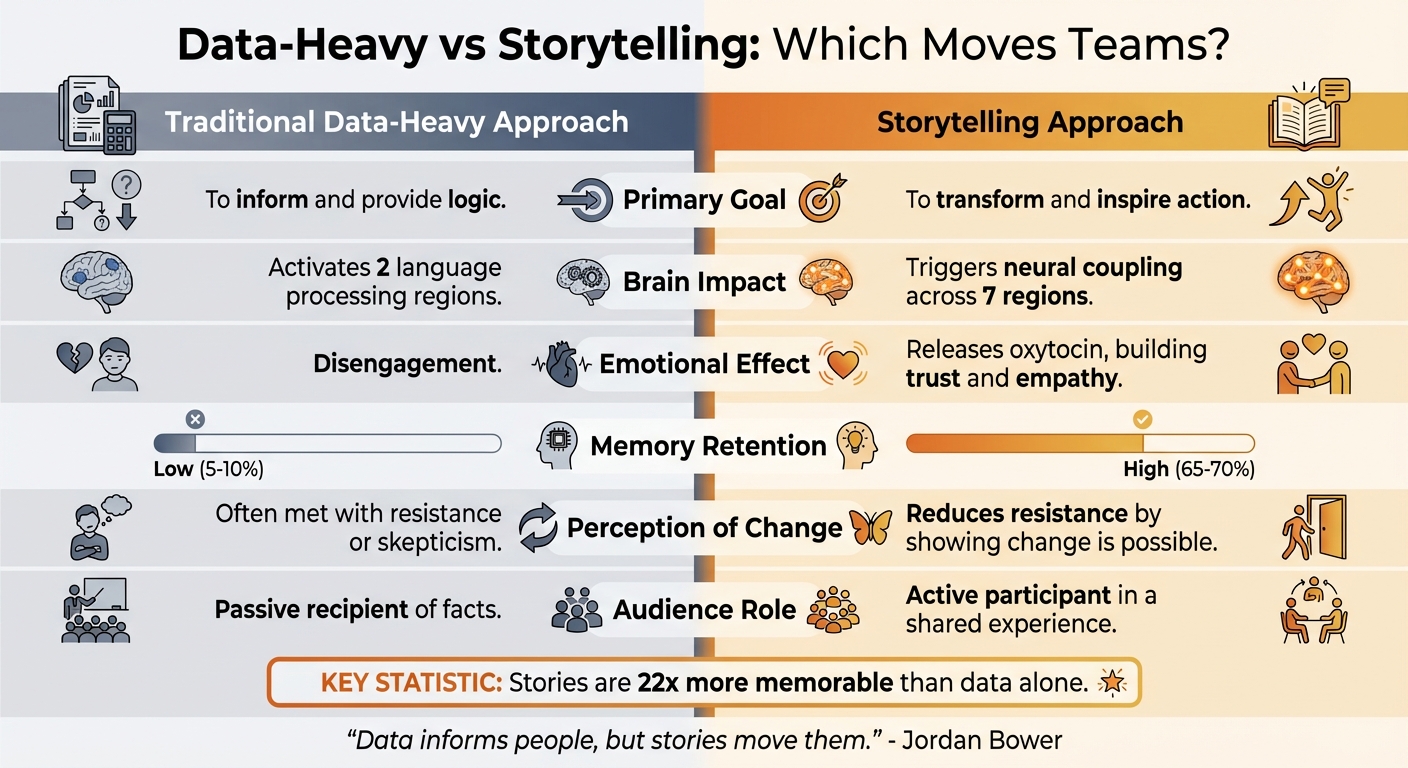
Data vs Storytelling: Impact on Brain Activity and Memory Retention
The table below highlights the key differences between traditional data-heavy presentations and storytelling approaches. When it comes to driving organizational change, the way leaders communicate can make all the difference. Traditional methods rely heavily on data, while storytelling taps into human emotions and connections, leading to far more impactful outcomes.
Research shows that while data-driven presentations activate only a few areas of the brain, storytelling triggers "neural coupling", engaging multiple regions like motor, sensory, and emotional centers [3]. This means stories go beyond just presenting facts - they explain why those facts matter by focusing on the people and emotions behind the numbers [15]. In fact, stories are up to 22 times more memorable than plain data [1][2].
"We should never let our data speak for itself... In every shocking statistic... there's a heroic story waiting to be revealed" [15].
This comparison underscores why storytelling can be so powerful in influencing and inspiring teams.
| Feature | Traditional Data-Heavy Approach | Storytelling Approach |
|---|---|---|
| Primary Goal | To inform and provide logic | To transform and inspire action |
| Brain Impact | Activates 2 language processing regions | Triggers neural coupling across 7 regions |
| Emotional Effect | Disengagement | Releases oxytocin, building trust and empathy |
| Memory Retention | Low (approx. 5–10%) | High (approx. 65–70%) |
| Perception of Change | Often met with resistance or skepticism | Reduces resistance by showing change is possible |
| Audience Role | Passive recipient of facts | Active participant in a shared experience |
This shift from data-heavy presentations to storytelling doesn't just inform - it motivates. While spreadsheets and charts often lead to disengagement, stories create a shared experience that draws audiences in, making them feel part of the journey [2][3]. Leaders who use storytelling don’t just share information - they spark action and foster connection.
Conclusion
These five storytelling techniques offer a solid framework for fostering trust and inspiring meaningful change. When leaders share personal anecdotes, craft vivid visions of the future, build emotional connections, create shared narratives, and use stories to address resistance, they go beyond mere communication. They're cultivating the psychological safety and trust that teams need to adapt to change effectively [4][2]. Both research and practical experience back up these methods, showing their impact in real-world scenarios.
The data is compelling. Stories significantly boost memory retention and stimulate oxytocin release, which helps build trust and empathy [1][2]. This shift in approach can deeply influence team engagement and reshape how employees perceive and respond to organizational changes.
As one expert put it:
"In times of constant change, stories can remind people why their work matters, how they fit into something larger than themselves, and highlight what's possible." – Entrepreneur [4]
At the heart of it all is emotional connection. While facts appeal to logic, stories resonate with emotions, and it's that emotional impact that drives action.
Leaders can amplify their storytelling by adopting a structured narrative approach [2] and maintaining a "Story Bank" filled with authentic moments from team interactions and customer feedback [1]. This ensures they always have meaningful, relatable stories to share. By weaving these strategies into their communication, leaders help every team member see their place in a unified vision.
For those ready to refine their storytelling skills and lead transformative change, Seth Mattison offers keynote presentations, workshops, and advisory services tailored to elevate your communication and guide you through complex transitions.
FAQs
How do I pick the right story for a change message?
Picking the right story structure can make all the difference when it comes to connecting with your audience on an emotional level. Frameworks like the Hero's Journey, ABT (And-But-Therefore), or ADKAR can help you craft a narrative that aligns with your communication goals.
- The Hero's Journey works well when you want to inspire transformation. This structure takes your audience through a relatable journey of challenges and triumphs, making the message more impactful.
- For concise and clear messaging, the ABT framework is a great option. It simplifies your story into three parts: a setup (And), a conflict (But), and a resolution (Therefore).
- If you're aiming for change management or personal development, ADKAR can guide your storytelling. It focuses on Awareness, Desire, Knowledge, Ability, and Reinforcement to drive action.
The key is to ensure your story speaks directly to your audience's fears, hopes, or motivations. When people see themselves in the narrative, the message becomes more relevant and encourages them to take action.
How can I use stories without oversharing at work?
To tell stories effectively without crossing into oversharing, focus on making them relevant and tied to your leadership objectives. Start by giving your story a clear purpose and context, ensuring it aligns with your vision. This keeps your message focused and avoids unnecessary tangents.
It's also important to strike a balance between vulnerability and professionalism. Share enough to connect with your audience, but steer clear of overly personal or unrelated details. Tailor your stories to resonate with your listeners, keeping their needs and interests in mind.
Finally, anchor your storytelling in your organization's values. This not only builds trust but also helps you maintain appropriate boundaries while delivering a message that inspires and motivates.
How do I measure if storytelling is driving change?
To understand if storytelling influences change, focus on metrics like surveys and engagement data to gauge its effects on behavior, trust, and emotional connection. Pay attention to how well key messages are remembered - after all, stories are 22 times more memorable than standalone facts. Look for signs of behavioral changes, such as greater motivation or increased participation. By combining these approaches, you can get a clearer view of how storytelling contributes to driving change within an organization.