
Articles Mar 18, 2026 9:00:00 AM Seth Mattison 26 min read

Navigating ambiguity is now a core challenge for leaders. With constant changes in technology, the economy, and global dynamics, decision-making often happens without clear information or predictable outcomes. Here's how leaders can succeed in uncertain times:
- Understand Ambiguity: It's about dealing with unknowns - situations without clear probabilities or complete data.
- Provide Stability: Focus on principles, short-term goals, and clear communication instead of rigid plans.
- Build Resilience: A growth mindset, values-driven decisions, and learning from mistakes are key.
- Take Action: Use small, reversible steps to gather insights and stay flexible.
- Communicate Clearly: Be transparent about knowns and unknowns, repeat goals often, and check in regularly with your team.
Leaders who embrace uncertainty as an opportunity to learn and improve can guide their teams through challenges with confidence and clarity.
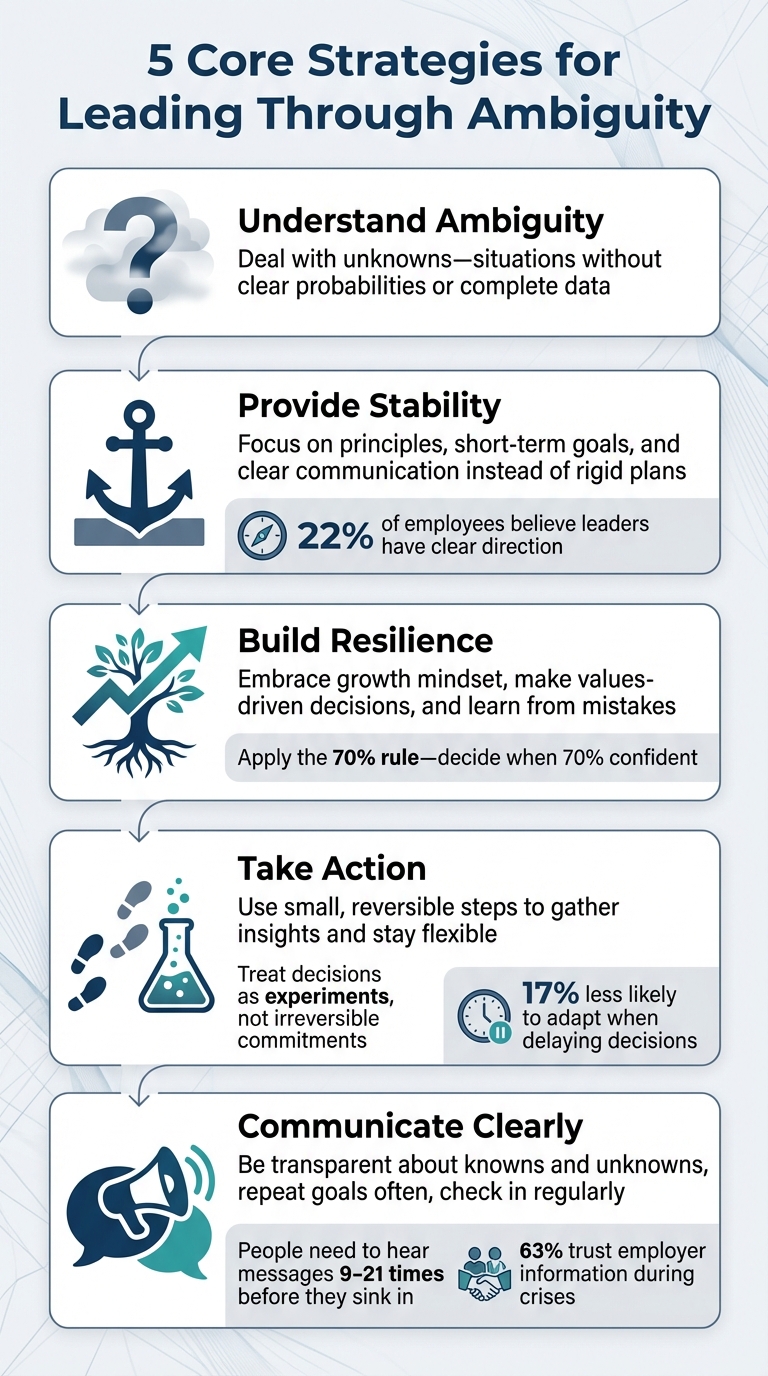
5 Core Strategies for Leading Through Ambiguity and Uncertainty
Building a Resilient Leadership Mindset
A resilient mindset sets thriving leaders apart from those who stumble in uncertain times. While external factors may remain unpredictable, how leaders interpret and respond to these challenges is entirely within their control. According to Harvard Business Publishing, the ability to "embrace ambiguity and uncertainty" is becoming one of the most sought-after leadership skills. Additionally, the CEO Genome Study by ghSMART reveals that leaders who navigate ambiguity effectively are far more likely to succeed [3]. This mindset builds upon the stability strategies discussed earlier.
Adopting a Growth Mindset
Leaders with a growth mindset don’t see ambiguity as a threat - they see it as an opportunity for innovation [1]. This perspective shifts how decisions are approached. Instead of waiting for perfect data, resilient leaders take proactive steps. They make small, exploratory moves that generate new insights and help clarify the way forward [1].
A great example of this is StageKings, an Australian event set-building company. When the pandemic hit in March 2020, their core business collapsed overnight. Instead of shutting down or laying off staff, the company pivoted by launching IsoKing, a line of flat-packed furniture. This new venture quickly gained traction and eventually outperformed their original business [1].
This kind of adaptability hinges on cognitive resilience - the ability to juggle conflicting ideas without rushing to premature conclusions. Leaders can maintain momentum by distinguishing between reversible decisions (Type 2), which can be adjusted later, and irreversible ones (Type 1), which require more careful deliberation [7].
Making Decisions Based on Core Values
A growth mindset is only part of the equation. Anchoring decisions in core values provides steady guidance when external circumstances are chaotic. When data is unreliable or shifting rapidly, core values act as a compass [4]. Damien Dwin, Founder and CEO of Lafayette Square, demonstrated this in January 2025. By rejecting traditional credit models and aligning his investment strategies with purpose, he developed financing solutions for underserved communities, achieving both financial and social goals [5].
"The landscape is always shifting. If you wait for absolute clarity, you'll miss the window for impact." - Damien Dwin, Founder and CEO, Lafayette Square [5]
Values-based decision-making also helps leaders avoid letting emotions interfere with strategy. By cultivating metacognitive awareness - the ability to identify and name emotions like fear or doubt - leaders can ensure that their judgment remains clear. Tools like the I.B.C.O. framework offer practical steps for this process: Intent (defining your guiding purpose), Boundaries (establishing non-negotiables), Checkpoints (setting decision milestones), and Options (outlining paths with clear triggers for change). This approach ensures decisions align with core values while remaining flexible [4]. With this foundation, leaders can turn setbacks into opportunities for growth.
Treating Mistakes as Learning Opportunities
Resilient leaders understand that progress matters more than perfection. Colin Powell’s "70% rule" is a great example of this philosophy: make decisions when you’re 70% confident, rather than waiting for absolute certainty. This approach avoids paralysis and allows leaders to adjust as new information becomes available [3][6].
Jeff Bezos embodied this mindset at Amazon. When launching Amazon Prime and Fulfillment by Amazon (FBA), he faced significant internal pushback and financial risks. Yet, he relied on what he called "expert intuition" and a willingness to experiment, even without guaranteed success [6]. As Bezos himself put it:
"All of my best decisions in business and in life have been made with heart, intuition, guts… not analysis." - Jeff Bezos, Founder, Amazon [6]
To turn mistakes into learning opportunities, leaders can implement checkpoints to assess progress and pivot if needed [7]. Additionally, creating "quit criteria" alongside success metrics prevents the trap of continuing a failing effort just because time or resources have already been invested [4]. By treating mistakes as part of the process, leaders can build strategies that are both adaptable and informed.
Practical Strategies for Managing Ambiguity
Managing uncertainty requires more than just human-centric leadership and a resilient mindset - it demands actionable strategies that leaders can apply daily. These approaches help maintain forward momentum while allowing for necessary adjustments along the way.
Using Core Values as Anchor Points
When external conditions are chaotic or unpredictable, core values can act as a guiding light. While strategies and tactics may need to shift, sticking to a clear purpose ensures everyone stays on the same page, even when the path ahead is uncertain. Take Airbnb in early 2020 as an example. Faced with a massive revenue drop during the pandemic, Airbnb's leadership leaned on their mission of "helping people belong anywhere." This focus helped them prioritize actions like preserving cash, supporting their host community, and halting nonessential projects - all while staying true to their purpose [4].
The I.B.C.O. framework builds on this idea by providing a structure for values-based decision-making:
- Intent: Define your overarching goal and the specific problem you're solving.
- Boundaries: Set clear limits that cannot be crossed.
- Checkpoints: Identify decision points where evidence will determine whether to proceed.
- Options: Keep multiple pathways open, with clear triggers for when to pivot.
This framework ensures that while your desired outcome remains constant, the methods you use to achieve it can adapt as needed.
Making Small, Reversible Decisions
Waiting for perfect data often leads to paralysis. Instead, effective leaders take small, calculated steps to gather insights and adjust their approach. This method allows for continuous learning without locking into a single, irreversible course of action. Amazon founder Jeff Bezos famously referred to these as "two-way door" decisions - choices that can be reversed if needed, as opposed to one-way doors that are final.
Organizations that embrace this mindset can pivot more easily when challenges arise. To avoid falling into the sunk-cost trap, set clear "quit criteria" before starting a project. Pair these with success metrics to measure progress objectively. Keeping a simple decision log can also help teams track their reasoning, making it easier to view course corrections as learning opportunities rather than failures.
Incremental decisions like these need regular alignment to stay effective.
Checking for Alignment Regularly
Frequent check-ins are essential to keep teams on track during uncertain times. Weekly stand-ups and bi-weekly reviews can help assess progress, address unknowns, and respond to shifting conditions.
"The quickest way to lose a team in ambiguity is to substitute activity for agreement, or to mistake head-nods for shared understanding." - Mike Fisher, Author, Fish Food for Thought
Another helpful tool is a confidence index, which measures team confidence at critical decision points. If confidence wanes despite growing evidence, it may be time to reconsider your approach. Setting medium-term goals - such as three-month targets - can also provide a sense of stability while leaving room for adjustments.
Before making major decisions, consider running a short pre-mortem exercise. In these sessions, the team imagines a scenario where the project fails six weeks down the line and works backward to identify potential risks. This process can uncover issues early, allowing for proactive solutions before problems escalate.
How to Communicate During Uncertain Times
Effective communication becomes a cornerstone for guiding teams through uncertainty. The way you share - or fail to share - information can either anchor your team or leave them feeling adrift. Clear, honest communication reinforces objectives and keeps the team connected, even during turbulent times.
Why Transparency Matters
When communication is unclear or absent, employees often assume the worst. In fact, only 22% of employees strongly believe their leaders have a clear direction for the organization [8]. A lack of transparency can quickly undermine trust.
"Uncertainty triggers fear. People are freaking out and wondering, 'What does this mean for my company, my job, and my future?'" - Paul Argenti, Professor of Corporate Communication, Tuck School of Business at Dartmouth College [11]
The best approach is to be upfront about what you know - and what you don’t. Amy Edmondson, Novartis Professor of Leadership and Management at Harvard Business School, advises leaders to say: "Here's what we do know, here's what we don't know, and this is what we are doing to close that gap" [11]. Speculation can harm your credibility, but acknowledging uncertainty strengthens it. Interestingly, 63% of employees trust information from their employer more than they trust government websites (58%) or traditional media (51%) during crises [10].
It’s tempting to soften bad news, but this often backfires. As Edmondson points out, "When you sugarcoat, you come across as a liar or someone who's out of touch" [11]. If the truth eventually comes out in fragments, the damage to trust will be far greater than if you had been straightforward from the beginning. Showing vulnerability, when done thoughtfully, can enhance your leadership rather than diminish it [9][10].
Repeating Goals and Expectations
One-time announcements don’t cut it. Research indicates that people need to hear a risk-related message 9 to 21 times before it truly sinks in [9][10]. During stressful times, people’s ability to process complex information is reduced, and they tend to focus on immediate concerns [10].
To make your core messages stick, keep them simple and actionable. Use positive framing - "do this" rather than "don’t do that" - to make instructions easier to follow [9][10].
For example, in April 2020, SquareFoot VP of People Eugenie Fanning increased the frequency of all-hands meetings from bi-weekly to weekly after the CEO announced company-wide pay cuts. These meetings consistently reinforced known information and highlighted small wins, helping the team stay grounded during a challenging period [11]. Repetition fosters clarity, and clarity eases anxiety, making it easier for teams to focus.
Scheduling Regular Check-Ins for Team Alignment
Frequent check-ins prevent the kind of information gaps that can fuel fear. In early 2020, Andres Lares, Managing Partner at Shapiro Negotiations Institute, implemented a structured communication schedule: team-wide meetings every Monday and one-on-one sessions with core managers twice a week. This rhythm allowed employees to share concerns and helped leadership develop unified responses, keeping the team productive [11].
The key isn’t the exact timing but establishing a predictable routine. Consider setting aside 15–30 minutes at the start or end of meetings for well-being check-ins or open discussions [10].
In one-on-ones, start with a simple question like, "How are you holding up?" before diving into tasks [12]. This approach acknowledges the human side of leadership and can surface concerns that might otherwise go unnoticed, especially in remote or hybrid settings. Remember, factors like meaning and well-being can influence up to 25% of employee performance [10], so investing in these conversations pays off in both morale and results.
Building Teams That Can Handle Ambiguity
Teams that excel in uncertain situations don't just endure ambiguity - they thrive in it. This requires intentional adjustments in how work is structured, decisions are made, and individual members are supported. When a team builds the skills to navigate ambiguity effectively, they become more resourceful, imaginative, and better equipped to seize opportunities others might overlook. Below are practical strategies to help teams embrace uncertainty, encourage diverse thinking, and make decisions with clarity and confidence.
Encouraging Flexibility and Problem-Solving
Waiting for all the facts to emerge before acting can leave teams stuck. Instead of relying on a "decide to act" approach - where one "best" option is chosen based on incomplete data - teams can adopt an act to decide mindset. This involves taking small, incremental steps to gather insights and uncover new opportunities rather than committing to a single, high-stakes path. These iterative actions often reveal information that static analysis alone cannot provide [1].
By treating decisions as experiments rather than irreversible commitments, teams are more willing to move forward without complete certainty. Experimentation fosters discovery and reduces the fear of failure.
"Productively engaging with ambiguity often requires balancing our bias for committing to a single course of action with a bias for learning and exploration - taking smaller actions to determine the best way forward." - Peter Evans-Greenwood and Katherine Wannan, Deloitte [1]
The language used when discussing decisions also plays a crucial role. Swapping terms like "betting" or "hedging" for scientific ones such as "hypothesis", "variables", or "experiment" can shift the team's mindset. This reframing lowers the emotional stakes, encouraging teams to see decisions as opportunities to learn rather than as high-risk gambles [2].
At the heart of this approach is trust. Without trust, uncertainty becomes paralyzing. Leaders can build trust by being open about the unknowns and challenges the team faces. Acknowledging these uncertainties creates a safe space for team members to engage and contribute without fear [14].
Bringing in Different Perspectives
Complex problems rarely have simple solutions. Sensemaking - the process of gathering diverse inputs, creating a shared understanding, and testing that understanding - allows teams to respond to ambiguity with agility [2]. Team members bring unique perspectives shaped by their experiences, and these differences are assets that enrich decision-making and strengthen the team's ability to adapt.
For example, after the 2014 annexation of Crimea, Ikea localized its production and disconnected its Russian operations from its global supply chain. This modular strategy prepared the company for potential political disruptions. When the conflict escalated in 2022, Ikea was able to exit Russia more efficiently than competitors with tightly integrated operations. This foresight was made possible by considering multiple scenarios and viewpoints about geopolitical risks [2].
Encourage curiosity by reframing challenges as "What if?" questions. Instead of asking, "What happens if our main supplier fails?" try, "What if we no longer relied on our traditional suppliers?" [14]. This subtle shift encourages exploration and creative problem-solving. Drawing inspiration from other industries or organizations that have faced similar challenges can also spark fresh ideas [14].
Reducing Decision Fatigue
Ongoing uncertainty can drain mental energy, slowing down decision-making. Research shows that organizations that delay decisions are 17% less likely to adapt successfully to changing circumstances [15].
The goal isn't to make fewer decisions but to streamline the process. Delegating decision-making authority to the appropriate levels ensures decisions are made quickly and with the right context. Clearly documenting who is responsible for which decisions prevents confusion and the inaction that often arises when roles are unclear [15].
Providing teams with clear guidelines and risk boundaries empowers them to act confidently without fear of being second-guessed. Using "phase framing" can also help clarify where the team stands in the decision-making process. For example, labeling discussions as "Phase 1" (gathering input) or "Phase 2" (decision made, moving to execution) eliminates ambiguity about whether further input is needed [15].
Focusing on medium-term goals, such as three-month timeframes, can provide a sense of purpose while remaining flexible enough to adapt to changes. In times of crisis, narrowing the focus to immediate priorities can simplify decision-making and keep teams on track [2]. Using inclusive language like "we" and "us" reinforces a sense of unity and support during high-stress periods [2].
Lastly, encourage your team to let go of outdated projects or "business-as-usual" initiatives that no longer align with current priorities. Productivity isn't about doing more - it's about staying focused on what matters most.
"In moments of uncertainty, focus is the fuel that keeps progress alive." - IDEO [13]
Tools and Exercises for Leading Through Ambiguity
Effective leaders don’t just rely on gut feelings when navigating uncertain situations - they use structured tools and exercises to maintain focus and clarity. These methods help transform abstract challenges into actionable steps, ensuring decisions align with core values while remaining flexible enough to adapt as new information arises.
Reframing Challenges as Opportunities
Before jumping to solutions, it’s essential to deeply understand the problem. One powerful method is The E5 Approach, which breaks the process into five phases:
- Expand: Brainstorm alternative ways to define the problem.
- Examine: Conduct a root cause analysis.
- Empathize: Map out stakeholders’ perspectives.
- Elevate: Analyze the issue through multiple lenses.
- Envision: Work backward from an ideal future outcome [16].
This approach can reveal opportunities hidden within challenges. In fact, a study of 350 decision-making processes at medium to large companies showed that over half failed to meet goals because leaders didn’t fully examine problems from all sides, often due to time pressure [16].
Albert Einstein’s famous advice resonates here:
"If I had one hour to solve a problem, I would spend 55 minutes thinking about the problem and five minutes thinking about the solution" [16].
Another useful strategy is multi-frame thinking, which encourages leaders to approach problems from four perspectives: Structural, Human Resources, Political, and Symbolic [16][17]. Executive coach Sheril Mathews explains:
"In complex situations - where real leadership is required - the frame itself is the decision" [17].
To get started, try frame-storming before brainstorming solutions. Ask open-ended questions like “What if...?” or “How might we...?” to uncover assumptions and blind spots [16]. Tools like the Iceberg Model can help dive deeper into systemic patterns and mental models driving surface-level issues [16]. Additionally, conducting 10-minute pre-mortems can highlight potential failure points before committing to a plan [4].
Once challenges are reframed, aligning decisions with core values becomes the next critical step.
Values-Alignment Audits
In moments of uncertainty, core values act as a compass. A values-alignment audit is a three-step process designed to reconnect decisions with personal and organizational principles.
- Reconnect to Core Values: Reflect on how personal beliefs align with the organization’s mission.
- Examine Behaviors: Evaluate daily actions - like how time is spent or how meetings are conducted - to ensure they align with stated principles.
- Evaluate Outcomes: Assess both performance and the cultural impact of decisions, focusing on trust and alignment with values [19].
A helpful exercise is the Personal Credo Exercise: Write a one-page memo for your team as if you were leaving for six months. Specify the principles and metrics they should use to resolve conflicts and make decisions without your guidance. This forces clarity on what truly matters.
To track alignment, monitor value metrics by auditing how you allocate three key resources: time, energy, and finances. Another idea is the artifact exercise, where you identify a tangible object that symbolizes a core value, turning abstract principles into relatable stories. Finally, set "quit criteria" alongside success metrics to avoid falling into the sunk-cost trap during uncertain projects.
With values firmly in place, leaders can turn to structured frameworks to guide daily decision-making.
Decision-Making Frameworks and Tools
Structured frameworks bring consistency and reduce mental fatigue when navigating incomplete or unclear information. The I.B.C.O. Framework is particularly effective, breaking decisions into four key components:
- Intent: Define the overarching goal or problem.
- Boundaries: Set clear limits, such as budget or scope.
- Checkpoints: Establish decision gates and timelines for gathering evidence.
- Options: Lay out alternative paths and triggers for switching or stopping [4].
Here’s a quick overview of additional tools:
| Tool | Purpose | Key Components |
|---|---|---|
| I.B.C.O. Frame | Helps execute plans in uncertain conditions | Intent, Boundaries, Checkpoints, Options |
| Consequences × Conviction Matrix | Guides pacing for decisions | Differentiates between reversible (low stakes) and irreversible (high stakes) choices |
| Empathy Maps | Explores stakeholder perspectives | Captures what they Say, Think, Feel, and Do |
| Backcasting | Designs solutions by starting with the end goal | Defines goals, reverse engineers steps, and sets milestones |
For added clarity, maintain a Decision Log to document dates, decision types (reversible vs. irreversible), alternatives considered, and evidence needed before the next checkpoint [4]. This transparency prevents second-guessing and fosters accountability. Publishing a Confidence Index at each checkpoint can also help teams view adjustments as part of a thoughtful process rather than backtracking [4].
Another useful tool is the Impact Filter, which narrows focus to the specific result you want to achieve. Dan Sullivan, founder of Strategic Coach, puts it this way:
"Leadership is the boundary between certainty and uncertainty" [18].
Mike Fisher adds:
"In uncertainty, leadership is less about accurate prediction and more about durable intent. You won't make the fog go away, you'll make it navigable" [4].
These tools and frameworks offer leaders a way to move forward with clarity and confidence, even when the full picture isn’t yet clear.
Conclusion: Leading with Confidence Through Ambiguity
Key Takeaways for Leaders
Stepping into ambiguity as a leader means finding ways to move forward even when the path is unclear. The best leaders understand their role isn't just about managing tasks but also about interpreting the chaos around them. Acting as a "Chief Sense-Maker", they help their teams make sense of external challenges by crafting a clear and steady narrative [12]. This approach requires being a calming presence, not an amplifier of stress, so that trust can thrive and problem-solving can flourish.
It all begins with self-awareness. Managing your own stress - through mindfulness, coaching, or other techniques - ensures that your anxiety doesn't trickle down to your team [12]. From there, adopt a mindset of experimentation, focusing on small, low-risk actions that allow for learning and adjustment [1]. As Eckhart Tolle wisely said:
"If uncertainty is unacceptable to you, it turns into fear. If it is perfectly acceptable, it turns into increased aliveness, alertness, and creativity" [12].
Ground your decisions in your organization's core purpose [12], communicate openly about what you know and what remains uncertain, and approach new initiatives as opportunities to gather insights rather than irreversible commitments. True confidence comes not from having all the answers but from acknowledging what you don't know while trusting your ability to navigate forward [20].
Moving Forward
With these principles in mind, uncertainty can become a source of growth instead of a roadblock.
Ambiguity isn't going anywhere. The NFIB Uncertainty Index, for example, has reached its highest levels since November 2020 [20]. This makes the ability to handle uncertainty a crucial leadership skill. By reframing uncertainty as a chance for creativity and innovation, you can turn what feels like a challenge into an opportunity [1].
Leadership expert Ryan Estis puts it this way:
"Uncertainty is the new normal, and knowing how to leverage uncertainty into opportunity is a real advantage" [20].
Leaders who succeed in uncertain times often rely on a "personal board of directors" - a trusted group of family, friends, mentors, and colleagues who provide perspective and support [20]. They also focus on fostering well-being within their teams. Simple shifts, like asking "How are you holding up?" during one-on-one check-ins instead of diving straight into project updates, can make a big difference [12]. Creating an environment of psychological safety - where team members can admit struggles or propose bold ideas without fear of judgment - further strengthens the team’s resilience [12].
Pick one strategy from this guide to put into practice this week. Whether it’s aligning actions with your core values or rethinking a current challenge, taking even a small step can turn uncertainty into a springboard for growth. As Brian Tracy aptly said:
"The true test of leadership is how well you function in a crisis" [12].
FAQs
How can I decide quickly without enough data?
Making decisions without all the data can feel tricky, but it’s definitely doable. The key? Adopting a probabilistic mindset - this means relying on your best estimates and assumptions rather than waiting around for flawless data that may never come. Instead of aiming for perfection, focus on taking small, incremental steps. These allow you to adjust as fresh information becomes available.
Be mindful of common biases, like ambiguity aversion, which can make uncertainty feel more intimidating than it actually is. Embracing flexibility and staying open to change can help you move forward with confidence and purpose, even when the path ahead isn’t entirely clear.
What’s the simplest way to use core values in decisions?
The easiest way to incorporate core values into decision-making is by clearly identifying and prioritizing them. When faced with uncertainty, let these values serve as your compass, guiding your actions to align with what truly matters to you. This approach fosters consistency and strengthens trust in your leadership.
How can I keep my team calm and aligned in uncertainty?
During uncertain times, keeping your team steady and united starts with establishing a clear sense of shared purpose. Instead of offering guarantees you can’t deliver, focus on communicating a strong, lasting intent - this helps build trust. Open communication is key here; it ensures everyone feels informed and heard.
To navigate ambiguity effectively, define clear decision-making boundaries while encouraging creative problem-solving. By doing so, you empower your team to think outside the box while staying aligned with organizational goals. Lastly, prioritize building resilience within your team. With the right mindset, uncertainty can become less of a hurdle and more of a chance to grow together with confidence.