
Articles Feb 10, 2026 9:00:00 AM Seth Mattison 34 min read

In today’s hybrid work environment, where employees split time between remote and in-person settings, traditional skills often fall short. With 63% of employers citing skills gaps as a major challenge and 85% prioritizing upskilling through 2030, reskilling has become essential for business success. This guide breaks down the key steps to thrive in hybrid work:
- Key Challenges: Hybrid work exposes skill gaps in communication, leadership, and trust while introducing issues like proximity bias and team cohesion.
- Essential Skills: Employees need digital fluency, self-management, outcome-focused leadership, and strong interpersonal abilities to succeed.
- Steps to Reskill: Assess skill gaps by aligning with business goals, using tools like self-assessments and AI platforms. Tailor learning plans to roles, blending e-learning and live feedback.
- Leadership Role: Managers must prioritize learning time, shift to coaching roles, and ensure clear communication to support reskilling efforts.
- Measuring Success: Use metrics like retention rates, productivity, and Return on Learning Investment (ROLI) to track program impact.
Reskilling isn’t just cost-effective - it’s a strategic move to address rapid changes in job demands. Start by analyzing your team’s needs, implementing targeted training, and tracking results to stay ahead in the evolving workplace.
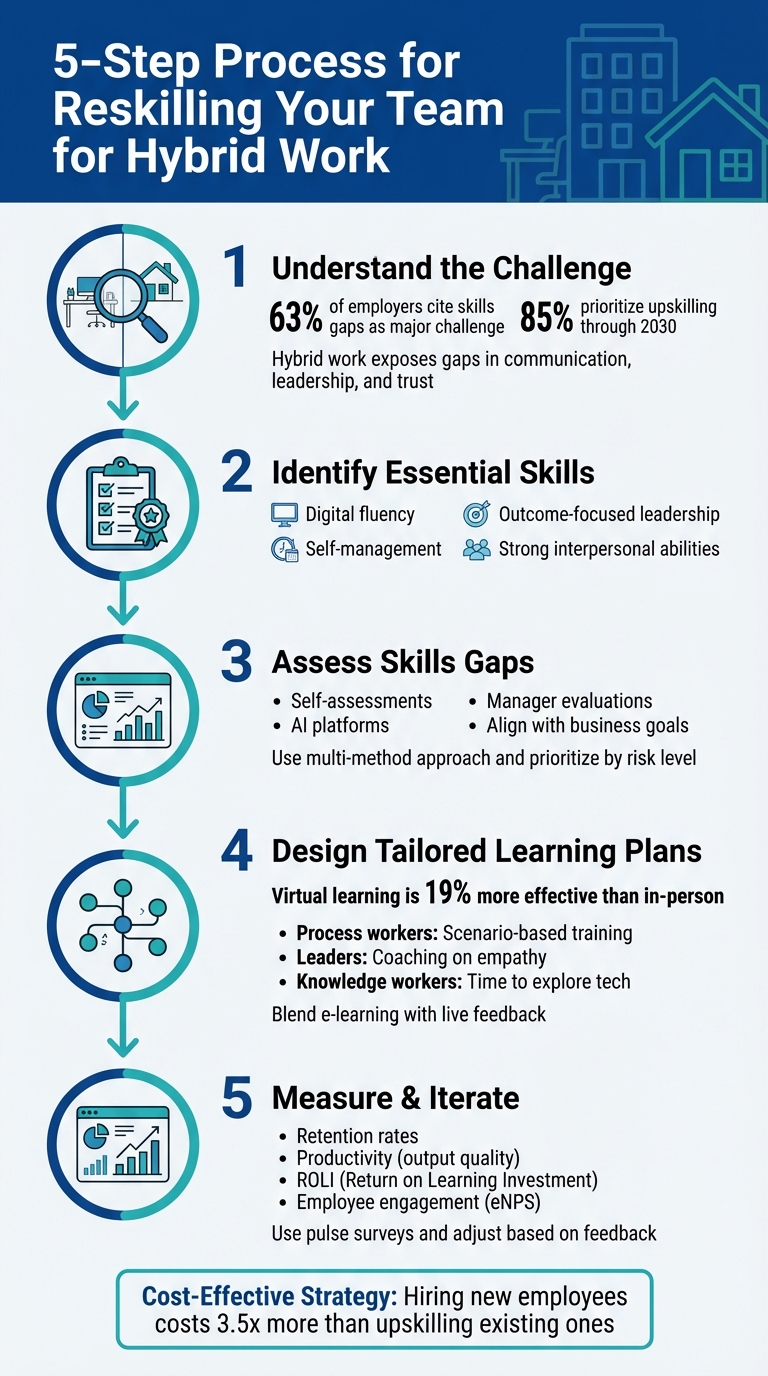
5-Step Process for Reskilling Your Team for Hybrid Work Success
What Hybrid Work Is and Why It's Difficult
How Hybrid Work Functions
Hybrid work strikes a balance between fully in-person and fully remote setups, allowing employees to split their time between an office and remote locations [1]. But it’s more than just where people work - it’s about how teams collaborate to achieve results.
Successful hybrid organizations focus on outcomes rather than processes. As Brian Elliott, CEO of Work Forward, puts it:
"Organizations excelling at flexible work today... have discovered that workplace transformation isn't about where people work - it's about how they work together to drive outcomes" [8].
This approach requires rethinking office spaces, which are now designed to foster collaboration and creativity, while individual, focused work often happens remotely. Digital tools must support both teamwork and independent tasks, and managers must shift their focus from tracking physical presence to measuring results.
Leadership in hybrid environments demands a fresh perspective. Instead of relying on "input measurements" like hours logged or attendance, effective leaders give employees the freedom to choose where they work most effectively while ensuring accountability for their responsibilities [8]. In this model, offices act more like "clubhouses" for connection and brainstorming, rather than traditional workstations [10]. Yet, despite these forward-thinking strategies, hybrid work brings its own set of challenges.
Common Problems in Hybrid Work
Hybrid work isn’t without its hurdles. It often exposes existing skill gaps, especially in soft skills that are harder to display in virtual settings. A study of 54,000 performance reviews highlighted significant differences between in-office and remote employees in areas like leadership networking, executive presence, and empowerment [2].
Another major challenge is proximity bias. Leaders often unintentionally favor employees they see in the office, creating what one expert describes as a "proximity echo-chamber." This bias limits their ability to learn from remote team members and can lead to poor decision-making [9]. Additionally, many managers harbor doubts about remote productivity, and inconsistent schedules can disrupt team cohesion [9].
The issue of trust looms large. Many managers struggle to believe their teams are productive without direct oversight, while employees working remotely need to develop stronger self-discipline and problem-solving abilities [1]. Catherine Stewart highlights the risks of poor leadership in hybrid setups:
"When leaders don't set norms, manage behavior, or create a consistent cadence, people end up isolated no matter where they sit" [8].
This sense of isolation isn’t tied to physical location - it stems from a lack of clear systems, expectations, and consistent communication. Without these, hybrid work can feel fragmented and disconnected.
sbb-itb-9ceb23a
Skills Employees Need for Hybrid Work
Hybrid work requires a unique blend of technical know-how and interpersonal skills to navigate both in-person and virtual settings effectively. Without the convenience of immediate, face-to-face support, employees must adapt to a more self-reliant and versatile approach.
An analysis of over 54,000 performance reviews highlighted significant skill gaps between traditional office workers and those in hybrid roles, particularly in areas like leadership, relationship building, and executive presence [11]. With 69% of U.S. companies offering some form of flexible work arrangements in 2024 [12], addressing these gaps is critical for maintaining business operations.
Required Technical Abilities
Hybrid teams thrive on digital fluency - the ability to navigate tools like video conferencing software, collaboration platforms, and project management systems. Employees also need to master asynchronous communication, which allows team members across time zones and schedules to stay connected. Equally important is data literacy, which enables workers to interpret data and use it to inform decisions in areas like marketing, development, and customer service [3][6].
Another key skill is hardware troubleshooting. Remote employees often have to resolve technical issues on their own, such as fixing connectivity problems or managing equipment. This self-sufficiency minimizes delays and reduces the strain on IT teams, keeping productivity on track.
While technical expertise is a cornerstone of hybrid work, interpersonal skills are just as crucial for fostering collaboration and cohesion.
Interpersonal Skills for Hybrid Teams
In a hybrid setup, interpersonal skills ensure that teams remain connected and productive, even when separated by physical distance.
Self-management and autonomy are essential. Employees must shift from relying on external office cues - like observing colleagues' work habits - to developing their own discipline. This means managing time effectively, taking ownership of projects, and finding solutions independently. The rigid 9-to-5 schedule often gives way to setting boundaries and maintaining accountability.
Dr. Erin Eatough, an Occupational Health Psychologist at BetterUp, explains:
"Soft skills are even more important... in a dispersed workplace, where it may be more common for workers to feel isolated and disconnected" [11].
For managers, adaptive leadership is key. Leaders must replace visibility-based oversight with outcome-focused performance tracking. This involves coaching, giving regular feedback, and ensuring that both in-office and remote employees feel equally supported. Managers also need to address proximity bias, where those working on-site might unintentionally receive better opportunities and more frequent feedback [12][13].
Effective communication is another critical area. Hybrid teams need to balance real-time (synchronous) and flexible (asynchronous) communication. Knowing when to send a concise written update versus scheduling a live discussion can make or break collaboration. Traditional soft skills like empathy and authenticity become harder to convey over digital platforms, requiring more intentional effort to maintain team dynamics.
Lastly, creating psychological safety is vital. Hybrid setups can lead to divisions between in-office and remote workers, fostering an "us vs. them" mentality. Skills like network leadership and empowerment help bridge this gap, ensuring all team members feel valued and comfortable contributing. Alarmingly, 40% of employees report that their managers fail to have frequent, honest conversations about work [12], highlighting an area that hybrid teams must address.
| Skill Category | Traditional Approach | Hybrid Approach |
|---|---|---|
| Communication | Face-to-face, social cues | Succinct written updates, asynchronous, active listening |
| Leadership | Visibility-based management | Outcome-focused, inclusive, coaching-oriented |
| Collaboration | Spontaneous, in-person | Planned, virtual-first, digital tools |
| Self-Management | Fixed 9-to-5 schedule | Autonomy, boundary setting, self-discipline |
| Inclusion | Physical presence | Psychological safety, reducing proximity bias |
How to Assess Your Team's Skills Gaps
Before reskilling your team for hybrid work, it's crucial to pinpoint where the gaps are. The key is understanding which skills your organization currently has and which ones it needs to succeed in the future. With 63% of organizations identifying the skills gap as the main hurdle to business transformation [16], this step is essential.
Hybrid work has shifted the definition of "proficiency." Skills like relationship building and executive presence, once easy to observe, are now harder to evaluate in virtual settings [11]. On top of that, the skills required for the average job have changed by 25% since 2015, and that rate is expected to double by 2027 [14].
Steps to Analyze Skills Gaps
Start by aligning your assessment with your business goals. Think about where your organization is headed over the next one to three years. Are you entering new markets, adopting AI tools, or focusing on outcome-based performance? The skills you need depend on your future direction, not just your current state [16][17].
Next, develop success profiles for hybrid roles. These profiles act as blueprints, outlining the skills, proficiency levels, and behaviors required for specific positions in a distributed work environment [14].
Scott Erker, Senior Client Partner at Korn Ferry, emphasizes the importance of this approach:
"By providing clarity on the talent you have versus the talent you need, your skills assessment framework becomes the compass that guides your organization through constant change" [14].
To assess your team, use a multi-method approach. Each method has its strengths and limitations:
- Self-assessments are quick and scalable but can be biased.
- Manager evaluations offer practical insights but may be influenced by personal relationships.
- Peer reviews highlight collaborative strengths but can be swayed by team dynamics.
- Work simulations predict real-world performance but require significant resources [14][15].
For example, a healthcare cloud technology company used the Cornerstone Skills Transformation platform in December 2022 to tackle staffing challenges. By year-end, 83% of employees had completed a skills profile. The platform helped employees identify an average of 22 skills, double the market average of 11, enabling rapid staff redeployment as project needs shifted [16].
Don't forget to review existing HR data. Performance evaluations, exit interviews, and safety reports can reveal recurring skill deficiencies that might not be obvious in daily operations [15].
Finally, prioritize skill gaps by their level of risk. Not all gaps demand immediate attention. Rank them as Critical, Important, or Not Important to focus your resources on areas with the highest impact [15]. Tools like a skills matrix or heat map can help visualize these gaps across your organization [16][19].
Tools for Skills Assessment
Adding advanced tools to your multi-method approach can refine your understanding of skill deficiencies. AI-powered platforms are becoming increasingly popular because they analyze objective data - such as project histories, learning logs, and performance reviews - to create dynamic, real-time skills profiles [16][18]. These platforms often uncover hidden skills that employees might not mention themselves.
Google revamped its hiring and assessment process by moving away from GPAs and test scores. Instead, they implemented behavioral interviews and skill-based assessments to identify top talent. Laszlo Bock, Senior VP of People Operations, described traditional metrics like GPAs as "worthless" for predicting success [16].
For organizations not ready to adopt AI platforms, simpler tools can still be effective. Skills frameworks provide standardized definitions and proficiency levels, ensuring that managers apply consistent criteria. Use a 1–5 or basic-to-excellent scale to keep evaluations uniform [14][17].
Regular one-on-one check-ins are another valuable tool, especially for assessing soft skills and well-being. These aspects are often invisible in remote settings but are crucial for maintaining team cohesion. Schedule quarterly development conversations to ensure career growth discussions don't fall by the wayside [11][20].
| Assessment Method | Best For | Limitation |
|---|---|---|
| Self-Assessment | Scalability and employee engagement | Prone to individual bias [14] |
| Manager Assessment | Practical context and performance observation | Influenced by relationship quality [14] |
| Peer Assessment | Collaborative and interpersonal skills | May be influenced by team dynamics [14] |
| Work Simulations | Predicting real-world job performance | Resource-intensive to implement [14] |
| AI-Powered Inference | Objective, real-time data collection | Requires integrated digital systems [16] |
Skills frameworks need to stay flexible. In industries experiencing rapid change, plan to revisit your framework every six months to stay current [14][16]. By 2030, six out of every ten workers will need substantial training to keep up with evolving job demands [16]. Continuous assessment is no longer optional - it's a necessity.
With these tools and strategies, you're ready to build reskilling programs that address your team's most pressing needs.
Creating Reskilling Programs That Work
Once you’ve pinpointed skill gaps, the next step is building programs that deliver measurable outcomes. Research shows that virtual learning is 19% more effective than in-person training [22], yet even before the pandemic, 56% of companies described their skills gap as moderate to severe [23]. Hybrid work has only amplified this challenge.
The key is starting with business outcomes instead of rushing to compile a list of skills. Many organizations fall into the trap of focusing solely on what employees need to learn without first identifying the results they want to achieve. As West Monroe puts it:
"Too often, organizations start with the skills, attitudes, and knowledge their people need to learn, instead of identifying what business results they want to create and what behaviors are needed to get them there" [1].
Another critical factor: one-size-fits-all training doesn’t work. Different roles require tailored approaches. Process-driven workers benefit from scenario-based problem-solving exercises, leaders need coaching on empathy and vulnerability, and knowledge workers require time to explore new technologies. This is especially pressing when 60% of skilled workers believe their current abilities will become outdated within three to five years [23].
The financial argument for reskilling is clear. Hiring a new employee costs 3.5 times more than upskilling an existing one [23]. For example, a customer care center that implemented real-time "actionable knowledge" training saved an estimated $5 million by reducing call times, cutting repeat calls, and shortening training periods [1].
Let’s explore how to design personalized learning plans, encourage internal career movement, and align leadership practices to support reskilling success.
Designing Individual Learning Plans
To meet business goals, learning plans must be tailored to employees’ current skill levels. A blend of on-demand e-learning for foundational knowledge and live virtual sessions for feedback works well [22]. This approach allows employees to learn at their own pace while still benefiting from interaction to reinforce new skills.
Ernst & Young has embraced this model. Heidi Grant, Director of Behavioral Science & Insights at EY Americas, explains:
"Virtual learning can be scaled relatively easily, delivered flexibly and in ways that accommodate other ongoing work, and spaced to allow learning opportunities to be embedded into long-term memory, built upon, and practiced" [22].
To combat Zoom fatigue, schedule short breaks every 30–60 minutes and encourage learners to turn off their self-view during video calls. Structured virtual breakout sessions with clear roles can also enhance engagement and reduce awkwardness.
Experiential learning through simulations is another powerful tool. Scenario-based training provides a safe space for employees to practice problem-solving without real-world consequences. It’s also a scalable and cost-effective alternative to traditional hands-on training [21].
Continuous learning beats one-off workshops. Employees need structured practice, regular self-assessment, and ongoing feedback - not annual sessions that are quickly forgotten [23].
| Employee Group | Primary Learning Need | Recommended Approach |
|---|---|---|
| Process-Oriented Workers | Problem-solving and resourcefulness | Scenario-based training and real-time actionable knowledge [1] |
| People Leaders | Transitioning from "doer" to "coach" | On-the-spot coaching, continuous feedback, and modeling vulnerability [1] |
| Knowledge Workers | Keeping pace with tech advancements | Protected time for learning and dedicated spaces to test new ideas [1] |
Promoting Movement Within Your Organization
Reskilling isn’t just about individual growth - it’s about creating pathways for internal mobility. This is crucial because 63% of employees who quit their jobs cited a lack of advancement opportunities as a major factor [21]. Aligning reskilling efforts with clear career pathways can help close skill gaps while boosting organizational performance.
Self-led learning platforms play a big role here. By giving all employees access to training materials - regardless of location or schedule - you create fair opportunities for advancement [7]. This is especially important in hybrid setups, where remote workers might miss out on the informal learning that happens in offices.
Virtual office hours can mimic the one-on-one guidance employees often get in physical workplaces, offering real-time support as they apply new skills [1].
Cross-department assignments are another way to build competencies while meeting business goals. Start small by piloting initiatives in one department or among a willing group, then expand after seeing results [1].
To motivate employees, connect internal job boards with reskilling opportunities. When people see how learning new skills can extend their career longevity - especially as automation changes job requirements - they’re more likely to engage [1].
Finally, provide accessible performance support materials that employees can use both at home and in the office. This reduces reliance on memorization and frees up mental energy for more complex problem-solving [1].
What Leaders Must Do to Support Reskilling
Leadership plays a pivotal role in the success of reskilling programs. Yet 84% of business leaders admit they sometimes or never redesign the employee journey before rolling out new technology [1]. This disconnect can undermine even the best-designed efforts.
Leaders need to prioritize dedicated time for learning. Knowledge workers, in particular, benefit from having spaces - physical or digital - where they can experiment with new skills without interruptions [23].
Jorge Tamayo, Assistant Professor at Harvard Business School, underscores the importance:
Leaders must also shift from task-doers to coaches. This means modeling vulnerability, encouraging feedback, and fostering empathy to help hybrid teams manage stress and avoid burnout [1].
Clear communication is another must. Instead of simply mandating new tools or processes, explain how these changes will improve day-to-day work. This approach helps overcome resistance and builds trust [7].
Finally, leaders should audit their own behaviors to ensure they’re not contributing to burnout. In hybrid setups, where work-life boundaries often blur, managers should be trained to recognize and address unhealthy patterns [7].
Tracking Your Reskilling Results
Creating a reskilling program is just the start; measuring its effectiveness is where the real work begins. Surprisingly, only 22% of companies have solid metrics to evaluate improvements from hybrid work, even though 54% report higher productivity levels [27]. This gap leaves many organizations flying blind - unable to prove ROI or make adjustments when programs fall short.
To measure success, you need a mix of leading and lagging metrics:
- Leading indicators (like enrollment rates, course completions, and learner satisfaction) provide early insights into how well the program is being received.
- Lagging metrics (such as retention rates, productivity, and revenue) reveal the long-term impact on the business.
Focusing on only one type of metric can backfire. Leading indicators alone don’t prove lasting results, while lagging metrics take too long to uncover issues.
A helpful framework is the Kirkpatrick Model, which evaluates training programs on four levels: Reaction (did employees find the training relevant?), Learning (did they acquire new skills?), Behavior (are they applying those skills in their roles?), and Results (has it positively impacted outcomes like retention or revenue?) [26]. This approach connects day-to-day participation to broader strategic goals.
For hybrid work, it’s smart to track collaboration-specific metrics. These could include cross-team meeting ratios, response times in chat tools, and shared virtual whiteboard usage. Monitoring absenteeism can also highlight stress or burnout linked to reskilling workloads [27]. Tying these metrics to financial performance strengthens the case for reskilling investments.
Financial Impact: ROLI
Understanding the financial side of reskilling is just as important. One way to do this is by calculating Return on Learning Investment (ROLI). Compare the program’s direct benefits (like productivity gains or lower turnover costs) against its expenses (such as technology, trainers, and downtime for training). This complements traditional ROI metrics, offering a fuller view of program effectiveness. Notably, 40% of companies report a positive ROLI for their reskilling efforts [29], proving that well-structured programs can pay off.
Metrics That Show Success
Different stakeholders care about different metrics. Executives want to see business KPIs and ROI. Managers focus on behavior changes and team performance, while employees are often interested in how reskilling can advance their careers [26]. Aligning these perspectives strengthens the program’s perceived value.
Retention is a key indicator. Compare voluntary turnover rates between employees who completed reskilling and those who didn’t. Internal mobility metrics - like promotion rates, lateral moves, and career plan adoption - can show whether employees are finding growth opportunities through the program.
Productivity should be measured by output quality, not simply hours worked. In hybrid teams, this might mean tracking task completion rates, project timelines, and goal achievement rather than time spent in meetings or at desks [27]. This approach reflects the flexibility of remote work.
Engagement is another critical metric. Tools like Employee Net Promoter Score (eNPS) and pulse surveys can gauge how connected employees feel to the company’s culture and flag early signs of burnout [27]. Denisse Calderon-Trevizo, Fractional COO for Startup Operations, explains:
"The strongest hybrid teams treat their internal systems like a product, always refining based on real usage and feedback" [27].
Another valuable metric is speed to mastery - the time it takes for employees to become proficient in their new roles [28]. This is especially relevant for hybrid onboarding, where remote workers may need extra time to build networks and absorb informal knowledge.
For programs tied to digital transformation or AI adoption, track specific outcomes like the number of AI use cases implemented, customer satisfaction scores, or progress on digital initiatives [28]. These metrics directly link learning to strategic goals.
| Stakeholder | Primary Success Metrics |
|---|---|
| Executives | Business KPIs, ROI/ROLI, revenue per FTE, retention rates |
| Business Unit Leaders | Productivity, project cycle times, time-to-fill for key roles |
| Line Managers | Behavior changes, team engagement scores, delegation efficiency |
| Employees/Learners | Promotion rates, career plan adoption, internal mobility |
Getting Feedback and Making Changes
Metrics tell you what’s happening, but feedback explains why. Regular feedback is crucial for refining your program. In fact, 90% of employees are more likely to stay with an employer that seeks their input and acts on it [30]. Unfortunately, many companies still rely on annual surveys that come too late to address problems.
Pulse surveys - short, frequent check-ins - are a better option. Ask targeted questions like, "Does your current schedule support a healthy work-life balance?" or "Do you feel informed about team decisions?" [32]. Break down responses by team, role, and location to uncover gaps in communication or access to development opportunities [32].
For larger programs, consider A/B testing. Compare a pilot group’s performance against a baseline group to measure the impact of reskilling before scaling it company-wide [28]. This method provides clear evidence of ROI and highlights areas for improvement.
Performance reviews in hybrid settings should be two-way conversations. Employees should feel comfortable sharing whether the reskilling program aligns with their daily tasks [31]. When these reviews are virtual, keeping cameras on helps both parties pick up on non-verbal cues and reduces miscommunication [31].
Managers also play a critical role. As Grant Aldrich notes:
"I believe every manager can and should be trained in active and empathetic listening, which is a foundational element of any employee listening strategy" [30].
This involves paraphrasing employees’ concerns and asking open-ended questions like, "How can I support you right now?" [30].
Use tools like virtual suggestion boxes and AI-driven sentiment analysis to sift through feedback and identify urgent issues [30]. Creating a psychologically safe environment is key - currently, 34% of employees hesitate to share honest feedback due to fear of retribution [30].
Finally, establish a regular review cadence. Senior executives and the board should evaluate reskilling KPIs monthly or quarterly to maintain accountability [29]. Don’t wait for year-end data; monitor interim signals like reenrollment rates and periodic skills assessments. This approach allows you to make timely adjustments and demonstrate value before long-term metrics like revenue come into play [28].
How Seth Mattison Can Help with Hybrid Work Reskilling
When it comes to reshaping hybrid work reskilling, having the right guidance can make all the difference. Seth Mattison, the founder and CEO of FutureSight Labs, is widely regarded as a leading expert on the future of work. Named one of the Top 50 Keynote Speakers in the World [33], Mattison focuses on transforming leadership to unlock human potential in an increasingly AI-driven world. His impressive collaborations with organizations like NASA and PwC highlight his ability to rethink leadership and workforce strategies [36].
At the heart of Mattison's approach is his "Extremely Human" framework, which emphasizes leveraging inherently human traits - creativity, empathy, and connection - to help organizations stand out in a tech-heavy landscape [33][34]. Jane Datta, Chief Human Capital Officer at NASA, praised his influence, saying:
"Seth's work with the agency has had a big impact on the way we think about digital transformation and the future of leadership" [33].
Through his keynote speeches, workshops, and advisory services, Mattison addresses the pressing issue of Job Transformation - how rapidly evolving roles are outpacing people's ability to adapt [33]. Programs like "The Human Advantage: Unleashing the Power of People in the Age of Machines" and "The Heart of Leadership" offer actionable frameworks designed to empower hybrid teams. Tim Ryan, US Chairman at PwC, shared his perspective:
"Seth created a paradigm shift for the way we think about leading the next generation of talent" [33].
One of the standout aspects of Mattison's work is his focus on connection as a strategic asset. His "Love as a Strategy" philosophy redefines connection as the driving force that turns employees into innovators. By helping leaders move away from extraction-based management models and adopt stewardship-focused approaches, he creates environments where hybrid teams feel safe to take risks and contribute their best work [35].
To help organizations put these ideas into action, Mattison offers a range of tailored reskilling solutions. For in-person engagements, his programs range from $30,000 to $50,000, while virtual sessions are priced between $20,000 and $30,000 [35]. These immersive experiences combine research-driven insights with practical tools, enabling teams to transition from being "future-ready" to "future-leading." As Mattison explains:
"The future belongs to organizations that learn to combine human creativity with AI-driven efficiency - using technology not to replace people, but to elevate them" [35].
Conclusion
Reskilling for hybrid work is no longer optional - it’s a business necessity that will shape the future of organizations. With over 1 billion people worldwide needing to reskill by 2030 [6], and skills gaps continuing to block business growth [4], the urgency is undeniable. Consider this: the average lifespan of a learned skill is now less than five years [5]. What your team mastered just a few years ago may already be outdated.
The companies that thrive will treat reskilling as more than just an HR initiative. Instead, they’ll make it a core component of their strategy. Skills-based organizations are 98% more likely to retain top talent and 52% more likely to drive innovation compared to those sticking to traditional approaches [6]. Plus, upskilling is far more cost-effective than hiring new employees [1].
As Sagar Goel and Orsolya Kovács-Ondrejkovic from BCG put it:
“Reskilling is a strategic imperative... it reflects profound changes in the labor market, which is increasingly constrained by the aging of the working population” [5].
This perspective underscores the critical need for a workforce that can adapt to rapid changes and disruptions.
To succeed, organizations must move beyond one-off training sessions and adopt “superlearning” - embedding learning into daily workflows. This involves creating environments where employees feel safe to take risks, make mistakes, and grow. Leaders play a pivotal role here. They must champion learning initiatives, carve out time for development, and build the psychological safety needed for teams to be honest about their skill gaps.
The next step? Take action. Start by assessing your team’s current skills, craft personalized learning plans tied to business goals, and measure progress with actionable metrics. The organizations that act now - those that blend human creativity with the power of technology - will lead the way into the future.
FAQs
How do I spot hybrid skills gaps without proximity bias?
To pinpoint hybrid skills gaps while avoiding proximity bias, rely on a structured, data-driven skills gap analysis. This approach prioritizes objective metrics over an employee's physical presence. Equip managers with training to reduce bias by emphasizing trust and clear communication within their teams. By integrating AI-driven insights and performing regular, impartial evaluations, you can accurately assess skills gaps, no matter where team members are located.
Which hybrid skills should we reskill for first?
Reskilling in digital soft skills, communication, adaptability, and self-motivation is key to thriving in today’s hybrid work setups. These abilities are crucial for seamless virtual collaboration, clear and effective communication, and staying self-driven while managing tasks independently.
On top of that, leadership, problem-solving, and emotional intelligence play an important role in leading hybrid teams. These skills help leaders navigate challenges, foster team cohesion, and manage diverse working styles. Focusing on these areas equips employees to handle the demands of hybrid work, maintaining both productivity and flexibility as work environments continue to evolve.
How can I prove reskilling ROI in a hybrid team?
To show the return on investment (ROI) for reskilling within a hybrid team, start by setting clear business goals. These could include improving productivity, boosting employee retention, or enhancing work quality. Once your objectives are defined, track metrics that align with these goals.
A practical approach is to compare performance data from before and after reskilling initiatives. For example, evaluate how productivity levels or work quality metrics have shifted post-training. This quantitative data provides a solid foundation for measuring impact.
Don't stop at numbers - gather feedback from both employees and managers. Their insights can provide valuable context and help paint a more complete picture of the reskilling program's effectiveness. Combining these qualitative results with measurable data strengthens your case.
Finally, make sure the outcomes align with your team’s broader strategic objectives. By doing so, you ensure that reskilling efforts are not just impactful but also tied to the overall success of the organization.