
Articles Feb 18, 2026 9:00:00 AM Seth Mattison 23 min read

Upskilling is the key to staying competitive in a fast-changing workplace. With 63% of employers citing skills gaps as the top challenge, and nearly half of workers willing to leave for better training opportunities, businesses must act now to build future-ready teams.
Here’s what you need to know:
- Skill Lifespan Is Shrinking: The average skill lasts less than five years.
- AI and Digital Expertise Are Critical: 72% of Fortune 500 CHROs expect AI to replace roles by 2027–2028.
- Upskilling Improves Retention: Employees with access to training are 47% less likely to leave their jobs.
This guide outlines how to identify skill gaps, create tailored training programs, and integrate learning into daily work. By focusing on both technical and human-centered skills, businesses can close gaps and prepare for future challenges.
Key takeaway: Upskilling isn’t just about technology - it’s about empowering your workforce to drive success.
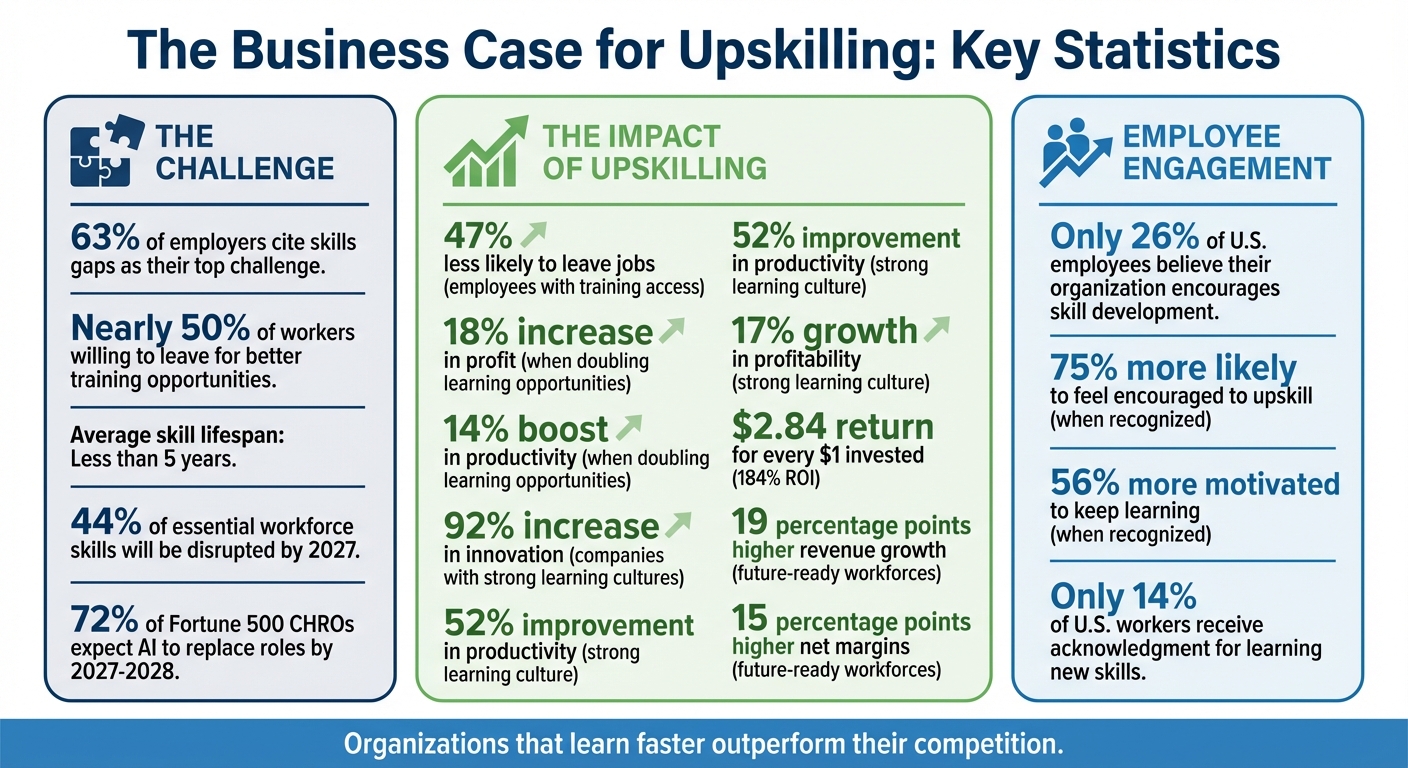
Upskilling Statistics: Impact on Business Performance and Employee Retention
Identifying Innovation Skill Gaps
Before diving into any upskilling efforts, it's crucial to evaluate your team's current abilities and the skills they'll need in the future. With 63% of organizations identifying skill gaps as the main obstacle to business transformation, getting this assessment right is key to staying ahead of the competition[8].
Running Skills Audits
A skills audit starts with defining your strategic goals and identifying the skills needed to achieve them. From there, assess your team's current abilities, analyze gaps using tools like heat maps, and take targeted action[8].
Traditional self-assessments often fall short because they rely on employees self-reporting their skills, which can overlook hidden talents. Today, many organizations are turning to AI-powered tools that analyze project histories, performance reviews, and learning data to create more accurate skill profiles[8][11]. For instance, Johnson & Johnson used AI in early 2020 to evaluate 4,000 technologists on 41 future-ready skills. By March 2024, 90% of those employees had accessed the learning platform, leading to a 20% increase in professional development usage[11].
These AI-driven platforms often uncover far more skills than traditional methods. On average, employees list about 11 skills in self-assessments, but AI tools can reveal closer to 22 skills[8]. Organizations that adopt this approach are 52% more likely to innovate and 49% more likely to improve efficiency[10].
Skills audits shouldn't be treated as one-off exercises. Leading companies are moving away from static annual reviews to "always-on" assessments that leverage real-time data to detect gaps as they emerge[9]. This continuous approach ensures your skills data stays aligned with your evolving business needs.
Once you've completed a thorough audit, the next step is identifying which skills will be essential for the future.
Determining Future-Ready Skills
It's important to distinguish between technical skills that might become outdated and more enduring capabilities like analytical thinking, resilience, and agility[8][9].
A practical way to do this is by building a skills taxonomy - a detailed list of abilities needed for upcoming digital products and reimagined processes. For example, Johnson & Johnson developed a 41-skill taxonomy that included everything from master data management to advanced analytics, rated on a 0–5 proficiency scale[11]. This level of detail avoids vague goals like "improve digital skills" and instead provides clear, actionable targets.
"Skills are dynamic. What makes you successful today won't make you successful three years, five years, or 10 years from now."
– Nick van der Meulen, Research Scientist, MIT CISR[11]
The urgency of this approach is backed by data: 44% of essential workforce skills are projected to be disrupted by 2027[9], and 72% of Fortune 500 CHROs expect AI to start replacing roles by 2027–2028[2]. Your skills taxonomy should reflect this rapid change, emphasizing adaptability and learning agility alongside technical expertise.
Both hard and soft skills are essential. While AI fluency and data literacy are critical, innovation also hinges on human-centered abilities like design thinking, creative problem-solving, and cross-functional collaboration. Companies that have prioritized these human-focused skills have outperformed the S&P Index by 228%[12].
With a well-defined skills taxonomy in hand, the next step is aligning these capabilities with your business objectives.
Matching Skills to Business Objectives
After identifying skill gaps, connect them directly to your business goals. Tools like heat maps can help you visualize where critical gaps exist across teams, departments, or regions, allowing you to focus resources where they'll have the most impact[8][11].
For example, if you're planning to launch an AI-powered customer service platform, prioritize filling gaps in machine learning and natural language processing within your customer experience team. These gaps should take precedence over similar gaps in unrelated areas.
Upskilling your current workforce is often more effective than external hiring, with 85% of global employers now prioritizing internal development to close skill gaps[8]. This approach not only saves money but also leverages employees' existing knowledge of your business, customers, and processes. They just need the technical skills to apply that knowledge in new, innovative ways.
"It's about not guessing the skills organizations have in place... but to allow organizations to understand the skills their employees have, to expand these skills through suggestions, and to put them to good use."
– Cyril Le Mat, Expert, Cornerstone[8]
When deciding where to focus, prioritize high-risk gaps that could derail critical initiatives. For instance, a gap affecting just 5% of your workforce but threatening a key revenue stream should take priority over a widespread gap with minimal impact. This strategic focus ensures your upskilling efforts deliver measurable results.
Upskilling Strategies for Innovation
Once you've identified skill gaps and set clear objectives, the next step is implementing training strategies that truly work. Many organizations are moving away from generic, one-size-fits-all programs. Instead, they’re opting for personalized approaches that fit into employees' daily routines and tap into internal expertise. These strategies not only help employees develop new skills but also make learning a natural part of their workday.
Creating Personalized Learning Paths
Personalized learning starts with recognizing that different roles require different skill sets. For example, executives often need training in vision and strategy, managers benefit from coaching and leadership skills, and employees on the ground need practical tools to excel in their roles. AI-powered platforms play a big role here, tailoring content to individual career goals, interests, and skill gaps. Companies are also creating modular learning units that balance high-demand topics with role-specific content[13].
Take Visa, for instance. In March 2020, they launched "Visa University" using the Degreed platform to deliver tailored learning experiences to 20,000 employees. The platform offered 80,000 curated pieces of content aligned with individual interests. Within just four months, Visa saw a 65% engagement rate, which helped keep their workforce connected during the pandemic lockdowns[14].
Similarly, Walmart invested $1 billion in its "Live Better U" program between 2018 and 2021. This initiative covered 100% of tuition costs for 1.5 million associates. By 2021, active student participation skyrocketed from 4,000 to 30,000. These participants were four times less likely to leave the company, twice as likely to be promoted, and showed a 10% improvement in performance ratings within six months of enrolling[14].
Embedding learning into daily work is another effective strategy. Companies are using tools like microlearning modules, digital nudges, and push notifications to deliver relevant content when employees need it most. These methods help employees retain information by weaving it into their everyday tasks[14].
"To fight the forgetting curve, employees need relevant, personalized, easily digestible lessons ingrained into the everyday rhythm of their daily work" – Andrew Dyer, Senior Advisor at BCG[14]
Pairing personalization with bite-sized, practical learning makes the process even more effective.
Using Microlearning and Project-Based Training
The "70/20/10" model suggests that 70% of learning happens on the job, 20% through interactions with peers, and only 10% through formal training[14]. Microlearning aligns perfectly with this idea by breaking down complex topics into short, 5–10 minute modules. This format respects employees' busy schedules while ensuring the material sticks. Project-based training takes it a step further by allowing employees to apply new skills to real-world challenges, which not only improves retention but also sparks innovation.
The urgency to upskill is clear: the half-life of digital skills is now less than three years[14]. Organizations are increasingly turning to AI tools to teach AI-related skills, making learning scalable and customizable[13]. For instance, generative AI is enabling employees without coding experience to create software through prompt engineering. This approach is making technical skills more accessible across the workforce[1]. In fact, 70% of employees who have used generative AI believe it opens doors to learning new skills and improving work quality[4]. Hands-on experimentation is key - it builds both competence and confidence.
Setting Up Mentorship and Peer Learning
Your organization's internal expertise can be one of its most valuable resources. Mentorship programs connect employees with experienced colleagues who offer guidance on both technical skills and strategic thinking[15]. This kind of one-on-one support helps employees not only learn but also understand how to apply their knowledge within the organization. Peer learning programs, on the other hand, create opportunities for collaborative problem-solving, fostering teamwork and communication skills[7].
A critical factor in the success of these programs is psychological safety - the belief that team members can take interpersonal risks without fear of judgment or backlash[7].
"Psychological safety is a shared belief held by members of a team that the team is safe for interpersonal risk taking" – Amy Edmondson, Professor, Harvard Business School[7]
Leaders play a key role here. By showing vulnerability and being open about their own challenges, they set the tone for a safe and supportive learning environment[7].
A great example is the Money Management Institute (MMI), which in 2025 used the D2L Brightspace platform to launch scalable leadership programs like the "Leadership Pathway" and "MMI Academy." By incorporating automated release conditions and socialized learning pathways, MMI increased engagement in their Leadership Pathway program from 46% to 87%, with other programs reaching engagement rates as high as 95–99%. These programs focused on career-stage development across 200 member firms[15].
Organizations that excel in skill-building practices see 2.1 times higher employee engagement and 1.6 times better retention rates than their peers[15]. To achieve this, accountability must be shared across three levels: learning and development teams provide the infrastructure, business leaders define role-specific needs, and executives ensure alignment with broader strategies[15]. It's no surprise that 74% of organizations with advanced upskilling practices cite leadership sponsorship as a key factor in their success. When mentorship and peer learning are supported at the highest levels, they can drive the kind of innovation readiness that sets organizations apart.
Solving Common Upskilling Challenges
Upskilling programs often face challenges like time limitations, employee resistance, and difficulty measuring ROI. Thankfully, these hurdles can be addressed with focused strategies.
Managing Limited Learning Time
Time is one of the biggest barriers to upskilling. According to research, 89% of CHROs cite "time away from job responsibilities" as the top obstacle to learning and development, with 41% of employees agreeing [16]. The solution? Integrate learning into the workday. Microlearning modules, which fit seamlessly into daily tasks, are a great way to make this happen [16][18]. These bite-sized lessons allow employees to learn exactly when they need it, reducing the reliance on traditional, time-consuming instructor-led training [18].
But here’s the catch: managers can either help or hinder this process. A lack of manager support is identified by 39% of CHROs as a major barrier [16]. When supervisors view upskilling as a distraction, they unintentionally block their team’s growth. The fix? Train the managers too. By equipping them with their own development opportunities, they’ll better understand how to support their teams. This is critical since employees who feel their supervisor impedes their growth are more likely to consider leaving the company [16].
Once time constraints are tackled, the next challenge is addressing employee resistance to change.
Handling Resistance to Change
Resistance often stems from fear - fear of becoming obsolete or not understanding how new skills will help. Currently, 22% of workers worry their jobs will disappear due to technology, up from 15% in 2021 [2]. Yet, only 15% of employees feel their organization has a clear plan for integrating AI and other technologies [16][2]. To ease these fears, human-centric leaders need to communicate clear plans for technology adoption and recognize employees’ skill-building efforts. This not only reduces anxiety but also highlights how upskilling secures career longevity and relevance [2][16][19].
"Having a well-designed reskilling program doesn't help an organization if people don't sign on to participate in it." – Carl Clarke, Director of Talent, Learning, Leadership, Skills, and People Performance at Vodafone [19]
Recognition plays a huge role here. Currently, only 14% of U.S. workers say they receive acknowledgment for learning a new skill [16][2]. Yet employees who are recognized for their efforts are 75% more likely to feel encouraged to upskill and 56% more motivated to keep learning [16][2]. Formalizing recognition - whether through celebrating milestones or showcasing achievements - sends a clear message: growth matters.
Once employees are engaged, the focus shifts to proving the business value of upskilling.
Tracking ROI on Upskilling
Measuring the impact of training can be tricky, but tools like A/B testing and tracking specific metrics provide clarity. For instance, a global energy company used A/B testing during a retail transformation by comparing a pilot group of upskilled frontline leaders with a baseline group. The result? The upskilled leaders delivered a 3% boost in profitability, prompting a full-scale rollout [17].
The numbers speak for themselves. Doubling the percentage of employees who feel they have learning opportunities can lead to an 18% increase in profit and a 14% boost in productivity [16]. Additionally, employees who feel supported in their learning are 47% less likely to actively look for another job [16]. These insights highlight how upskilling isn’t just about individual growth - it’s a strategic driver for business success.
| Challenge | Addressing Strategy | Key Metric to Track |
|---|---|---|
| Limited Time | Embed in paid hours; Microlearning | Enrollment/Completion rates |
| Manager Resistance | Manager-specific training; Accountability | Employee engagement scores |
| Tracking ROI | A/B Testing; Skill Proficiency Tracking | Profitability; Retention; Productivity |
Creating a Continuous Learning Culture
Building a culture of continuous learning isn't just about staying competitive - it's a proven way to drive growth. Companies with strong learning cultures see innovation increase by 92%, productivity improve by 52%, and profitability grow by 17%. Even better, for every $1 invested, organizations see an average return of $2.84 (a 184% ROI) [20].
Getting Leadership Support
Leaders play a critical role in making learning a priority. As Vidya Krishnan, Chief Learning Officer at Ericsson, emphasizes:
"L&D doesn't own upskilling for your organization alone. Business partners, managers and employees are co-owners of skills as well. The companies that outlearn other companies will outperform them." [21]
For example, at Teradyne, Michelle Randall-Berry, Global Head of Talent, drastically shortened the launch of a core upskilling curriculum - from a year-long timeline to just 45 days. How? By securing executive buy-in early and using fast feedback loops with cross-functional teams [21]. Leaders can also shadow teams to understand challenges firsthand and align learning initiatives with the company’s 1-3 year strategic goals. This is especially important as skills continue to evolve - having already shifted by 25% since 2015 and projected to change by at least 70% by 2030 [21].
When leadership actively supports these efforts, it becomes easier to weave learning into the fabric of daily work.
Integrating Learning Into Daily Work
Learning works best when it’s part of the everyday workflow - not treated as an afterthought. Studies show that 70% of knowledge is retained through experiential, on-the-job learning, compared to just 10% through formal training sessions [14].
Amazon’s $1.2 billion "Career Choice" program is a great example of this concept in action. The program prompts warehouse associates to sign up for courses right from the scanners they use during their shifts [21]. Other companies protect learning time by introducing initiatives like "Learn-a-Thons", meeting-free Wednesdays, or setting aside Friday afternoons for skill-building [20]. Removing financial barriers is another way to simplify participation - streamlined reimbursements or eliminating out-of-pocket costs can make a big difference [20].
Once learning becomes a natural part of the workday, the next step is to celebrate and reward progress.
Recognizing and Rewarding Progress
Acknowledging achievements can turn external rewards into internal motivation, creating a lasting commitment to growth. Making learning part of performance reviews and promotion criteria sends a clear message about its importance [14].
Formal recognition - whether it’s through employee awards, companywide shoutouts for top learners and mentors, or public acknowledgments - can significantly boost morale and encourage continued development. The goal is to make progress visible and link it directly to career advancement opportunities.
Conclusion: Building Innovation Readiness Through Upskilling
Key Takeaways from This Guide
The urgency around innovation readiness can't be overstated: by 2030, over 1 billion people will need reskilling[7]. On top of that, 59% of the global workforce will require training to keep up with evolving job demands[6]. Upskilling isn't just an HR initiative anymore - it demands the attention and commitment of CEOs. Companies that excel in this area transition from one-off training sessions to "superlearning", where AI-driven personalization and microlearning are seamlessly integrated into daily workflows[7]. The results speak for themselves: organizations with future-ready workforces report 19 percentage points higher revenue growth and 15 percentage points higher net margins compared to their peers[23]. To achieve this, businesses must identify skill gaps through audits, design personalized learning paths tied to business goals, create a culture of psychological safety, and celebrate learning through recognition and rewards. Naturally, the question arises: how can leaders turn upskilling into a driver of innovation?
How Leaders Drive Innovation
Leadership plays a pivotal role in making upskilling efforts successful. When senior executives actively champion learning rather than delegating it to HR, transformation accelerates. For example, between 2020 and 2023, Ericsson upskilled over 15,000 employees in AI and automation, with senior leaders reviewing progress quarterly. Similarly, Amazon’s Machine Learning University has empowered thousands of employees, many starting with no prior experience, to develop expertise in machine learning[3]. The common factor? Leaders who demonstrate vulnerability and embrace continuous learning inspire meaningful change.
Seth Mattison offers valuable frameworks for navigating these challenges. His programs focus on leadership in the AI era and fostering human-centered workplace cultures. Through keynotes, workshops, and advisory services, he helps organizations balance technological advancements with human creativity. His approach equips leaders with the tools to transform upskilling from a buzzword into a competitive edge, setting the foundation for actionable next steps.
Your Next Steps
Think of upskilling as a change management initiative, not just a training program. Only 26% of U.S. employees strongly believe their organization encourages skill development, yet those who feel supported are 47% less likely to look for other jobs[2]. Clearly define your AI vision - right now, only 25% of employees feel their employers have communicated one[5]. Align upskilling efforts with what employees care about most: 59% prioritize higher earnings, and 50% value job security[5]. Develop a layered technology strategy and establish strong learning and development governance to maximize ROI[7]. Tie these efforts into your broader talent strategy to ensure long-term success.
The clock is ticking. Smart investments in innovation can lead to 2.4 times higher profits[22]. Partnering with experts like Seth Mattison can accelerate this transformation and help align your upskilling strategy with your business goals. The organizations that thrive will be those that learn faster than their competition - and that journey starts with the decisions you make today.
FAQs
How do I pick the top skills to upskill first?
To prepare for future workforce demands and align with your organizational goals, it's crucial to focus on skills that meet both current and emerging challenges. Emphasize areas such as AI fluency, creative thinking, leadership, flexibility, and emotional intelligence. These abilities are key to driving innovation and adapting to rapid technological advancements.
Take a close look at your industry’s specific needs to strike the right balance between technical expertise - like proficiency in AI and digital tools - and human-focused skills, such as resilience and effective problem-solving. This combination ensures your team remains competitive and well-equipped for what lies ahead.
What’s the fastest way to upskill without taking people off the job?
The fastest way to help employees grow their skills without pulling them away from their jobs is by using digital learning platforms. These platforms offer convenient, real-time training that's built right into their daily tasks. By weaving personalized, on-the-job learning into their routine, employees can pick up new skills quickly while staying focused on their work.
How can I prove upskilling ROI to executives?
Proving the ROI of upskilling to executives means tying your metrics directly to business outcomes. Focus on measurable results like revenue growth, cost savings, or even improved innovation capacity. Use hard data to back up your case - think increased productivity, better employee retention rates, or lower turnover costs.
The key is to align your evaluations with what matters most to leadership. Highlight clear, tangible benefits that support their strategic goals. This approach not only makes your case stronger but also ensures it resonates with decision-makers who need to see the direct value.