
Articles Feb 11, 2026 9:00:00 AM Seth Mattison 19 min read

Stories are the secret weapon for leadership growth. Research shows that storytelling makes lessons 22 times more memorable than plain facts. Unlike traditional training methods, which often fail to stick, stories engage emotions, build trust, and help leaders apply what they’ve learned in real situations.
Here’s why storytelling works so well:
- Engages the brain fully: Stories activate both emotional and sensory areas, improving focus and retention.
- Builds trust: Personal stories foster deeper connections between leaders and their teams.
- Improves skill retention: Emotional, story-based learning taps into episodic memory, helping leaders recall lessons under pressure.
- Encourages reflection: Stories push leaders to think critically about challenges and solutions.
Despite U.S. companies spending $160 billion on training in 2015, most programs fail because they rely on lectures and data-heavy formats. Storytelling fills this gap by creating emotional connections and actionable insights. Leaders who master storytelling can inspire teams, drive behavior change, and navigate complex challenges more effectively.
Problems with Conventional Leadership Training
High Costs and Time Investment
In 2015, U.S. corporations poured a staggering $160 billion into training programs, yet many of these efforts fail to deliver measurable results [1]. The issue isn’t just the cost - it’s how these programs are structured. Too often, leadership training is designed for convenience rather than effectiveness. When budgets get tight, these programs are among the first to go, dismissed as "nice-to-haves" rather than critical investments. Even more concerning, 70% of leadership program directors admit they focus on generating "positive reactions" from participants rather than measuring whether the training actually improves their skills [11].
The high price tag is further compounded by training methods that fail to leave a lasting impact, making the investment feel like a short-term fix rather than a long-term solution.
Poor Retention and Limited Application
Most traditional training programs rely heavily on semantic memory - where abstract rules, policies, and concepts are stored. The problem? This type of memory doesn’t hold up well under pressure. When leaders face real-world challenges, they need to draw on episodic memory, which is tied to vivid, emotion-filled experiences. This type of memory helps connect past lessons to present-day problems [10].
Without that emotional connection, many leaders quickly fall back into old habits - a phenomenon researchers call the reversion problem [1]. For example, some programs focus on having participants memorize values or codes of conduct, a "parrot training" approach that rarely translates into meaningful behavioral change. Leaders aren’t equipped to handle complex situations or ethical dilemmas, and the result is a lack of real-world application [10]. In fact, 63% of program directors measure success based on short-term knowledge gains, with none able to demonstrate lasting effects on career growth or organizational outcomes [11]. By contrast, storytelling - because it engages episodic memory - can significantly improve retention and practical use of new skills.
Weak Emotional Connection and Self-Awareness
Traditional training methods often feel cold and impersonal. Rational presentations may check the box for efficiency, but they fail to address a critical truth: human behavior is largely driven by emotion [9]. Leadership development isn’t just about learning new skills - it’s about navigating the messy, emotional process of change. This journey often involves moments of vulnerability and frustration, which are rarely addressed in conventional programs [3].
"Leadership development programs are often designed to maximize convenience for participants or to minimize interference with work deemed more important" [11]
Without tapping into the emotional energy needed to push through challenges, these programs struggle to foster the empathy and self-awareness that set great leaders apart. Formats like memos, emails, and lecture-style presentations don’t engage participants on a deeper level. They’re easy to forget because they lack the emotional and interactive elements that make learning stick [8][9].
Despite the billions spent, conventional leadership training continues to miss the mark. It fails to help leaders genuinely grow, adapt, and apply new behaviors in the complex, ever-changing environments they face. Organizations are left with a significant gap between what’s taught and what’s actually needed in practice.
sbb-itb-9ceb23a
How Storytelling Speeds Up Leadership Learning
Real Experiences as Learning Tools
When leaders share personal stories, something fascinating happens: the listener's brain synchronizes with the storyteller's through a process called neural coupling, creating what researchers call an "artificial reality" [5][13]. This means the audience isn't just hearing a story - they're mentally stepping into the storyteller's shoes, experiencing the highs, lows, and lessons right alongside them.
This makes storytelling a far more engaging learning tool compared to traditional, data-heavy training methods. Presentations filled with facts and figures only activate specific areas of the brain, like Wernicke's and Broca's areas, which handle language processing. Stories, on the other hand, light up the entire brain, including regions like the occipital and temporal lobes, which process sensory and emotional inputs [13][7]. This full-brain engagement offers a cognitive advantage that raw data can't match [2][6].
By sharing their own mistakes or tough decisions, leaders create a safe space for others to mentally rehearse how they might handle similar situations. This kind of mental practice transforms neural engagement into actionable leadership skills, making storytelling a powerful tool for leadership growth.
Building Engagement Through Shared Stories
Stories do more than help people remember - they build real connections. A well-told story triggers the release of oxytocin, the "trust hormone", which strengthens bonds between the storyteller and the audience [5][13]. For example, a leader who shares a personal failure can foster deeper trust and camaraderie with their team than one who sticks to polished success stories.
"Storytelling forges connections among people, and between people and ideas. Stories convey the culture, history, and values that unite people." - Vanessa Boris, Harvard Business Publishing [2]
Another reason storytelling is so effective lies in its universal appeal to different learning styles. Research shows that learners are roughly split into three groups: 40% are visual, 40% are auditory, and 20% are kinesthetic [2][6]. Stories naturally engage all three groups - visual learners imagine the scenes, auditory learners pick up on the tone and rhythm, and kinesthetic learners connect with the emotions embedded in the narrative.
Building Empathy and Encouraging Reflection
Storytelling doesn't just engage - it also encourages the kind of self-reflection that is key to empathetic leadership. Neuroscience reveals that decisions often start in the amygdala, the brain's emotional center, before logical reasoning kicks in [13][7]. Traditional training, which tends to focus on logic and analysis, often misses this emotional layer. Storytelling, however, taps directly into it. As leadership consultant Karen Eber puts it, "Data doesn't change our behavior, emotions do" [13].
Stories also push leaders to think critically about their own experiences and consider situations from different angles. Hearing about someone else's tough conversation with an underperforming team member, for instance, isn't just about learning a technique. It's about emotionally processing the stakes, imagining the challenges, and reflecting on how they might handle a similar situation. This kind of reflection fosters the empathy and self-awareness that traditional training often struggles to instill.
Storytelling for Leaders: How to Connect, Influence, and Drive Change
Benefits of Storytelling for Leadership Development
Storytelling isn't just about making a point - it’s a powerful tool for shaping leadership and strengthening team dynamics. Its impact goes beyond traditional learning methods, offering profound benefits for personal growth and team cohesion.
Improved Self-Awareness and Identity Development
Crafting an "Origin Story" encourages leaders to reflect on the key moments that shaped their identity and leadership style - something that typical training programs often overlook [14].
Take Microsoft CEO Satya Nadella as an example. He often shares personal anecdotes during keynotes, revealing the values and experiences that have guided his leadership journey. These stories not only connect emotionally with his audience but also help him reinforce his understanding of what drives him as a leader [14].
Leaders can make their narratives even more impactful by including what Deloitte calls "internal texture" - descriptions of their thoughts and emotions during pivotal moments [4]. By sharing how past challenges turned into strengths, they can transform vulnerability into a tool for growth [14]. Research involving 18,000 professionals from 150 countries highlights storytelling as an essential skill for CEOs in today's world [14].
Building Trust and Stronger Teams
Storytelling goes beyond dry, fact-based communication - it builds trust by aligning personal experiences with collective challenges.
For instance, when Starbucks CEO Brian Niccol stepped into his role in October 2024, he used his first quarterly earnings call to share a "Growth Story" called the "Back to Starbucks" plan. By openly addressing the need for strategic changes and painting a vision of returning to the brand's roots, Niccol demonstrated how storytelling can clarify goals and create trust during uncertain times [14].
The science supports this approach. Sharing authentic stories, even those that include professional missteps, triggers the release of oxytocin - the hormone tied to trust and empathy. It also makes information up to 22 times more memorable compared to plain facts [15][16]. Despite this, only 13% of employees strongly feel that their leadership communicates effectively [14].
When leaders share stories of their failures, they create an atmosphere of psychological safety. This openness encourages team members to speak up and collaborate more freely, fostering a culture of honesty and connection [2][16]. As Brené Brown wisely puts it:
"People don't trust perfection; they trust what feels real" [16]
This kind of vulnerability can break down walls that data-driven presentations often fail to reach.
Faster Behavior Change and Skill Growth
Storytelling taps into how our brains naturally process information, making it a powerful tool for driving behavioral change. When leaders share stories about specific strategies - like a successful collaboration between teams - it provides a clear example for others to follow [6]. A simple statement like "we hit our goals" doesn’t resonate as deeply as a story that highlights the journey behind the achievement.
Patti Sanchez, Chief Strategy Officer at Duarte, Inc., describes this as providing "emotional fuel" for learning:
"When you see learners as heroes on a quest, you'll gain insight into the struggles they'll encounter, outwardly and inwardly. You'll also be better able to give them the emotional fuel they need to endure and triumph" [3]
This emotional connection helps individuals push through the challenges of behavior change, where frustration or doubt might otherwise hold them back. By engaging multiple learning styles - visual, auditory, and kinesthetic - storytelling ensures that everyone on the team absorbs and applies new skills effectively.
How to Add Storytelling to Leadership Programs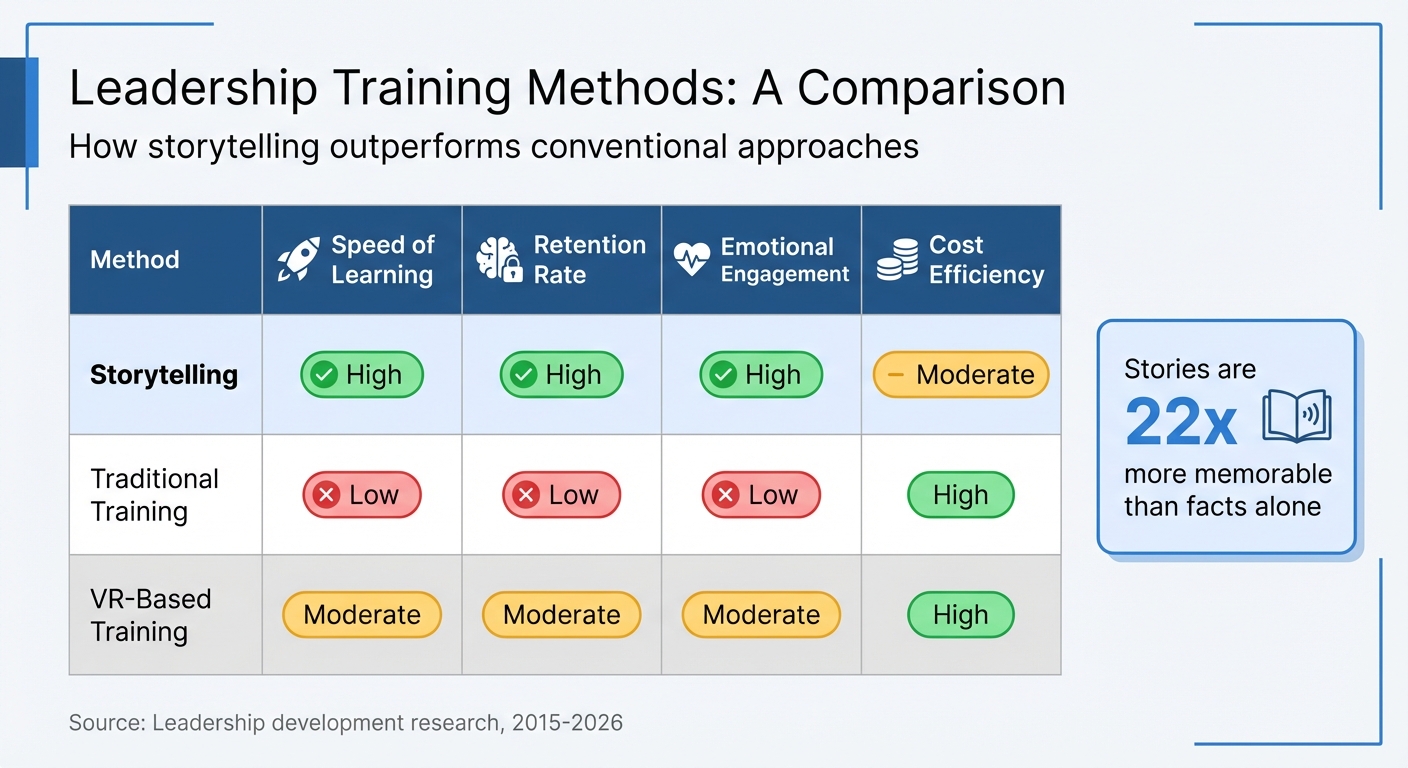
Storytelling vs Traditional Training Methods for Leadership Development
Turning storytelling into a practical tool for leadership development requires specific, actionable techniques. The goal is to move away from artificial exercises and instead focus on real experiences that leaders can immediately apply.
Group Storytelling Sessions
Forget generic speeches - invite senior executives to share honest accounts of their professional missteps and the lessons they’ve learned along the way [17][12]. These stories help create a sense of psychological safety while offering real-world scenarios participants can relate to and adapt. To structure these sessions, consider Deloitte's four-element framework: Ground it (use specific details), Tell it (explain what happened), Add texture (share thoughts and emotions), and Frame it (highlight the intended takeaway) [4].
This approach allows participants to crowdsource solutions to real challenges, making the learning process far more interactive than traditional role-playing. Storytelling also caters to diverse learning styles [17]. Adding visual aids can further anchor these stories in memorable, actionable insights.
Visual Story Mapping Tools
Tools like the VentureScape model turn leadership journeys into visual narratives, breaking them down into key stages: Dream, Leap, Fight, Climb, Arrive [3]. By identifying their current stage - say, “the climb” - leaders can determine the type of emotional support they need. This visual approach transforms abstract ideas into clear, relatable milestones. Leaders can envision themselves as heroes on a quest, supported by their teams and equipped with their unique strengths to tackle obstacles [3].
During tougher phases, encourage participants to share small wins. These moments of progress can act as “emotional fuel” to keep them motivated [3].
Pairing Stories with Strengths Assessments
To deepen the impact of storytelling, pair it with insights from strengths assessments. After reviewing their results, ask leaders to share a recent success and a challenge that highlight specific strengths in action [3][4]. This practice connects abstract data to real-life experiences, making development plans more actionable. Instead of just presenting numbers, leaders should use anecdotes to show how they’ve applied their strengths to overcome obstacles [3]. This method positions managers as mentors, helping others see how to leverage their own strengths effectively. Plus, it significantly improves information retention.
Comparison: Storytelling vs. Other Methods
A quick comparison highlights storytelling’s edge over traditional and VR-based training methods:
| Method | Speed of Learning | Retention Rate | Emotional Engagement | Cost Efficiency |
|---|---|---|---|---|
| Storytelling | High | High | High | Moderate |
| Traditional Training | Low | Low | Low | High |
| VR-Based Training | Moderate | Moderate | Moderate | High |
The data makes it clear: storytelling outshines other methods. While traditional training might seem budget-friendly, its low engagement and retention rates often lead to poor application in real-world scenarios. Storytelling, on the other hand, delivers the nuanced, context-rich learning that bullet points and mnemonics simply can’t provide [12]. It’s a powerful way to drive meaningful behavior change.
Conclusion
Key Takeaways
Storytelling is emerging as a crucial tool for leadership development in 2026. Research indicates that storytelling makes information up to 22 times more memorable compared to simply presenting facts [15]. Traditional training methods often fail to stick, with up to 90% of information forgotten within a week [15]. In contrast, storytelling engages multiple learning styles - visual, auditory, and kinesthetic - creating a more lasting impact [2].
What makes storytelling even more powerful is its ability to drive behavioral change. Stories go beyond explaining "what" to do - they demonstrate "how" to do it by offering practical frameworks leaders can apply in various situations [12]. Sharing personal challenges and failures through stories helps leaders build trust and empathy with their teams. Moreover, storytelling supports emotional resilience, helping leaders navigate the "messy middle" of skill development - the tough phase where progress feels slow and uncertain [3]. These elements highlight storytelling's role in shaping leadership for a rapidly changing workplace.
Final Thoughts on Leadership Growth
As AI takes over routine communication, human-centered leadership becomes the defining edge. In hybrid and remote work settings, where face-to-face interaction is limited, stories act as the "connective tissue" that unites teams and reinforces organizational culture [18]. Zoë Arden from the University of Cambridge Institute for Sustainability Leadership captures it perfectly:
"In 2026, leadership won't be defined by who has access to the most data, but by who can make that data meaningful" [18].
The way forward is clear: organizations must make storytelling a cornerstone of leadership development. By incorporating storytelling into leadership programs - whether through group workshops, visual tools, or combining stories with strengths assessments - leaders can foster stronger teams, speed up skill-building, and enhance overall resilience. Storytelling isn't just a training tool; it's a powerful driver for navigating the complexities of transformational leadership. Leaders who master this skill will not only grow personally but will also elevate their organizations to new heights.
FAQs
How can I start using storytelling as a leader this week?
To begin incorporating storytelling this week, create a short narrative tied to your goals or challenges. Build it around three key parts: the current reality, the future vision, and the journey of change. Share this story with your team in a way that feels genuine, keeping it brief - under two minutes. The aim is to build trust, spark motivation, and align everyone toward a common purpose. Focus on making it emotionally engaging, and rehearse to ensure it feels natural and impactful.
What makes a leadership story feel authentic, not cheesy?
A leadership story resonates best when it’s grounded in real values, transparency, and authentic experiences. Overly polished or exaggerated accounts can feel insincere and may alienate your audience. Instead, aim for honesty and relatability - this approach helps to foster trust and create a genuine connection.
How do you measure ROI from storytelling in leadership training?
To gauge the return on investment (ROI) of storytelling in leadership training, look at shifts in engagement, trust, and behavior change. Tools like surveys and performance metrics can help you track how stories influence actions and results. Pay attention to concrete outcomes - think improved collaboration, better decision-making, or increased productivity - to see how storytelling contributes to leadership growth.