
Articles Feb 4, 2026, 12:19:55 PM Seth Mattison 21 min read

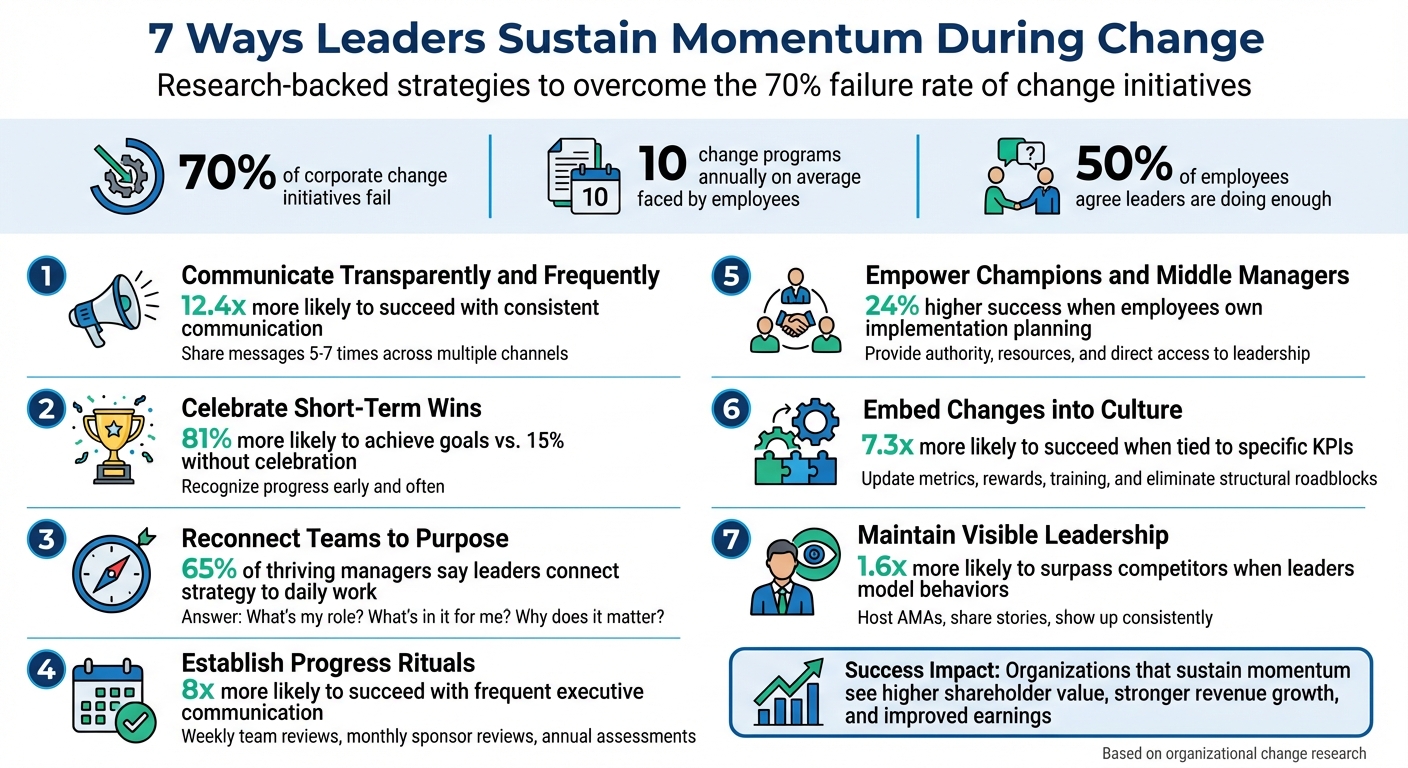
Most change efforts fail. Research shows that 70% of corporate change initiatives don’t succeed, often due to poor execution, miscommunication, or a lack of sustained engagement. Employees face an average of 10 change programs annually, which can lead to resistance, fatigue, and distrust. Leaders may think they’re doing enough, but only about half of employees agree. So, how do you keep momentum alive during transformation?
Here’s the short answer: focus on clear communication, celebrate progress, and embed changes into daily routines. Below are seven actionable ways to maintain momentum during change:
- Communicate often and clearly: Regular updates and honest discussions build trust and counter rumors.
- Celebrate small wins: Recognize early successes to keep morale high and reinforce progress.
- Reconnect to purpose: Help employees see how their roles contribute to the bigger picture.
- Track progress: Use structured reviews to measure milestones and align on goals.
- Empower middle managers and champions: Equip key players to drive change at the ground level.
- Integrate changes into systems: Align policies, rewards, and training with new behaviors.
- Stay visible as a leader: Show up, engage directly, and lead by example.
These steps aren’t a one-size-fits-all solution but can be tailored to your organization. Start small, focus on the most pressing challenges, and build from there. The key is consistent, deliberate action over time.
7 Leadership Strategies to Sustain Momentum During Organizational Change
Why Do Change Efforts Lose Momentum?
sbb-itb-9ceb23a
1. Communicate Transparently and Frequently
When it comes to navigating change, silence can be your worst enemy. Lack of communication breeds rumors and worst-case assumptions. Here's the kicker: change initiatives are 12.4 times more likely to succeed when senior managers communicate consistently [8]. Yet, nearly 70% of managers admit they feel uncomfortable talking to their teams about change [9]. That disconnect can be a huge barrier.
Effective communication needs to address different levels of understanding. Senior leaders should focus on the big picture, while supervisors handle how the change affects individuals directly [10]. A great example? When Jan Carlzon took charge of Scandinavian Airlines in the early 1980s during a $20 million loss, he distributed a cartoon handbook titled "Let's Get in There and Fight" to all 20,000 employees. This bold move helped rally the team, resulting in an $80 million earnings jump within a year [7][8]. It’s a clear reminder that strategic communication can drive real results.
Here’s something to keep in mind: people need to hear key messages five to seven times before they stick [10][11]. To make that happen, mix up your communication channels. Use town halls to share the vision, implement future-ready leadership strategies, team meetings for the nuts and bolts, and one-on-one conversations to address personal concerns [12]. Take IBM’s 2006 "values jam" as an example. Over 72 hours, 150,000 participants from 104 countries generated 46,000 posts, helping to shape the company’s direction [13][14]. That’s the power of consistent and inclusive messaging.
"No one says they learned about a change too early. But many people say they've learned about a change too late."
– Michelle Haggerty, Chief Operating Officer, Prosci [10]
Honesty is key. Acknowledging emotions like fear and skepticism builds trust faster than pretending everything is smooth sailing [12]. Equip managers with FAQs and talking points to ensure they’re aligned [11]. Create feedback loops, like "Ask Me Anything" sessions, so employees can share concerns and see their input valued [8][11]. Listening matters more than you might think - good listening has been shown to boost leadership effectiveness by 40% [9]. Open, honest communication keeps your team engaged and your change efforts moving forward.
2. Celebrate Short-Term Wins
Recognizing progress through short-term wins is a powerful way to keep the momentum going during times of change. Big transformations can feel overwhelming, which is why these smaller victories matter - they offer clear, measurable proof that your efforts are paying off. Think of them as milestones to highlight, share, and celebrate early and often. In fact, organizations that actively plan for celebrating these successes are 81% more likely to achieve their goals, compared to only 15% of those that skip this step [15][16]. Acknowledging these wins builds the foundation for long-term resilience.
But celebrating wins isn’t just about boosting morale. Research shows that these moments enhance positive emotions, improve performance, and even help reduce stress [1]. On a neurological level, celebrating achievements activates dopamine pathways in the brain, which strengthens motivation and keeps the team moving forward [18].
It’s important to make these wins visible and connect them to the larger vision. Don’t keep the celebration limited to your immediate team - share it across the organization to show that the change initiative is making progress. As Teresa Amabile from Harvard Business School found, small wins are a major driver of workplace motivation and sustained engagement [18]. Even simple gestures, like a team-wide message or a shout-out during a meeting, can highlight progress and inspire others to stay committed.
"Quick wins, when piled on top of each other, build confidence that even the greatest challenges can be met."
– James M. Kouzes & Barry Z. Posner [17]
However, there’s an important balance to strike. Celebrate the milestone, but avoid declaring victory too soon. After acknowledging a win, make sure to outline the next steps to keep the momentum alive [16]. Reflective questions like, "What helped us achieve this?" can help identify patterns for future success. Frame these wins as added value, not just a replacement for old ways, to keep your team focused and moving forward.
3. Reconnect Teams to the Change Purpose
Even the most carefully planned change can stumble if the purpose behind it gets lost. Leaders often assume their message is clear, but research paints a different picture: while people believed others would understand their message about 50% of the time, the actual success rate was less than 5% [14]. This disconnect, often called the "curse of knowledge", highlights the need for repeated and intentional communication. Simply put, explaining the purpose once isn’t enough - it needs to be woven into everyday conversations.
One of the most effective ways to do this is by helping employees see how their individual roles contribute to the bigger picture. For instance, 65% of thriving managers say their own leaders excel at connecting business strategy to their daily work [11]. But this isn’t about parroting corporate buzzwords. Instead, it’s about answering three simple but crucial questions: What is my role? What’s in it for me? Why does it matter? [11]. When leaders address these questions directly, they make abstract strategies feel personal and relevant. This clarity drives deeper commitment and keeps employees engaged. By integrating these conversations into daily routines, leaders ensure the purpose stays top of mind.
"Believing in the 'why' behind a change can therefore inspire people to change their behavior."
– Tessa Basford and Bill Schaninger, McKinsey & Company [14]
It’s also important to frame change positively - as something that adds value, rather than something that takes away. Instead of focusing on what’s being left behind, highlight the new opportunities, capabilities, or impact the change creates [1]. Today’s workforce is motivated by more than just profits; they value autonomy, mastery, and meaning [19]. By linking the transformation to how it benefits customers or advances the mission, leaders tap into deeper motivations that financial incentives alone can’t match [14]. This connection between purpose and action not only drives short-term wins but also helps build the long-term cultural shifts needed to sustain momentum.
4. Establish Progress Rituals and Milestones
Once teams are reconnected to the purpose behind change, the next step is to ensure progress stays on track and measurable. This is where progress rituals come into play - they provide the structure and rhythm needed to keep everyone aligned and moving forward.
Change thrives on consistency, visibility, and a clear cadence. Leaders who set up regular progress rituals turn abstract goals into measurable steps. In fact, initiatives with frequent executive communication are 8 times more likely to succeed [3].
One effective strategy is using a layered review schedule. This approach ensures alignment at every level:
- Weekly reviews for initiative teams to track milestones and operational performance.
- Monthly or quarterly reviews for sponsors and steering committees to evaluate organizational health and business outcomes.
- Annual reviews to assess progress across the entire organization.
This structure creates accountability without micromanaging, allowing teams to focus on results while staying connected to the bigger picture.
But tracking progress isn’t just about meeting deadlines or staying on budget. Leaders should focus on four key dimensions:
- Operational performance at the initiative level (e.g., cycle times, quality metrics).
- Organizational health, including shifts in mindsets and behaviors.
- Business outcomes, such as revenue growth or cost reductions.
- Overall value creation for the organization.
As N. R. Narayana Murthy, former Chairman of Infosys, put it: "In God we trust; everybody else brings data to the table" [3]. Without a comprehensive view like this, there’s a risk of mistaking activity for actual progress. By focusing on these areas, routine check-ins can evolve into powerful tools for driving meaningful change.
Finally, progress rituals should focus on engagement through questions, not just directives. Asking the right questions during regular meetings reinforces alignment and strengthens involvement. For example, using openers that touch on themes like safety can integrate key values into daily operations. These small but consistent interactions build momentum, helping change feel like a natural part of the organization’s rhythm instead of an external directive.
5. Empower Champions and Middle Managers
Senior leaders may set the vision, but it’s middle managers and change champions who bring that vision to life. These individuals act as the critical link between high-level strategies and the day-to-day work, turning broad goals into practical steps for their teams. Without their active participation, even the most well-thought-out change initiatives can stumble. The key is to identify and empower those best suited to bridge the gap between strategy and operations.
Start by finding employees who naturally earn respect among their peers, excel in communication, and have a knack for influencing others - regardless of their official title. You can identify these champions through manager recommendations, self-nominations, or by observing who naturally connects different groups in your organization.
But spotting potential champions is just the beginning. To truly empower them, you need to equip them with the authority and resources to effect change. Clearly outline their roles and expectations, including how much time they’ll need to dedicate, and provide training in areas like coaching and conflict resolution. It’s also crucial to give them direct access to senior leadership for quick issue resolution. This keeps them aligned with the overall strategic direction. Research backs this up: when employees are involved in decision-making, success rates for change initiatives increase by 15%. And when they take ownership of implementation planning, those rates jump by 24% [20].
Beyond individual empowerment, building a community of champions can amplify the impact. Such a network allows these leaders to share insights, provide feedback from the ground level, and support one another. This group also acts as an early warning system, spotting resistance before it becomes a bigger issue. Equip them with tools like culture kits that simplify the change narrative and recognize their contributions through awards and performance reviews.
Additionally, empower these leaders to make operational adjustments, allocate budgets for change initiatives, and integrate new behaviors into performance evaluations. When projects are managed with strong change management practices, they are up to seven times more likely to succeed [5]. By giving middle managers and champions the autonomy to lead change within their areas, you transform them from simple messengers into true drivers of progress - and that’s when real momentum begins to build.
6. Embed Changes into Culture and Processes
Real change only sticks when it becomes part of the everyday rhythm of your organization. Enthusiasm alone won’t carry the weight - new behaviors must be baked into your policies, procedures, and systems. Without this, employees may see the change as a passing phase, waiting it out until things return to the old way. The starting point? Revamping your organizational structures.
Update your infrastructure to align with the new direction. This could mean revising performance metrics, reward systems, and job descriptions to reflect the priorities of the change. For instance, if you’re aiming for customer-centricity, performance reviews should focus on customer satisfaction and engagement, not just raw sales numbers. Promotions should also reward those who embrace and model the new behaviors - this sends a clear message that the change is here to stay. Research backs this up: change initiatives are 7.3 times more likely to succeed when tied to specific KPIs that are consistently tracked [21].
"Change efforts often fail to achieve their intended outcomes because they are not supported by existing organizational levers that promote certain types of employee behavior -- things like reward structures, promotion processes, and existing roles and responsibilities." - Gallup [1]
To sustain the momentum, invest in ongoing training to prevent backsliding. Think of initial training as installing new software - ongoing education is the regular update that keeps it running smoothly [23]. Studies suggest employees need to hear messages at least 8 times before they fully absorb them [23]. Set up a quarterly training schedule and create spaces, like communities of practice, where employees can share insights and tackle challenges together. Organizations that prioritize these sustainment activities meet or exceed their project objectives 81% of the time, compared to just 15% for those that don’t [16].
Lastly, eliminate structural roadblocks that clash with your new vision. Outdated processes, irrelevant compensation models, or old job descriptions can sabotage even the best efforts. In fact, over 70% of change projects fail because they lack consistency or a comprehensive approach [22]. By removing these legacy obstacles, you make the new behaviors not just encouraged, but the only practical choice. And don’t forget - active leadership involvement is the glue that holds it all together.
7. Maintain Visible Leadership Engagement
Change initiatives often falter when leaders stay distant or detached. Kanika Bedi sums it up perfectly: "Visibility isn't performance - it's presence" [24]. When leaders actively show up during times of transformation, they help ease resistance and build trust. Employees need to feel that leadership is genuinely invested, not just issuing commands from behind closed doors.
The numbers back this up. Companies where leaders model expected behaviors are 1.6 times more likely to surpass their competitors [25][14]. However, there's a glaring disconnect: while 86% of leaders think they're setting the right example, only 53% of their direct reports agree [3]. This gap underscores the importance of leaders visibly demonstrating their commitment to change.
Take Indra Nooyi, the former CEO of PepsiCo, as an example. She sent handwritten notes to employees’ families, acknowledging their contributions. Similarly, David Farr, CEO of Emerson Electric, regularly engaged with employees by asking direct, thoughtful questions [3]. These weren’t staged events - they were meaningful, consistent interactions that strengthened alignment and trust.
"Leadership is felt before it's heard." - Kanika Bedi, Strategic Communication Consultant [24]
Practical visibility can take many forms. Hosting regular "Ask Me Anything" sessions gives employees a platform to share concerns directly. Informal actions, like eating in the company cafeteria, joining team meetings, or walking the office floor, also go a long way. Sharing personal stories through internal channels adds another layer of relatability. Seth Mattison highlights that authentic, visible leadership fosters the trust needed to maintain momentum during change. For instance, an oil and gas company saw employee satisfaction with communication jump by 9 percentage points after training 650 leaders with a program that included storytelling and role-playing exercises [25].
Visible leadership doesn’t just engage employees - it amplifies the effectiveness of every other strategy in driving lasting change.
Conclusion
Organizational change often falters when leaders lose the drive and focus needed to bring their vision to life. The strategies discussed earlier work together to keep your transformation on track and ensure it becomes a lasting effort [2]. By communicating openly, celebrating wins, reconnecting to purpose, establishing progress rituals, empowering champions, embedding changes into systems, and staying visibly engaged as a leader, you can build momentum that sustains itself [4].
The stakes couldn't be higher. Research shows that 66% of large-scale organizational change efforts fall short of expectations [4]. However, organizations that succeed often see dramatic results. These momentum-driven companies experience higher shareholder value, stronger revenue growth, and improved earnings [2].
"Momentum isn't accidental; it is purposefully cultivated through disciplined leadership and consistent reinforcement." – Tristam Brown, CEO, LSA Global [4]
These strategies aren't meant to be a one-size-fits-all checklist. Every organization operates within its own unique culture, pace, and set of challenges. What works for a fast-moving tech company might not translate to a manufacturing firm or healthcare provider. The key is to adapt these approaches to fit your specific context. Avoid the temptation to launch too many transformational changes at once, as this often leads to change fatigue [1]. Instead, break your long-term vision into smaller, achievable goals. Once momentum is established, it requires far less effort to sustain than to restart from scratch [26].
Leaders also need to manage their own energy throughout this process. A leader under stress can erode team trust and disrupt momentum [2]. Seeking guidance from experts can make a significant difference. Advisory services, workshops, or keynote speakers - like Seth Mattison, who specializes in leadership transformation - can provide valuable insights. External experts bring objective assessments, proven frameworks, and training in emotional intelligence, helping you monitor employee sentiment as closely as you track business metrics [6].
Sustaining momentum during change requires more than good intentions - it demands deliberate, consistent action. Start by focusing on one or two strategies that tackle your most urgent challenges. Gradually expand your efforts while staying visibly committed to the process. Remember, your team looks to you for energy and direction.
FAQs
What’s the best way for leaders to communicate effectively during times of change?
Effective communication is a cornerstone for leaders navigating their teams through periods of change. Start with transparency - explain the "why" behind the change, what it involves, and how it will benefit both the organization and the individuals. When people understand the reasoning, they’re more likely to feel included and less resistant.
Equally important is active listening. Take the time to hear employees' concerns, answer their questions, and address any uncertainties they may have. This creates a sense of trust and shows that their input matters.
To maintain focus and enthusiasm, present a clear and inspiring vision of what success looks like. Break it down into specific, tangible goals so the team can visualize the end result. Regular updates and open conversations can help ease uncertainty, keeping everyone engaged and on the same page.
By blending clear communication, empathy, and ongoing dialogue, leaders can build confidence and motivate their teams to embrace change with a positive mindset.
What is the role of middle managers in keeping change initiatives on track?
Middle managers are the glue that holds an organization together during times of change. They bridge the gap between senior leadership and frontline employees, ensuring that strategic goals are communicated clearly and transformed into practical, actionable steps. Their role in aligning their teams with the company’s overarching vision helps build trust and keeps everyone on track.
But their job isn’t just about managing tasks. Middle managers also play a huge part in addressing the emotional side of change. By actively listening to their teams, being transparent, and tackling resistance head-on, they create an environment where employees feel heard and supported. This leadership keeps teams engaged and motivated, even as the organization navigates through challenging transitions.
Why is it important to celebrate small wins during organizational change?
Celebrating small wins during organizational change plays a key role in keeping the team motivated and engaged. It’s a way to highlight progress, show that efforts are making a difference, and boost morale during what can often be a challenging process.
Acknowledging these milestones not only reinforces confidence in the change but also helps maintain momentum. When leaders take the time to celebrate short-term successes, it creates a ripple effect - energizing the team, encouraging a positive outlook, and strengthening their commitment to achieving the bigger picture. It’s a reminder that every step forward, no matter how small, contributes to the larger vision.