
Articles May 3, 2026 9:00:01 AM Seth Mattison 18 min read

Organizations often evaluate training programs using surface-level metrics like attendance and completion rates. But do these numbers reflect genuine improvements in employee performance or business outcomes? Not always. In 2026, the focus is shifting toward human-centered metrics, which measure deeper impacts like behavior changes, skill application, and long-term results.
Key takeaways:
- Surface metrics fall short: Completion rates and test scores don't guarantee lasting behavior changes or business impact.
- Human-centered metrics focus on outcomes: These include employee engagement, knowledge retention, and measurable business improvements (e.g., faster ticket resolution, higher customer satisfaction).
- Long-term insights matter: Regular reviews, feedback, and tracking career progression ensure upskilling efforts deliver sustained value.
- Employee growth aligns with business goals: Metrics should connect individual progress to organizational performance, such as efficiency improvements or internal mobility.
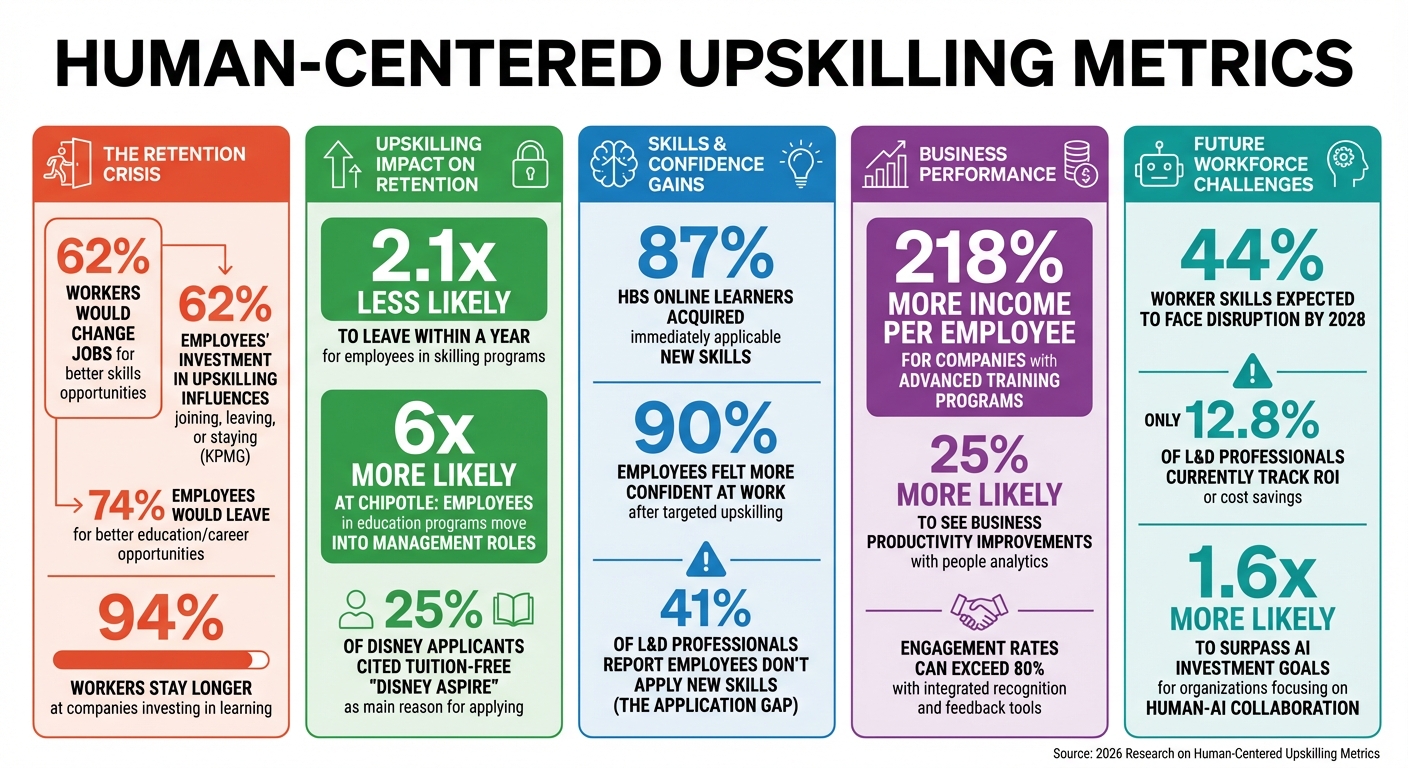
Human-Centered Upskilling Metrics: Key Statistics and Impact Data
Core Principles for Designing Human-Centered Metrics
To create metrics that reveal true employee growth while driving business outcomes, it’s essential to strike a balance between individual development and the organization’s overall success.
Connecting Employee Growth to Business Goals
For metrics to be meaningful, they need to link individual progress directly to business performance. This means focusing on observable behavioral changes rather than just knowledge acquisition. As Joshua Margolis, Professor at Harvard Business School, puts it:
"The mix of structure and direction versus support and development that you provide needs to fit the people you're leading and the situation you all face together." [4]
Start by mapping each role to specific KPIs. Ask questions like: What business metrics does this role influence? How would a small efficiency improvement, say 5% to 10%, in this role affect overall productivity? [4] For instance, post-training metrics for customer service teams could measure changes in ticket resolution time or customer satisfaction scores.
It’s also important to look ahead. Metrics should reflect skills that will be critical for future initiatives, such as entering new markets, launching products, or adopting AI tools [4]. Including these development goals in annual performance reviews ensures accountability and links employee growth to career progression. The numbers highlight how crucial this is:
62% of workers would consider changing jobs if recruited by a company offering better opportunities to advance their skills [4].
Additionally:
62% of employees surveyed by KPMG say that investment in upskilling influences whether they join, leave, or stay with an organization [5].
Thought leaders like Seth Mattison (https://sethmattison.com) emphasize that developing uniquely human skills is key to maintaining a competitive edge in an AI-driven world. Aligning development with both immediate and long-term business goals ensures that initial improvements lead to sustained performance gains.
Measuring Long-Term Impact
Short-term wins are important, but they don’t guarantee lasting behavior change. To validate that training investments deliver enduring value, it’s crucial to measure long-term impact.
This requires a multi-layered approach: tracking engagement, retention, behavior change, and business outcomes. Each layer offers unique insights. For example, while engagement can indicate early interest, Kristin Thomas, Director of Customer Value Realization at Pluralsight, cautions:
"Engagement's an early indicator of success, but it isn't the complete story. Just using something does not mean that it is actually changing the business." [6]
Quarterly reviews and trend analysis can help identify whether skills are sticking or if additional support is needed [1]. To reinforce learning, combine these data points with qualitative methods like coaching sessions, peer feedback, and team check-ins. This approach helps prevent skills from fading amidst daily responsibilities.
The results speak for themselves:
87% of learners who completed HBS Online programs reported acquiring new skills that were immediately applicable to their roles, while 90% of employees felt more confident at work after completing targeted upskilling programs [4].
Key Human-Centered Metrics for Measuring Upskilling Success
These metrics not only track individual progress but also tie directly to business outcomes. Building on the idea of human-centered outcomes, here are some key ways to measure the success of upskilling efforts.
Employee Engagement and Satisfaction
Engagement reflects whether employees value the training, but it’s just the beginning. Kristin Thomas, Director of Customer Value Realization at Pluralsight, highlights this point:
"Engagement's an early indicator of success, but it isn't the complete story. Just using something does not mean that it is actually changing the business." [6]
To get a fuller picture, combine participation rates with real-time sentiment data gathered through pulse surveys or workplace tools like Slack and Teams [1]. A particularly telling metric is employee confidence - those who feel assured in their new skills are more likely to apply them effectively, speeding up project timelines [6].
Pair quantitative data with quick qualitative feedback to assess whether the training pace was manageable and aligned with actual job demands. Beyond engagement, the true test lies in how quickly employees can put their new skills to use.
Time to Competence
Time to proficiency measures how quickly employees become productive after training. This metric has a direct impact on your bottom line: the sooner employees can apply their new skills, the faster you’ll see a return on your training investment [7].
Start by establishing performance baselines before training begins. Then, compare post-training results and use insights from managers and peer reviews to confirm whether employees are applying their skills to critical tasks [1][7]. Data shows that companies with advanced training programs generate 218% more income per employee than those without, largely because they’ve streamlined this process [7].
However, there’s a challenge - 41% of L&D professionals report that employees don’t apply their new skills after training [7]. Many programs focus on knowledge transfer but fail to foster behavioral changes. Scenario-based simulations and follow-up assignments can help close this gap [7].
Ultimately, tracking competence must connect to retention and long-term career growth.
Retention and Career Progression Rates
Internal mobility metrics confirm that upskilling leads to real career advancement. When employees see opportunities for growth, they’re more likely to stay. The statistics back this up: employees who participate in skilling programs are 2.1x less likely to leave their jobs within a year [8]. On the flip side, 74% of employees say they’d leave for better education and career opportunities elsewhere [8].
To measure success, track promotion rates, internal job placements, and career shifts [8]. For instance, at Chipotle, employees enrolled in its education program were 6x more likely to move into management roles than non-participants [8]. Similarly, The Walt Disney Company reported that 25% of applicants for hourly roles cited its tuition-free “Disney Aspire” program as their main reason for applying [8].
Matthew Daniel, Senior Director of Talent Strategy at Guild, underscores the importance of these efforts:
"The goal of career mobility should be to build the skills needed for the future of work and to fill internal talent pipelines for in-demand roles." [8]
Bon Secours Mercy Health offers another compelling example. By investing nearly $50 million in internal mobility programs in 2022, the organization helped thousands of employees advance their clinical careers, improving retention rates along the way [8]. Brenda Woodcock, Chief Nursing Officer, shared:
"Since we started this partnership and launched this program, we have 650 nursing students. Something I really love is that now we can predict our workforce." [8]
Given that 44% of worker skills are expected to face disruption by 2028, internal mobility is becoming a critical metric for organizational resilience [8]. Yet, only 12.8% of L&D professionals currently track ROI or cost savings from their training programs [7]. By focusing on career progression metrics, organizations can demonstrate how upskilling delivers lasting benefits for both employees and the business.
Balancing Performance Metrics with Human Outcomes
Upskilling programs need to measure more than just business outcomes - they must also account for employee experiences. Human-centered metrics go beyond standard ROI by capturing both tangible results, like revenue growth, and the less quantifiable aspects of the employee journey. Companies that use people analytics to track these metrics are 25% more likely to see improvements in business productivity [10]. The challenge lies in building a system that values hard data while also prioritizing employee well-being and workplace culture.
To do this, organizations must consider factors like investment costs, workforce impact, and financial ROI, while also keeping an eye on how these efforts affect employees [3][1]. Kristin Thomas, Director of Customer Value Realization at Pluralsight, highlights the importance of this dual focus:
"We need to be able to prove that the skill investments that we're making are resulting in net new skill gain happening... [and] that those skills are being used in our work environments on the things that are most mission critical." [6]
A well-rounded approach combines hard metrics with qualitative feedback. While dashboards might show faster ticket resolution times or shorter project cycles, employee interviews and focus groups can reveal whether the training pace was manageable or if staff struggled to apply new skills. This balance is key to understanding both performance and well-being.
Productivity and Efficiency Gains
With this framework in place, the next step is to zero in on productivity metrics that align with team KPIs. Instead of relying on vague measures of output, focus on specific indicators like ticket resolution times, error rates, project cycle durations, or sales close rates. Pick one or two metrics that directly tie to your business goals [6].
Measuring employee confidence is just as important as tracking skill acquisition. Confidence boosts can lead to quicker execution and less hesitation when tackling critical tasks [6]. For instance, nearly 90% of learners reported feeling more confident at work after completing targeted upskilling programs [4]. This confidence often translates into tangible results, like faster project completion, fewer errors, and higher-quality work [10]. However, these gains can be negated if employees experience burnout or stress.
Employee Feedback and Well-Being Metrics
Productivity numbers only tell part of the story. Employee feedback provides insight into how well the human aspect of upskilling is working. While metrics like course completion rates might look good on paper, they often reflect surface-level activity rather than real behavioral changes or skill application [2]. To get a fuller picture, combine these numbers with well-being indicators like absenteeism rates, employee sentiment from surveys, and voluntary turnover. Feedback can also uncover barriers - such as outdated systems or unsupportive workplace cultures - that prevent employees from applying their new skills effectively.
Organizations using integrated recognition and feedback tools have seen engagement rates surpass 80% [1], proving the importance of listening to employees. Creating a "permission to learn" culture is also vital. Employees need time and resources for upskilling without feeling overwhelmed [6]. As Joshua Margolis, a professor at Harvard Business School, explains:
"The mix of structure and direction versus support and development that you provide needs to fit the people you're leading and the situation you all face together." [4]
Dashboards that combine quantitative data with narrative insights and visual cues can help pinpoint teams that may need extra support or where learning efforts aren’t translating into performance [1]. Before gathering any data, ask yourself: "What decision will this data help me make?" If the answer isn’t clear, the metric might not be useful [2].
Finally, consider this: 94% of workers say they’d stay longer at a company that invests in their learning and development [9]. It’s a powerful reminder that well-being metrics aren’t just about employee satisfaction - they’re also a cornerstone of effective retention strategies.
Implementing and Sustaining a Metrics-Driven Upskilling Strategy
Creating a metrics-driven upskilling strategy means more than just setting up systems - it’s about ensuring those systems evolve with your workforce and business objectives. Companies that view metrics as a one-and-done task often see their programs lose momentum over time. The real challenge lies in building a framework that adapts, using data to reflect both employee growth and measurable business outcomes.
Building Stakeholder Buy-In
Gaining stakeholder support begins with understanding their priorities. Tie upskilling metrics directly to existing KPIs. For example, ask sales leaders which metrics best reflect revenue growth or consult operations managers about how they measure team productivity. This approach reframes upskilling as a solution to core business challenges, rather than just an HR initiative.
As Kristin Thomas from Pluralsight puts it:
"Begin with the end in mind." [6]
Before rolling out any program, ensure stakeholders agree on the desired behavioral changes post-training. Whether it’s shortening sales cycles, improving customer service response times, or reducing errors, clarity on these outcomes is critical. Start small - focus on just a few key metrics, like the number of employees upskilled or the depth of skill acquisition, to avoid overwhelming teams. Employees are more likely to embrace training when they see how it directly connects to their daily responsibilities.
This alignment with leadership naturally sets the stage for leveraging technology to track meaningful data.
Using Data and Technology to Track Metrics
Technology transforms metrics into actionable insights. Tools embedded in platforms like Slack or Microsoft Teams can track real-time engagement effortlessly. For example, in late 2025, Jeff Hagel, President of M&H, introduced such a platform, achieving engagement rates exceeding 80% across the organization. [1] This shift encouraged peer-to-peer interaction rather than focusing solely on top-down compliance.
Specialized learning platforms go beyond basic course completion tracking, offering deeper insights into performance. Pairing these platforms with analytics tools like Power BI or Tableau allows organizations to link training activities with real-world outcomes. Dashboards that include narrative summaries and visual cues make it easier to identify trends and pinpoint areas needing attention.
Tracking both confidence and competency is equally important. Employees who feel confident in their new skills are more likely to apply them to critical tasks. Combining quantitative data from dashboards with qualitative feedback from interviews or focus groups helps uncover obstacles, such as outdated tools or unsupportive work environments, that might hinder the application of new skills.
To truly benefit from the data, it must be used to refine and improve training strategies continuously.
Continuous Improvement Through Regular Feedback
Metrics-driven strategies thrive when they are treated as dynamic processes. Quarterly trend reviews help track long-term behavioral changes, revealing whether skills are being retained or additional support is needed. [1] Regular feedback ensures that training programs stay aligned with evolving business needs and employee expectations.
Surveying participants regularly can confirm whether the training resources provided - whether online, in-person, or hands-on - are effective. Focus on metrics that reflect genuine skill application rather than superficial measures like attendance or course completions. This approach provides a clearer picture of how well the training is working.
A forward-thinking approach treats evaluation as an ongoing conversation between goals and results. As Kirkpatrick Partners wisely note:
"If data tells us what's visible, reflection helps us understand what's valuable." [2]
Organizations that integrate this reflective process into their strategy create upskilling programs that adapt over time, supporting both employee growth and broader business objectives.
Conclusion: The Future of Upskilling Metrics
In an AI-driven workplace, metrics that prioritize the human element create a real edge. The Deloitte 2026 Global Human Capital Trends report highlights this shift, emphasizing that success now depends more on enhancing human capabilities than relying solely on technology [11]. Organizations that focus on fostering collaboration between humans and AI - rather than just automating tasks - are 1.6 times more likely to surpass their AI investment goals [11].
Traditional metrics often fail to capture the deeper impact of learning. While surface-level measurements might show attendance or completion rates, they don’t reveal whether skills are being applied effectively. Metrics that focus on engagement, knowledge retention, behavioral changes, and business outcomes paint a much clearer picture of learning's true value. These interconnected measures provide insights that go beyond isolated data points.
To stay ahead, organizations need to treat metrics as part of an ongoing conversation between goals and results. Quarterly reviews and pulse surveys are key for identifying skill gaps in fast-moving environments [1]. Combining quantitative data with qualitative insights - like interviews and focus groups - helps uncover the reasons behind a program’s success or struggles. Static ROI figures alone can’t provide this depth of understanding.
Forward-thinking companies are reimagining workflows to better integrate human and AI collaboration. Measuring reductions in errors, faster project cycles, and improved client satisfaction offers a clearer view of progress. By treating learning as a continuous process instead of a one-time event, metrics evolve to show what’s working, what’s sticking, and where additional support is needed. This approach shifts upskilling from being a simple checkbox to becoming a strategic tool for long-term performance and differentiation. It ties directly into the broader framework of aligning human outcomes with business success.
FAQs
What human-centered metrics should we track first?
Tracking the right metrics is essential to understanding the impact of your upskilling efforts. Start by monitoring program participation rates, as they reveal how many employees are actively engaging with the initiative. Pair this with insights into employee morale - happy, motivated employees are often a sign that the program is resonating. Finally, gather feedback through surveys to capture direct input from participants. These indicators work together to paint a clear picture of engagement and motivation, which are critical for assessing the overall success of your upskilling initiatives.
How do we prove employees use new skills on the job?
To demonstrate that employees are truly applying new skills, focus on human-centered metrics such as observable behavioral changes and measurable business outcomes. Look for signs like enhanced performance, the practical use of new skills in daily tasks, and insights from surveys or performance reviews. You can also tie skill development to tangible results, such as increased productivity or improved customer satisfaction, to confirm the effectiveness of upskilling efforts. By blending behavioral evaluations, performance metrics, and business impact data, you get a well-rounded picture of how effectively new skills are being integrated.
How can we link upskilling to retention and promotions?
Upskilling isn’t just about improving skills; it’s also a powerful tool for boosting retention and supporting promotions. To make this connection, organizations need to focus on people-focused metrics instead of solely relying on traditional ROI. Metrics like employee engagement, skill progression, and internal mobility can help identify top talent and those with high potential.
Offering personalized incentives - like clear career growth opportunities - can go a long way in building loyalty. When companies emphasize outcomes such as applying new skills and advancing within the organization, they create a direct link between upskilling efforts and long-term employee development. This approach not only supports retention but also strengthens promotion pathways, benefiting both employees and the business.