
Articles Jun 7, 2026 10:21:28 PM Seth Mattison 13 min read

In a world where AI is transforming industries at lightning speed, leaders face a critical challenge: What can humans do that AI can't? The answer lies in the concept of the Human Moat - qualities like judgment, accountability, and trust that machines can't fully replicate.
This article explores two leadership approaches:
- Data-Driven Leadership: Focuses on using AI for efficiency, speed, and decision-making at scale. It's about letting AI handle routine tasks while humans step in for complex, high-stakes decisions.
- Human Moat–Oriented Leadership: Prioritizes uniquely human capabilities like empathy, moral judgment, and contextual understanding. This approach ensures decisions are not just fast but thoughtful and grounded.
The key takeaway? Success lies in combining AI's precision with human insight. Leaders who strike this balance gain a lasting edge by leveraging the best of both worlds.
| Dimension | Data-Driven Leadership | Human Moat–Oriented Leadership |
|---|---|---|
| Strength | Speed and scalability | Judgment and trust |
| Risk | Contextual blind spots | Slower decision-making |
| Focus | Efficiency and optimization | Relationship-driven decisions |
Leaders must master when to rely on AI and when to lean on human judgment to stay ahead in this rapidly evolving landscape.
The #1 Leadership Skill AI Can NEVER Replace
sbb-itb-9ceb23a
1. Data-Driven Leadership
Data-driven leadership focuses on using data not just for its volume but for making smart, timely decisions. As Seth Mattison says, "Artificial intelligence isn't just automating work. It's compressing advantage." [1]
Value Definition
Leadership has evolved. In the past, it relied on exclusive access to knowledge. Now, with AI making data widely accessible, the real value lies in deciding which tasks are worth pursuing. The emphasis has shifted from doing the work to deciding the work. [7]
Decision-Making Approach
This redefined value of judgment is reshaping how leaders approach decisions. Instead of being the final authority on every call, leaders are becoming decision architects. They establish frameworks that allow AI to manage routine decisions while keeping human insight for high-stakes or complex challenges. Known as boundary architecture, this approach ensures that automation handles repetitive tasks, leaving critical decisions to human expertise. [9]
A stark example of why this balance matters is Zillow's 2021 pricing algorithm failure. The algorithm overpaid for homes, costing the company $881 million because it lacked essential human context. [3]
"If you let AI make your decisions without a human architect checking context, you aren't innovating - you're just making mistakes at the speed of light." - Nikki Stone, Founder, YQ [3]
Capability Development
In the age of AI, leaders must excel at making judgments under uncertainty. This includes developing override literacy - the skill to step in and override AI recommendations when the situation demands human intuition or contextual understanding. [9][4]
Performance Metrics
To assess the success of these changes, organizations need to measure performance on two levels. One focuses on what automation delivers: efficiency, speed, and transaction volume. The other evaluates uniquely human contributions like trust, culture, relationship quality, and decision-making effectiveness. Combining these into a single metric often leads to missteps.
"The fact that you can't cleanly explain the ROI is exactly why it matters. When everything measurable becomes commodity, the unmeasurable becomes the moat." - Libby Rodney, Chief Strategy Officer, The Harris Poll [6]
One way to highlight the importance of human input is by documenting pivots - instances where human intervention altered a project's direction. These moments, driven by intuition or cultural awareness, often reveal insights that no dashboard could provide. They emphasize the "Human Moat", the unique value humans bring that AI cannot replicate. [10]
2. Human Moat–Oriented Leadership
This section dives into how uniquely human judgment can create a lasting edge in the age of AI. While data-driven leadership emphasizes leveraging AI for smarter decisions, Human Moat–oriented leadership asks a deeper question: What can only humans do in this scenario? As Tom Monahan, CEO of Heidrick & Struggles, explains:
"The competitive advantage of the AI age will not belong to the companies with the best agents or systems. It will belong to companies with leaders who can use those agents and systems without surrendering what makes leadership human." [11]
Value Definition
At the heart of Human Moat leadership is identifying the distinct human contributions - referred to as "human alpha" - that AI cannot replicate. This isn't about vague claims but a precise evaluation of where human involvement creates irreplaceable value. The defining factor here is moral conscience, not just computational ability. Monahan underscores that true leadership means making choices with moral accountability [11]. These values then serve as a foundation for creating decision-making frameworks.
Decision-Making Approach
Human Moat leaders take a different approach to decision-making. Instead of simply making decisions, they focus on designing the environment where decisions happen. They define which decisions can be automated by AI and which require human oversight. This framework prevents leaders from becoming bottlenecks while ensuring that critical human judgment remains part of the process. This is especially relevant when only 24% of CEOs and board members feel their current AI usage gives them a competitive edge [11].
Capability Development
The most crucial skills for Human Moat leadership are what can be called "Above the Line" capabilities. These include negotiation, empathy, understanding group dynamics, navigating political challenges, and connecting seemingly unrelated ideas. These high-context skills are uniquely human and essential for creating a competitive moat. For instance, in 2025, OpenAI's internal data agent needed six layers of human context - ranging from institutional knowledge to prior corrections - before it could operate effectively [12]. While AI provided raw intelligence, it was the human-added context that made it truly effective.
For these human skills to matter, they must translate into measurable performance outcomes.
Performance Metrics
"The new scarcity is not information. It is attention, coherence, decision integrity, and institutional trust." - Raktim Singh, Enterprise AI Thought Leader [9]
Traditional metrics like task completion or tool adoption no longer capture what matters most. Instead, Human Moat leadership focuses on metrics such as decision velocity (how quickly teams move from insights to action), decision quality at scale, and minimizing economic errors. Another key measure is tracking override rates, which indicate how well systems align with human oversight.
This approach aligns with thought leader Seth Mattison’s frameworks, which encourage leaders to focus on high-value, uniquely human capabilities.
| Dimension | Traditional Leadership | Human Moat–Oriented Leadership |
|---|---|---|
| Value Source | Information & Expertise | Judgment & Contextual Intelligence |
| Decision Role | Primary Decision-Maker | Decision-Designer & Orchestrator |
| Key Asset | Data | Institutional Knowledge & Tacit Context |
| Success Metric | Task Productivity | Decision Velocity & Economic Error Reduction |
Pros and Cons
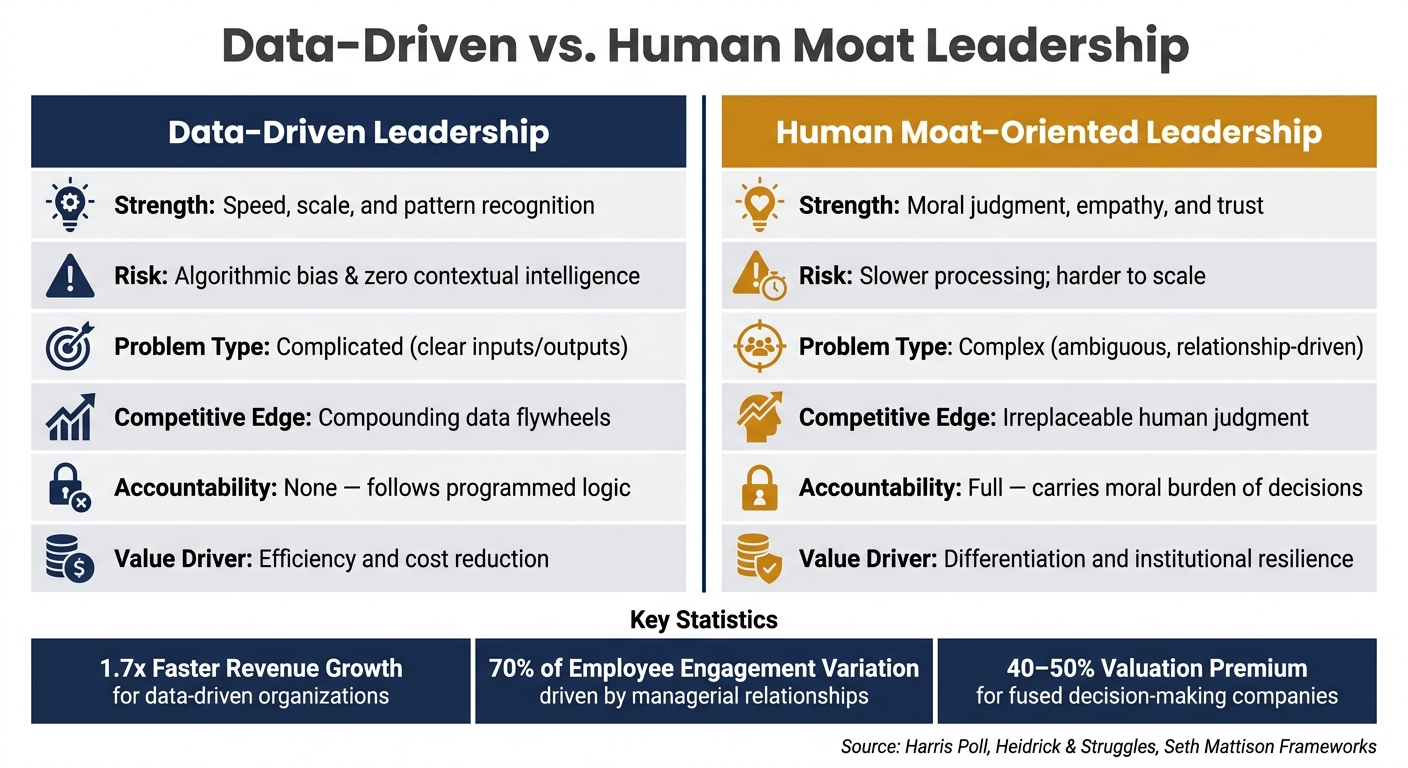
Data-Driven vs. Human Moat Leadership: Key Differences & Stats
Both leadership models bring distinct advantages and challenges. Here's a side-by-side breakdown to help illustrate where each approach excels and where it falls short:
| Data-Driven Leadership | Human Moat–Oriented Leadership | |
|---|---|---|
| Primary Strength | Speed, scale, and pattern recognition [9] | Moral judgment, empathy, and trust [11] |
| Problem Type | Complicated (clear inputs and outputs) [13] | Complex (ambiguous, relationship-driven) [13] |
| Competitive Edge | Compounding data flywheels [5] | Irreplaceable human judgment [8] |
| Key Risk | Algorithmic bias; zero contextual intelligence [3] | Slower processing; harder to scale [11] |
| Accountability | None - follows programmed logic [8] | Full - carries the moral burden of decisions [8] |
| Value Driver | Efficiency and cost reduction [11] | Differentiation and institutional resilience [9] |
This comparison highlights the challenge of blending AI's precision with the deeply human qualities that make leadership resilient and trustworthy.
Data-driven leadership shines when speed and scalability are critical. AI can shrink decision timelines, uncover patterns in massive datasets, and optimize operations like no human could. Organizations that prioritize this model often see 1.7x faster revenue growth and 3.6x higher total shareholder returns compared to their competitors [5]. However, relying solely on AI can lead to blind spots - algorithms may process inputs with incredible efficiency but often lack the contextual awareness needed to navigate nuanced, real-world situations [3].
On the other hand, Human Moat–oriented leadership bridges those gaps. It thrives in ambiguity, tackles edge cases, and fosters trust - something algorithms simply can't replicate. For example, managerial relationships are responsible for 70% of the variation in employee engagement [13], a metric no AI system can single-handedly influence. That said, human-led approaches can be slower, harder to standardize, and often undervalued in systems that prioritize efficiency. As Tom Monahan, CEO of Heidrick & Struggles, aptly put it:
"Efficiency can scale output and create new opportunities, but it cannot replace judgment or conscience." [11]
Ultimately, the goal isn't to pick one model over the other but to understand which tool fits which problem. The real skill lies in balancing these approaches and recognizing when to lean on data's precision or human judgment. Mastering this balance is the key to integrating both effectively.
Conclusion
Data and human judgment work best as a team - AI brings speed, scale, and the ability to spot patterns, while humans contribute context, ethical decision-making, and accountability. Relying solely on one or the other just doesn’t cut it.
Companies that excel at blending these strengths - what’s often called "fused decision-making" - can see valuation premiums of 40% to 50%. On the flip side, depending too heavily on algorithms without human oversight can increase the likelihood of catastrophic failures by 40% [14].
To manage these risks, leaders need to separate routine decisions, which AI can handle, from complex, relationship-driven ones that require human judgment. From there, it’s essential to build skills like ethical reasoning, understanding context, and knowing when to step in and override AI when necessary.
As Seth Mattison puts it:
"The future belongs to those who choose to lead where advantage now lives." [1]
That advantage doesn’t lie in the algorithm itself - it’s in the human ability to give it purpose, direction, and accountability. Technology might be the tool, but humans remain the differentiator - the edge that sets forward-thinking leaders apart from the rest [2].
FAQs
What is a “Human Moat” in leadership?
A Human Moat is a leadership approach that emphasizes the distinctly human skills that machines simply can't duplicate. As AI continues to transform how we define value, leaders need to prioritize traits like contextual judgment, ethical reasoning, accountability, and the ability to steer technology toward purposeful objectives. These qualities help foster trust, encourage flexibility, and strengthen resilience - key factors for organizations to succeed in an AI-driven landscape.
When should AI decide vs. when should humans decide?
AI works best for decisions that are low-risk and easily reversible, thanks to its ability to process data and execute tasks quickly. However, when it comes to high-stakes or permanent decisions, human leaders need to step in. In these situations, AI can assist with analysis, but ultimate responsibility should remain with people. Human oversight is crucial when dealing with uncertainty, ethical dilemmas, or situations that require context-specific understanding. The true edge comes from blending AI’s speed and precision with human judgment, accountability, and a strong sense of ethics.
How do you measure human judgment and trust in business outcomes?
Measuring human judgment and trust requires more than just automated metrics. To approach this effectively, consider using two distinct scorecards: one focused on AI-driven efficiency and another centered on human values, such as trust and relationships.
When overriding AI recommendations, it's important to document the reasoning behind those decisions. This practice not only ensures accountability but also clarifies who owns the decision-making process. Additionally, decisions should be guided by evidence rather than relying on hierarchy or authority alone.
To assess trust, pay close attention to key factors like transparency, meaningful connections, and ethical practices. These elements play a vital role in maintaining long-term performance and strong relationships.
Related Blog Posts

Seth Mattison
Top 50 Keynote Speakers in the World | Future of Work Strategist | Co-Founder & CEO