
Articles Jul 7, 2026 9:23:08 PM Seth Mattison 19 min read

If you want more new ideas at work, mentorship needs to do more than help people move up. It needs to help them think better, test ideas sooner, and learn from failure.
Here’s the core idea in plain English: I’d use mentorship to connect people to actual business problems, build skills like judgment, curiosity, resilience, and empathy, and track results that show whether people are trying new ideas and getting better at solving hard problems. That matters even more now because 28% of early-career workers say AI has reduced chances to learn on the job, and fewer than one-third say they have a mentor.
If I were summarizing the full article in a few points, I’d say this:
- Start with business goals, not vague people-development plans
- Match mentors to problems, not just titles
- Use questions instead of giving answers
- Make it safe to share early ideas
- Go beyond one-to-one mentoring with reverse, team, and cross-functional formats
- Measure outcomes, not just meeting counts
A few numbers stand out:
- 60% of employees have held back ideas because they feared negative fallout
- Teams with high psychological safety are 67% more likely to produce new ideas
- 44% of workforce skills are expected to be disrupted in the next five years
- One reverse mentoring example cited a 96% retention rate over three years
This article is about one thing: how I’d use mentorship as a leadership habit that builds stronger thinking, better experiments, and a team that keeps learning as work changes.
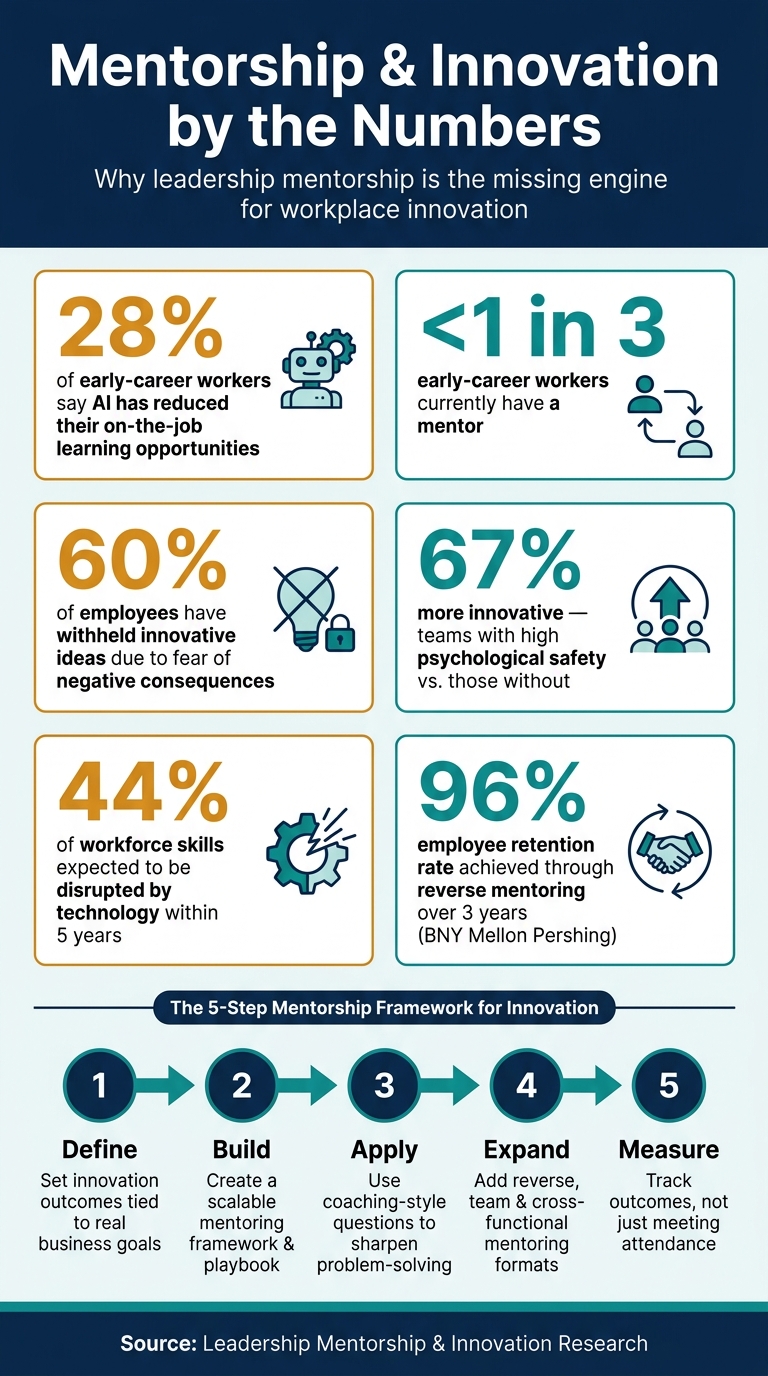
Mentorship & Innovation: Key Statistics Leaders Need to Know
The Barbell Guide to Mentorship - A Game-Changing Strategy for Creative Leaders & Innovators #351
sbb-itb-9ceb23a
1. Define the innovation outcomes mentorship should produce
The best mentorship programs begin with clear innovation goals linked to actual business problems. That means starting with a business challenge the mentor can help the mentee tackle, not with a vague plan to “develop people.”
Tie mentoring goals to real business challenges
Choose a small set of innovation priorities your organization is already trying to move forward. Stay close to problems like process improvement, cross-functional collaboration, or recurring bottlenecks.
As strategic advisor Cris Beswick puts it:
"The leverage point for innovation isn't mavericks at the edges - it's middle managers in the middle." [7]
That idea matters. If mentoring is tied to day-to-day business friction, it has a much better shot at changing how work gets done.
Identify the human capabilities to build
Once the business challenges are clear, work backward and ask: What do people need in order to solve these problems well?
For innovation mentorship, the key capabilities include curiosity, creative confidence, resilience, empathy, critical thinking, and complex problem-solving. These traits help people reframe problems, deal with ambiguity, and make decisions when the full picture isn’t available. Good mentors also help people look past today’s task list and spot what may be coming next.
Set success measures before the program starts
Set the success measures before the first mentoring session begins. Focus on two types of results:
- Near-term innovation results, such as experiments launched, ideas moved to pilot, process improvements put in place, and new cross-functional collaborations formed [1][6]
- Long-term capability growth, such as retention of high-potential talent, growth in problem-solving confidence, stronger confidence to innovate, and whether former mentees later become mentors [1][5][6]
| Metric Category | Near-Term Wins | Long-Term Capability |
|---|---|---|
| Execution | Ideas advanced to pilot; experiments launched | Retention of high-potential talent; promotion rates |
| Culture | Cross-functional projects formed | Confidence to innovate; mentee-to-mentor conversion |
| Behavior | Number of risks taken; ideas shared in forums | Ability to spot early signals; enhanced problem-solving skills |
These outcomes give you the foundation for the mentoring framework that follows.
2. Build a mentorship framework leaders can scale
Once the outcomes are clear, leaders need a setup they can use again and again. That’s what turns mentoring from a nice idea into a steady habit. Without that setup, mentorship tends to drift. It becomes informal, uneven, and hard to tie back to innovation goals.
Create a simple mentoring playbook
A playbook gives mentoring a shared structure. It helps leaders build better judgment, speed up learning, and run more useful experiments. Keep it simple. Cover the purpose of the mentoring work, each person’s role, meeting cadence, timeline, and review points. A 90-day or 6-month timeline usually works well. Add review points so the work stays connected to the innovation goals from Step 1 [8][2].
One detail makes a big difference: include a short list of questions mentors can use to push thinking instead of jumping in with answers. That shift matters. It helps mentees work through their own thinking and build stronger judgment over time [4][8].
Match mentors and mentees based on innovation needs
The next step is matching people around the innovation challenge they need to solve. Matching by title or seniority alone misses the mark. In innovation work, the best matches come from the problem itself, not the org chart.
Start with the mentee’s specific challenge area. Then find a mentor whose experience connects to that challenge from a different functional angle. An engineer paired with a marketer, or a finance leader paired with a product designer, can bring a very different point of view. Different functions tend to spot different assumptions, and that helps teams look at problems in a new light [2].
Skip mirror-image pairings that just repeat the same thinking. It also helps to match people based on learning agility, like curiosity and how they respond to feedback, not just title or visibility [8]. If needed, define the mentor’s role at the start. They might serve as a sounding board, advisor, connector, or perspective-shifter [9].
Formal vs. informal mentoring structures
Structure matters, but not every innovation need should use the same format. Sometimes you need a set system. Other times, a quick conversation in the flow of work does the job. The comparison below shows how formal and informal mentoring support different innovation needs [8][2].
| Feature | Formal Mentorship | Informal Mentoring |
|---|---|---|
| Consistency | High; follows a repeatable playbook and timeline | Low; depends on individual initiative |
| Speed | Slower to launch; requires matching and setup | Immediate; happens in the flow of work |
| Accountability | High; tracked via review points and organizational goals | Low; no formal oversight |
| Resources | Significant; requires coordination | Minimal; requires only leader time |
| Best Use | Scaling leadership capacity and breaking silos | Rapid problem-solving and just-in-time learning |
| Primary Value | Long-term capability building | Immediate judgment transfer |
3. Apply mentoring practices that improve problem-solving
Once the framework is in place, the day-to-day habit matters most. A mentor's job is to build independent thinking, not create reliance. That's what turns the Step 2 framework into better problem-solving on the ground.
Ask questions that reframe the problem
When a mentee brings you a problem, resist the urge to jump in with the answer. Start with questions that help them test their own assumptions and move from vague ideas to small experiments and clearer choices.
Questions like "What do you think is really going on here?" or "What would you try if you weren't asking me?" push the person to think for themselves [4].
"Mentoring often means asking better questions, not giving quicker solutions." - Sarah Stall, Author and Leadership Expert, Leadership Circle [4]
Even a simple question like "What options have you already considered?" can shift the conversation. It helps mentees spot low-cost tests, try ideas early, and avoid big failures later.
Build trust so people can share early ideas
Trust matters because people rarely share rough ideas if they expect to get shut down. 60% of employees have withheld innovative ideas specifically because they feared negative consequences [10]. When that happens, ideas die before anyone can test them.
A better move is simple: lead with curiosity, save judgment for later. Keep the idea phase separate from the critique phase. If mentors criticize too soon, people learn that only polished, low-risk ideas are safe to bring up.
Failure also needs a different frame. When mentors treat failure as data, smart risk-taking feels normal instead of dangerous. And the payoff is hard to ignore: Teams with high psychological safety are 67% more innovative than those without it [10].
That kind of trust also supports bigger mentoring models, including reverse mentoring and team mentoring.
Directive mentoring vs. coaching-style mentoring
Coaching-style mentoring assumes the mentee can solve problems. Directive mentoring assumes the mentor should lead and the mentee should follow. That difference shapes how people learn, how fast they grow, and how well they handle tough problems.
Coaching-style mentoring builds independent thinking, faster learning, and stronger resilience - the same traits innovation depends on [4].
The table below shows how the two approaches differ in the areas that matter most for innovation:
| Feature | Directive Mentoring | Coaching-Style Mentoring |
|---|---|---|
| Creativity | Low; limited to the leader's expertise | High; encourages unconventional thinking |
| Ownership | Low; mentee executes instructions | High; mentee develops and defends ideas |
| Learning Speed | Slow; dependent on the leader's input | Fast; accelerated by reflection and trial |
| Resilience | Low; teams become dependent | High; teams become independent and adaptive |
| Best Use Case | Crisis management or routine execution | Innovation and complex problem-solving |
The key is balance: keep structure, but don't take ownership away from the mentee.
Once one-on-one mentoring starts sharpening judgment, the next step is to spread that approach across teams and functions.
4. Expand innovation capacity with reverse, team, and cross-functional mentoring
One-on-one mentoring can build strong thinkers. But if you want innovation to spread across a company, that alone isn't enough.
When ideas move only through one-to-one relationships, teams miss what happens when people from different age groups, departments, and backgrounds learn from each other. To grow innovation across the business, leaders need mentoring formats that move insight across role, function, and level.
Use reverse mentoring to sharpen leadership in the age of AI
Reverse mentoring flips the usual setup. Instead of senior leaders guiding junior employees, younger or more digitally fluent employees mentor senior leaders.
This isn't about career coaching. It's about giving leadership a direct view into AI tools, new ways of working, and how younger customers think and behave.
The skills gap here is hard to ignore. Research shows 32% of workers ages 55 to 65 report a lack of computer skills, compared with just 7% of workers ages 25 to 34 [11]. And with 44% of workforce skills expected to be disrupted by technology within the next five years [15], that gap has to close.
BNY Mellon's Pershing put this into practice through its GENEDGE employee resource group. The company paired emerging leaders with senior executives so they could trade perspectives on AI adoption, communication styles, and workplace culture. The result was a 96% retention rate over the program's first three years [12][15].
"In the age of intelligent machines, the most adaptive leaders will be those humble enough to keep learning - especially from those younger, newer, and closer to change." - Dr. Ravinder Tulsiani, Workforce Capability Strategist [13]
For reverse mentoring to work well, pair people based on specific knowledge, not just job level. A data analyst matched with a CFO is a good example [15][17].
Use mentoring circles and team mentoring to break silos
Mentoring circles shift the focus from pairs to small groups. You might have an engineer, a marketer, a finance leader, and a product designer in the same circle. These are people who often don't get much time together to work through problems.
That mix matters. People have to explain their thinking to colleagues who don't share the same assumptions. And that's often where better ideas start to take shape.
There's another upside. When no one is singled out for what they don't know, the group tends to stay open and curious instead of shutting down. That's a much better setup for early-stage ideas [14]. Keep the circles small, and tie them to one actual problem. If the goal is fuzzy, energy fades fast. A clear question gives the group something to wrestle with.
Compare mentoring models by innovation goal
Each mentoring model helps with a different kind of innovation work. The common thread is simple: move know-how faster than the org chart normally would.
| Mentoring Model | Scope | Resource Needs | Collaboration Impact | Typical Outcomes | Best-Fit Context |
|---|---|---|---|---|---|
| One-to-One | Individual | Moderate | Low (dyadic) | Career guidance, skill transfer | High-potential development [2] |
| Reverse | Leadership | Moderate | Medium (intergenerational) | Digital fluency, cultural insight | AI adoption, DEI initiatives [13][16] |
| Cross-Functional | Departmental | High | High (silo-breaking) | Problem-solving, idea flow | Product innovation, R&D [2][3] |
| Mentoring Circles | Group | Low | High (peer-to-peer) | Diverse perspectives, trust | Knowledge sharing, culture building [2][1] |
Many organizations that do this well don't pick just one model. They use several at the same time, depending on the problem they're trying to solve. The next move is to measure which setup helps ideas move faster and which one builds skills that stick.
5. Measure results and sustain mentorship as a leadership discipline
Measure outcomes, not attendance. Activity counts tell you what took place. They don't tell you if mentorship is leading to better decisions, faster testing, or skills that stick over time. Use the same goals from Step 1 and review them on a set cadence.
Track short-term wins and long-term capability gains
Look at the same outcomes across two time frames: short-term execution and long-term capability.
| Time Horizon | Innovation & Problem-Solving | Capability |
|---|---|---|
| Short-Term Wins | Experiments run; idea implementation rates | Psychological safety scores |
| Long-Term Gains | Quality of decision-making; sustained creative output | Leadership effectiveness scores (r = .82) [4]; retention of high-potential talent; promotion velocity |
Track promotion velocity: how fast mentored employees move into roles with more responsibility. It's a clean signal that the program is building actual capability, not just goodwill [4].
Build feedback loops into every mentoring cycle
Once your measures are set, turn them into a review cycle. Use structured surveys and one-on-one check-ins to gather insight on mentee growth, satisfaction, and relationship quality [1]. Each review should answer four questions:
- Is the mentor relationship working?
- Is the mentee making progress on their innovation goals?
- Are there barriers to testing ideas that still haven't been addressed?
- Do the original goals still make sense?
Use short surveys to track psychological safety - whether mentees feel safe enough to share unfinished ideas or admit what they don't know [1] [3]. If those scores are low, the mentoring relationship isn't creating the conditions that innovation needs.
Conclusion: Make mentorship part of how leadership creates advantage
Use what the reviews show to improve the next mentoring cycle. The steps in this guide build on each other: define the innovation outcomes you need, build a framework that can scale, apply coaching-style practices that sharpen thinking, and measure what's changing - not just what happened.
When leaders measure outcomes and adjust the mentoring cycle, mentorship becomes a repeatable driver of judgment and innovation. Mentorship builds the Human Moat: judgment, trust, and creative confidence that AI cannot replace. That's how Seth Mattison describes durable advantage - and mentorship is one of the clearest ways leaders build it.
FAQs
How do I start a mentorship program tied to innovation goals?
Start with clear objectives that support your strategic vision. If the goal is fuzzy, the program will drift.
Then match people based on complementary skills and different points of view, not just job title or seniority. A good pairing often comes from how well two people can fill each other’s gaps.
Keep the program flexible. Give people room to test ideas, take smart risks, and brainstorm without worrying about being shut down too fast. That kind of space often leads to better thinking.
It also helps to encourage cross-functional and reverse mentorship. People in different roles see different problems, and newer employees often bring sharp ideas that more senior team members might miss.
When it’s time to measure success, look past meeting counts. Focus on things like:
- Project outcomes
- Decision quality
- Employee confidence
What mentoring format works best for cross-functional innovation?
The formats that work best tend to pull people out of their usual lanes and bring different points of view into the room. Cross-functional mentorship connects people from different departments, while reverse mentorship gives junior employees space to share what they know about emerging technologies, digital trends, and new ways of working.
It also helps to pair people on purpose based on growth goals, not just job titles. And when these exchanges show up inside product reviews and strategy sessions, mentorship becomes part of how the company thinks and builds day to day.
How can leaders measure whether mentorship is driving new ideas?
Leaders should look past activity logs and pay attention to growth, decision quality, and results.
That means tracking project outcomes and looking at how often new ideas are put into practice with success. A busy log can look good on paper, but it doesn’t tell you much on its own. What matters is whether people are learning, making better calls, and turning ideas into work that moves the team forward.
It also helps to look at team members’ confidence, the kinds of risks they’re willing to take, and the quality of the choices they make over time. Surveys and one-on-one check-ins can give leaders a clearer read on individual growth and how the team feels about the mentorship process.
Related Blog Posts

Seth Mattison
Top 50 Keynote Speakers in the World | Future of Work Strategist | Co-Founder & CEO