
Articles Apr 27, 2026 9:00:00 AM Seth Mattison 25 min read

In today’s fast-moving markets, balancing immediate tasks with broader goals is critical. Many organizations struggle to address short-term needs while keeping long-term objectives on track. The solution? Connect short-term actions with a clear, overarching direction.
Key takeaways from this guide:
- Strategic anchors act as guiding principles, aligning every decision with long-term goals.
- Agile sprints break down big goals into manageable tasks, ensuring steady progress.
- OKRs (Objectives and Key Results) link daily efforts to broader objectives, driving measurable outcomes.
- Use a 70-20-10 rule for resource allocation: 70% on core activities, 20% on strategic initiatives, and 10% on experiments.
- Regular reviews and feedback loops ensure alignment and quick course corrections.
Setting Up Strategic Anchors for Long-Term Direction
Strategic anchors are the core principles that keep your organization on track, ensuring that every decision aligns with your long-term goals. Think of them as your compass - they won't dictate every move, but they'll make sure you're heading in the right direction.
These anchors help establish a leadership mindset, aligning your team around what truly matters and preventing "mission creep" - that tendency to chase every tempting new opportunity [3]. Organizations that root their decisions in data and long-term objectives often see measurable success. For instance, companies leading in AI have achieved 1.5x higher revenue growth and 1.6x greater shareholder returns compared to their peers [4].
In today's fast-changing market, having clear anchors is even more essential. By 2025, enterprise spending on generative AI is projected to reach $37 billion, a 3.2x increase year-over-year [4]. Interestingly, up to 40% of this spending now comes from individual users rather than top-down mandates [4]. This dual pressure - external market shifts and internal demands - can easily pull teams in multiple directions without firm guiding principles in place.
How to Define Strategic Anchors
To establish effective anchors, focus on what success looks like over the next 12–18 months - a timeframe that balances relevance with meaningful direction [2]. Consider questions like: What obstacles are keeping us from achieving our short-term goals? What foundational capabilities do we need to develop?
A helpful tool here is the Balanced Scorecard, which ensures your anchors address four key areas: Customer Impact, Internal Processes, Learning and Growth, and Financial Sustainability [3]. Anchoring solely to financial metrics often overlooks critical factors like operational efficiency or team development. For example, the Pennsylvania Outdoor Corps (PAOC) - which engages over 1,000 youth and young adults annually - embedded their strategic anchors into everything from recruitment to project prioritization across Pennsylvania's public lands [3].
"Through our work together, we now have a clear action plan and attainable objectives." – Jill Wiles Wolf, President, Hopebound Ministries [3]
Once you've defined your anchors, the next challenge is turning them into actionable objectives.
Making Strategic Anchors Actionable
Strategic anchors only deliver results when they lead to specific, measurable objectives that guide daily operations. One effective approach for resource allocation is the 70-20-10 rule: allocate 70% of resources to core business activities, 20% to strategic initiatives tied to your anchors, and 10% to innovative experiments [1].
A mid-sized manufacturing company, for example, faced declining profitability. They adopted a 12-month strategy centered on one anchor: simplifying their product portfolio. By reducing SKUs and focusing on medium-sized customers, they achieved a 50% increase in profitability within a year [2]. The key was turning a broad principle into tangible actions.
To keep anchors relevant, regular evaluation is critical. Schedule periodic reviews to track progress and adjust tactics as needed, ensuring you stay aligned with your broader goals [2]. Tools like a priority matrix can help categorize tasks by urgency and strategic value, preventing day-to-day challenges from overshadowing long-term priorities [1].
When strategic anchors are actionable, they not only guide decisions but also fuel momentum through agile workflows, keeping your team focused and aligned.
Using Short-Term Iterations to Stay Agile
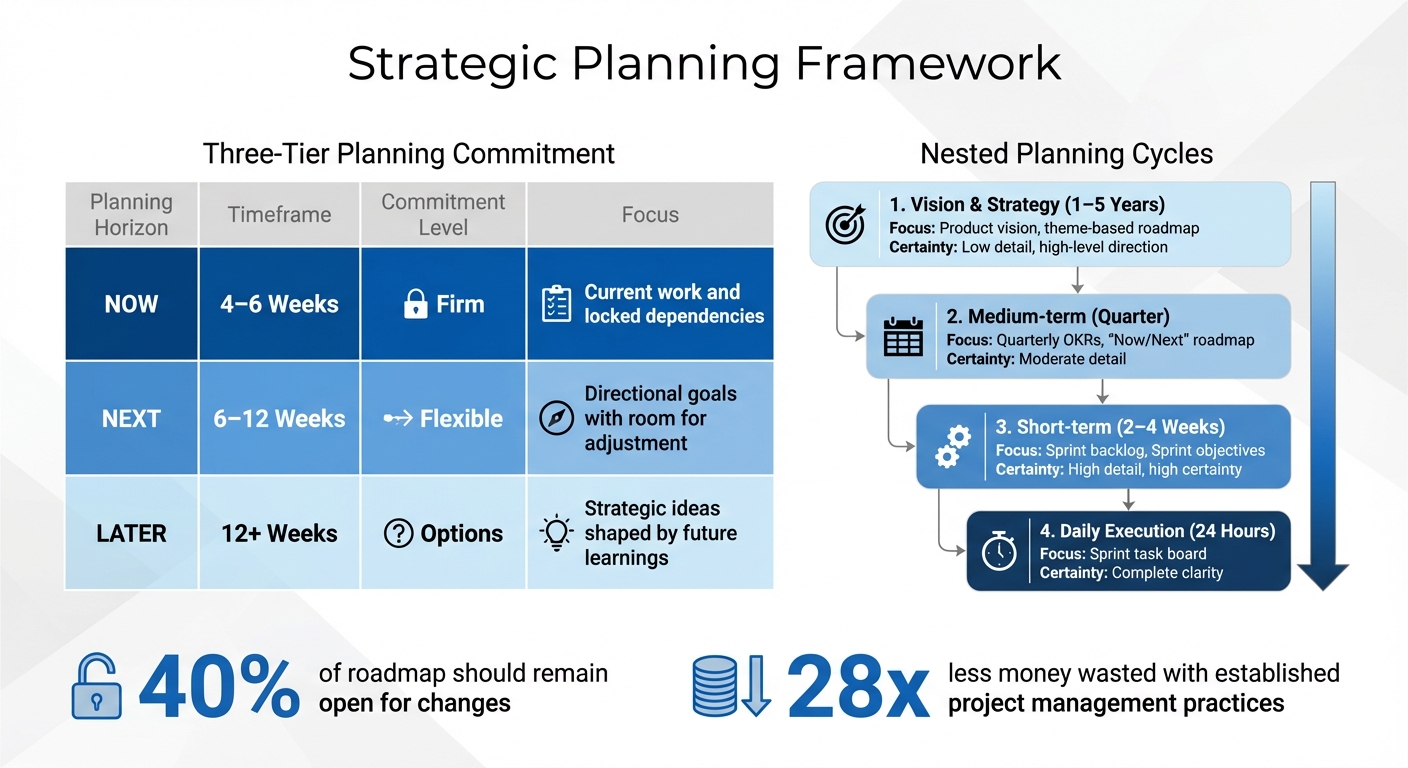
Strategic Planning Framework: Time Horizons and Commitment Levels
Short-term iterations, typically lasting two to four weeks, help break down long-term goals into smaller, actionable tasks. These cycles allow teams to make consistent progress while staying adaptable to new information. By working in these manageable bursts, organizations can align their actions with broader strategies while responding to changes effectively.
Here's a compelling stat: organizations that follow established project management practices waste 28 times less money, ensuring steady progress toward their goals [5]. But here's the catch - true iterative planning isn’t just about sticking to a rigid roadmap. It's about continuously refining the plan based on what you learn along the way [7].
How Agile Sprints Work
Agile sprints are all about focusing on the most valuable work you can deliver in a set timeframe. The goal? Ship it, learn from it, and adjust. Each sprint revolves around answering one key question: What’s the most valuable thing we can deliver right now?
To balance focus and flexibility, structure your planning into three commitment tiers [7]:
| Planning Horizon | Timeframe | Commitment Level | Focus |
|---|---|---|---|
| Now | 4–6 Weeks | Firm | Current work and locked dependencies |
| Next | 6–12 Weeks | Flexible | Directional goals with room for adjustment |
| Later | 12+ Weeks | Options | Strategic ideas shaped by future learnings |
This approach keeps current tasks well-defined while leaving space for adjustments as new insights emerge. In fact, leaving around 40% of your roadmap open for changes isn’t a lack of planning - it’s a deliberate way to stay adaptable [7].
It’s also important to distinguish between two types of iterations: learning iterations (which test assumptions with minimal viable versions) and quality iterations (which deliver polished features) [7]. If you can’t clearly define what you’re trying to learn from an iteration, you’re not iterating - you’re just shipping incomplete work [7].
Each sprint not only moves you closer to your goals but also helps refine your strategic anchors. This dynamic process ensures your efforts stay aligned with evolving market conditions.
Connecting Iterations to Your Larger Vision
While short-term sprints set the pace, it’s crucial to ensure they align with your long-term vision. Every sprint decision contributes to your overall strategy, whether intentionally or not [6]. The key question is: Are these decisions steering you toward your stated vision or quietly pulling you off course?
To maintain alignment, implement nested planning cycles that ensure a steady flow of information [5]:
- Annual vision reviews to confirm your long-term direction
- Quarterly OKRs to translate vision into measurable outcomes
- Bi-weekly sprint planning to identify the next high-value task
- Daily stand-ups to keep execution on track
During sprint reviews, ask the "6-Month Question": If we continue working this way for six months, what will become easier, and what will become harder? [8]. This simple question helps uncover hidden challenges before they become roadblocks.
Building in Feedback Loops
Shipping work is only half the battle. The real value comes from interpreting results and adjusting accordingly. As systems expert CJ Matthews puts it:
"Shipping without interpretation leads to activity, not learning" [6].
To ensure learning happens, wrap up every sprint with a 30-minute reflection session. Address these three questions [7]:
- What did we learn that changed our thinking?
- What should we do differently next time?
- What do we need to learn next?
Discovery work should be time-boxed to a maximum of two weeks [7]. If no clear outcome emerges within that time, simplify your approach to keep things moving. Before starting any learning iteration, define an explicit hypothesis [7]. For example: "We believe [this change] will lead to [this outcome] because [this assumption]." Without a hypothesis, you’re just guessing - not learning.
Keep a decision log to track major choices, the reasoning behind them, and expected outcomes [7]. Later, compare these predictions with actual results to refine your decision-making process and catch early signs of misalignment with your strategic anchors.
Finally, assign someone to oversee "reversibility" - someone who ensures that short-term decisions don’t create long-term problems [6]. If simple updates suddenly require complex coordination or certain areas of your system become untouchable, you’re likely accumulating strategic debt that will need to be addressed eventually.
Using OKRs to Connect Short and Long-Term Goals
The Objectives and Key Results (OKRs) framework serves as a bridge between strategy and execution. It translates high-level strategic goals into measurable, actionable daily tasks [9]. As OKR consultant Dan Montgomery explains:
"Strategy isn't a plan to be executed, but a hypothesis to be continuously tested and validated." [9]
This ongoing testing happens through structured goal cycles, which tie your long-term vision to quarterly priorities and weekly activities. Start by defining an annual "North Star" OKR - a clear, overarching objective for the year [9]. Then, break it down into 90-day cycles to maintain a sense of urgency while ensuring steady progress [11]. Here's why this approach works: organizations using quarterly goals report a 31% higher return compared to those relying solely on annual goals [11]. On top of that, only 8-9% of people who set annual goals actually achieve them [11].
To ensure alignment, cascade goals from leadership down through the organization, while also laddering them upward to connect short-term efforts with strategic priorities [9]. This structure ensures that short-term actions contribute to long-term objectives, avoiding wasted effort on tasks that don’t drive meaningful progress. It also complements agile methodologies by ensuring that each iteration aligns with broader strategic goals.
Once you’ve established a clear vision, the next step is crafting OKRs that effectively operationalize your strategy.
How to Set Effective OKRs
Start with one clear long-term direction to maintain focus and energy [9]. Your annual North Star OKR should act as the foundation for all shorter-term goals, creating a clear link between long-term objectives and daily behaviors [11].
For each 90-day cycle, aim to define 3–5 OKRs at most [12]. Keeping the number limited prevents overcommitment and reduces the risk of burnout. Focus these OKRs on areas of change or growth, rather than routine tasks [9]. As Natalija Hellesoe puts it:
"OKRs are an expression of the strategy, helping you reach your goals, but they aren't the strategy itself." [9]
When writing OKRs, remember to differentiate between Objectives (which are qualitative and aspirational) and Key Results (which are quantifiable milestones) [12]. Prioritize lead metrics, such as "number of demos scheduled" or "emails sent", over lag metrics like "total revenue" [12]. Lead metrics offer quicker feedback and help teams stay proactive, especially when results take time to materialize.
Using if-then planning can also boost follow-through. For instance: "If Monday at 9 AM arrives, then spend one focused hour on prospecting" [11]. Research shows that people using these specific plans are about three times more likely to follow through on challenging goals [11].
Avoid writing OKRs too far in advance - stick to one cycle at a time [9]. This keeps your approach flexible, allowing you to adapt based on lessons from the previous quarter. A great example of this adaptability is Intel’s "Operation Crush" in the 1980s. Faced with competition from Motorola, Intel quickly pivoted its strategy, aligning thousands of employees under a single OKR focused on winning sales designs. By year's end, Intel had successfully shifted customer focus to their products, outpacing their rival [10].
Tracking and Reviewing Your Progress
Just as agile sprints rely on feedback for improvement, regular OKR reviews ensure your goals stay aligned with your strategy. Use a structured review cadence to connect daily tasks with long-term goals [13]:
| Review Frequency | Focus Area | Primary Goal |
|---|---|---|
| Weekly | Tactical/Operational | Review weekly priorities and lead metrics |
| Monthly | Performance Check-in | Assess OKR progress and address critical actions |
| Quarterly | Strategy Refresh | Review 90-day performance and set next cycle focus |
| Annual | Long-term Planning | Review 12-month performance and set a new North Star |
Set these review dates at the start of the year and treat them as non-negotiable [13]. This consistency builds a rhythm and ensures OKRs remain visible amid daily demands.
During quarterly reviews, apply the "Three Cs": Close Out completed metrics, Carry Forward ongoing targets, or Create New goals [13]. Strive to achieve about 70% of your key results - this indicates your goals are ambitious enough without being unrealistic [13].
If your team consistently falls short of OKRs, treat it as an early warning signal. It may indicate that the strategy itself - not just execution - needs rethinking [9]. Rick Klau, former Chief Technology Officer for Innovation in California, used this approach during a complex website migration. By clarifying outcomes and conducting regular reviews, his team identified priorities, adjusted focus, and completed the project on time while speeding up future initiatives [9][10].
To maintain company-wide alignment, make OKR progress visible through physical or digital dashboards [13]. This transparency leverages the "goal-gradient effect", where people tend to work harder as they see themselves nearing a goal [12]. As Klau notes:
"Without that framework, the conversation just becomes horse-trading." [9]
OKRs should evolve alongside your strategy. As Naveen Gavini, Head of Product at Pinterest, explains:
"While our mission has remained consistent over the years; our strategy, objectives, and key results evolve." [9]
This adaptability ensures that short-term efforts remain aligned with long-term goals, turning everyday actions into meaningful progress.
Balancing Stability with Flexibility in Your Plans
Continuing our exploration of iterative planning and measurable goals, let’s dive into how to strike a balance between maintaining strategic stability and adapting to ever-changing market demands. Successful organizations stick to their long-term vision while staying nimble in execution. Amazon founder Jeff Bezos famously embraced this idea by holding firm to a customer-first philosophy while adjusting tactical decisions as needed [2].
Your vision, overarching strategy, and key themes should act as a steady compass over 1–5 year horizons [5]. Meanwhile, the specifics - like feature details, timelines, and execution methods - should remain flexible, allowing you to adapt based on feedback and new insights [14].
The rigidity of traditional 5-year plans often makes them liabilities in today’s fast-moving markets [2]. Studies show that up to 90% of strategies fail to deliver results, often due to inflexible execution or a lack of focus [2]. To counter this, many organizations now adopt 12–18 month strategy cycles. These shorter cycles address immediate priorities while staying aligned with broader objectives [2].
Creating a Portfolio of Initiatives
To balance short-term and long-term goals, consider structuring your work into nested planning cycles with varying time horizons [5]. This approach ensures resources are allocated across immediate needs, medium-term goals, and future opportunities.
| Planning Level | Time Horizon | Focus | Certainty Level |
|---|---|---|---|
| Vision & Strategy | 1–5 Years | Product vision, theme-based roadmap | Low detail, high-level direction |
| Medium-term | Quarter | Quarterly OKRs, "Now/Next" roadmap | Moderate detail |
| Short-term | 2–4 Weeks | Sprint backlog, Sprint objectives | High detail, high certainty |
| Daily Execution | 24 Hours | Sprint task board | Complete clarity |
Instead of managing individual features, group related initiatives under strategic themes [5]. For example, rather than focusing on tasks like "Add mobile checkout button" or "Optimize mobile payment flow", create a broader theme like "Improving mobile experience." This method maintains focus on larger goals while giving teams room to adjust the details.
Another key tactic is Agile Budgeting, which involves funding ongoing product teams or value streams instead of temporary, fixed-scope projects [5]. This allows for predictable costs while giving teams the flexibility to shift priorities as needed. Research shows that organizations using effective project management practices waste significantly less money because more strategic initiatives succeed [5].
With a well-structured portfolio, the next step is to embed adaptability directly into your long-term planning.
Building Flexibility into Long-Term Plans
Shift to outcome-oriented roadmaps that focus on solving customer problems, rather than committing to rigid features or deadlines [5]. This approach ensures that resources are allocated to initiatives that deliver meaningful results, even if it means abandoning projects that are technically on track but fail to meet broader goals [14]. As Propeller emphasizes:
"Green status reports don't mean progress if the outcome hasn't moved." [14]
Use the "Now, Next, Later" framework to clearly communicate priorities and acknowledge uncertainty [5]. In this model, "Now" covers well-defined initiatives for the current quarter, "Next" highlights challenges for the following quarter without locking in solutions, and "Later" includes long-term ideas that remain open-ended.
Schedule quarterly reviews to assess progress and refine your strategy based on actual results [2]. These reviews provide an opportunity to redirect resources toward what’s working and away from what isn’t. Rather than seeing adjustments as failures, view them as smart responses to new information.
The contrasting paths of Amazon and Nokia highlight the importance of this balance. Amazon’s ability to adapt tactically while staying true to its strategic vision helped it thrive. In contrast, Nokia’s rigid adherence to incremental improvements in mobile phones left it unprepared for the smartphone revolution, allowing competitors like Apple to dominate the market [2]. This example underscores why blending a clear strategic direction with flexible execution is critical for staying competitive.
Conclusion
This guide has explored how combining strategic anchors with agile iterations can help organizations stay ahead in a fast-changing market. Striking the right balance between short-term adaptability and long-term vision is key to maintaining an edge. In fact, teams that successfully align these elements report 3x higher employee engagement and 2.5x better project completion rates [1].
Jeff Bezos captured this balance perfectly when he said, "We are stubborn on vision. We are flexible on details." [2] Strategic anchors act as a compass, providing clarity and preventing organizational drift. Meanwhile, agile iterations allow businesses to respond swiftly to changing market conditions, technological advances, and shifting customer demands.
In today’s AI-driven world, where traditional value sources are being reshaped, execution speed has become a critical advantage [16]. Organizations that adopt disciplined frameworks see 2.3x faster decision-making [15]. The contrasting paths of Nokia and Apple illustrate this principle vividly: Nokia’s rigid planning left it unable to pivot when the market changed, while Apple’s ability to pair a steadfast long-term vision with tactical flexibility enabled it to thrive. Success isn’t about having the most detailed five-year plan - it’s about adapting quickly while staying true to your overarching goals. As Seth Mattison points out, winning in the AI era depends on seamlessly blending agility with strategic focus.
To stay competitive, adopt the 70-20-10 principle, define your North Star vision, and establish regular review cycles to ensure your strategy remains flexible and relevant.
FAQs
How do I choose the right strategic anchors for the next 12–18 months?
To find the right strategic anchors, start by examining your surroundings and identifying ways to maintain a competitive edge. A 5C analysis - focusing on your Company, Collaborators, Customers, Competitors, and Context - can help pinpoint crucial success factors and potential risks.
Pay attention to emerging trends, such as the influence of AI on workflows, the importance of trust, and how integration is evolving. Make sure your strategy aligns with these insights to position yourself effectively for the next 12 to 18 months.
How can we keep sprints flexible without drifting off strategy?
To keep sprints flexible while staying aligned with long-term goals, think of strategy as a process that evolves through small, iterative steps. Build in room for adjustments during sprints, but make sure every step contributes to the broader objectives. Tools like strategic compasses can help you plan in a way that balances immediate actions with the overall vision. This method allows for adaptability without drifting away from your ultimate goals.
What’s the simplest way to connect OKRs to sprint work?
To link OKRs to sprint work, start by breaking down your long-term objectives into smaller, actionable goals for each sprint. This means translating high-level OKRs into clear, measurable sprint goals that directly support your overall strategy. Stick to a consistent rhythm, like quarterly OKRs paired with 2- or 4-week sprints, to maintain alignment and track progress effectively. This approach ensures that daily tasks stay focused on driving long-term results.