
Articles Jul 6, 2026 12:49:45 PM Seth Mattison 15 min read

Most AI alliances fail from people and governance problems, not model issues. From the article, the main pattern is simple: when partners do not agree on goals, data rights, model rules, and decision ownership, risk grows fast.
Here’s the short version:
- Misalignment usually starts early in incentives, governance, and decision rights.
- Data is a major friction point: about 75% of firms report incomplete or inconsistent data in AI collaboration work, and 66%+ point to poor data quality or siloed systems.
- Accountability gets blurry fast when data, models, and liability are split across partners.
- Legal exposure can spread through weak data rights, unclear IP provenance, and poor deletion or use controls.
- Performance suffers too: 47% of AI projects never reach production, often due to people, process, and governance problems.
- Governance put in place early helps: firms with mature AI governance are 65% more likely to report success, while formal partner governance is tied to 42% fewer compliance incidents and 38% faster time-to-market.
If I had to boil the article down to a few plain lessons, they would be these:
-
Set rules before scale.
Agree on data ownership, model oversight, escalation paths, and who makes final calls before launch. -
Map accountability in plain English.
If a model fails, if a regulator asks questions, or if customer data is misused, everyone should already know who owns the response. -
Do not leave governance to the tech team alone.
Legal, security, data, and business teams need shared oversight across the full alliance. -
Review the alliance often.
Goals, data flows, and model use change over time. Governance has to change with them.
A quick comparison of the article’s main risk areas:
| Risk Area | What Goes Wrong | Early Sign | Likely Result |
|---|---|---|---|
| Data rights | Unclear ownership or use limits | Missing data-flow records | Privacy issues, fines, trade-secret loss |
| Model governance | No shared rules for quality and control | Drift, uneven outputs | Rework, launch delays |
| Decision ownership | No clear final owner | Teams cannot explain AI decisions | Liability and regulator pressure |
| IP provenance | Training sources are unclear | Poor source transparency | Infringement claims, weak ownership |
| Exit planning | No fallback if the alliance breaks | Deep tool or model dependency | Lock-in, high switching cost |
| Accountability | Responsibility spread across parties | No human review rules | Slow incident response |
Bottom line: I’d sum up the article this way: AI alliances work better when leaders treat alignment as a daily management job, not a one-time contract task. The big risks are not hidden. They usually show up first in unclear incentives, weak governance, messy data, and shared accountability with no single owner.
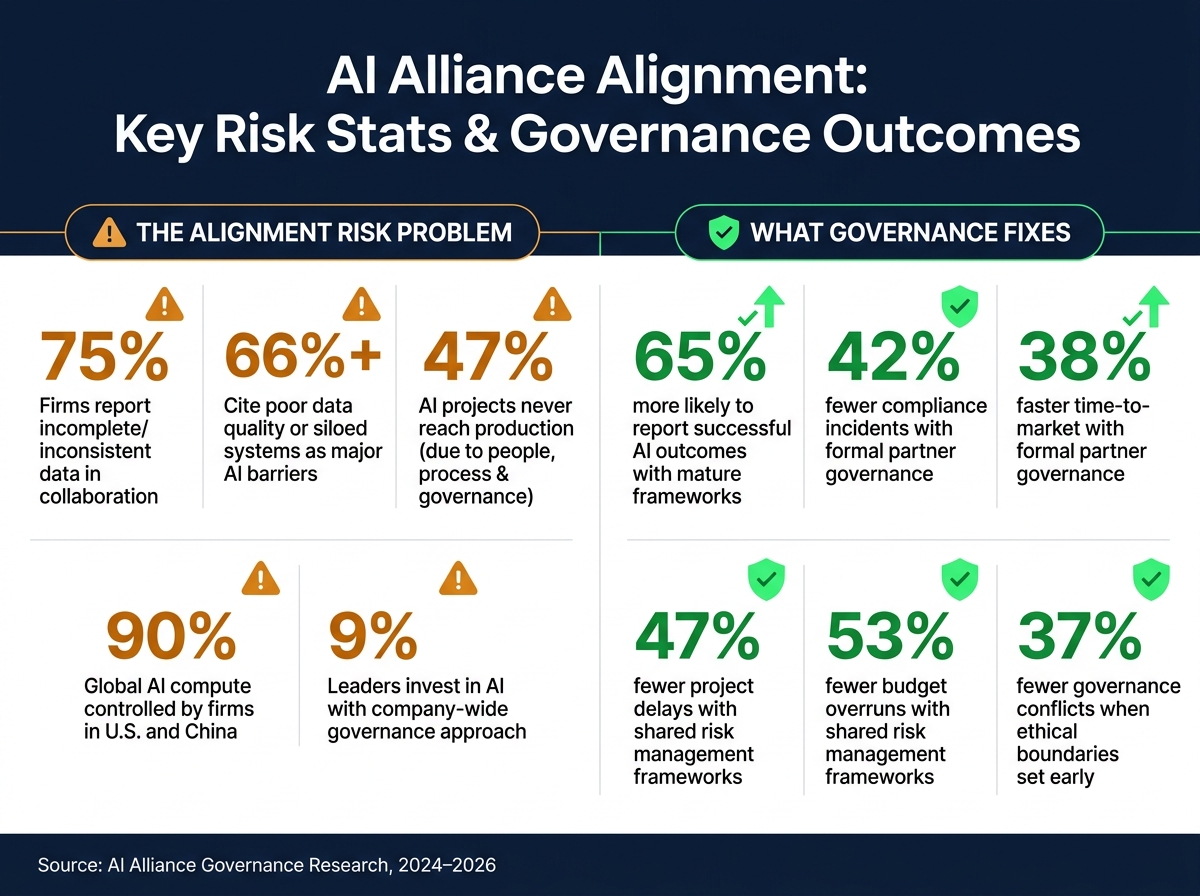
AI Alliance Alignment: Key Risk Stats & Governance Outcomes
Why AI Governance Failures Are Becoming a Major Business Risk
sbb-itb-9ceb23a
Where stakeholder misalignment shows up in AI alliances
Misalignment tends to show up first in incentives, governance, and decision rights. That’s usually where things start to fray: who wants what, who gets to decide, and who carries the risk.
Conflicting objectives, incentives, and time horizons
Partners often chase different returns on different timelines. One side may want near-term revenue, while the other is betting on long-term learning or market position. When that happens, private gain can crowd out shared value and hurt joint execution.[4]
Volatile markets make this worse. Instead of adjusting the alliance strategy together, partners often shift into self-protection mode and guard their own resources.[1] That can slow progress, create friction, and leave the partnership stuck between two agendas.
Unclear governance for data, models, and accountability
AI alliances don’t move in a simple vendor-to-customer line. Data, models, and accountability are spread across multiple parties, so weak governance creates confusion fast.[3]
The friction usually shows up around a few familiar issues:
- data ownership
- model governance
- AI safety and compliance standards
The data problem is hard to ignore. Roughly 75% of organizations report struggling with incomplete or inconsistent data when trying to work on AI collaborations, and more than 66% cite poor data quality or siloed systems as major barriers to AI progress.[3] When the ground truth is messy, pilots stall and scale-up loses steam.
Power imbalances, trust gaps, and knowledge divides
Partners rarely come in with the same level of power or know-how. Research points to a gap in industry proximity - cases where one firm is much closer to the alliance’s industry context than the other.[4] That gap cuts both ways. The closer partner faces a higher risk of industry-specific knowledge expropriation, while the farther partner may have trouble learning and using the other side’s knowledge.
Power concentration makes the imbalance even sharper. As of 2026, 90% of AI compute is controlled by firms in the U.S. and China.[2] For global alliances, that can create sovereignty concerns and hard dependencies.
There’s also a people problem inside the alliance itself. Technical and nontechnical teams often don’t share the same view of tradeoffs, so decisions take longer and governance gets weaker.
These patterns feed straight into legal, ethical, and performance risk.
The main risks that misalignment creates
Misalignment in AI alliances stacks risk fast. Weak data controls can lead to privacy failures, regulator attention, loss of trust, and slower rollout. And in these alliances, the issue isn't just a model breaking. It's split control over data, models, and liability.
Compliance, legal, and accountability risk
Once proprietary data enters a partner's training pipeline, getting it back out - or deleting it - can be hard. That makes trade-secret control weaker. If partners aren't aligned on data rights, a customer's data may end up improving a model used for another customer without consent. [6]
Regulators are clear on one point: legal accountability still sits with the deployer, even if the failure started with a third-party partner's model. That gap between who is responsible on paper and who controls the system day to day makes non-compliance more likely. [7]
IP risk is just as concrete. If a partner's model was trained on copyrighted works without authorization, the alliance may face downstream infringement claims. On top of that, purely AI-generated outputs may not qualify for copyright protection, which shapes what the alliance can own and enforce. [6]
Trust, ethics, and performance risk
When partners use different safety standards, biased outputs or hallucinations can slip through. The damage isn't limited to model quality. It can hit reputation and delay deployment. [6][9] In fact, 47% of AI projects fail to reach production, often because the blockers are organizational and strategic, not technical. [8] As Vincent English observed:
"The most significant barriers are rarely purely technical. They are social, organisational, and strategic: conflicting priorities, weak trust, poor translation across functions, ambiguous governance, risk asymmetries, and breakdowns in collective decision-making." [8]
Once accountability is split across partner lines, it's much harder to pin down who owns model outcomes, safety calls, and failure response. Clear ethical boundaries and ownership help cut that risk. Partnerships that set those boundaries early see 37% fewer governance conflicts during implementation, and organizations with mature AI governance frameworks are 65% more likely to report successful outcomes from AI initiatives. [9]
Risk map of common misalignment patterns
The table below shows the most common misalignment patterns, the type of risk they create, the early signs to watch for, and the business impact that tends to follow.
| Misalignment Pattern | Primary Risk | Early Signal | Likely Outcome |
|---|---|---|---|
| Unclear Data Rights | Compliance & Legal | Missing data-flow register; vague "fair use" clauses | Regulatory fines (GDPR/CCPA); loss of trade secrets |
| Ambiguous Model Governance | Trust & Performance | Model drift; inconsistent output quality | Rework; stalled launches; loss of public legitimacy |
| Decision Ownership Gaps | Accountability | Inability to explain automated decisions across partner boundaries | Liability for biased outcomes; regulatory enforcement (FTC) |
| Weak Exit Strategy | Business & Operational | Hard-coded vendor dependencies; no fallback model | Vendor lock-in; high integration debt during breakdown |
| IP Provenance Gaps | Legal & Financial | Lack of transparency in training data sources | Downstream infringement claims; inability to copyright outputs |
| Diffuse Accountability | Accountability & Ethics | No clear "human-in-the-loop" requirements across partners | Delayed response to regulatory audits or model failures |
The pattern that catches many executive teams off guard is diffuse accountability. Ownership doesn't disappear all at once. It wears away bit by bit as decisions spread across partner boundaries. Nothing dramatic has to happen at first. Then a model failure or regulatory inquiry lands, and suddenly everyone is asking the same thing: who actually owns this?
That's why early governance matters so much. Fixing problems after launch is harder, slower, and more expensive. The next issue is which governance models can prevent these failures before scale makes them costly.
What research says lowers alignment risk
The risks in the previous section point to a clear fix: put governance in place before the alliance scales.
Research shows that governance cuts misalignment risk in AI alliances by making data rights, decision rights, and accountability clear. Companies with mature AI governance frameworks are 65% more likely to report successful outcomes from AI initiatives. And organizations with formal governance across partners report 42% fewer compliance incidents and 38% faster time-to-market. [9]
Build governance before scaling the alliance
Set the ground rules before deployment starts.
That means agreeing upfront on decision rights, data definitions, and accountability. Who can deploy the system? Who owns the results? Which team is on the hook when something goes wrong? Those answers need to be clear before launch, not sorted out later.
Data definitions matter just as much. If partners define the same metric in different ways, the model can drift off course fast. In fact, inconsistent definitions are a primary cause of AI performance failure. [10]
One useful anchor here is the NIST AI Risk Management Framework (AI RMF 1.0). It gives partners a shared language for governing risk, which makes alignment a lot easier when multiple groups are involved. [9]
Use cross-functional and multi-stakeholder oversight
After the core rules are set, oversight has to go beyond the technical team.
Technical teams alone can't govern AI alliances. Legal, security, data, and business leaders all need a seat at the table across the AI lifecycle. If that sounds like extra process, it is - but it's the kind that keeps alliances from drifting into confusion.
The governance model also needs layered accountability across internal teams, vendors, and external partners. Otherwise, responsibility gets blurry. And once that happens, problems tend to bounce from one group to another with no clear owner. [9]
Shared risk management frameworks across AI partnerships have been linked to 47% fewer project delays and 53% fewer budget overruns. [9]
Governance models compared by trust and alignment impact
These models mainly differ in how far they spread decision rights and accountability.
| Governance Model | Stakeholder Coverage | Speed | Trust Impact | Misalignment Risk Reduction |
|---|---|---|---|---|
| Technical-Only Oversight | Narrow (IT/Data Science only) | High | Low | Low; fails to address business and legal gaps |
| Cross-Functional Enterprise Governance | Moderate (Legal, Security, Business, Tech) | Moderate | Medium | Moderate; aligns internal silos |
| Multi-Stakeholder Ecosystem Governance | Broad (Internal teams + vendors + external partners) | Lower | High | High; prevents responsibility diffusion |
Broader coverage takes more time to put in place, but it does a better job of preventing responsibility diffusion across the alliance. Multi-stakeholder governance is the model most consistently linked to sustained alignment across the full alliance lifecycle. [9]
Conclusion: What AI alliance leadership requires going forward
The evidence points in one direction: AI alliances break down when alignment is treated like a one-time setup job instead of a day-to-day operating practice. Most of the time, misalignment doesn't show up all at once. It starts with drift. Then scale turns small gaps into legal trouble and weaker results. Alliances that build trust early, set clear decision rights, define accountability in plain terms, and move beyond internal-only controls toward ecosystem governance are in a much better spot to scale AI responsibly.
Only 9% of global business leaders say they invest in AI with a company-wide governance approach. [11] That's where alignment risk starts to grow.
What senior leaders should take away
This gap closes only when leaders give clear ownership for deployment, escalation, and data control. One person should own deployment decisions. Teams should map data flows and handoffs before signing a deal or scaling the work. That step cuts legal, ethical, and performance risk tied to the patterns above. Cross-functional teams also need to align on data definitions before launch, before hidden mismatches show up in production. [5][10]
Alliance risk doesn't stand still, so governance can't stay fixed either. It needs regular review as incentives, data flows, and model use change. Joint governance over time helps stop alignment drift as the alliance grows. In AI alliances, trust, judgment, and coordination are the human skills that keep governance working. Success comes from steady stakeholder alignment, not a one-time agreement.
FAQs
How can we spot alignment problems early?
Spot alignment problems early by looking past strategy and into the places where conflict usually hides: decision rights, operating cadence, and stakeholder incentives.
Look for unclear final authority, leadership drift after the first two quarters, detractors with mixed motives, missed milestones, and governance that can't settle small disputes. Those signs often point to a structural issue, not a personnel problem.
Who should own AI decisions in an alliance?
AI decision ownership in an alliance should be clear, structured, and split by scope and impact.
Project managers handle workstream decisions that can be reversed without much fallout. Program managers own decisions tied to cross-partner coordination. Executive sponsors make the call on decisions that shift partnership strategy, long-term roadmaps, or major capital allocation.
One designated person should own the go-live decision so accountability is crystal clear. At the same time, adoption and quality should stay a shared responsibility across stakeholders.
What should an AI alliance governance plan include?
An effective AI alliance governance plan should do more than sit in a contract. It needs to work as a living framework across the entire ecosystem.
That means putting a few core pieces in place:
- a data-flow register that maps how data moves between parties
- clear decision rights and accountability through a RACI matrix
- automated monitoring that supports real-time risk assessment
- interoperability standards so systems can work together without constant friction
- documented exit strategies to protect continuity if a partner fails or changes direction
Put simply, the plan shouldn't just define the relationship on paper. It should help people manage risk, assign ownership, and keep operations running when conditions change.
Related Blog Posts

Seth Mattison
Top 50 Keynote Speakers in the World | Future of Work Strategist | Co-Founder & CEO