
Articles May 9, 2026 9:00:00 AM Seth Mattison 17 min read

AI is changing leadership, but it’s not replacing it. While artificial intelligence can handle data-heavy tasks and make complex predictions, it lacks the human judgment, emotional understanding, and accountability that define effective leadership. The key takeaway? Leaders must learn to work with AI, not fear it.
Here’s what you need to know:
- AI doesn’t replace leaders; it supports them. Leaders who combine AI insights with human decision-making gain a competitive edge.
- AI can’t handle leadership alone. Without human oversight, AI risks amplifying errors, biases, and poor decisions.
- AI isn’t impersonal. When used wisely, it frees leaders to focus on building relationships and engaging with their teams.
- AI isn’t just for big budgets. Starting small with focused pilot projects can deliver results without massive costs.
The real value lies in creating what experts call a "Human Moat" - a leadership approach that leverages AI for efficiency while preserving the uniquely human qualities that drive trust and long-term success. AI is a tool, not a replacement for leadership.
Myth 1: AI Will Replace Human Leaders
The Job Replacement Fear
There's a growing concern that AI might make human leaders redundant. This idea stems from the increasing ability of AI to handle complex tasks, like analyzing market trends or generating strategic insights. It's easy to see why this fear exists - AI often outshines human judgment in technical areas, and employees sometimes trust AI more for these tasks [8][10]. Naturally, this leaves many leaders questioning their future roles.
But here's the thing: while AI is great at spotting patterns, making predictions, and boosting efficiency, it lacks the human touch needed to shape and sustain an organization's culture [11]. Take, for example, the process of restructuring a department. It’s not just about moving names around on an org chart - it’s about managing emotions, navigating relationships, and understanding the deeper dynamics of the workplace. AI simply can’t replicate the "scar tissue" that leaders develop through years of real-world experience and navigating complex human interactions [9].
Reality: AI Supports Leaders, Not Replaces Them
The truth is, AI isn't here to replace leaders - it’s here to support them. Futurist Brian Solis puts it perfectly:
"AI does not replace leaders. It replaces leaders who cannot see what is happening" [2].
Think of AI as a powerful tool that handles the grunt work of processing data and recognizing patterns. This allows leaders to focus on what truly matters: building relationships, fostering creativity, and imagining new possibilities within their domain [2]. While AI can speed up decision-making by compressing learning cycles, human judgment remains essential - especially when the data is messy or contradictory [11]. Leadership expert Jeff Burningham sums it up well:
"Leadership has never been about having the most information. It has always been about deciding what matters when information conflicts" [11].
Despite AI's potential, the gap between its promise and actual results is massive - only about 5% of AI pilot projects deliver measurable business outcomes [1]. The real challenge isn’t the technology itself; it’s finding leaders who can skillfully combine human insight with AI's capabilities. This blend creates what some call a "Human Moat" - a competitive advantage built on trust, sound judgment, and distinctly human qualities that AI can never replicate.
sbb-itb-9ceb23a
Myth 2: AI Can Run Leadership Functions Alone
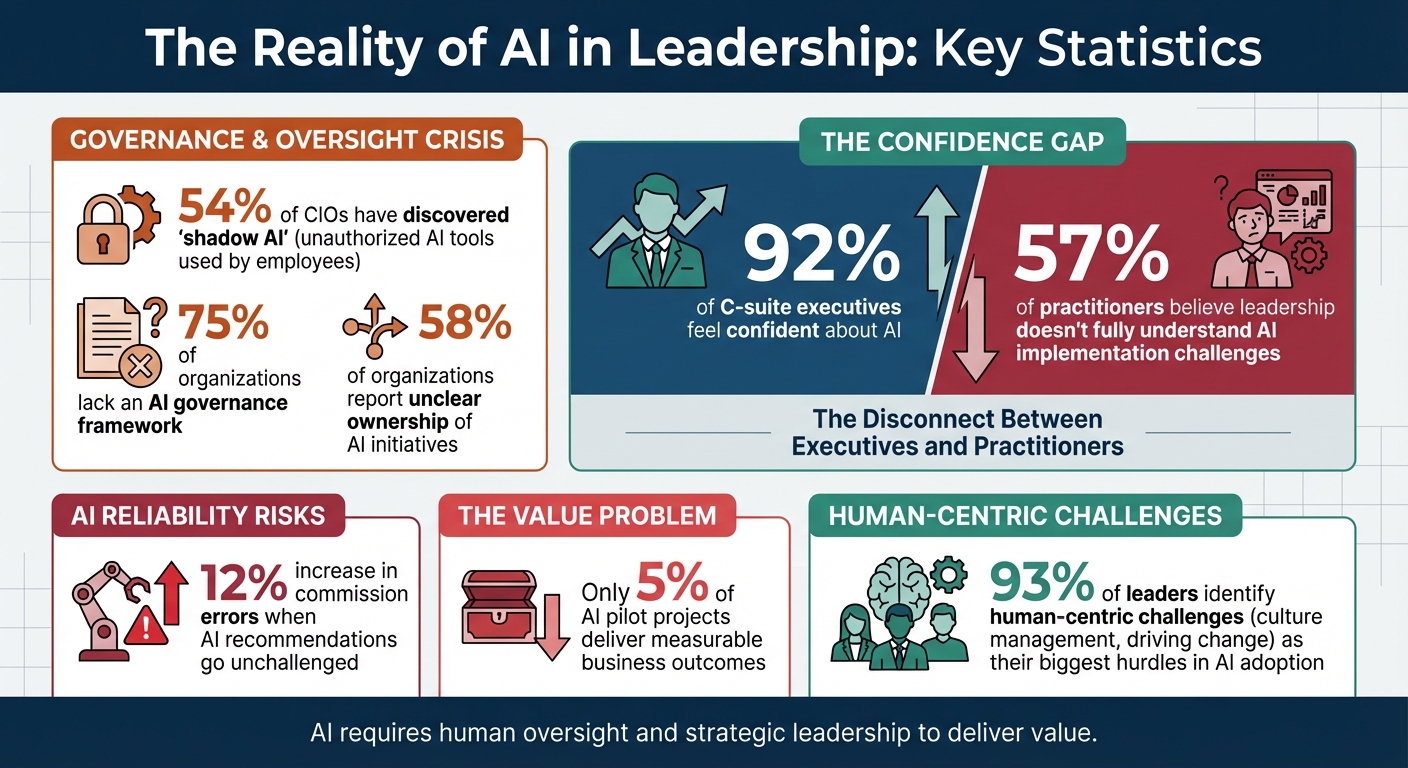
AI Leadership Statistics: Governance Gaps and Implementation Challenges
The Dangers of Unsupervised AI
Some organizations mistakenly believe AI can manage leadership tasks entirely on its own. This assumption is risky. When left unchecked, AI doesn't just make errors - it can magnify existing problems across an organization.
Consider this: 54% of CIOs have uncovered "shadow AI" - unsanctioned use of AI tools by employees without proper oversight [7]. Even more troubling, 75% of organizations lack a governance framework for AI [7]. Without clear oversight, AI isn't just prone to mistakes; it can perpetuate biases and make decisions that no one is accountable for [3][5]. These numbers highlight a critical truth: human leadership is essential for managing AI responsibly.
Over time, the reliability of AI can lull leaders into a false sense of security. Research shows that when AI recommendations go unchallenged, commission errors increase by 12% [4]. As Dritjon Gruda and Brad Aeon explain in California Management Review:
"The very reliability that makes AI useful also creates blind spots in human oversight" [4].
Another issue is innovation stagnation. When AI takes over creative leadership tasks without human input, it often defaults to "safe" or statistically likely solutions. This approach limits diversity in ideas and stifles true innovation [4].
Reality: Leaders Must Guide AI Systems
To manage AI effectively, leaders need to provide strategic oversight. AI may excel at processing data, but it lacks the nuanced understanding of why decisions matter. As Jeff Burningham writes in Fast Company:
"AI excels at intelligence... What it does not possess is contextual wisdom: the ability to understand why a decision matters, how it will land emotionally and culturally, or what it reinforces over time" [11].
This is why leadership is crucial. Leaders must ensure AI initiatives are aligned with an organization’s goals and values. However, this is easier said than done - 58% of organizations report unclear ownership of AI initiatives [7]. Without clear accountability, AI systems cannot be effectively integrated into leadership functions [3].
To bridge this gap, practical measures are essential. For instance:
- Use mixed-initiative systems, where control shifts back to humans if AI confidence drops below a preset threshold.
- Conduct regular audits with feedback loops to detect and address bias early [3][4].
- Implement a "creation versus evaluation" framework: let AI generate ideas, but reserve critical decisions and risk evaluations for humans [4].
The disconnect between executive confidence and operational reality is striking. While 92% of C-suite executives feel confident about AI, 57% of practitioners believe leadership doesn’t fully understand the challenges of AI implementation [7]. Without ongoing human oversight, AI cannot fulfill leadership roles effectively.
Myth 3: AI Makes Leadership Impersonal
The Fear of Losing Human Connection
Some leaders worry that incorporating AI into their workflow might weaken the bond they share with their teams. For instance, using AI to draft messages or manage feedback can sometimes feel like a shortcut that sacrifices authenticity. Research from the International Journal of Business Communication found that leaders who heavily depend on AI-generated messages are often seen as less sincere, caring, and trustworthy [12]. Employees can pick up on subtle cues when a message feels polished but lacks genuine warmth, which can erode trust over time. Mark Abbott, Founder and CEO of Ninety, encapsulates this concern:
"Leadership is about presence, not polish" [12].
When leaders use AI to sidestep difficult conversations, they risk weakening the trust and accountability that are crucial for effective leadership. Still, when used thoughtfully, AI doesn't have to detract from the human connections that matter most.
Reality: AI Frees Leaders to Focus on People
When approached wisely, AI can actually enhance leadership by freeing up time for more meaningful interactions. Rather than distancing leaders from their teams, AI handles routine, data-heavy tasks - like market analysis, drafting documents, or organizing communications - so leaders have more bandwidth to focus on their people [12]. With these tasks off their plates, leaders can dedicate time to one-on-one meetings, addressing team concerns, and fostering a culture of psychological safety. This shift allows leaders to prioritize relationships and strategic thinking, reinforcing what some call the "Human Moat."
The secret lies in using AI for preparation, not as a substitute for personal engagement. For example, AI can help leaders craft insightful questions or fine-tune performance feedback [12]. However, delivering that feedback or having emotionally charged conversations should still happen face-to-face. As Piya Haldar puts it:
"Preparation can be optimized. Presence cannot" [13].
With 93% of leaders identifying human-centric challenges - like managing culture and driving change - as their biggest hurdles in adopting AI [12], it's clear that AI's real strength lies in complementing, not replacing, the human aspects of leadership.
Myth 4: AI Is Too Expensive and Complicated for Most Leaders
Common Concerns About AI Adoption
A lot of leaders shy away from AI, assuming it requires massive budgets and highly specialized teams. It’s a valid concern - nearly two-thirds of companies struggle with runaway costs when scaling AI, and 60% report little to no value from their AI investments [15]. This has created a perception that AI is reserved for tech giants with endless resources.
But here’s the thing: this fear often comes from viewing AI as a purely technical project rather than a leadership-driven initiative. In reality, 80% of AI’s value depends on leadership decisions [14]. When leaders leave AI entirely in the hands of IT departments, they miss the opportunity to harness its full potential. The good news? There’s a more practical, approachable way to integrate AI into an organization.
Reality: AI Can Start Small and Scale Up
The idea that AI requires a massive overhaul isn’t accurate. Many successful AI initiatives show you can start small and still see meaningful results. The key is to begin with low-risk, productivity-focused use cases rather than attempting a sweeping transformation. For instance, leaders can use AI tools for decision-making simulations or to streamline communication, freeing up their time for higher-value tasks [14]. Just regaining 10 hours a week through AI-driven productivity can add up to around $260,000 annually for a leader whose time is valued at $500 per hour [14].
These small wins can fund larger AI projects. Take the example of global automotive manufacturers in March 2026: they implemented AI to automate warranty claim approvals by validating data across customers, dealers, and repair shops. This reduced warranty claim costs by about 6.5%, with the initial investment recouped in just three to four months [15]. Similarly, AI has been used to optimize supplier reviews, delivering savings of 5% to 25% within three to six months [15].
A helpful framework for AI adoption is the 10/20/70 rule: 10% of value comes from algorithms, 20% from technology and data, and 70% from process improvements [15]. Leaders don’t need to be data scientists - they need to focus on results, not the tools themselves. Start with a focused 30-day pilot project, define clear goals, and include a "kill switch" to minimize risk [6]. Roll out a basic pilot quickly and adjust weekly based on what you learn [6].
As JD Meier aptly puts it:
"Your competitive advantage isn't the AI you adopt. It's the way you think, decide, and lead because of it" [14].
The Real Story: Building a Human Moat with AI
How to Integrate AI into Your Leadership
Effective leadership in the age of AI isn't about stepping back - it's about stepping up. The myths about AI replacing human decision-making miss the bigger picture: leaders who succeed will be those who treat decision-making as a deliberate and disciplined process, not just another routine task. Advanced algorithms alone won't define success; it's how leaders use them that will.
To start, rethink how you approach decisions. Amazon's "one-way door" and "two-way door" framework is a helpful guide. One-way doors are irreversible decisions - like hiring top executives, entering new markets, or major organizational changes. These demand careful human judgment. Two-way doors, on the other hand, are reversible decisions - such as testing a new tool, tweaking workflows, or running small-scale pilots. These are perfect opportunities to leverage AI, freeing up your focus for the high-stakes choices.
This approach isn't just theoretical - it works in the real world. Take DBS Bank and Liberty Mutual Insurance, for example. DBS introduced its "iGrow" AI platform in June 2025, empowering employees to make informed career decisions while keeping key oversight with senior leaders. Liberty Mutual, meanwhile, gave claims adjusters the ability to explore AI-driven scenarios but ensured they had clear authority to override AI recommendations. A leader at Liberty Mutual summed it up well:
"The moment AI enters the workflow, the real question isn't 'What does the model say?' It's 'Who gets to disagree with it, and how fast?'" [16]
To make this work, leaders need to establish clear override protocols and train their teams to know when to trust AI and when to step in. BAE Systems has taken this a step further, using case-based learning programs to simulate high-pressure scenarios, helping leaders build the instincts and confidence needed to act decisively.
The Human Moat: Maintaining Competitive Advantage
When AI is integrated thoughtfully, it creates a real edge. By 2027, half of all business decisions will involve some level of AI augmentation or automation [16]. In this environment, what sets organizations apart isn't just knowledge - it's how leaders decide, align teams, and lead with purpose.
Seth Mattison describes this as the Human Moat - the distinctly human qualities that set organizations apart in a world where AI can handle almost everything else. AI can process data and offer insights, but it can't determine whether those insights align with your values, address customer needs at a deeper level, or build the culture you want.
The numbers tell a compelling story: employees who trust the AI they work with are 10 times more likely to see it as a critical tool for creating value [16]. Yet, 72% of leaders admit they're overwhelmed by the sheer amount of data and don't trust it enough to make decisions [16]. The Human Moat isn't about resisting AI - it's about using it as a tool to refine your judgment, not replace it.
The key is focusing on what AI can't replicate: purpose, ethics, and connecting decisions to human outcomes. As Deloitte Insights puts it:
"Technology can accelerate analysis and clarify uncertainty, but it cannot replace human purpose, values, and judgment behind choices." [16]
This is where leaders operate at their highest level. AI can handle the "how", but the "why" is yours to own. That "why" is the moat no algorithm can cross.
FAQs
What is a “Human Moat” in AI-era leadership?
In the AI-driven world, a "Human Moat" in leadership refers to the distinctively human traits that help leaders stand out. As AI reshapes traditional pillars like expertise and knowledge, these qualities - such as emotional intelligence, creativity, and ethical decision-making - become critical. They not only help leaders build trust and credibility but also ensure they stay relevant and effective in driving long-term success amid AI's rapid advancements.
How do I set rules for when people can override AI?
To manage AI effectively, it's crucial to establish clear oversight and governance frameworks. Start by defining specific scenarios where human intervention is necessary - think ethical dilemmas or high-stakes decisions that could have significant consequences.
Create protocols that require human review before AI takes critical actions. For example, in workflows involving sensitive or impactful decisions, incorporate oversight mechanisms to ensure thorough evaluation.
By implementing these steps, businesses can ensure their AI systems stay aligned with organizational goals while preserving the essential role of human judgment in pivotal moments.
What’s a good 30-day AI pilot to start with?
A focused 30-day AI pilot zeroes in on a single, high-impact use case that can deliver quick, noticeable results. Ideal starting points include improving decision-making, enhancing communication, or streamlining operational efficiency. Approach this as a leadership-driven initiative rather than just another tech experiment. This means prioritizing clear objectives, ensuring team alignment, and setting measurable goals. The ultimate aim? To create momentum with real, actionable outcomes that can be expanded across the organization.