
Articles Jul 6, 2026 9:39:48 PM Seth Mattison 16 min read
AI should handle scale. People should handle judgment. That’s the core idea.
If I had to sum up the article in a few lines, it would be this: AI can help more employees get support, answer routine questions, track progress, and improve matching. But human mentors still matter most for trust, sponsorship, office politics, ethics, and big career calls. That split matters because structured mentoring links to 49% lower turnover, 89% measurable improvement in four months, and in some teams, 51% lower turnover and 78% less absenteeism.
Here’s the plain-English version:
- Use AI for access and scale
- matching mentors and mentees
- reminders, scheduling, and prompts
- skill gap spotting
- low-pressure Q&A
- Use people for the hard stuff
- career judgment
- sponsorship and visibility
- values-based choices
- reading team dynamics and politics
- Do not let AI make big career decisions alone
- human review should own promotions, mobility, and high-stakes calls
- privacy rules should be clear from day one
- employees should be able to question AI output
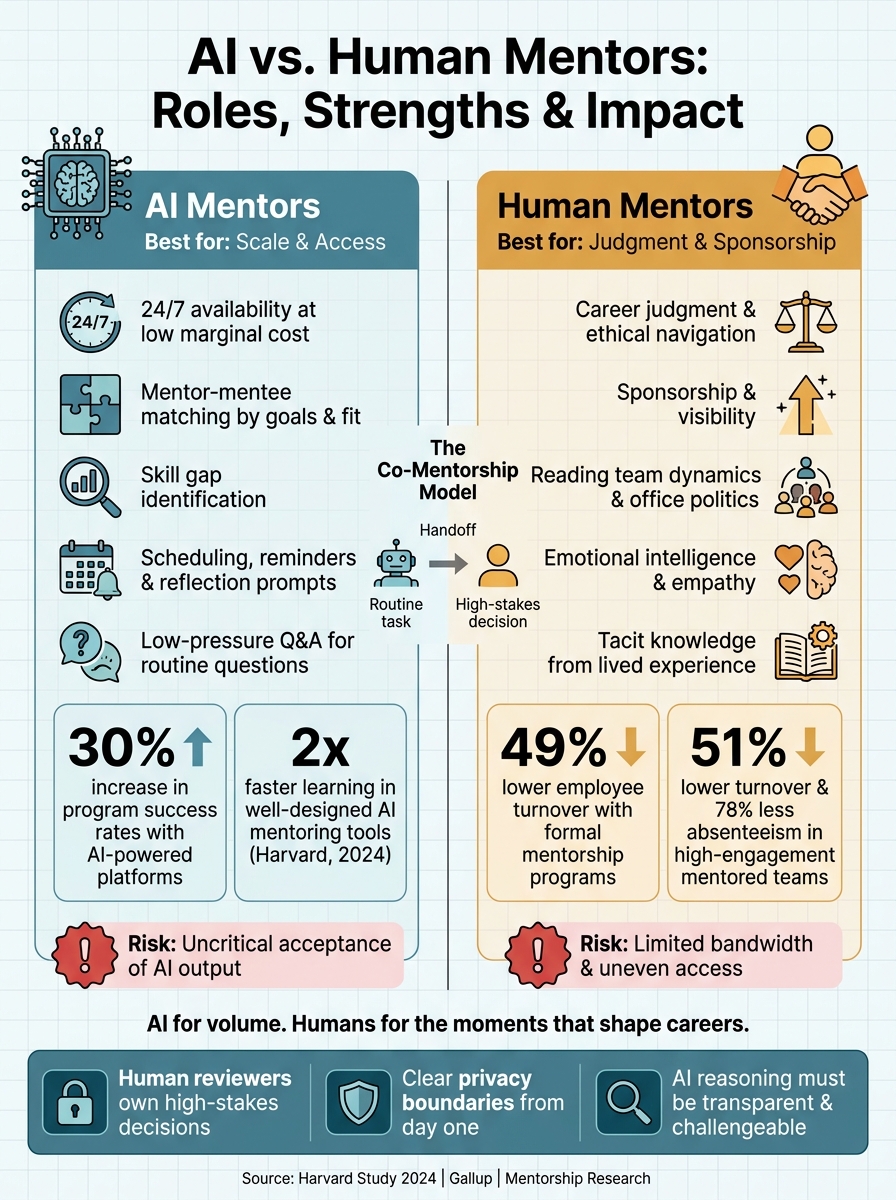
AI vs. Human Mentors: Roles, Strengths & Impact
Mentor Collective's Product Spotlight Series: AI + Human Connection = the Future of Mentorship
Quick Comparison
| Area | AI Mentors | Human Mentors |
|---|---|---|
| Best use | Routine guidance at scale | High-stakes career support |
| Strength | 24/7 help, structure, reach | Trust, empathy, judgment |
| Weak spot | Lacks context and lived experience | Limited time and bandwidth |
| Career impact | Helps people prepare | Helps people move forward |
| Risk | Blind trust in wrong output | Uneven access and burnout |
| Best model | Support tool | Final decision-maker and sponsor |
So if you’re building a mentoring program, the answer is not AI or people. It’s AI for volume, humans for the moments that shape careers.
AI Mentors: What They Do Well and Where They Break Down
Where AI Adds Real Value in Mentoring at Scale
AI’s biggest strength in mentoring is scale. It can support thousands of people at once without getting tired, slowing down, or running out of bandwidth. The goal isn’t to replace human mentors. It’s to cut friction and open the door to more people.
You can see that in a few practical ways. AI can improve mentor-mentee matching by pairing people based on goals, needs, and fit. It can handle onboarding, send reminders to keep people engaged, and track progress over time. It also gives mentees a low-pressure place to ask basic or repeated questions without worrying about being judged.
That kind of support can make a big difference. A 2024 Harvard study found that students using a well-designed AI mentoring tool learned more than twice as much in less time than peers in standard settings. [7]
AI can also help people sort out a problem and test a few paths before they sit down with a human mentor.
The line shows up fast, though. Once the choice becomes personal, political, or high-stakes, AI starts to hit a wall.
Where AI Falls Short in High-Stakes Career Decisions
AI can suggest skills to build. What it can’t do is tell whether a job fits your manager, your workplace politics, or the path you want over the next several years.
At that stage, speed stops mattering as much. Judgment takes over. And that’s where automation runs into its limits. AI doesn’t have contextual judgment. It doesn’t carry the situational awareness that seasoned leaders build from years inside actual organizations. It can’t pick up on what goes unsaid in a meeting, notice a mentee’s anxiety around a deeply personal setback, or sort through the moral side of a hard choice. [2]
Human mentors bring empathy, trust, and emotional nuance that AI can’t match.
There’s also a risk people don’t talk about enough: overreliance. Research shows that people often accept AI output with little scrutiny, even when it’s wrong. [2] That becomes a serious problem when someone is making a career move that could shape their next few years.
Governance Rules for Responsible AI Mentorship
AI mentorship needs clear rules before it plays any role in promotion, mobility, or development decisions.
Three rules matter most:
- Human reviewers must own high-stakes decisions. AI can flag patterns and suggest options, but algorithmic bias can quietly reinforce existing inequities when identifying high-potential talent. [5]
- Privacy boundaries must be stated upfront. Mentees should know what the AI is tracking, what gets shared with the organization, and what stays private.
- AI reasoning needs to be clear enough to challenge. As Caterina L. Valentino, a post-secondary educator and former healthcare executive, noted:
"The algorithms are so opaque that even the people who create them cannot fully understand or explain how the AI mentor arrived at a particular result." [8]
Mentors and mentees should be trained to question AI outputs, log overrides, and send high-stakes calls to people.
Those limits mark the point where human mentors need to step in.
Human Mentors: What Only People Can Do
Trust, Empathy, and Judgment in Complex Situations
When AI hits the edge of routine guidance, human mentors step in.
They deal with the moments that call for judgment, not just information. They pass along tacit knowledge - the intuition, situational awareness, and judgment that come from years of lived experience inside real organizations.[3] That kind of knowledge doesn’t move through a dashboard. It moves through conversation, observation, and trust.
Human mentors also pick up what data misses. A strong mentor notices what a mentee doesn’t say out loud and uses that signal to reframe the issue. That matters most when a choice could affect promotion, mobility, or reputation. A mentor can help someone work through fear, push back on a limiting belief, or stay firm on a values-based decision under pressure. Those aren’t information problems. They’re human problems.
Sponsorship, Visibility, and Long-Term Career Direction
Mentorship and sponsorship aren’t the same. A mentor offers guidance from someone who has been in the room. A sponsor uses their influence to help the mentee get into the room.[5] AI can suggest a path. Only a person can speak up for the person who should take it.
Human mentors also do something AI can’t do at a basic level: they question whether the goal itself makes sense. AI tends to optimize for what you say you want. A good mentor asks whether that goal fits where you’re trying to go.[4] They can do that because they know the person - their strengths, blind spots, and long-term direction. That’s the gap between mentorship and information retrieval. In a world flooded with AI, people still make the difference through judgment, trust, and advocacy.
That creates a plain design problem: use AI for reach, and save people for judgment and sponsorship.
Why Human Mentorship Does Not Scale Easily
The hard part is scale. Human mentorship doesn’t stretch well across large organizations. High performers burn out, matching often stays manual, and quality can vary when mentors get little or no coaching training.[3][5]
Nearly 6 in 10 employees say they’re not getting the on-the-job coaching they need to support core job skills.[9] That’s not a motivation issue. It’s a structural one. Human mentorship is scarce, so organizations need to use it where it can change careers most.
A practical split looks like this:
- Let human mentors focus on high-value coaching
- Let AI handle matching, reminders, and scheduling
That division of labor is what the next section makes explicit.
sbb-itb-9ceb23a
AI vs. Human Mentors: A Direct Comparison for Senior Leaders
Use AI for reach and people for judgment only when leaders know where each one works well, and where it doesn’t. This comparison is about fit, not about picking a winner.
Scalability, Personalization, and Access
AI runs 24/7 at a low marginal cost. Organizations using AI-powered mentoring platforms have seen program success rates increase by up to 30% [6]. That tends to happen when AI matches people based on goals, personality, and availability instead of surface-level traits.
But scale and depth are not the same thing.
AI can adjust content and pacing. Human mentors adjust advice to the person, the team, and the office politics around them. AI helps employees move through routine choices faster. Human mentors help them make the right long-term call.
There’s also an access point here that matters. AI can open the door to more people through self-matching and broader reach, including underrepresented talent. That makes the trade-offs a lot easier to spot.
The next issue is trust. Reach is useful, but can leaders lean on it when the stakes are high?
Trust, Ethics, and Workforce Resilience
Trust in AI comes down to one thing: governance. Without clear data privacy rules, algorithm oversight, and human-in-the-loop overrides, AI can quietly repeat the same inequities organizations are trying to fix [5].
Trust in human mentors works differently. It’s what makes hard feedback stick. It’s what makes sponsorship matter. Business units with high engagement supported by mentoring report 51% lower turnover and 78% less absenteeism [3].
There’s also a risk on the AI side that deserves a hard look: uncritical acceptance. Research points to a behavioral pattern where users accept AI outputs without much scrutiny, which can lower accuracy even as confidence goes up [2]. For high-stakes career decisions, that’s not a small issue.
So this isn’t an either/or choice. It’s a split model with clear roles.
| Dimension | AI Mentors | Human Mentors |
|---|---|---|
| Scalability | High; supports large populations at low marginal cost | Low; limited by individual bandwidth and time |
| Personalization | Data-driven; adapts content and pacing | Context-driven; addresses nuance and politics |
| Trust Basis | Transparency, governance, and data privacy | Empathy, shared experience, and vulnerability |
| Primary Value | Speed, structure, and information retrieval | Judgment, context, and ethical navigation |
| Cost | High initial setup; low ongoing operational cost | High ongoing opportunity cost (leader time) |
| Implementation Complexity | Technical integration and algorithm oversight | Cultural alignment and relationship management |
That is the Human Moat: judgment, trust, and advocacy remain the differentiators.
The Future Model: Human-AI Co-Mentorship
The strongest mentorship model mixes AI’s scale with human judgment. AI is shrinking the time it takes to access knowledge, know-how, and support. Human mentors still stand out where judgment, trust, and advocacy matter most. A co-mentorship model lets organizations build around that split on purpose. But it only works when each side has a clear job.
How to Divide Roles Between AI and Human Mentors
AI should take care of routine coordination. Human mentors should take care of judgment.
AI can manage:
- matching
- skill gap identification
- scheduling
- reminders
- reflection prompts
Human mentors should own sponsorship, ethical judgment, high-stakes career guidance, and tacit knowledge. This line matters most when careers are on the line. AI helps with development at scale, while people shape the openings that push careers ahead.
High-stakes career decisions should never be fully delegated to AI [10][5]. Final authority for major career moves belongs to a human who understands the person, the organization, and the context. That puts the focus on one practical issue: where the handoff should happen.
Design Principles for a Future-Ready Mentorship System
Once the roles are clear, the system needs rules.
Start with a tiered model. Use AI for broad access and skill building. Save human mentors for executive crises and other high-stakes decisions [1].
Set governance rules early. Keep AI mentoring data private, and share only anonymized trends with leadership [10][5]. Platforms should meet SOC 2 Type II certification standards to protect sensitive mentoring conversations [1].
Train human mentors for the work AI can’t do well. As AI takes over routine guidance, mentor training should shift toward emotional intelligence, listening, and cultural competence [10][5]. That matters most when someone needs to move from AI guidance to human advocacy without friction.
Build handoff moments into the program itself. Create clear triggers that move a mentee from AI-led development to a human sponsor who can provide advocacy and access to opportunity [5]. That’s the point where development starts to turn into advocacy.
Conclusion: What Leaders Should Do Next
The model is clear. Now comes the hard part: execution.
AI and human mentors do not solve the same problem. AI helps with access, scale, and day-to-day guidance. People bring judgment, sponsorship, and trust.
Key Takeaways for Building a Balanced Mentorship Strategy
The first shift is simple: stop treating mentorship like an HR side project. Companies with formal human mentorship programs report 49% lower employee turnover rates [11], and high-engagement teams see up to 51% lower turnover when mentoring gets proper attention [3]. That’s not just a morale win. It’s a business outcome.
What leaders need now is a practical split, not another round of theory:
- Use AI for broad access and routine skill building. AI coaching tools can give every employee support, not just the few who happen to know a senior mentor.
- Reserve human mentors for what matters most. Sponsorship, ethical judgment, and high-stakes career decisions should stay with people, not platforms. This is the Human Moat.
- Measure beyond participation. Look at internal mobility, time to productivity, and leadership readiness, not just how many people signed up.
- Set governance standards before you scale. Put clear rules around governance and data boundaries for any AI mentoring platform that handles sensitive career conversations, so employees can trust the system.
- Embed mentorship in performance expectations. When mentor time is tight and mentorship is treated like extra credit, it fades fast. When it becomes part of job expectations and shows up in performance frameworks, it has a much better shot at lasting.
Once those roles are clear, leaders need to track outcomes and hold the line on boundaries. Define where AI fits. Assign human sponsors for high-stakes moments. Measure success through mobility, readiness, and retention.
FAQs
When should AI hand off to a human mentor?
AI should hand off to a human mentor when a situation calls for judgment, not just pattern-matching or speed.
That usually means moments with ethical gray areas, unfamiliar circumstances, or choices where context changes everything. It also includes decisions tied to moral accountability. Data can point in a direction. A human still has to decide what’s right, what’s fair, and what they’re willing to stand behind.
Human mentors matter just as much when the issue involves trust, empathy, psychological safety, resilience, office politics, or leadership identity. Those aren’t just logic problems. They’re people problems, and people rarely fit into neat boxes.
AI can sort information, surface options, and help make sense of a messy situation. But mentors do the part that matters most: they turn information into wisdom, then into action, and then into accountability.
How can companies keep AI mentoring private and fair?
Companies need clear guardrails. They should spell out which data is confidential, what can be measured, and what can be reported so participants know exactly how their information is used.
To support equity, administrators should watch for bias in matching and in high-potential labels. At the same time, human leaders should still have the final say and step in when AI suggestions miss the mark.
What should leaders measure in a hybrid mentoring program?
Leaders should measure a hybrid mentoring program on two levels, not with one metric alone.
Track operational efficiency - like AI matching quality, tool adoption, and admin progress. Then look at human outcomes too: trust, culture, relationship quality, decision velocity, decision quality at scale, minimizing economic errors, and the impact of human-led interventions.
Related Blog Posts

Seth Mattison
Top 50 Keynote Speakers in the World | Future of Work Strategist | Co-Founder & CEO