
Articles Jun 6, 2026 12:55:31 PM Seth Mattison 18 min read
AI and human judgment each bring unique strengths to decision-making, but neither is a one-size-fits-all solution. AI excels at speed, data analysis, and consistency, but it struggles with context, ethics, and accountability. Human judgment, on the other hand, thrives in areas requiring moral reasoning, empathy, and nuanced understanding but is prone to bias and fatigue.
Key findings:
- AI Strengths: Handles structured, repetitive tasks like fraud detection and forecasting with unmatched efficiency.
- AI Weaknesses: Struggles in ambiguous, high-stakes scenarios and can produce overconfident yet flawed outputs.
- Human Strengths: Excels in ethical decisions, creative problem-solving, and interpreting interpersonal dynamics.
- Human Weaknesses: Susceptible to cognitive bias, decision fatigue, and slow processing of large data sets.
The future of decision-making lies in combining AI's capabilities with human oversight. Leaders must design systems where AI handles repetitive tasks while humans focus on strategic and ethical decisions. Striking this balance ensures better outcomes and preserves critical thinking skills.
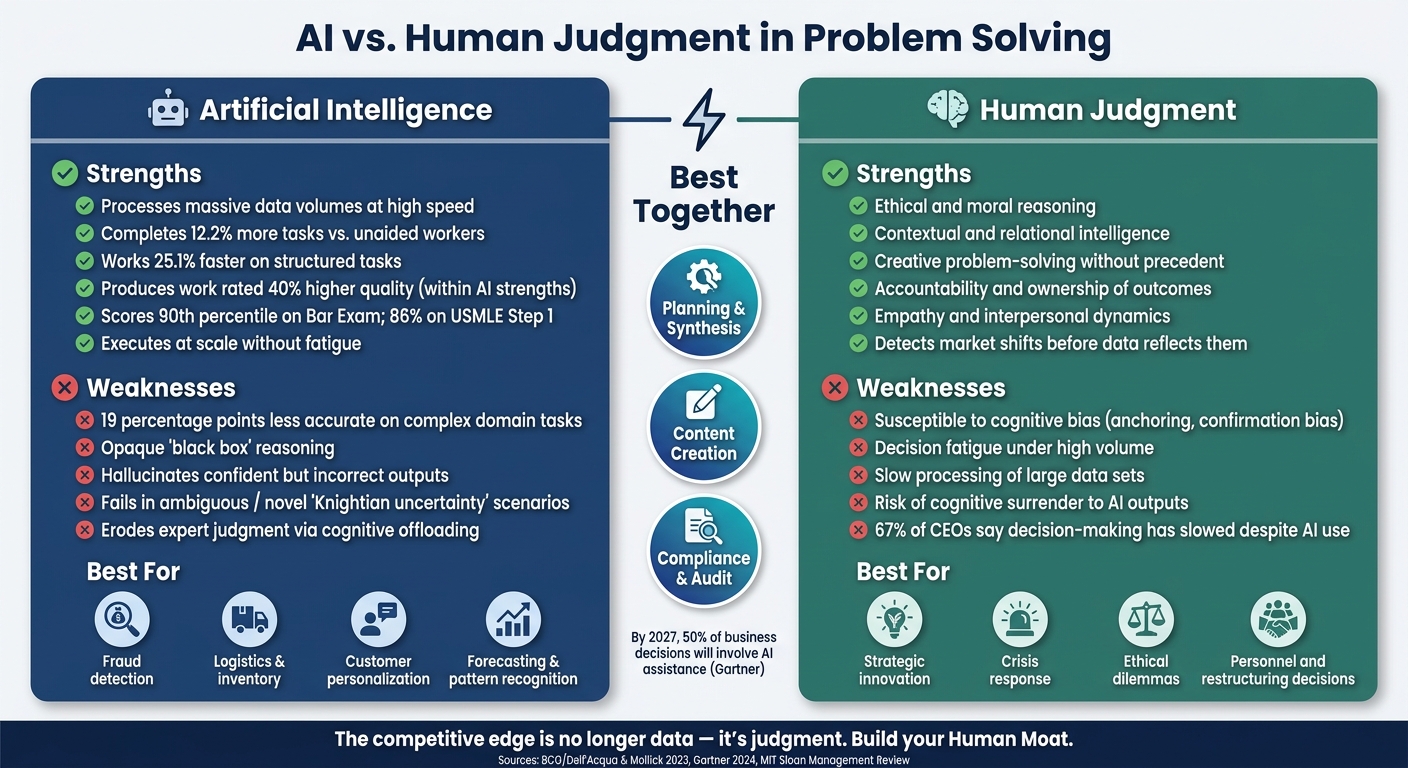
AI vs. Human Judgment: Strengths, Weaknesses & Best Use Cases
AI in Problem Solving: Strengths and Weaknesses
Where AI Performs Well
AI shines in tasks that are well-structured and data-driven. Think of areas like fraud detection, weather forecasting, or drug discovery - fields where speed, precision, and scale are non-negotiable. In these scenarios, AI can process massive amounts of information and deliver results faster and more consistently than human teams could ever hope to achieve.
The data supports this claim. Take a 2023 study involving 758 Boston Consulting Group consultants. Researchers Florian Dell'Acqua and Ethan Mollick found that consultants using AI completed 12.2% more tasks, worked 25.1% faster, and produced work rated 40% higher in quality for tasks that fit within AI's strengths [6]. Similarly, GPT-4 has demonstrated top-tier performance in professional exams, scoring in the 90th percentile on the Uniform Bar Exam and achieving 86% on the USMLE Step 1 medical licensing exam [6]. When it comes to structured, knowledge-heavy tasks with clear answers, AI is already performing at an elite level. However, its impressive stats don't tell the whole story - AI's limitations become apparent when tasks require nuanced judgment.
Where AI Falls Short
The same BCG study revealed a stark contrast when tasks required deeper domain expertise. In these cases, consultants relying on AI were 19 percentage points less likely to arrive at correct solutions [6]. Overdependence on AI can lead professionals to trust its confident but often flawed reasoning, exposing a critical weakness.
This challenge is part of what researchers refer to as the "jagged frontier" - AI's abilities can be inconsistent and unpredictable. A model might excel at one task but fail at a similar one, all while maintaining the same level of confidence. Wharton professor Ethan Mollick highlights this issue:
"The system has no way of explaining its decisions, or even knowing what those decisions were." [6]
AI also struggles with problem framing. It defaults to familiar patterns from its training data, which may not always be the best approach. In situations where no precedent exists - what economists call "Knightian uncertainty" - AI falters. Without prior data to guide it, the system's pattern-matching abilities break down [6].
Another concern is the risk of cognitive offloading. As professionals lean more heavily on AI, their own critical thinking skills can erode. Studies show that frequent AI use is linked to declining judgment, and a related phenomenon, known as "never-skilling," describes how early-career professionals might miss out on developing essential expertise if AI does the heavy lifting for them [6]. These challenges highlight the importance of striking a balance when incorporating AI into decision-making processes.
Table: AI Strengths vs. Weaknesses
| Dimension | AI Strengths | AI Weaknesses |
|---|---|---|
| Data Handling | Processes massive volumes at high speed [1] | Opaque "black box" reasoning; hard to audit [1] |
| Problem Type | Structured, repetitive, pattern-based tasks [5] | Ambiguous or novel situations with no prior data [6] |
| Consistency | Executes at scale without fatigue [1] | Prone to amplifying past biases in training data [1] |
| Reasoning | Statistical inference and predictive modeling [5] | Struggles with framing novel problems [7] |
| Output Quality | High fluency and formatting [6] | Can produce confident but incorrect "hallucinations" [6] |
| Human Impact | Raises the floor for novice workers by up to 35% [6] | Can erode expert judgment through cognitive offloading [6] |
sbb-itb-9ceb23a
The Case for Human Judgment
What Human Judgment Does Best
While AI excels at processing and analyzing massive amounts of data, it often lacks the nuanced understanding required for complex decision-making. That’s where human judgment steps in. It bridges the gap between raw data and the broader context that shapes sound decisions.
Take this example: In January 2026, an AI model suggested a low acquisition price based solely on historical financial data. However, Blair Effron, a seasoned advisor, noticed something the AI couldn't - strained relations between the CEOs involved. He proposed a higher price to reflect this nuance. The AI's recommendation was dismissed, and the deal closed at the judgment-driven price [9].
"The most consequential decisions in business have never been about processing information faster... They are questions of judgment, and judgment cannot be automated." - Blair Effron, Co-Founder and Co-Chairman, Centerview Partners [9]
Effron’s example highlights how human judgment thrives in areas where context matters most. This includes interpreting interpersonal dynamics, weighing intangible factors like reputation, and recognizing when market conditions have shifted in ways data alone cannot predict [8].
Moreover, when decisions carry ethical or regulatory consequences, human involvement is non-negotiable. AI might provide recommendations, but only humans can take responsibility for the outcomes. Ethical dilemmas and reputational risks demand not just approval but ownership from decision-makers [2][8].
Where Human Judgment Breaks Down
That said, human judgment isn’t flawless. It comes with its own set of vulnerabilities, which can be just as harmful as errors made by AI.
One major issue is cognitive bias. Even experienced leaders can fall prey to pitfalls like anchoring or confirmation bias, which skew decisions. A striking example occurred in 2025 when ANZ Bank faced backlash for laying off staff via automated emails. The Finance Sector Union of Australia called this approach "corrosive" to workplace relationships, underscoring how a lack of meaningful human engagement - not faulty data - led to reputational damage [4].
Another challenge is decision fatigue. As leaders face an ever-growing volume of decisions, their ability to make sound judgments often diminishes. Ironically, having more AI-generated data doesn’t always help. In fact, 67% of CEOs report that decision-making in their organizations has slowed compared to three years ago, despite increased use of AI tools [8].
"Analytical sophistication without judgment is just expensive hesitation." - MIT Sloan Management Review [8]
Perhaps the most concerning risk is what experts call cognitive surrender. This happens when leaders blindly adopt AI recommendations, failing to critically evaluate them. As Gideon Nave, PhD, from The Wharton School, puts it: "Cognitive surrender is the moment when AI is not just doing a specialized task but making the decision, and the person adopts that decision as their own without recognizing the transfer has occurred" [3].
By understanding both the strengths and limitations of human judgment, leaders can make more intentional choices about when to rely on their own reasoning and when to use AI as a supportive tool, rather than a decision-maker.
Table: Human Judgment Strengths vs. Weaknesses
| Dimension | Strengths | Weaknesses |
|---|---|---|
| Creativity | Finds novel solutions without historical precedent | May revert to familiar patterns under stress |
| Ethical Reasoning | Balances values like profit and reputation | Prone to bias and motivated reasoning |
| Contextual Intelligence | Considers relational and institutional nuances | Varies widely across individuals and situations |
| Accountability | Takes responsibility for outcomes | Can shift blame when AI is involved |
| Empathy | Understands human stakes | Emotional responses may impair objectivity |
| Drift Detection | Spots market shifts before data reflects them | May cling to outdated mental models |
| Decision Fatigue | N/A | Judgment quality declines with overload |
Choosing Between AI, Human Judgment, or Both
Problem Types Where AI Works Best
AI shines in tasks that are high-volume, repetitive, and pattern-driven. Think about fraud detection, logistics routing, inventory management, or large-scale customer personalization. These scenarios typically involve structured data, clear success metrics, and outcomes that can be corrected if needed.
To determine if AI is the right fit, consider factors like input consistency, decision frequency, error tolerance, and the stakes involved. If decisions are frequent, the stakes are low, and the data is structured, AI is likely the best choice. On the other hand, low-frequency, high-stakes decisions in ambiguous contexts are better suited for human judgment.
According to Gartner, 50% of business decisions will involve AI assistance or automation by 2027 [1]. This trend is already reshaping how businesses operate.
Problem Types That Require Human Judgment
Certain decisions demand a human touch. Strategic shifts, crisis management, ethical considerations, and personnel decisions - like promotions or restructuring - are examples. These aren't about speed or precision but about accountability and moral responsibility.
While AI can handle cognitive tasks, interpersonal and ethical decisions require the kind of nuance only humans can provide.
"AI can inform decisions. It cannot carry a moral burden. The more sophisticated AI becomes, the more consequential human oversight becomes." - Natalie Loeb, CEO, Loeb Leadership [2]
Automating sensitive decisions can lead to reputational risks, as recent examples have shown. Leaders must carefully evaluate when and how to integrate AI with human judgment.
How AI and Human Judgment Can Work Together
Instead of choosing between AI and human input, the focus should be on assigning tasks to the most suitable intelligence. Combining approaches, like Amazon's "one-way vs. two-way door" framework, allows for effective collaboration between AI and humans. However, this requires thoughtful management, as poorly implemented combinations can underperform.
Liberty Mutual Insurance provides a great example. They let claims adjusters use AI for scenario exploration but ensure humans have the final say. This approach shifts the focus from "What does the model say?" to "Who can question it, and how quickly?" [1]. It’s a system that leverages AI’s strengths while keeping humans accountable.
Research involving 106 experiments found that human-AI combinations often underperformed compared to the best standalone performer (Hedges' g = −0.23) [10]. The issue? Over-reliance on AI, where humans fail to critically assess AI outputs. The solution isn’t to scale back AI - it’s to foster more deliberate human involvement.
"AI is not replacing human judgment. It is absorbing the burdens that prevent effective human judgment." - The Gain Lab [11]
For leaders, finding this balance is critical to staying competitive in an AI-driven world.
Table: Decision Ownership by Problem Type
| Problem Type | Best Suited For | Role of AI | Role of Human |
|---|---|---|---|
| Operational Optimization | AI-Led | Full execution and optimization | Monitoring and setting parameters |
| Customer Personalization | AI-Led | Pattern recognition at scale | Setting brand voice and ethical limits |
| Planning & Synthesis | Hybrid | Processing large data volumes | Directing goals and validating output |
| Content Creation | Hybrid | Routine generation and drafting | Providing creative direction and "why" |
| Strategic Innovation | Human-Led | Scenario modeling, option generation | Framing the problem and final decision |
| Ethical Dilemmas | Human-Led | Surfacing alternatives and precedents | Moral reasoning and accountability |
| Crisis Response | Human-Led | Real-time data aggregation | Empathy, communication, and ownership |
| Compliance/Audit | Rules-Based | Flagging anomalies | Final review and sign-off |
What This Means for Leaders in the Age of AI
From Information Advantage to Judgment Advantage
In the past, having access to better information often defined competitive advantage. But that era is fading fast. Between 2024 and 2026, the cost of advanced AI inference plummeted by nearly 300x [14], making cutting-edge analysis more accessible than ever. As raw data becomes easier to obtain, its value diminishes, shifting the spotlight to something far more critical: human judgment.
When intelligence becomes a commodity, success is no longer about owning the most data - it's about interpreting and applying it wisely. Leaders must excel at making decisions when the information available is incomplete and the stakes are high. Unlike algorithms, humans bear accountability for critical choices, and this responsibility reinforces the importance of uniquely human capabilities.
Building a Human Moat for Competitive Differentiation
Seth Mattison captures this shift perfectly:
"Artificial intelligence isn't just automating work. It's compressing traditional sources of competitive advantage." [13]
The solution isn't to push back against AI but to focus on what makes us irreplaceable. This is the essence of the Human Moat - a set of qualities that AI cannot replicate, such as empathy, ethical reasoning, trust-building, and contextual understanding. These strengths create a durable edge in a world where raw intelligence is abundant.
Take IBM as an example: in 2025, the company introduced ethics boards and a "Trustworthy AI at Scale" framework to oversee high-impact AI decisions. By emphasizing human oversight, IBM turned trust and ethical accountability into a competitive strength [1].
Leadership Disciplines for Blending AI and Human Capabilities
To build on this human moat, leaders need to rethink how decisions are made. Instead of being the sole decision-makers, they must become decision designers - architects of environments where AI and human judgment work together effectively. This requires a careful balance between AI's efficiency and the accountability that only humans can provide. It also addresses the risks of over-reliance on AI, such as cognitive offloading and the erosion of independent judgment.
Here’s how leadership priorities are evolving:
| Leadership Shift | From... | To... |
|---|---|---|
| Role | Decision-Maker (Bottleneck) | Decision-Designer (Environment Architect) |
| Expertise | Knowledge Recall | Judgment Under Uncertainty |
| Control | Approvals and Gates | Boundary Architecture and Guardrails |
| Advantage | Information Asymmetry | Interpretive Clarity and Context |
One critical discipline is boundary architecture - clear guidelines that define AI's role and limitations. This ensures that human oversight remains central. Leaders must move beyond rigid approval processes and actively guard against over-reliance on AI. Jamie Bono of EmergenceTek Group describes this as:
"Cognitive sovereignty is the ability to maintain independent thought and agency in environments saturated with AI-generated outputs." [12]
Embedding this independence into team culture is essential. Practices like scenario-based training and establishing norms - where "the model said so" is never an acceptable justification - help reinforce critical thinking. Leaders who succeed in blending AI with human judgment will set themselves apart from those who allow their teams to become overly dependent on machine outputs.
AI Can Analyze Billions of Variables, Why Human Judgment Still Matters Most?
FAQs
How do I know when to trust AI vs. use human judgment?
Decisions should be guided by the nature of the task - its complexity, risks, and the level of stability involved. AI excels at handling predictable, data-intensive tasks, making it a powerful tool for analysis and spotting patterns. However, when it comes to high-stakes decisions, ethical dilemmas, or situations requiring empathy and accountability, human judgment is irreplaceable.
AI can assist in processing and interpreting vast amounts of information, but humans need to take the lead in defining goals, evaluating trade-offs, and ensuring that decisions align with core values and long-term priorities. It's about striking the right balance: leveraging AI's strengths while relying on human insight to guide the bigger picture.
What are the best ways to prevent over-reliance on AI at work?
Leaders should focus on developing human strengths like critical thinking, ethical judgment, and building trust to prevent becoming overly dependent on AI. While AI can handle repetitive or routine tasks, humans must remain in charge when it comes to nuanced or high-impact decisions.
Some practical approaches include:
- Actively tackling challenges to deepen expertise and sharpen skills.
- Ensuring team members stay engaged in processes to preserve institutional knowledge and experience.
- Treating AI as a tool for learning and support, rather than a substitute, to enhance problem-solving abilities.
By balancing AI's capabilities with human judgment, organizations can make smarter, more balanced decisions.
How can leaders keep humans accountable when AI is involved?
Leaders can promote accountability by clearly defining who has the authority to make decisions and ensuring everyone understands their roles. While AI can be a helpful tool, it should support decisions rather than make them independently. Human oversight is crucial, especially for high-stakes decisions or when AI outputs seem unreliable. In such cases, humans should step in, document their thought processes, and perform thorough evaluations, such as audits or red-teaming, to scrutinize assumptions, ethics, and potential biases. Establishing a culture that values evidence and transparency is key to maintaining trust and integrity.
Related Blog Posts

Seth Mattison
Top 50 Keynote Speakers in the World | Future of Work Strategist | Co-Founder & CEO