
Articles Jun 7, 2026 11:24:35 PM Seth Mattison 29 min read

In today’s fast-changing business world, staying flexible is no longer optional. Companies that adjust quickly outperform others, with research showing they are 2.4x more likely to achieve better financial results. This article breaks down seven key practices to help organizations thrive in uncertain times:
- Define Clear Behaviors: Pinpoint specific actions that show flexibility, like seeking feedback or embracing uncertainty.
- Use Learning Loops: Create daily cycles of reflection and improvement to drive constant progress.
- Normalize Experimentation: Encourage teams to test ideas and learn from failures without fear.
- Build Psychological Safety: Foster an environment where employees feel safe to speak up and take risks.
- Align Hiring and Rewards: Prioritize hiring for curiosity and resilience, and reward learning-focused behaviors.
- Flexible Governance: Shift from rigid systems to adaptable decision-making processes.
- Develop Human Skills: Focus on growing critical abilities like judgment, collaboration, and communication.
These strategies help organizations stay ahead by prioritizing learning, flexibility, and human strengths. Start small by reviewing recent decisions or team practices to identify areas for improvement.
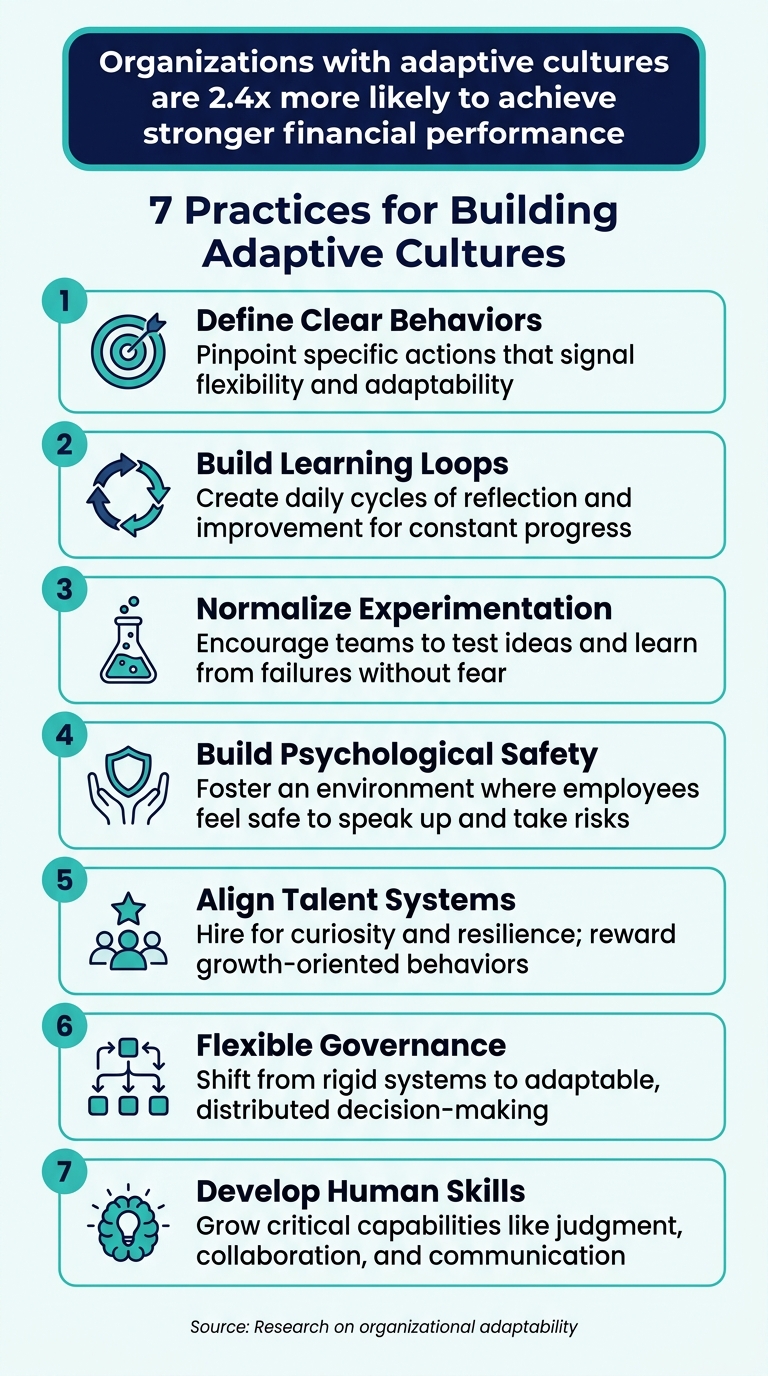
7 Practices for Building Adaptive Cultures
Episode #47: How to Build an Adaptive Learning Organization That Thinks and Grows
sbb-itb-9ceb23a
Practice 1: Define the Behaviors and Mindsets of Adaptability
To make adaptability actionable, it's essential to define it through specific, observable behaviors. Without clarity, adaptability risks becoming just another vague goal.
Key Behaviors That Signal Adaptability
Adaptability shows up in how people behave, especially in challenging situations. Some key indicators include:
- Seeking and acting on feedback regularly.
- Viewing setbacks as opportunities to learn rather than as failures.
- Acknowledging uncertainty instead of pretending to have all the answers.
For example, when a senior leader openly admits, "I don't have a clear answer yet", it signals to the team that it's okay to embrace ambiguity. This openness cultivates an environment where uncertainty is seen as a natural part of problem-solving.
Other behaviors include identifying issues early before they escalate and questioning assumptions by offering unconventional solutions. Teams that adopt these practices are better equipped to navigate disruptions effectively.
"Adaptability refers to an organization's ability to consistently evolve at a speed that surpasses the changes in its environment." - Michael Watkins, Professor of Leadership and Organizational Change [10]
The next step is to embed these behaviors into your organization's daily practices to ensure they become second nature.
Connecting Behaviors to Organizational Processes
Defining adaptable behaviors is just the starting point. The real challenge lies in weaving these behaviors into the fabric of your organization so they become part of its natural rhythm. Start by examining recent promotions or major decisions. Were they based on having the "right" answer, or did they reward the ability to navigate uncertainty? This kind of review can reveal whether your systems are encouraging adaptability or unintentionally stifling it.
Once you've identified the behaviors, tie them to specific processes within your organization. For example:
- Use After Action Reviews (AARs) to reframe setbacks as learning opportunities.
- Build the habit of challenging assumptions into your planning cycles.
- Encourage open discussions about uncertainty during leadership meetings by asking questions like, "What are we avoiding?"
- Promote early problem identification during performance check-ins or team rituals.
- Integrate feedback-seeking into hiring, onboarding, and development programs.
| Behavior | Embedding Point |
|---|---|
| Reframing setbacks as learning | After Action Reviews (AARs) |
| Challenging assumptions | Strategy and planning cycles |
| Naming uncertainty openly | Leadership meetings |
| Surfacing problems early | Performance check-ins and team rituals |
| Seeking and acting on feedback | Hiring, onboarding, and development processes |
Practice 2: Build Learning Loops into Daily Work
Learning loops take defined behaviors and turn daily experiences into measurable progress. Once these behaviors are established and woven into your processes, the challenge lies in keeping them active every day. A learning loop is essentially a structured cycle that transforms daily events into actionable improvements, but it only works if it’s seamlessly integrated into regular workflows.
A functional learning loop consists of four stages: event, reflection, change, and testing. As Graham Charlton aptly put it, “without a testable change, a retrospective is merely conversation” [11].
Simple Feedback and Reflection Cycles That Work
The most effective learning loops are small and frequent. Instead of relying on a single annual review, organizations should implement loops at various intervals [14].
| Loop Frequency | Sensing Mechanism | Primary Goal |
|---|---|---|
| Daily | Real-time leadership modeling | Immediate behavioral correction [14] |
| Weekly | Pulse surveys / Team huddles | Detecting drift before it becomes entrenched [14] |
| Quarterly | Ways-of-working retrospectives | Identifying slow-moving patterns [13][14] |
| Annual | Cultural audits | Connecting culture to long-term strategy [14] |
Structured formats like "Start, Stop, Continue" - asking what the team should start doing, stop doing, and continue doing - can add clarity without unnecessary complexity [15]. To keep accountability intact, focus each session on just one or two testable changes. Each proposed change should specify what will be altered, who owns it, the timeframe for implementation, and how success will be measured [11].
By keeping these loops frequent and focused, the adaptive behaviors you’ve established stay reinforced, driving continuous improvement.
Using Data as a Learning Tool
Data can take adaptive learning to the next level. While many teams use data to assess performance, adaptive teams leverage it to ask better questions. Instead of focusing on blame, such as “Who missed the target?”, they ask, “What does this say about our process?” [2][17].
One way to shift toward this mindset is to kick off weekly metrics reviews with a simple question: "What surprised you this week?" [17]. Another powerful tool is tracking learning velocity - how quickly teams identify mistakes, adjust behaviors, and spread new practices. This metric provides a better sense of organizational health than traditional performance metrics [2][12].
"The ability to learn faster than your competitors may be the only sustainable competitive advantage." - Arie de Geus, Former Head of Planning, Royal Dutch Shell [16]
Empowering frontline teams with direct access to their data tightens feedback loops. This enables teams to self-correct quickly, reducing the time between identifying an issue and resolving it [13][14]. When ownership of data is pushed to the team level, the organization becomes far more agile in addressing challenges.
Practice 3: Make Experimentation and Learning from Failure Normal
Expanding on the idea of continuous learning, creating an environment where experimentation is encouraged can significantly enhance an organization's ability to adapt. Teams can only push boundaries when they feel secure testing new ideas. This requires a culture where experiments are structured, and failures are treated as valuable data points - a key ingredient for fostering a growth mindset.
"In unprecedented situations, effective leadership calls for a problem-solving, experimental approach. We should think of everything we're doing as our current experiment." - Herman "Dutch" Leonard, Professor, Harvard Business School [18]
How to Set Up Experimentation Zones
The main obstacle to experimentation isn't a lack of creativity - it's uncertainty about what can safely be tested. Without clear boundaries, teams tend to play it safe. To counter this, define "safe-to-test" parameters by setting clear limits on budget, brand risk, legal compliance, and customer impact [19]. These guardrails give teams the confidence to explore new ideas.
Two practical tools can streamline this process. First, metered funding allows teams to focus on testing high-risk assumptions early on, scaling up only if initial results are promising [22]. Second, time-boxing experiments ensures that testing remains efficient. For example, NASA's Jet Propulsion Laboratory (JPL) mandates that experiments must show results within two weeks. This approach has fast-tracked innovations like augmented reality and 3D printing for active space missions [23].
Spotify's "squad model" takes this concept even further. Autonomous teams are empowered to experiment without waiting for top-down approval. The "Discover Weekly" playlist, for instance, began as a small-scale test using machine learning and user data. It eventually became one of Spotify's most popular features [21]. By empowering those closest to the challenges, organizations can drive innovation at a faster pace.
When combined with a focus on learning loops, fostering a culture that embraces calculated risks can significantly enhance adaptability.
Shifting the Way Teams Think About Failure
Creating experimentation zones is just the first step; reframing how teams view failure is equally important. Not all failures are the same, and distinguishing between them can help teams learn more effectively. Failures can be categorized into three types: basic failures (avoidable errors), complex failures (systemic issues), and intelligent failures (calculated risks that offer valuable insights) [24]. Many teams struggle because they treat all failures the same, leading to either reckless behavior or excessive caution. Clarifying these differences helps teams respond more constructively.
The key to changing how teams handle failure is shifting from a mindset of blame to one of inquiry. Google's blameless postmortems are a great example of this. These reviews focus on understanding the system rather than assigning fault, creating an environment where team members feel safe admitting mistakes. This approach has been linked to improved reliability because it encourages honest discussions about what went wrong [25].
Leadership plays a crucial role here. When leaders openly share their own failed experiments, it sets the tone for the entire organization. This transparency reduces pressure on team members and encourages them to take thoughtful risks [19][21].
"If a business leader only runs tests they know will turn out positive, not only is the organization not learning, but the test is unnecessarily delaying known value." - John Rhoades, VP of Global Test & Learn, Mastercard [20]
One final perspective to consider: in a well-managed experimentation program, success rates are often low - typically around 25%–35%. In fact, a study of over 100 experiments found that 61% yielded inconclusive results [26]. This isn't a sign of failure; it's exactly how experimentation should work. The goal isn't to succeed in every test but to learn faster than the cost of running the tests.
Practice 4: Build Psychological Safety and High-Trust Norms
Experimentation and learning loops thrive only when people feel secure enough to engage with them. Without that sense of safety, even the most well-thought-out systems can crumble. Employees may choose silence over speaking up, avoid risks, and wait for someone else to take the lead.
What Psychological Safety Is and Why It Matters
Psychological safety is the shared belief within a team that it's okay to take interpersonal risks. It encourages employees to voice their opinions, own up to mistakes, and challenge ideas without fear of negative consequences. This sense of safety is key to fostering a work culture that supports ongoing learning and adaptability.
The numbers paint a clear picture. According to 2025 Gallup data, only 3 in 10 employees strongly feel that their opinions matter at work [31]. Furthermore, employees who plan to stay with their company show a 30-point higher psychological safety score compared to those planning to leave [27]. Perhaps most strikingly, 83% of sustained high performers - those who consistently excel over time - agree with the statement, "I feel safe to take risks." This is 9 points higher than those who are high performers only once [30].
"The greater the uncertainty, the more knowledge-intensive and complex the work is, and the larger the effect of psychological safety on performance." - Amy Edmondson, Professor, Harvard Business School [27]
Psychological safety isn't just a "nice-to-have." It's a critical factor for driving the adaptability, learning, and performance that organizations need to succeed today.
Leader Behaviors That Build Safety
Leaders play a pivotal role in creating psychological safety - far more than any policy or program. Employees decide whether to speak up based on how leaders listen and respond, especially when their ideas or feedback challenge the status quo [28].
One of the most impactful actions a leader can take is modeling vulnerability. When leaders admit, "I got that wrong", they send a clear message that honesty is welcome and safe [27][28]. Similarly, how leaders handle bad news is crucial. Acknowledging and thanking someone for raising a concern before addressing the issue itself can instantly shift the tone [27][28].
Silence in meetings often signals fear, not agreement [27][28]. Leaders can break this pattern by asking open-ended questions like, "What assumptions should we challenge today?" or "What are we avoiding talking about?" These kinds of questions encourage open dialogue and make dissent feel normal rather than risky.
"The quality of your listening shapes the type of speaking that is going to come back." - Esther Perel, Psychotherapist and Author [30]
To make psychological safety a lasting part of the workplace, leaders can implement structured practices that reinforce these behaviors. For example:
- Team charters: These documents clearly outline group norms and expectations, reducing uncertainty and easing interpersonal tension [29].
- Regular retrospectives: These meetings focus on reviewing what went wrong and what can be improved, making it normal to discuss mistakes.
- Inclusive meeting formats: Approaches like Lean Coffee distribute speaking opportunities, ensuring quieter team members have a voice in shaping discussions [29].
Practice 5: Align Talent Systems with Growth Mindset
To truly embed learning and adaptability into your organization's DNA, your talent systems need to reflect these priorities. If your hiring and performance practices focus solely on finding people with the "right" answers rather than those who embrace learning and growth, you risk limiting your culture from the very start.
Hiring for Learning Orientation and Resilience
Forward-thinking companies are shifting their focus to hire individuals with learning agility - a blend of curiosity, adaptability, and the ability to quickly adopt new methods in uncertain situations [6]. A practical way to identify these traits is by asking candidates to share a story about a failed experiment and the lessons they took from it. Candidates who can clearly articulate their learning from setbacks often bring the reflective mindset critical for adaptive teams [7].
Another key indicator is what researchers call "Heat Experiences" - moments that push individuals far beyond their comfort zones. These experiences often serve as pivotal growth opportunities. Interestingly, 28.6% of leaders credit such moments of discomfort as the most significant factor in their professional development [7]. When candidates describe how they navigated such challenges, it reveals their resilience and capacity for growth.
"Enabling people to experiment where possible becomes a hallmark of resilient organizations. People need permission and support to build new things, explore, and adapt." - Senior Vice President, Multinational Company [5]
Once you've brought the right people on board, the next step is to ensure your recognition systems reinforce the behaviors that foster an adaptive culture.
Recognizing and Rewarding Growth Behaviors
Hiring for adaptability is only part of the equation. Your recognition systems must consistently reinforce the value of a growth mindset. This isn't about surface-level gestures, like motivational posters or occasional mentions in meetings. Instead, it’s about actively acknowledging behaviors that reflect learning and improvement. Over time, these small, consistent reinforcements create a compounding effect [3].
For example, peer recognition has a powerful impact - delivering a ninefold multiplier in trust compared to top-down acknowledgment [3]. When team members recognize each other’s growth behaviors, it not only strengthens trust but also embeds those behaviors into the team's daily rhythm. This approach is far more effective than relying solely on quarterly or annual performance reviews. By weaving peer recognition into everyday interactions, growth-oriented behaviors become second nature in your workplace.
Practice 6: Set Up Governance Systems That Can Flex with Change
Most governance systems are built for stability. They focus on compliance, protecting existing processes, and often slow down decision-making. But here's the catch: only 27% of organizational leaders believe their companies manage change effectively [5]. This creates a serious gap between how organizations are governed and the speed at which the world is evolving - a gap that can become a major disadvantage.
Governance Mechanisms That Support Adaptation
To keep up with rapid change, governance systems need to shift. Just as organizations embrace a growth mindset in behavior and talent development, their governance should prioritize flexibility over rigid structures. This means moving away from heavy bureaucracy and adopting lightweight coordination mechanisms like cross-functional councils, routine sense-and-adjust reviews, and decision-making authority that empowers those closest to the information.
"Adaptability is a recipe. It comes from aligning how organizations work, how they develop people, and how decisions are made. The companies getting ahead are moving beyond isolated fixes to disciplined, coordinated execution." - Atif Zaim, Deputy Chair and Managing Principal, KPMG US [9]
One effective approach is what Sarah Marshall, a strategy and operations leader, calls "Freedom within a Framework". This method sets clear boundaries and goals while giving teams the freedom to decide how to achieve them [32]. A great example of this is Google Search’s response to the rise of ChatGPT in early 2023. They condensed a typical six-month strategic planning process into just six weeks. By the end of Q1 2023, they had rolled out a revised strategy, including initial LLM integration. This wasn’t the result of extraordinary individual effort but rather the use of existing structural capabilities like transparent portfolio updates, clear decision-making rights, and consistent operating rhythms [32].
The difference between traditional and adaptive governance becomes clear when you compare their core elements:
| Governance Element | Traditional Approach | Adaptive Approach |
|---|---|---|
| Planning | Annual cycles, fixed KPIs | Living documents, regular assumption checks |
| Decision-Making | Centralized, hierarchical | Distributed decision-making based on real-time insights |
| Coordination | Heavy oversight, silos | Lightweight mechanisms, cross-functional |
| Accountability | Activity-based (tasks completed) | Outcome-based (value delivered) |
| Information Flow | Hoarded at the top | Democratized and transparent |
Allocating Resources Flexibly
Rigid budgets are a major barrier to adaptability. When resources are locked into specific departments or static plans, organizations lose the ability to pivot quickly. Instead, budgets should be treated as working hypotheses, not fixed commitments [2].
This adaptive mindset extends to resource allocation as well. For example, organizations can set aside experimental budgets that don’t require traditional 90-day ROI metrics. They can also establish clear investment thresholds, empowering teams to act without waiting for executive approval at every step [2][33]. Walmart demonstrated this in 2025 by implementing AI systems that allowed store associates to adjust stocking and staffing models in real-time. This gave local teams the ability to respond to immediate conditions without needing top-level approval [5]. The result? Faster decisions at the store level, driven by real-time data.
"AI and advanced analytics are showing leaders exactly where the problems are, but many are realizing their systems are designed to reward activity, not outcomes. Adaptability isn't about knowing more; it's about realigning your incentives." - Rob Fisher, Global Head of Advisory, KPMG International [9]
While 63% of executives have increased their use of data in decision-making, fewer than 43% say decisions are actually happening faster or with greater clarity [9]. The issue isn’t a lack of information - it’s the outdated structures surrounding it. By combining flexible resource allocation with clear decision-making rights, organizations can finally turn data into meaningful action.
Practice 7: Develop the Human Capabilities That Drive Adaptability
While systems and processes provide the structure for adaptability, it’s ultimately human capabilities that fuel lasting change. Even the best systems fall short if people lack the skills to interpret data and take meaningful action. As AI takes on more data-driven tasks, the most essential skills remain deeply human: sensemaking, empathy, complex judgment, and the courage to challenge the status quo.
The Human Skills Adaptive Organizations Need
A staggering 92% of global CEOs recognize the need for adaptability in themselves and their teams that surpasses anything they've faced before [4]. Yet, only 8% of organizations feel confident in their ability to meet their workforce's continuous learning needs [5]. This gap often determines whether an adaptive culture thrives or collapses.
The human skills that bridge this gap are evident in how teams collaborate, how leaders communicate under stress, and how individuals react when the usual methods fail. Four key practices are particularly critical:
| Human Skill | Practical Applications |
|---|---|
| Curiosity | Prioritizing questions over assumptions and treating surprises as opportunities for learning [1] |
| Collaboration | Breaking down silos to solve problems collectively, creating shared capabilities no single leader can achieve alone [1] |
| Communication Agility | Tailoring messages and delivery styles without compromising substance [1] |
| Courage | Tackling uncomfortable questions to unblock stalled conversations [1] |
At the core of these practices is sensemaking - the ability to interpret changing conditions and adjust strategies in real time [1][5]. It distinguishes leaders who merely react from those who respond with purpose and clarity.
Bringing Human Skills into Leadership Development
To complement adaptive hiring and reward systems, cultivating these core human skills is the final piece in building a resilient culture. Traditional training focuses on knowledge transfer, but adaptive organizations emphasize applying that knowledge under pressure and uncertainty. This is why shifting from occasional training sessions to "changefulness" - embedding learning into daily work routines - is so crucial [5].
"Changefulness goes beyond these traditional approaches and cultivates workers' abilities to adapt, experiment, learn, and evolve as a daily muscle embedded in work, not as a disruption." - Deloitte Insights [5]
Seth Mattison's Human Moat framework (sethmattison.com) highlights how non-automatable skills like empathy, storytelling, complex judgment, and trust-building provide a competitive edge. As AI reduces the value of technical expertise, these uniquely human capabilities become an organization’s greatest asset [35].
This approach requires moving beyond conventional classroom training. For instance, in November 2025, Georgia-Pacific utilized AI-powered platforms to tailor change communications, cutting rollout times from days to minutes while boosting employee confidence in adopting new workflows [5]. Technology handled the logistics, but human judgment determined what was important and why.
"Knowing how to use AI is important. Knowing when to question it, validate it or override it is where value lives." - Candice Mitchell, CEO of Talent Collective [34]
Organizations that integrate these human capabilities into leadership development - through workshops, coaching, and real-world experiences that challenge leaders to grow - are 2.4 times more likely to achieve stronger financial performance than those that don’t [5]. This intentional focus on human skills plays a critical role in driving superior outcomes.
Conclusion: Using This Checklist to Drive Cultural Change
These seven practices act as a tool to identify where values and actions may not align within your organization.
Applying the Checklist in Real Change Initiatives
The best way to use this checklist is to measure it against what your organization actually does - not just what it claims to stand for. For example, review your last five promotions or strategic decisions: did they reward flexibility and learning, or were they based solely on technical skills? That gap often says more than any culture survey ever could [2].
A phased approach can ensure progress without overwhelming teams. Below is a 90-day roadmap to guide the process:
| Phase | Timeframe | Focus | Key Action |
|---|---|---|---|
| Diagnose | Days 1–30 | Identifying gaps | Compare stated values with actual behaviors [36] |
| Rewire | Days 31–60 | Incentives and rituals | Update performance reviews to reward experimentation and shared learning [36] |
| Embed | Days 61–90 | Long-term integration | Share cultural metrics internally with the same focus as financial results [36] |
These steps help embed adaptive practices into your organization’s daily operations in a structured way.
In your next leadership meeting, try asking: "What are we avoiding?" This simple question often uncovers the real barriers that traditional strategies tend to miss [2].
"If the way your teams behave under pressure does not match your intentions, no new policy will save you." - From Ideas to Impact [8]
Key Takeaways for Building Adaptive Cultures
This checklist does more than outline adaptive practices - it aligns with the growth mindset that drives lasting organizational change.
At the heart of these practices is the belief that skills and behaviors can evolve with the right systems in place. However, only 27% of organizations manage change effectively, and just 8% feel prepared to meet their workforce's ongoing learning needs [5]. These statistics highlight how rare adaptability is - and how much potential exists for leaders willing to close this gap.
Embedding a growth mindset into everyday processes - such as hiring, performance reviews, and how teams respond to setbacks - turns adaptability into a lived experience, not just a lofty goal.
"The organizations that will win over the next decade are not the ones with the best strategy. They are the ones that can learn and adapt faster than the rate of change in their environment." - Dr. Rick Goodman, Certified Speaking Professional [2]
Perfection isn’t the goal here. Instead, pick one structural element - like a meeting format, planning cycle, or performance review - and redesign it to encourage adaptive behavior over compliance [2].
FAQs
Where should we start if our culture isn’t adaptive yet?
To build a more flexible and responsive workplace, begin with a straightforward evaluation of your organization's current culture. Take a close look at recent promotions, key decisions, and even day-to-day meeting dynamics. These elements can reveal what your team values most and where there’s room for improvement.
As a leader, it’s equally important to reflect on your own mindset. Fear of failure can often hold you back from embracing change. By welcoming uncertainty and showing humility, you set the tone for a workplace that can adapt and grow with confidence.
How can we measure adaptability without using surveys?
To gauge how well individuals or teams adjust to change, start by observing their actions and analyzing performance metrics. Notice if there's hesitation when facing uncertain situations, recurring behaviors under stress, or a tendency to shy away from difficult conversations.
Evaluate whether recognition systems prioritize learning and experimentation instead of focusing solely on immediate outcomes. Pay attention to team engagement levels and the sense of psychological safety, as these are strong indicators of a healthy work environment. Additionally, examine structural data, such as how resources are allocated, hiring patterns, and how often pilot projects lead to meaningful adjustments. These insights can provide a clearer picture of adaptability within the organization.
How can leaders create psychological safety fast?
Creating psychological safety in a team starts with a shift in leadership style - moving away from command-and-control approaches and embracing actions that promote openness and trust. Here’s how:
- Model vulnerability: Show your team it’s okay to make mistakes by admitting your own. Whether it’s an error or uncertainty about a decision, being open sets the tone for honesty.
- Ask open-ended questions: Phrasing matters. Instead of asking, "Any questions?" which can feel dismissive, try, "What are we missing?" This invites deeper discussion and diverse perspectives.
- Respond with gratitude, not blame: When someone challenges an idea or points out a flaw, thank them. This reinforces that feedback is welcome and valued.
- Address safety concerns immediately: If someone feels unsafe to speak up, act quickly to resolve the issue. Ignoring it can erode trust.
- Create low-pressure feedback opportunities: Regularly provide spaces where team members can share thoughts without fear of consequences. This could be informal check-ins or anonymous surveys.
By showing that imperfection is acceptable and honesty is appreciated, you encourage a culture where everyone feels safe to contribute.
Related Blog Posts

Seth Mattison
Top 50 Keynote Speakers in the World | Future of Work Strategist | Co-Founder & CEO