
Articles May 7, 2026 9:00:00 AM Seth Mattison 19 min read
AI is transforming how hybrid teams work by solving common challenges like communication gaps, scheduling issues, and decision-making biases. Here's a quick snapshot of how it's making hybrid work more effective:
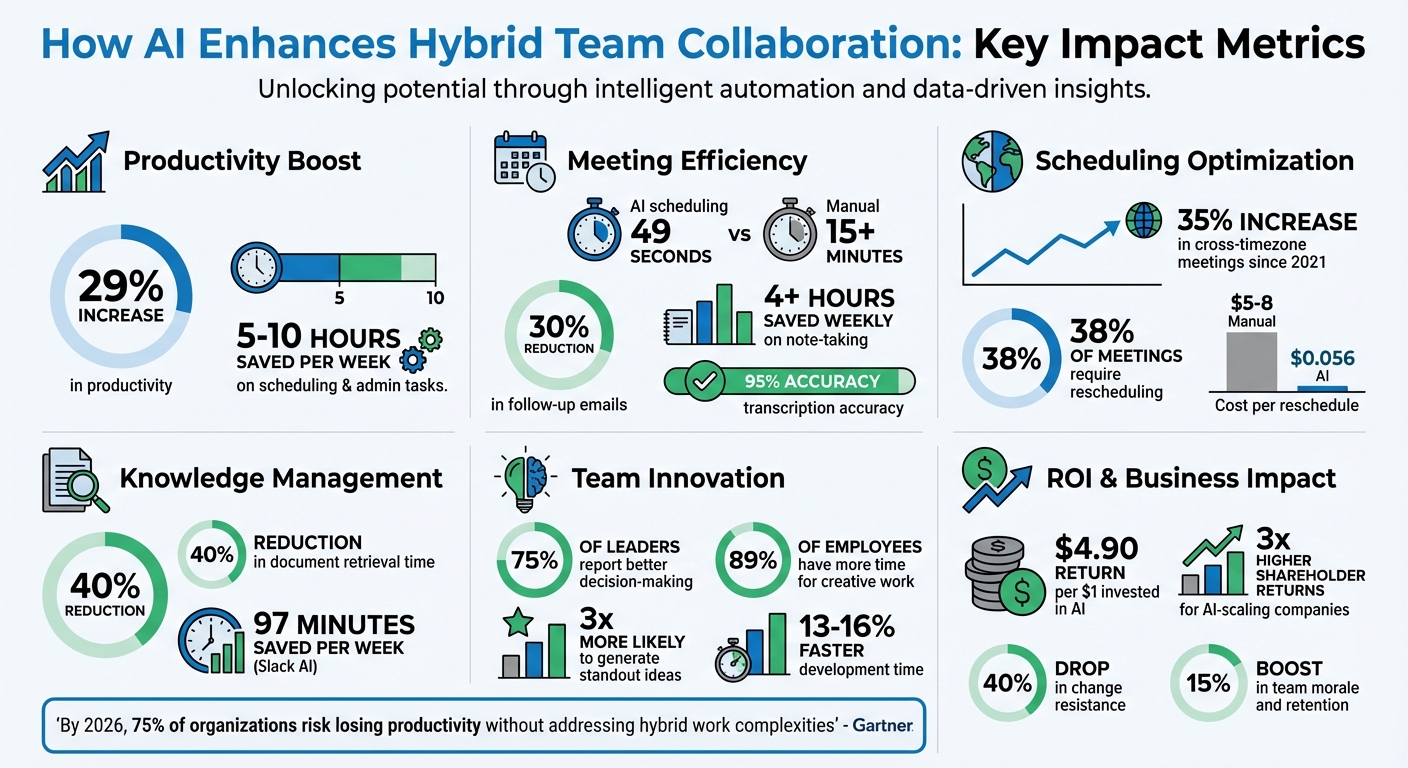
- Boosts Productivity: Teams using AI report a 29% increase in productivity and save 5–10 hours per week on scheduling and administrative tasks.
- Improves Meeting Efficiency: AI automates scheduling, real-time transcription, and action item tracking, reducing follow-up emails by 30%.
- Supports Remote Workers: AI ensures remote employees stay informed through automated summaries and shared records, reducing "proximity bias."
- Enhances Communication: Tools like real-time translation and sentiment analysis improve alignment across time zones and languages.
- Predicts and Solves Problems: Predictive analytics identify workflow bottlenecks and disengagement risks, helping leaders take timely action.
- Simplifies Knowledge Management: AI-powered tools reduce document retrieval times by up to 40%, keeping teams aligned and informed.
AI is not just a tool for efficiency - it’s changing the way teams collaborate, communicate, and innovate, ensuring hybrid work is both effective and equitable.
How AI Improves Hybrid Team Productivity: Key Statistics and Benefits
AI-Powered Scheduling and Meeting Management
AI is not just about leveling the playing field in meetings - it’s also a game-changer for managing the logistics behind them. Scheduling hybrid meetings often turns into a headache with endless email threads, timezone miscalculations, and the constant back-and-forth of rescheduling. On average, manual scheduling takes 15+ minutes per meeting, and when time zones are involved, 30% of meetings end up being scheduled at the wrong time [4]. This inefficiency can seriously disrupt team productivity.
AI scheduling tools, however, take the hassle out of this process. They can set up meetings in just 49 seconds [4]. By analyzing productivity habits - like developers needing uninterrupted mornings or sales teams favoring afternoon calls - these tools ensure meetings align with everyone’s optimal work rhythms [5].
Automated Scheduling Across Time Zones
Time zones are a classic scheduling nightmare, but AI makes them a non-issue. Forget manually figuring out what 2:00 PM EST means for your colleague in Tokyo - AI handles the conversion instantly and accurately. With meetings across multiple time zones increasing by 35% since 2021 [4], this feature is no longer just helpful; it’s essential.
AI also simplifies the often frustrating process of rescheduling. About 38% of scheduling requests involve changes, and while manual rescheduling costs around $5–$8 per meeting, AI can do it for just $0.056 in compute costs [4]. Plus, it only takes a single interaction to handle the entire process.
Automated Agendas and Action Item Tracking
AI doesn’t stop at scheduling - it also transforms how meetings are documented. It can automatically generate structured agendas, compile relevant documents, and highlight key discussion points [5][1]. During meetings, AI tools provide real-time transcription with up to 95% accuracy, identify speakers, and timestamp action items, making accountability crystal clear [1].
The benefits extend well beyond the meeting itself. Teams using AI meeting assistants report a 30% drop in follow-up emails [1] and save over 4 hours per week on manual note-taking [1]. AI ensures nothing gets lost in translation by integrating notes and action items directly into tools like Asana or Slack. This seamless flow from discussion to execution eliminates the need for tedious follow-ups and keeps projects moving forward [1].
Improving Communication and Knowledge Sharing with AI
Hybrid teams often grapple with a big question: how do you keep everyone aligned when they're spread across different time zones, languages, and work schedules? AI is stepping up to make communication smoother, more inclusive, and far less of a headache.
Real-Time Translation and Sentiment Analysis
Language barriers used to mean relying on separate translation services, but AI now provides instant, context-aware translations in over 50 languages [1]. Platforms like Loom AI and Microsoft Teams allow team members to speak in their preferred language while others receive real-time translations. On top of that, sentiment analysis tools integrated into platforms like Microsoft Teams and Slack can track communication patterns, flag potential burnout risks, and give leadership real-time insights into team morale [1].
The impact is tangible: early users of these tools reported a 15% boost in team morale and retention [1]. A 2024 study by Procter & Gamble revealed that teams using AI were three times more likely to generate standout ideas, while development time dropped by 13% for teams and 16% for individuals [6]. These advancements don’t just bridge language gaps - they help create a more connected and efficient workplace.
AI-Powered Knowledge Management
Beyond improving communication, AI is transforming how teams manage and access knowledge. Tools like Dropbox Dash and Notion AI use natural language processing to locate and summarize files across scattered platforms, making it far easier to find what you need [1]. For instance, Dropbox Dash slashes the time spent searching for documents by 40% [1], and Slack AI saves users an average of 97 minutes a week by summarizing messages and finding information quickly [1].
Organizations like the Atlantic Housing Foundation and JLL have seen firsthand the benefits of these tools. By early 2026, they were using AI to dramatically cut document retrieval times, whether for extracting lease details or managing 140,000 SharePoint sites across global teams [7]. AI doesn’t just locate information - it ensures it’s accessible and actionable, keeping everyone informed and on the same page.
Using Predictive Analytics to Improve Productivity
Building on AI's strengths in scheduling and communication, predictive analytics takes team performance to the next level. By analyzing data like meeting frequency and tool usage, it provides forward-looking insights that help leaders address issues before they disrupt productivity [8].
Rather than waiting for routine reviews to highlight problems, predictive systems monitor real-time behavioral changes. For instance, they can detect patterns like "silent disengagement" or "collaboration overload" by identifying when team members stray from their usual performance benchmarks [8]. This shift from reactive reporting to what experts call "proactive change intelligence" allows organizations to mitigate risks early, ensuring smoother operations and timely project delivery [8]. It’s a seamless way to link operational efficiency with leadership’s ability to offer timely support.
Finding Bottlenecks and Workflow Problems
AI doesn’t just count hours - it evaluates how effectively those hours are spent. Analytics platforms monitor factors like context switching, collaboration intensity, and the balance between deep work and meeting time [8]. When these metrics show concerning trends, AI flags potential bottlenecks.
Platforms like Monday AI and Asana AI analyze team data to predict delays and suggest task adjustments to maintain momentum [1]. For example, if one team member is bogged down with meetings while another has more focus time, the system may recommend shifting tasks to prevent burnout during high-pressure phases [8]. Companies leveraging these tools have seen a 40% drop in change resistance [8], while employees report a 29% boost in productivity due to quicker decision-making and reduced repetitive tasks [7][2].
"In 2026, predicting human response to change is not an enhancement - it is a core management capability." - We360.ai [8]
In addition to identifying workflow inefficiencies, AI equips leaders with real-time sentiment data, helping them balance productivity with team morale.
Sentiment Dashboards for Leadership
AI-powered sentiment dashboards provide leaders with instant insights into team morale without relying on traditional surveys. These tools analyze communication data from platforms like Microsoft Teams and Slack, interpreting tone and engagement trends to detect early signs of disengagement [1][8]. Some even track speaking time during meetings to ensure remote workers aren’t being overlooked [1].
The results are tangible. Early adopters have reported better morale and improved employee retention [1]. Leaders can use these dashboards to monitor collaboration intensity, identify when excessive meetings are disrupting focus time, and roll out new hybrid work policies tailored to each team’s readiness [8]. By spotting issues before they appear in performance metrics, organizations can offer targeted support or adjust workloads at the exact moment teams need it most.
How AI Supports Innovation in Hybrid Teams
AI isn't just making hybrid teams more efficient in scheduling and communication - it’s also becoming a game-changer for innovation. By generating ideas and tackling complex challenges, AI acts as a "cybernetic teammate", matching the creative output of entire human teams [9][10].
One of AI's standout contributions is its ability to break down silos within organizations. It bridges technical and market expertise across remote departments, fostering collaboration. A fascinating example comes from a March 2025 Harvard Business School study involving 776 Procter & Gamble professionals. The study found that blending diverse perspectives - technical and commercial - led to more well-rounded solutions, regardless of participants’ backgrounds [9][10]. As researchers Fabrizio Dell'Acqua, Charles Ayoubi, Hila Lifshitz, Raffaella Sadun, Ethan Mollick, and others observed:
"AI adoption at scale in knowledge work reshapes not only performance but also how expertise and social connectivity manifest within teams, compelling organizations to rethink the very structure of collaborative work." – Fabrizio Dell'Acqua et al. [9]
This sets the stage for understanding how AI tools can take collaborative innovation to the next level.
AI-Generated Ideas and Solutions
AI plays multiple roles in innovation - it acts as a Player, Tool, and Environment [3]. From generating scenarios and evaluating options to proposing solutions, AI works alongside human team members, freeing them from mundane tasks and enabling more creative problem-solving.
The numbers speak volumes. 75% of leaders using AI report better decision-making and improved collaboration, and 89% of employees say AI minimizes repetitive tasks, giving them more time to focus on creative work [11]. This directly addresses the collaboration paradox, where routine tasks often stifle innovation by monopolizing time and energy. By automating administrative duties, AI ensures teams can channel their efforts into solving complex problems.
Leaders, in particular, benefit from these efficiencies. 74% of leaders report saving at least one hour daily thanks to AI, compared to 46% of employees. This extra time allows them to prioritize strategic thinking over coordination and administrative work [11]. By reducing these operational burdens, AI creates space for deeper, more meaningful creative engagement.
Encouraging Collaboration for Creative Problem-Solving
Beyond generating ideas, AI also enhances team collaboration. Research shows that 30% of "AI Power Users" experience stronger team bonds and better creative collaboration, with more time spent on learning (12% vs. 8%) and socializing (11% vs. 9%) [13]. As AI takes over repetitive tasks, team members naturally shift their focus to the human connections and collaborative efforts that drive innovation.
AI tools are evolving to support this shift, moving from individual productivity features to "multiplayer" systems that facilitate shared interaction and context across hybrid teams [3]. For instance, AI embedded in visual collaboration tools can turn raw brainstorming into structured plans, user-journey maps, or prioritized backlogs - all without the need to switch platforms. Unsurprisingly, 81–83% of decision-makers are interested in AI that integrates seamlessly into shared, canvas-based workspaces [12].
The secret lies in treating AI as a core part of the team’s environment rather than just another tool. As noted by Salesforce:
"The value of new tools lies not in just helping individuals be more productive, but helping teams and organizations to operate more intelligently together." – Salesforce Blog [3]
For hybrid teams working on product development or strategic initiatives, AI can surface relevant past discussions, connect ideas, and ensure everyone - whether remote or in-office - operates with the same context. All of this happens without the need for manual coordination, making AI an indispensable partner in modern teamwork.
Leadership Strategies for Using AI in Hybrid Teams
Leaders today are tasked with integrating AI tools into their teams without losing sight of the importance of human trust and creativity. The challenge isn’t about choosing between people and technology - it’s about finding ways for them to work together, with each enhancing the other.
Combining Human and AI Strengths
A useful guiding principle here is: AI proposes, humans decide [1]. Assign repetitive tasks like note-taking, data entry, or routine responses to AI, freeing up people to focus on creative, strategic, and empathy-driven work. To ensure these efficiencies translate into long-term value, it’s critical to have humans review AI outputs, especially for customer-facing or high-stakes tasks. This step helps catch errors and keeps the human element intact.
Transparency plays a crucial role in making this collaboration effective. For instance, clearly tagging AI-generated tasks in project management tools (e.g., “Generated by Copilot – reviewed by [Name]”) can prevent misunderstandings, particularly in hybrid teams. Address common challenges like time zone conflicts and scattered documentation by consolidating tools into a single, centralized dashboard. When implemented thoughtfully, these strategies often deliver measurable ROI within 45-60 days [1].
By balancing automation with human oversight, leaders can lay the groundwork for what’s known as the Human Moat.
Building a Human Moat in the Age of AI
As AI takes over routine tasks, the real competitive edge lies in human capabilities like judgment, empathy, and creating a sense of psychological safety within teams. This combination of uniquely human skills - referred to as the Human Moat by thought leaders like Seth Mattison - becomes the foundation for lasting differentiation and success.
Unicorn Labs highlights this point perfectly:
"Ensure that AI serves as an amplifier of human potential, not a substitute." [14]
For leaders, this means moving away from micromanaging and instead empowering team members. Focus on outcomes and impact rather than simply tracking hours worked [14]. This shift not only enhances team performance but also reinforces the value of human contributions in an AI-driven workplace.
Conclusion
AI is reshaping how hybrid teams work together by automating repetitive tasks and improving team engagement [1]. Features like automated scheduling, which can reclaim 5 to 10 hours a week, and sentiment dashboards that detect burnout risks early, directly address the challenges distributed teams face daily [1]. These innovations not only solve practical problems but also deliver measurable results, such as boosting productivity by up to 29% [2]. On top of that, every $1 invested in AI is estimated to generate a $4.90 return [2].
But the shift goes beyond just efficiency improvements. AI is evolving from tools that enhance individual productivity to platforms designed for team collaboration. These "multiplayer" systems provide shared context, enable real-time interaction, and even contribute during brainstorming sessions. They act as a collective memory bank, surfacing relevant information when needed and fostering a deeper level of team connectivity [3]. This new wave of AI tools empowers leaders to embrace its potential while staying grounded in core human values.
From streamlining schedules to delivering actionable insights, the tools highlighted demonstrate that successful hybrid collaboration depends on merging intelligent technology with thoughtful human oversight. Companies that scale AI effectively see three times higher total shareholder returns compared to those that don't [2]. However, Gartner warns that by 2026, 75% of organizations risk losing productivity if they fail to address the complexities of hybrid work [2]. These statistics emphasize the importance of striking the right balance - letting AI handle the analysis while humans make the final calls [1].
The key to thriving in hybrid work lies in blending AI's analytical capabilities with human judgment, empathy, and a focus on psychological safety. As Andrea Small from Salesforce aptly notes:
"The value of new tools lies not in just helping individuals be more productive, but helping teams and organizations to operate more intelligently together" [3].
When technology and human insight work hand in hand, hybrid work becomes not just manageable but a true competitive edge.
FAQs
What AI features help hybrid teams the most?
AI brings several tools to the table that can make hybrid teams more efficient and connected. Here are some standout features:
- Automating routine tasks: By handling repetitive or time-consuming activities, AI frees up team members to focus on more strategic work. Think of tasks like scheduling meetings, managing emails, or updating project trackers.
- Data analysis for insights: AI can quickly analyze large datasets and highlight key trends or actionable insights. This helps teams make informed decisions faster, whether it's understanding customer behavior or tracking project performance.
- Enhancing communication: AI-powered tools like real-time translation, transcription, or smart suggestions improve how team members communicate, especially across different time zones or languages. This ensures clarity and keeps everyone on the same page.
These features streamline workflows and make collaboration smoother, even when teams are spread out geographically. They help create stronger connections and improve overall productivity.
How do we prevent AI from reinforcing bias in hybrid work?
To ensure AI doesn't reinforce bias in hybrid work settings, organizations need to tackle proximity bias - the tendency to favor in-office employees over remote workers. Adopting inclusive practices is key. For instance, remote employees should have an equal opportunity to contribute and be recognized for their work.
Additionally, promoting transparency and fairness in decision-making processes is crucial. By taking these steps, companies can create a more balanced environment where AI enhances collaboration without unintentionally amplifying biases.
What data should leaders track to spot burnout early?
Leaders need to keep an eye out for signs of overload, disengagement, and stress within their teams. AI tools can play a key role here by spotting these patterns early - sometimes even before they’re obvious to team members. This early detection gives leaders the chance to tackle potential burnout head-on and support their team’s well-being.