
Articles May 16, 2026 9:00:00 AM Seth Mattison 15 min read

Storytelling is one of the most powerful tools leaders can use to connect with their teams and align them toward shared goals. Why? Because stories blend logic with emotion, making complex ideas relatable and memorable.
Here’s what you need to know:
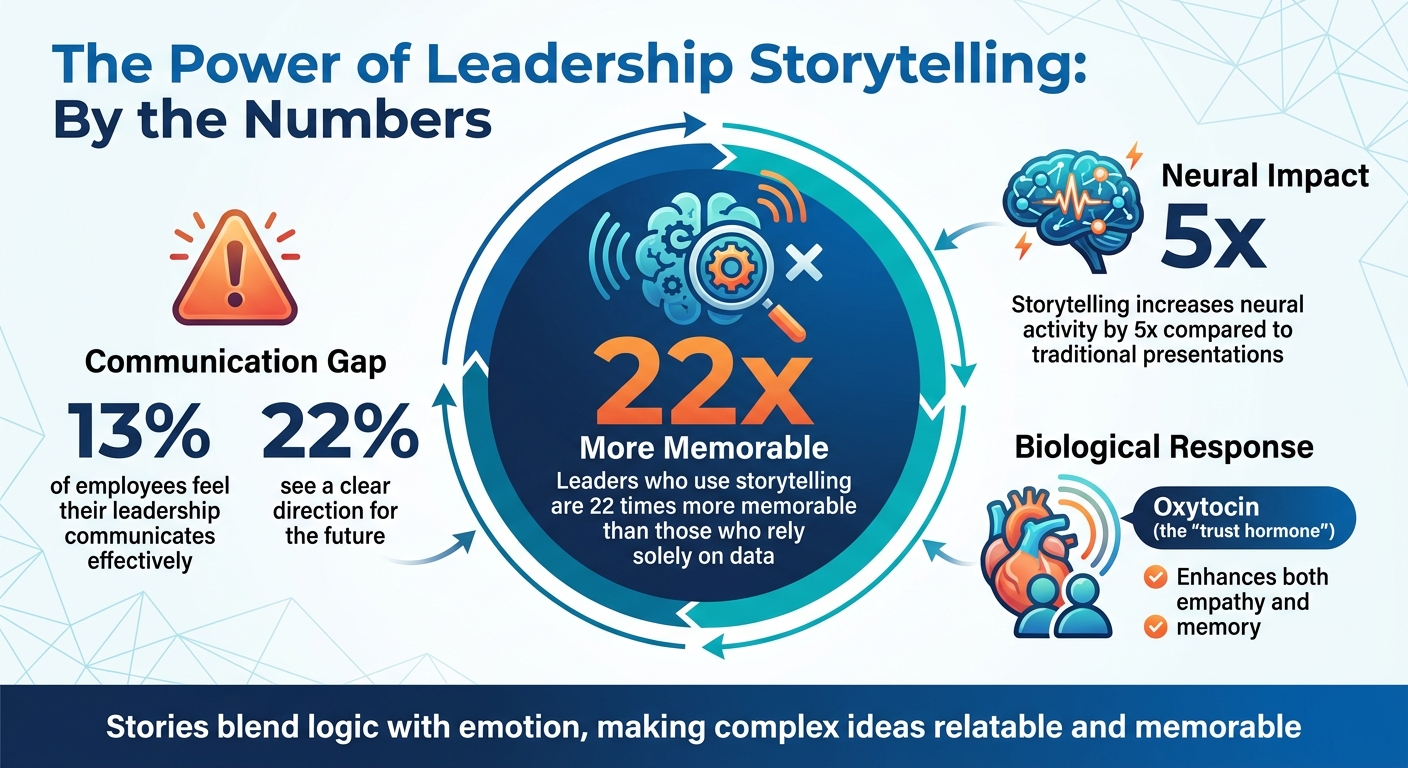
- Only 13% of employees feel their leadership communicates effectively, and just 22% see a clear direction for the future.
- Leaders who use storytelling are 22 times more memorable than those who rely solely on data.
- Sharing personal experiences - like successes, failures, or lessons learned - builds trust and fosters emotional connections.
Examples include Microsoft CEO Satya Nadella, who uses personal stories to promote empathy, and Cisco’s Rowan Trollope, who inspired his team with a story about a young cancer patient benefiting from their technology. Storytelling isn’t just about engagement - it’s about creating clarity, trust, and alignment in a way numbers alone can’t achieve.
Case Study: Rowan Trollope at Cisco

The Zero G Experience Keynote
Rowan Trollope, leading Cisco's $4 billion IoT and Collaboration Technology Group [7], used storytelling to bridge human emotion with Cisco's strategic transformation. One standout example was his narrative about 10-year-old Peyton Walton. Peyton, battling cancer, relied on Cisco's video technology to attend school from her hospital bed, 600 miles away. Trollope shared how this story deeply moved him:
"When you combine passion and capability with inspiration from a story as powerful as Peyton's, incredible things happen" [5].
This wasn’t just a feel-good moment - it was a way to make abstract goals tangible. Employees felt an emotional connection, with many experiencing goosebumps. The story demonstrated how their work directly impacted lives, making distance irrelevant in Peyton’s fight against cancer. It also reinforced why Cisco was seen as a great place to work. Trollope’s ability to tie strategic objectives to personal impact showcased how storytelling can inspire both connection and performance.
Results of Personal Vulnerability
Trollope didn’t stop at inspiring stories; he also shared his own vulnerabilities to reshape Cisco’s culture. He recounted a life-threatening mountain climbing incident in the Eastern Sierra, where a failed primary anchor almost cost him his life. A backup anchor - installed as an afterthought - saved him. This experience became a metaphor for his leadership philosophy:
"I became more focused on doing things right and paying attention to every little detail. I learned that 'good enough' was never acceptable" [6].
This mindset shift translated into measurable results. Under Trollope’s leadership, Cisco launched a refreshed telepresence portfolio and Project Squared, signaling a new cultural direction. Engineers adopted a "less is more" approach, a significant change for a company where simplicity hadn’t been a core value [7]. By sharing his personal experiences, Trollope built trust, fostered alignment, and drove meaningful business transformation.
sbb-itb-9ceb23a
How Leaders Share Personal Transformation Stories
Emotional Transparency for Alignment
Sharing personal transformation stories allows leaders to show their human side. When leaders talk about emotions they’ve experienced during tough times - like frustration over unexpected project changes, fear during a career setback, or uncertainty about the future - they create a sense of openness. This isn't about revealing too much; it’s about showing how vulnerability can build genuine connections with their teams.
By weaving their core values into personal stories, leaders can help team members see how their roles contribute to the bigger mission. This approach also fosters an environment where people feel safe to make mistakes and learn from them. As a result, a culture of trust and growth begins to take root. A great example of this comes from HSI leaders who have embraced this approach.
Matthew Luhn, a former Pixar storyteller, summed it up perfectly:
"Using a story to communicate with people makes all the content more memorable, impactful and personal." [3]
Case Study: HSI Leaders' Experiences

At the Training 2023 conference, HSI leaders illustrated how sharing short, honest stories can build trust and collaboration. Rather than relying on polished corporate messaging, they shared real emotional experiences. For example, one manager described the frustration of dealing with a sudden project shift - a moment that ultimately led to better communication with their team.
This candid approach changed how feedback was received. Instead of presenting themselves as heroes, HSI leaders took on the role of coaches, openly sharing lessons they had learned. This shift encouraged employees to share their own ideas and challenges, reinforcing the idea that transformation is something the entire team experiences together [3].
Frameworks for Leadership Storytelling
The Duarte Framework for Storytelling
Structured frameworks can help leaders craft compelling narratives, especially during times of change. Nancy Duarte and Patti Sanchez introduced the "Illuminate" framework, which portrays organizational transformation as an epic journey with five key stages: Dream, Leap, Fight, Climb, and Arrive [9]. This approach helps leaders navigate change by addressing the emotional journey that comes with it.
A core element of this framework is what Duarte calls a "story basket" - a collection of narratives that explain the organization's origins and its path forward. As Duarte puts it:
"To tell a really good story, you have to say 'I tried and I failed and then I tried again.'... it's the most powerful device to build devotion to yourself and devotion to the brand that you're leading" [9].
This framework encourages leaders to confront fears head-on, fostering open conversations about challenges like job security or major shifts. By addressing concerns directly, leaders can prevent misinformation and build trust during transitional periods [9]. The "Illuminate" framework has proven to be a valuable tool for guiding teams through complex transformations while maintaining clarity and inspiration [2].
Beyond structured storytelling, leaders can use narrative techniques to create deeper, more personal connections that technology alone cannot replicate.
Building a Human Moat with Storytelling
In addition to structured methods like the Duarte framework, storytelling can help leaders build what Seth Mattison calls a Human Moat - a way to secure trust and drive innovation in an increasingly automated world. Communication strategist Jessica Abo describes storytelling as "the missing link" in the AI era, offering the empathy and meaning that data or technology alone cannot provide [1]. This approach blends logical strategy with emotional connection, highlighting the uniquely human qualities that set organizations apart.
As automation continues to reshape traditional value sources like expertise and service, leaders must focus on areas where human creativity and empathy shine. The Human Moat framework emphasizes storytelling as a way to foster trust and create safe spaces for teams to take risks, innovate, and share honest feedback [1].
A collaborative approach to storytelling can also amplify its impact. Catherine Connors, former Head of Content at Disney Interactive, explains this shift:
"The real power of storytelling is in how we invite others to take the story on as their own" [8].
Storytelling Across Cultures
Relational Transparency in Diverse Teams
Leading a team across different cultures requires more than just understanding; it calls for narrative intelligence. This is the ability to connect through the cultural stories that shape people’s experiences. By sharing meaningful stories, leaders can build trust and unite diverse teams around a common goal. Personal origin stories, in particular, create bonds that go beyond nationality, race, or religion. Leadership experts Anna Oakes and Christina Blacken highlight this idea:
"To be able to communicate with, build trust, and lead people not like yourself, you have to understand these [social and cultural] narratives, where they show up, what impacts they have, and how you participate in them" [11].
Take Satya Nadella, CEO of Microsoft, as an example. He drew on his background as an immigrant and a parent to emphasize empathy as a core value. His storytelling helped shift Microsoft’s culture from being a "know-it-all" organization to a "learn-it-all" mindset. This shift wasn’t just symbolic. By 2024, under Nadella’s leadership, Microsoft hit a $3 trillion market valuation [10][4]. His personal stories made empathy more relatable and actionable for employees spread across different countries and cultures.
The power of storytelling isn’t just emotional - it’s backed by science. When a leader shares a story, neural activity in the listener’s brain increases fivefold [11]. This process, known as "neural coupling", aligns the listener’s brain with the storyteller’s, fostering trust quickly - even across cultural boundaries. Additionally, storytelling releases oxytocin, often called the "cuddle hormone", which enhances both empathy and memory [11].
This ability to connect through stories is a critical skill for leaders navigating global teams and diverse perspectives.
Case Studies from Expatriate Coaching
Stories of personal transformation are another powerful tool for leaders managing cross-border challenges. Global executives often face the daunting task of aligning teams with different cultural norms, and personal narratives can help bridge these gaps. For instance, Michel Koopman, CEO of CxO Coaching, uses his own journey - growing up in the Netherlands and becoming a tech executive in the U.S. - to connect with entrepreneurs and executives from around the world. His story provides a relatable foundation for addressing cultural and professional differences [10].
Another example is Indra Nooyi, former CEO of PepsiCo. She built her "Performance with Purpose" strategy around her immigrant experience, using it to frame sustainability initiatives. By grounding these initiatives in her personal story, she inspired global teams and fostered a sense of pride among employees in diverse markets [4]. However, as Oakes and Blacken point out, storytelling only works if it’s authentic and followed by consistent actions: "Story is the fastest way to build trust and move people to action" [11].
For leaders aiming to improve their cross-cultural storytelling, a "story audit" can be a helpful exercise. This involves reviewing the books, podcasts, and media they consume to ensure exposure to a variety of perspectives. Adding just one new source from a different culture each month can enhance empathy and broaden thinking [11]. These steps make it easier to craft stories that resonate across borders and bring teams closer together.
Key Takeaways for Leaders
Summary of Key Lessons
Storytelling has become a cornerstone for leaders aiming to connect, inspire, and lead effectively in today's world [3]. Throughout this article, examples like Rowan Trollope's use of personal stories illustrate how sharing experiences can make leaders more relatable, foster trust, and align teams. Research highlights a costly communication gap in many organizations, leading to disengagement and reduced productivity [1][2].
Stories have a unique ability to merge logic with emotion. As Jessica Abo, a Communication Strategist, explains, "Stories do what data cannot. They create emotional resonance. They provide context that makes complex concepts concrete" [1]. When leaders share personal stories - especially those that include failures and lessons learned - they create an environment of psychological safety that a purely data-driven approach cannot achieve. In fact, storytelling can increase neural activity in listeners' brains by up to five times compared to traditional presentations [11].
The best leaders excel in two key types of storytelling: Origin Stories, which humanize them and build trust, and Growth Stories, which outline a clear vision for the future [2]. They also adopt a collaborative approach to storytelling, shifting from one-way communication to a shared narrative. This method allows employees to see themselves as part of the story, fostering a stronger sense of ownership and connection [8][3]. By balancing clarity with emotional resonance, leaders can strengthen bonds within diverse teams.
The insights below offer actionable ways to incorporate storytelling into your leadership style right away.
Practical Steps for Leaders
- Define Your Origin Story: Reflect on three pivotal career moments that shaped your leadership style. Use these experiences to craft a compelling and authentic narrative [2].
- Focus on Emotional Impact: Before your next presentation, think about the emotions you want your audience to feel, not just the information you want to convey. Aligning your emotional tone with your data strengthens your message [8].
- Be Transparent About Challenges: Practice openness by addressing both successes and setbacks. As Matthew Luhn, a former Pixar storyteller, advises, "Share the successes AND the failures, but what's most important is that you never give up - on your team and on your company" [3].
- Expand Your Perspective: Conduct a "story audit" of the media you consume - books, podcasts, or films - and intentionally include sources from different cultural viewpoints. Adding one new perspective each month can broaden your empathy and enhance your storytelling skills [11].
Lastly, remember that storytelling isn't a single event - it's a continuous practice. The stories you share must align with your actions. Without this alignment, your narrative risks being perceived as manipulative rather than inspiring [11].
2 Stories Every Leader Should Tell
FAQs
How do I tell a story without oversharing at work?
To share a story at work effectively, stick to the details that matter most for your message and audience. Skip any overly personal or unrelated information that might detract from your point. Keep it short, highlight the main takeaway, and focus on lessons or values that resonate. This approach helps build trust and connection while maintaining professionalism and appropriate boundaries.
What’s the simplest storytelling framework I can use to lead change?
The simplest way to structure a story for driving change is the ABT Framework (And-But-Therefore). It breaks communication into three straightforward parts: context, conflict, and resolution. This approach ensures your key messages are clear and to the point, making it a powerful tool for addressing resistance and creating alignment during change efforts.
How can I make my stories land across different cultures?
To create stories that connect with people from various backgrounds, center them around shared values and themes that everyone can relate to, while being mindful of cultural nuances. Adjust your language, symbols, and examples to fit the audience's context, incorporating familiar metaphors or references they can easily understand. It's also important to factor in different communication styles to make your delivery more effective. By crafting stories that are genuine and inclusive, you can build trust and forge meaningful connections, which is key for leaders aiming to align teams across the globe.