
Articles Apr 16, 2026 9:00:00 AM Seth Mattison 16 min read

AI is transforming workplaces, but emotional intelligence (EQ) is now more important than ever. Here's why:
- EQ's Role: Emotional intelligence - self-awareness, self-regulation, empathy, and relational skills - fills the gap where AI falls short, like understanding emotions and building trust.
- Shifting Skills: With AI handling technical tasks, EQ is critical for decision-making, leadership, and team connection. Teams with high EQ make decisions 50% better in quality.
- Challenges with AI: AI can weaken human connection, create isolation, and increase stress. Over 82% of employees want more human interaction, and skepticism toward AI-generated messages is growing.
- EQ's Impact: Leaders who balance AI's abilities with EQ reduce disengagement and improve collaboration. High-EQ teams interpret AI insights with a human lens, ensuring better outcomes.
Bottom Line: As AI advances, EQ is the key to thriving workplaces. Leaders must combine AI's efficiency with human emotional insight to build trust, improve decisions, and maintain motivation.
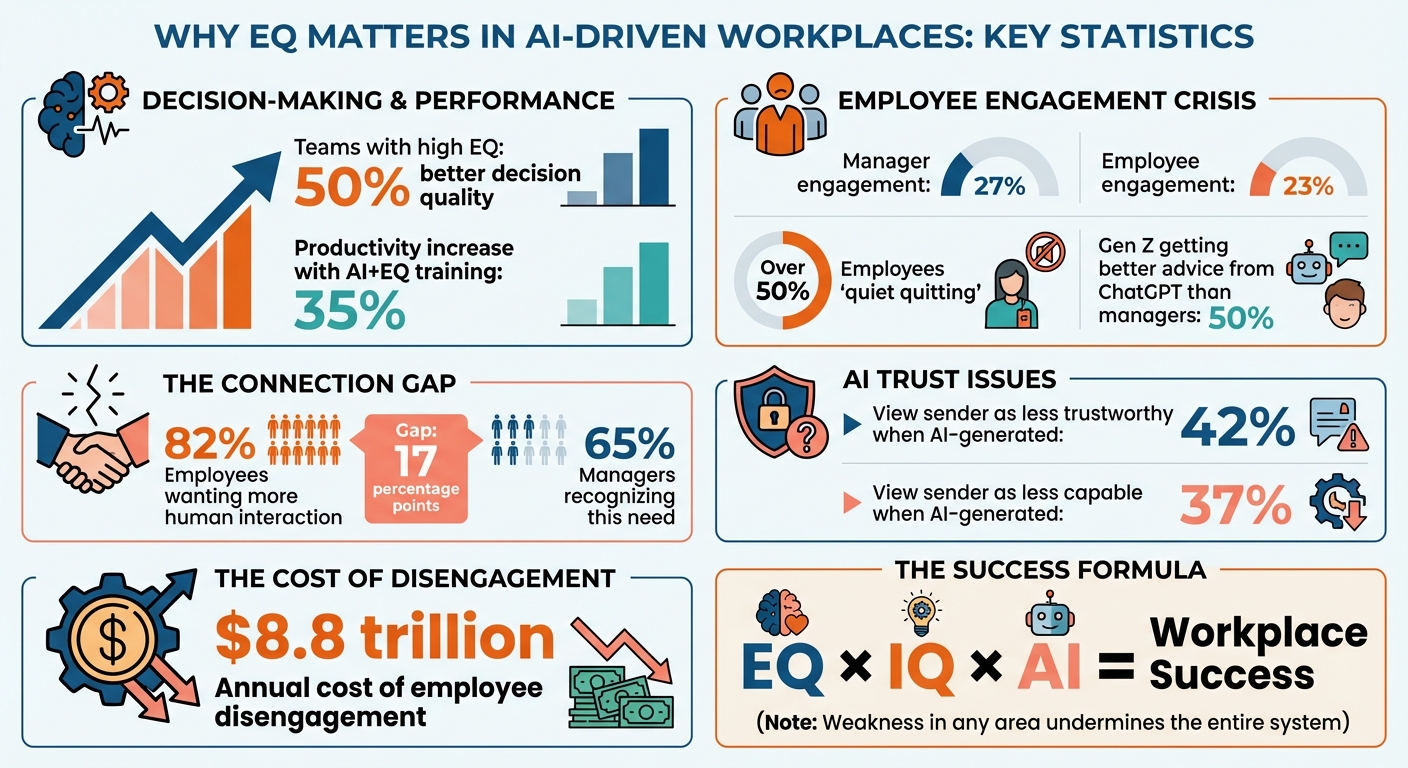
The Impact of EQ in AI-Driven Workplaces: Key Statistics
Problems That Emerge When AI Changes How Teams Work
How AI Weakens Human Connection
AI might make work more efficient, but it comes with an unexpected downside: it strips away the casual, spontaneous moments that help build strong team relationships. Tasks like scheduling, data entry, and routine communications are now often handled by AI, which means fewer chances for colleagues to connect naturally. Researchers call this absence of interaction a "connection void" - a space where silence and even cynicism can grow [4].
The numbers tell a concerning story. While 82% of employees express a need for more human interaction as AI becomes more integrated into their work, only 65% of managers recognize this need [4][5]. This disconnect leaves many leaders unaware of the isolation their teams are experiencing. On top of that, when employees suspect a message or report was generated by AI, 42% view the sender as less trustworthy, and 37% see them as less capable [6].
Tech expert Alexandra Samuel highlights this growing skepticism:
"The fact that it could be AI makes us second guess our relationships" [6]
Another issue is the loss of what Professor Linda Hill refers to as "creative abrasion" - the productive friction that comes from disagreements and diverse perspectives. AI, by smoothing over conflicts and scripting feedback, can unintentionally eliminate the very tension that sparks creativity and strengthens team dynamics [6]. The result? Workplaces may appear efficient but feel emotionally disconnected.
This lack of connection isn’t just a social issue - it also contributes to heightened stress and anxiety among employees.
The Stress and Anxiety of Working with AI
The emotional toll of AI on employees is significant, compounding the challenges created by weakened relationships. Many workers experience a constant cognitive load, questioning whether they’re interacting with a person or a machine. This mental strain - deciphering tone, verifying context - chips away at psychological safety, which is essential for teams to take risks and thrive [7].
Manager engagement has dropped to just 27%, and only 23% of employees feel fully engaged at work [2]. Over half of workers are now "quiet quitting", where they show up but hold back their effort and creativity [2]. Alarmingly, nearly 50% of Gen Z employees in 2023 reported getting better career advice from ChatGPT than from their actual managers [5]. Stanford psychologist Jamil Zaki puts it bluntly:
"If a chatbot is running circles around you as a leader, it might be time to do some soul searching" [5]
The situation worsens when companies rely on AI chatbots for delicate tasks, like delivering bad news or feigning empathy - a practice often called "empathy-washing." These superficial gestures tend to backfire, leaving employees feeling even more isolated and disconnected [5]. Without authentic human interaction, teams don’t just lose their productivity - they lose their motivation and sense of purpose.
sbb-itb-9ceb23a
How EQ Makes Human-AI Collaboration Work
Using EQ to Turn Data Into Better Decisions
Emotional intelligence (EQ) plays a crucial role in transforming raw data into decisions that truly consider human needs. While AI can process vast datasets and identify patterns at incredible speeds, it falls short when it comes to understanding the human context behind those patterns. Teams with strong EQ demonstrate a 50% improvement in decision-making quality [1] because they interpret AI insights with a focus on human impact.
For example, if an AI report highlights a drop in productivity, a high-EQ leader won't just focus on the numbers. Instead, they'll investigate potential causes like burnout, unclear priorities, or a lack of trust - factors that AI alone can't detect [2]. As one expert from The AI Journal aptly puts it:
"The leaders of the future aren't the ones who rely most on AI. They're the ones who know when not to." [2]
This shift mirrors the growing emphasis on EQ in workplaces where AI plays a central role. Leaders are increasingly blending AI's analytical power with human intuition to make well-rounded decisions. To do this effectively, they can evaluate tasks by sorting them into three categories: those where AI thrives, those that require EQ, and those needing a mix of both [1]. This kind of "AI+EQ literacy" ensures that decisions are both data-informed and people-centered.
Creating Safety in Teams That Mix Humans and AI
When humans and AI work together, psychological safety becomes essential - and emotional intelligence is the key to creating it. Teams thrive when they feel safe enough to take risks, voice ideas, and innovate. However, that sense of safety can vanish if employees feel reduced to mere productivity metrics.
High-EQ leaders understand that trust in AI collaboration isn't about uncritical reliance on technology. Instead, it’s built through consistent, positive experiences [10]. They often start by assigning AI low-risk tasks, gradually moving to more complex collaborations as trust grows. Transparency about AI's capabilities and limitations also plays a big role. When AI systems openly acknowledge their uncertainties, they build credibility - just as honesty does in human relationships [10].
The behavior of leaders sets the tone for the entire organization. If leaders treat employees as numbers on a spreadsheet, AI systems trained on those behaviors will replicate that detachment [2]. To counter this, some companies are introducing roles like "Empathy Architects" to ensure technology strengthens, rather than diminishes, human connection. These organizations are also expanding their metrics to include psychological safety, belonging, and well-being alongside traditional productivity measures [1].
Once psychological safety is in place, teams can channel emotional insight into creativity and innovation.
How Emotional Awareness Drives Better Ideas
EQ is a catalyst for generating groundbreaking ideas in human-AI partnerships. AI’s ability to handle routine analytical tasks frees up humans to focus on creative problem-solving and building meaningful relationships [1]. But unlocking that creativity requires emotional awareness at every level.
Studies show that while individuals working alone solve about 56% of complex reasoning problems, their performance improves significantly when they collaborate with AI - provided they apply perspective-taking skills [9]. As Professor Christoph Riedl from Northeastern University notes:
"The key driver is that my theory of mind ability is somehow reflected in how I prompt it, and that makes the AI write a better answer." [9]
EQ enables teams to recognize subtle emotional cues - such as tensions or shifts in dynamics - that signal when to adjust their approach. These nuances often go unnoticed by AI [2]. By taking the time to acknowledge and address these undercurrents, leaders create an environment where productive friction can lead to innovative breakthroughs. Sarah Thompson from Ahead App Blog captures this balance well:
"The sweet spot lies in managing workplace stress while leveraging AI's analytical strengths - creating a collaborative ecosystem where both human and artificial intelligence enhance each other." [1]
How to Build EQ in AI-Driven Workplaces
Combining EQ Training with AI Tools
AI often struggles to interpret the subtleties of human emotion, which is why pairing it with emotional intelligence (EQ) training can be a game-changer. By combining AI sentiment analysis with targeted EQ workshops, companies can create a practical feedback loop. For instance, AI might detect patterns in communication - like overly curt emails or dismissive tones - and flag them for improvement. Employees can then use EQ training to refine their responses, balancing empathy with efficiency. Imagine a manager’s email flagged as too cold; EQ training could help them adjust their tone without compromising clarity. Businesses taking this approach have reported up to 35% increases in productivity [11].
Another key skill is developing "AI+EQ literacy", which means understanding when AI's capabilities fall short and when human judgment needs to step in. For example, teams should have clear protocols for transitioning from automated processes to human-led interactions in situations that demand ethical decision-making or conflict resolution. This balance ensures that while AI handles routine tasks, humans step in where empathy and nuanced judgment are essential.
Building Stronger Connections in Hybrid Teams
In hybrid workplaces, AI can unintentionally create emotional distance if leaders aren't mindful. When efficiency dominates, teams may lose those informal, trust-building moments - like casual check-ins or collaborative brainstorming sessions. To address this, many organizations are creating shared vocabularies that bridge technical AI concepts with emotional frameworks. This ensures that both technical and non-technical team members can discuss insights and human needs more effectively.
One practical strategy is keeping sensitive conversations human-led. While AI might provide initial insights or talking points, discussions about performance reviews, team friction, or career development should remain in the hands of managers [1][2]. These human-led interactions help maintain the trust and relational bonds that make hybrid teams adaptable. Delegating repetitive tasks to AI also frees up time for employees to focus on relationship-building and creative problem-solving [1].
Tracking and Recognizing EQ Impact
Building psychological safety is crucial, but how do you measure the impact of EQ? Forward-thinking companies now use balanced scorecards that track not just traditional KPIs but also metrics like psychological safety, belonging, and emotional wellbeing [1]. Tools such as the INTE (Emotional Intelligence Questionnaire) and the KDMP (Workplace Well-being Questionnaire) provide insights into how emotional intelligence interacts with technology acceptance [12].
Beyond measurement, recognition plays a vital role. When employees see that behaviors like empathizing with colleagues or knowing when to override an AI-generated suggestion are valued and rewarded, these actions tend to multiply naturally. Establishing feedback loops where human insights improve AI systems also strengthens emotional awareness across teams, creating a workplace where both technology and empathy thrive [11].
Conclusion
What Leaders Need to Remember
As AI continues to take on more cognitive tasks, emotional intelligence (EQ) stands out as the key human advantage. The equation is straightforward: EQ × IQ × AI - a weakness in any one of these areas can undermine the entire system [3]. Leaders who prioritize EQ development alongside AI adoption empower their teams to perform better, with a 50% improvement in decision-making quality compared to their peers [1].
The best leaders see AI as a "cognitive sparring partner" rather than a decision-maker [3]. They use AI to challenge assumptions and uncover blind spots, but they keep the final say in critical areas like trust, ethics, and conflict resolution. It’s important to note that AI reflects the values of those who implement it [2]. If leaders focus solely on efficiency at the expense of empathy, their AI-driven workplace could mirror that detachment, contributing to the staggering $8.8 trillion annual cost of employee disengagement [8].
By investing in EQ, leaders can help reduce these losses and create a foundation for collaborative innovation. This approach ensures that human-AI partnerships evolve in a way that benefits everyone.
What Collaboration Will Look Like as AI Advances
The future of collaboration lies in combining the strengths of humans and AI. AI will excel at tasks like analyzing data, identifying patterns, and managing routine communications. Meanwhile, humans will take the lead in building trust, resolving conflicts, and making nuanced judgment calls - areas where AI falls short [2][3].
Organizations that succeed will balance AI's efficiency with the human touch of EQ [1]. This involves understanding when to rely on automation and when human input is critical. As Joshua Freedman, CEO of Six Seconds, aptly states:
"AI will determine what's possible. EQ will define what is truly valuable."
Ultimately, the most successful leaders won’t be those who rely solely on AI, but those who know when to step back and let human judgment take the lead [2].
Leading with Wisdom: Emotional Intelligence in the AI Era | The AI+HI Project
FAQs
Which work decisions should stay human, even with AI?
Work decisions that depend on emotional intelligence, empathy, and trust are best handled by humans. Leadership responsibilities such as cultivating relationships, addressing ethical challenges, and encouraging teamwork require emotional awareness and moral judgment. While AI is adept at automating repetitive tasks, it lacks the human touch needed to build connections and lead with emotional depth - qualities essential for fostering trust and maintaining an ethical, compassionate workplace environment.
How can leaders prevent AI from weakening team trust?
Leaders can build and maintain trust within their teams by focusing on transparency, open communication, and psychological safety. Start by clearly explaining AI's role and how decisions involving it are made. Involve team members in the process of adopting AI tools, ensuring their voices are heard. Providing training is another crucial step - it helps everyone feel confident and valued in the face of new technology.
Creating a safe space for team members to share their concerns or raise ethical questions is equally important. When people feel comfortable discussing potential challenges, it strengthens trust and collaboration. By prioritizing these people-first strategies, AI can become a tool that supports teamwork rather than disrupting it.
How is EQ measured in an AI-enabled workplace?
In workplaces where AI plays a significant role, emotional intelligence (EQ) is gauged by examining traits like empathy, self-awareness, and social skills, particularly during interactions mediated by AI systems.
To assess these qualities, organizations often rely on tools such as surveys or 360-degree assessments. Observing behaviors is equally important - things like trust-building, the quality of communication, and the level of emotional connection in interactions can offer valuable insights.
Strong EQ also reveals itself in how effectively individuals handle stress, navigate conflicts, and create a sense of psychological safety. These skills are especially critical in fostering productive and harmonious collaboration between humans and AI systems.