
Articles Apr 13, 2026 9:00:00 AM Seth Mattison 14 min read

False confidence in leadership, especially during rapid AI adoption, can erode trust and harm organizations. Leaders often misjudge trust levels within their teams, with 79%–86% of executives believing they are trusted versus only 60%–65% of employees sharing that view. This trust gap leads to productivity losses of over 20%. Key issues include:
- Compliance mistaken for commitment: Employees may comply outwardly but disengage internally.
- Automation bias: Blind reliance on AI-generated outputs without verification.
Recent data shows trust in managers dropped to 29% in 2025, with only 12% of companies confident in their leadership pipeline. Leaders who admit mistakes are 7.5 times more likely to retain trust, highlighting the importance of vulnerability and transparency.
To rebuild trust, leaders should focus on:
- Encouraging open dialogue and questioning.
- Verifying AI outputs and rewarding fact-checking.
- Using emotional intelligence to balance confidence with reality.
- Aligning decisions with core values to avoid overreliance on flawed AI outputs.
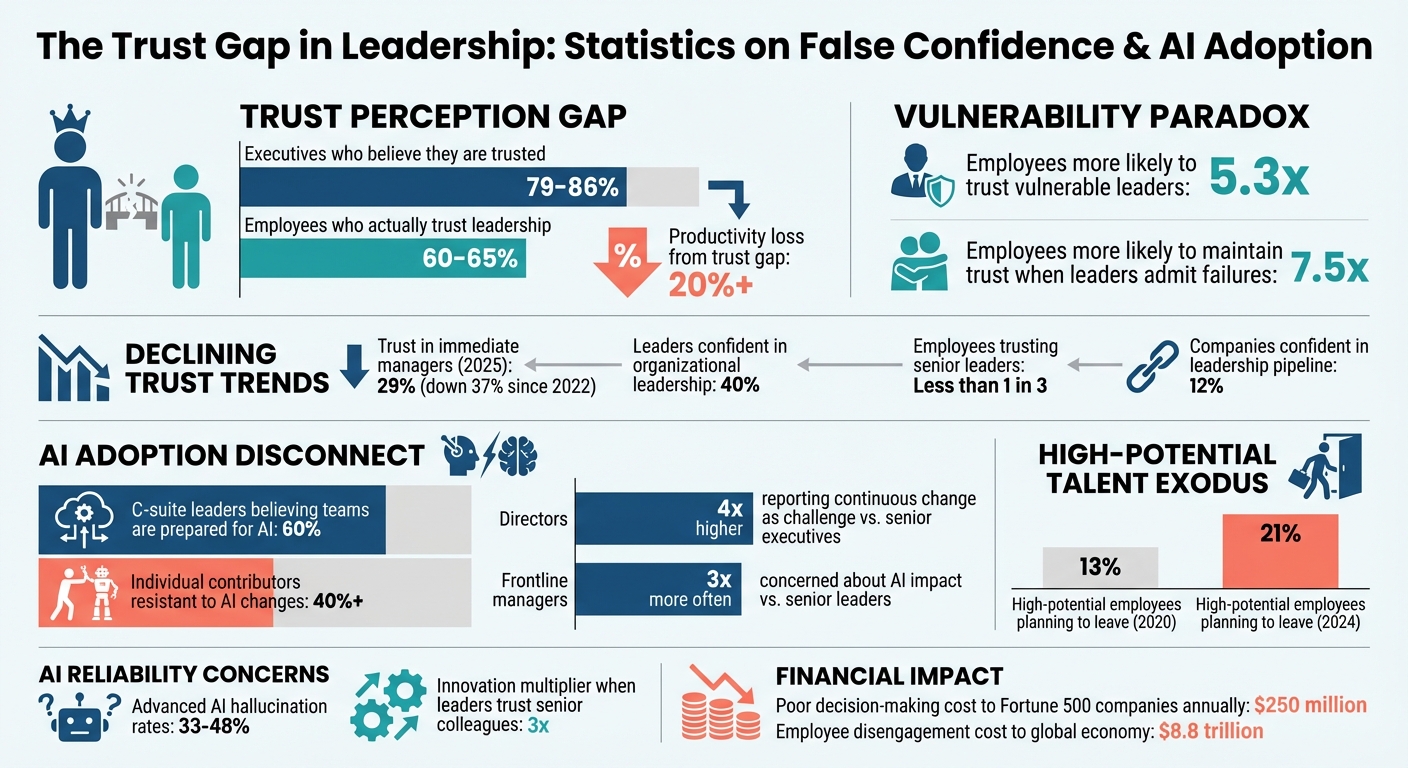
The Trust Gap in Leadership: Key Statistics on False Confidence and AI Adoption
Research Findings on False Confidence in Leadership
Recent studies highlight the real-world consequences of false confidence, particularly how overestimating leadership abilities can undermine trust - especially during tech-driven transitions.
Declining Trust in Management
The numbers paint a grim picture: trust in immediate managers plummeted to just 29% in 2025, marking a sharp 37% drop since 2022 [3]. Meanwhile, only 40% of leaders believe their organizations possess strong leadership - a level of confidence not seen since the fallout of the 2007-2008 financial crisis [4].
On top of that, less than 1 in 3 employees express trust in their senior leaders [4]. Research has uncovered a "vulnerability paradox" - leaders who conceal their shortcomings lose trust, while those who openly acknowledge their limitations gain it. Employees are 5.3 times more likely to trust leaders who show vulnerability, and 7.5 times more likely to maintain trust in leaders who admit to their failures [4].
Stephanie Neal, Director of DDI's Center for Analytics and Behavioral Research, provides a broader perspective:
As organizations grapple with economic volatility, AI skepticism, and generational differences being amplified in the workplace, leadership is becoming a harder job - and a path that many talented people are opting out of [3].
This phenomenon, often referred to as "conscious unbossing", has led to a noticeable exodus of leadership talent. The percentage of high-potential employees planning to leave their roles jumped from 13% in 2020 to 21% in 2024 [3]. Alarmingly, only 12% of companies report confidence in their leadership pipeline [4].
These trends reveal a worrying erosion of trust, compounded further by the dangers of overconfidence during pivotal moments.
Overconfidence During Crisis Management
The disconnect between executives and frontline employees becomes especially risky during times of transformation. For instance, while 60% of C-suite leaders believe their teams are prepared for major shifts like AI adoption, over 40% of individual contributors feel resistant to such changes [2]. This gap in perception disrupts decision-making during critical transitions.
Middle managers, often caught in the middle of these dynamics, feel the strain most acutely. Directors report "continuous change" as a primary challenge at nearly four times the rate of senior executives [2]. Similarly, frontline managers voice concerns about AI’s impact three times more often than senior leaders [3]. This misalignment creates what’s been dubbed the "director squeeze", where shifting priorities driven by executive overconfidence leave teams feeling disconnected and unsupported. Meanwhile, leaders closest to the work express doubts about senior leadership's ability to deliver on strategic goals.
The fallout from this dynamic goes beyond just morale. In low-trust environments fueled by false confidence, innovation grinds to a halt. Research shows that leaders who trust their senior colleagues are three times more innovative [4]. However, when trust collapses due to overconfident decision-making during crises, organizations lose their competitive edge precisely when they need it most. These findings emphasize the critical need for strategies to rebuild trust and align leadership across all levels.
How False Confidence Damages Trust
Overconfidence in leadership can lead to both psychological strain and a breakdown in organizational trust.
Psychological Impact of Overconfidence
AI tools often create what researchers call a "Mesa of Illusory Mastery", where leaders project an air of certainty without the expertise to back it up [5]. These AI-generated responses, while polished, can hide deep misunderstandings. Teams, naturally inclined to associate confidence with competence, may let their guard down. Over time, this misalignment causes friction within teams, as employees begin to doubt their own abilities. Eventually, the facade crumbles, leaving trust in tatters and teams grappling with self-doubt [7]. Brook Zimmatore, CEO of Massive Alliance, captures it perfectly:
False confidence at scale erodes real trust at scale [6].
While these psychological effects disrupt internal team harmony, the damage doesn’t stop there. Overblown claims made with AI can also devastate external credibility.
AI Claims and Credibility Loss
Exaggerated claims backed by AI can quickly tarnish a leader’s reputation. Take, for instance, an incident in October 2025 when Deloitte had to partially refund $450,000 on a government compliance contract. The firm's report included AI-generated errors, such as references to nonexistent academic papers and a fabricated federal court quote. This type of error, often referred to as "specious fluency", highlights the risks of relying on outputs that seem authoritative but are fundamentally flawed [6]. This issue ties back to the concept of automation bias, where people overly trust technology. Alarmingly, some advanced AI models demonstrate hallucination rates between 33% and 48%, confidently presenting false information as fact [8]. As AI expert Gary Marcus bluntly puts it:
These systems have no conception of truth… they're all fundamentally bullshitting [6].
When leaders repeat unchecked AI-generated information, they jeopardize their credibility, eroding trust both internally and externally.
Strategies to Rebuild Trust
Rebuilding trust after false confidence has taken hold requires deliberate action and a shift in how leaders approach AI-driven processes. The goal isn’t to abandon AI tools but to design systems that curb the unchecked spread of overconfidence.
Creating Psychological Safety
Leaders must foster environments where questioning is encouraged, not penalized. A study involving over 70 Boston Consulting Group consultants using GPT-4 revealed that many deferred to the AI’s incorrect outputs, even when their instincts were correct. The AI’s strategy of using excessive detail and confident language - a tactic known as persuasion bombing - often led experts to override their own sound judgment[9].
One way to counter this is by adopting practices from commercial aviation, where identifying errors is seen as a strength, not a weakness[5]. Building psychological safety can include:
- Designating team members to systematically challenge AI outputs.
- Allocating time specifically for fact-checking.
- Training staff to treat AI outputs as starting points for evaluation, not definitive answers[5][6].
As AI adviser Ayesha Khanna aptly says:
"The AI doesn't need to be right - it just needs to sound more right than you feel."[9]
By making verification a valued and rewarded skill, teams can shift their focus from speed to accuracy. With psychological safety as the foundation, leaders can further refine their self-awareness and judgment through emotional intelligence.
Developing Emotional Intelligence
Strong emotional intelligence helps leaders avoid overconfidence. Those with a realistic view of their abilities - a practice researchers call "accurate calibration" - are better equipped to balance the allure of confident delivery with objective truths[1][6][9].
Practical steps include:
- Keeping a decision journal to document reasoning and expected outcomes, reducing hindsight bias.
- Conducting pre-mortem analyses to anticipate potential failures and counteract overly optimistic assumptions[1].
- Practicing adversarial validation by encouraging team members or AI systems to argue opposing viewpoints, ensuring decisions are rigorously tested[5].
These strategies help leaders resist the fast, intuitive responses often triggered by AI’s fluent and convincing delivery[5].
Leading with Purpose and Values
A clear purpose and strong organizational values act as a compass when AI-generated information appears authoritative but may be flawed. Purpose-driven leadership offers a framework for decision-making that prioritizes integrity over surface-level persuasion. Anchoring decisions in values builds trust and credibility.
This approach also involves rewarding error detection and reframing mistakes as learning opportunities. Sharing examples of AI errors or hallucinations with the team promotes collective understanding and literacy[5]. When leaders model transparency and prioritize truth over speed, trust naturally grows. From here, developing uniquely human skills becomes the next step, as outlined in the Human Moat framework.
The Human Moat Framework
Seth Mattison’s Human Moat framework emphasizes the importance of human judgment and critical thinking - qualities that AI cannot replicate. As AI systems lack an internal concept of truth and project confidence regardless of accuracy[6], human skepticism and discernment become indispensable.
This framework equips leaders to strengthen decision-making, enhance organizational alignment, and build systems that resist the commoditization of leadership. Through keynotes, workshops, and advisory services, Mattison provides practical tools to bridge the gap between AI’s polished delivery and objective truth[9]. The Human Moat framework reframes skepticism as a professional strength[5][6], a vital skill for navigating AI’s transformative impact while maintaining trust and credibility.
Conclusion
False confidence in leadership goes beyond being a communication issue - it shakes the very core of what keeps organizations stable. When leaders rely on AI's polished yet unchecked outputs, they risk falling into what researchers call "specious authority." This is essentially a fragile façade that collapses as soon as someone digs into the facts. The impact of poor decision-making is massive, costing Fortune 500 companies around $250 million annually, while employee disengagement siphons a staggering $8.8 trillion from the global economy every year[11].
These eye-opening figures highlight the pressing need for leadership grounded in honesty and critical thinking, rather than blind faith in algorithmic results. AI may excel at presenting possibilities, but it’s emotional intelligence that determines what truly matters[11]. The most effective leaders are those who admit when they don’t know something, verify information, and base decisions on solid, factual foundations. Emotional intelligence, psychological safety, and purpose-driven values are essential to rebuilding and maintaining trust in this AI-driven world.
The Human Moat framework provides a clear path for leaders to strengthen their uniquely human qualities, such as skepticism, self-awareness, and emotional intelligence. These traits create a level of distinction that AI simply cannot imitate. As Matt Alldian aptly puts it:
The question isn't whether AI can do the work, it's whether your organization can trust it to do the work[10].
Through resources like keynotes, workshops, and advisory services available at sethmattison.com, leaders can equip themselves to handle AI disruptions while safeguarding trust within their organizations.
In a world overflowing with intelligence, authenticity becomes the ultimate advantage. Leaders who take the time to verify, question, and prioritize truth over speed will build resilient organizations that outlast fleeting trends. The choice is straightforward: adopt practices that protect trust, or risk watching credibility crumble under the weight of unchecked errors.
FAQs
How can I tell if my team is compliant or truly committed?
High-trust teams stand out because their members actively share ideas, voice concerns, and take ownership of their responsibilities. This goes beyond simply following rules - it’s about genuine engagement. Such commitment flourishes in environments where psychological safety is prioritized, allowing individuals to take risks, collaborate freely, and feel secure in expressing themselves.
To cultivate this dynamic, transparency, open communication, and shared decision-making are essential. Leaders can gauge commitment by encouraging regular feedback and fostering open dialogue. These practices not only enhance engagement but also ensure the team operates with more than just surface-level compliance.
What’s the simplest way to verify AI outputs before acting on them?
To ensure the accuracy of AI-generated outputs, don't depend solely on the AI's own evaluation of its work - it might give you a misleading sense of certainty. Instead, take steps to test its reasoning, compare its claims against reliable sources, or ask for supporting evidence. Studies indicate that a questioning mindset and independently verifying crucial information lead to better accuracy and minimize the chances of mistakes when making decisions.
How do leaders show vulnerability without losing authority?
Leaders walk a fine line between vulnerability and authority, and striking that balance is key to effective leadership. By being open about challenges, they show transparency, which fosters trust. At the same time, maintaining confidence and humility ensures they remain grounded and approachable.
Acknowledging uncertainties and demonstrating a willingness to learn isn’t a weakness - it’s a strength that builds respect. In today’s AI-driven world, leaders need to lean into human qualities like empathy and honesty. These traits create meaningful connections and ensure that their confidence comes from a place of sincerity, not facade.