
Articles Apr 28, 2026 9:00:00 AM Seth Mattison 21 min read

Workforce planning is evolving. Traditional methods focused on rigid roles and annual forecasts are no longer effective. With rapid AI advancements, shifting employee expectations, and market changes, businesses need flexible work models to stay competitive.
Key insights from the article include:
- Flexible work models focus on tasks and skills, not traditional roles, improving retention by up to 40% for women and 25% for men.
- These models include hybrid, remote, part-time, gig-based work, and job sharing, emphasizing outcomes over hours worked.
- Agile workforce planning reduces costs (e.g., Walmart cut labor costs by 15% in 2025) and addresses talent gaps faster than traditional hiring.
- Balancing permanent and contingent talent using frameworks like "Build, Buy, Borrow, Bot" ensures efficiency and scalability.
- Equity challenges, like proximity bias, must be addressed through outcome-based evaluations and fair policies.
Takeaways for leaders:
- Shift from annual workforce forecasts to continuous planning for real-time alignment.
- Blend permanent employees with freelancers and AI for a dynamic workforce.
- Create equitable policies to support diverse talent and minimize bias.
- Leverage technology for workforce analytics, collaboration, and retention strategies.
Flexible work models are no longer optional - they're essential for meeting modern workforce demands and staying relevant in a rapidly changing landscape.
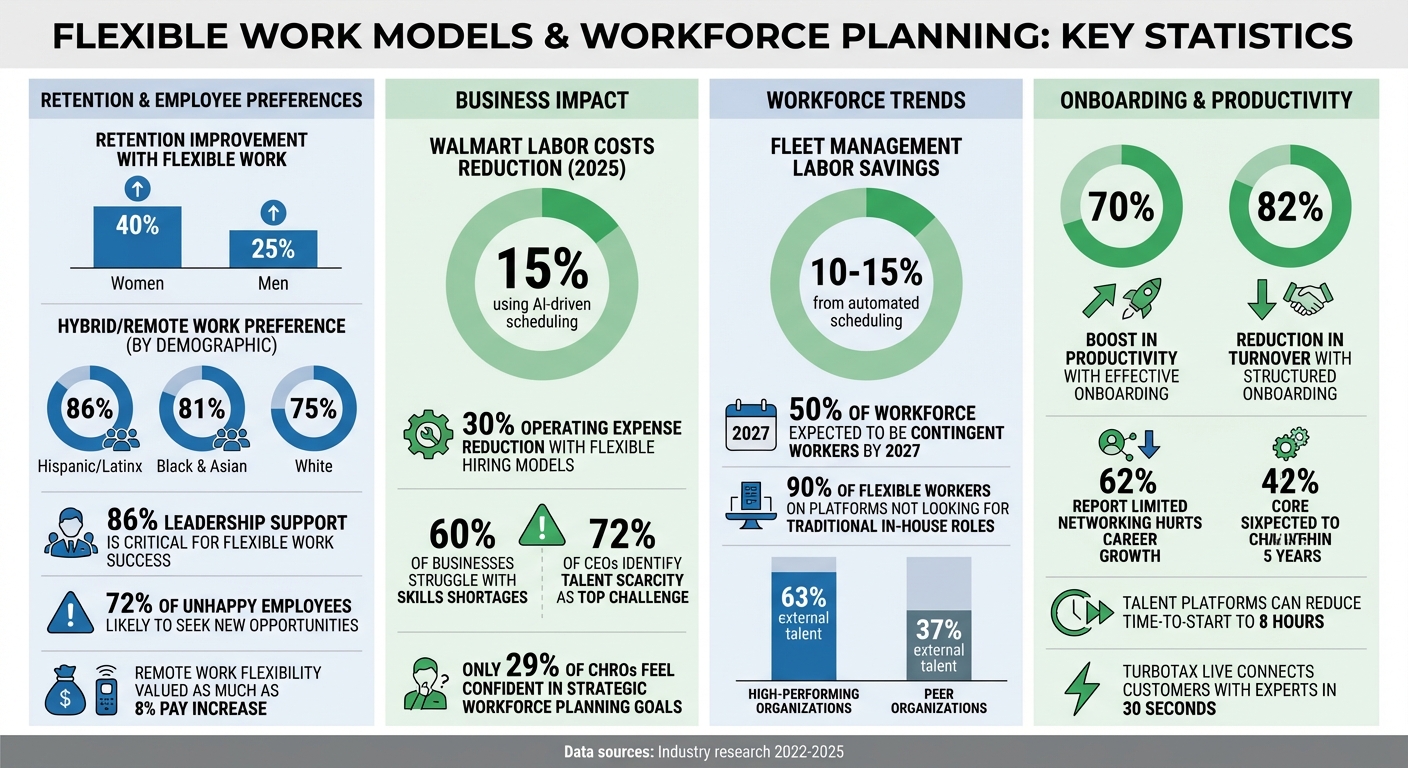
Key Statistics on Flexible Work Models and Workforce Planning Benefits
The Business Value of Agile Workforce Planning
Agile workforce planning brings measurable financial benefits while helping organizations stay adaptable in unpredictable markets. By moving away from static, annual workforce forecasts to a model of continuous, real-time resource alignment, companies can respond swiftly to market changes without overcommitting to permanent staffing. A great example of this is Walmart, which in 2025 used AI-driven tools to forecast staffing needs and optimize schedules. This approach led to a 15% reduction in labor costs while still maintaining high customer service standards [3]. Similarly, automated scheduling systems in fleet management have delivered labor cost savings of 10% to 15% [3]. These financial gains also allow businesses to strategically tap into specialized expertise exactly when it’s needed.
But it’s not just about cutting costs. Agile workforce planning helps organizations bridge critical talent gaps. With 60% of businesses struggling with skills shortages and 72% of CEOs identifying talent scarcity as a top challenge [1], having the ability to quickly access the right expertise is invaluable. By viewing their workforce as a dynamic, evolving ecosystem instead of a fixed headcount, companies can address skill shortages without the delays of traditional hiring processes.
Responding to Market Changes with Scalable Workforces
In today’s fast-paced markets, the ability to scale your workforce up or down quickly is essential. Rigid annual forecasting models simply can’t keep pace with the speed of change. Hewlett Packard Enterprise (HPE) tackled this challenge under Lindsey Taylor, Senior Director of Strategic Workforce Planning. By integrating workforce planning with organization design and people analytics, Taylor emphasized the importance of aligning organizational structure with workforce needs:
"The right shape of the organization, which is influenced by org design, is just as important as ensuring we have the right people in the right roles in the right time and place" [1].
Flexible staffing models make it easier for companies to handle seasonal demand surges, product launches, or unexpected disruptions without the financial strain of maintaining a large permanent workforce. Remote and hybrid work arrangements further enhance scalability by tapping into global talent pools. This allows businesses to provide round-the-clock service across different regions without needing additional office space [5]. In addition, flexible options like part-time schedules or flex-hours help retain key employees during economic slowdowns, ensuring a smoother recovery when markets improve [2]. This adaptability pairs well with agile access to specialized skills, which is explored further below.
Balancing Permanent and Contingent Talent
The most effective workforce strategies combine permanent employees with contingent workers. Many leading organizations now use a "Build, Buy, Borrow, Bot" framework to address their talent needs. This approach involves building skills internally, hiring full-time staff (buying), leveraging contractors or freelancers (borrowing), and using AI or automation (botting) to fill gaps efficiently [1]. This model ensures a stable core of permanent employees who uphold company culture, while also enabling flexibility through contingent talent and technology.
IBM has embraced this concept by implementing an AI-powered workforce planning system. This system analyzes digital footprints to assess employee skills and proficiency levels, creating a real-time snapshot of the workforce. With machine learning, IBM can make informed decisions about salaries and resource allocation, balancing permanent and contingent talent effectively [3]. By shifting from job-based to task-based planning, companies can assign the most appropriate resource - whether it’s a full-time employee, a contractor, or AI - to each task [1]. This detailed approach not only reduces costs but also allows organizations to adjust quickly as their needs change.
Experts like Seth Mattison highlight the importance of combining human insight with agile workforce strategies. This blend of human expertise and technology creates a competitive edge, ensuring businesses can adapt and thrive in a constantly evolving environment.
Building a Durable Talent Pipeline
Today’s leading organizations are rethinking how they manage talent, blending full-time employees with freelancers, gig workers, and alliance partners to create a flexible ecosystem [1][6]. This shift requires a new mindset - one that sees external workers not as temporary stopgaps but as key contributors who bring fresh ideas, share expertise, and enhance the skills of in-house teams [6]. A strong external talent pipeline supports agility, allowing businesses to adapt quickly to changing market demands.
Organizations that excel in agility are 1.6 times more likely to use freelancers to address skill shortages. Companies adopting flexible hiring models have also reported cutting operating expenses by 30% [6]. By focusing on external talent as part of their agile workforce strategy, these businesses ensure they have the right resources available when critical skills are needed.
Developing Relationships with Specialized Talent Platforms
When it comes to finding specialized talent, focusing on the problem you need solved rather than crafting detailed job descriptions can make all the difference. Talent platforms excel at vetting and matching candidates, often reducing the time-to-start to as little as eight hours [11].
Take Microsoft, for example. They expanded their freelance program and delivered a major enterprise product within a year [11]. Similarly, Intuit launched "TurboTax Live" in 2020, leveraging a flexible pool of vetted tax professionals. This allowed them to connect customers with experts in just 30 seconds, opening up new revenue streams [11].
Interestingly, most flexible workers - 90% on many platforms - aren’t looking for traditional, in-house roles, and half wouldn’t accept full-time positions, even with higher pay [11]. This highlights the importance of building strong partnerships with talent platforms. High-performing organizations are already prioritizing this approach, with 63% incorporating external talent into their workforce strategies compared to just 37% of their peers [6].
Streamlining Onboarding and Retention for Contract Talent
Once you’ve brought contingent workers on board, effective onboarding ensures they can hit the ground running. Start the process before their first day by sending welcome kits, necessary paperwork, and clear instructions about expectations. This approach not only reduces anxiety but also boosts productivity by 70% and lowers turnover by 82% [8][9].
Pairing contingent workers with permanent team mentors can help them adapt quickly to your company’s culture [7]. For instance, in 2022, ECI Solutions revamped its onboarding process for remote and hybrid staff under the leadership of Chief HR Officer Andrew Pryor. By introducing structured mentorship and digital onboarding tools, they saw an 11-point increase in employee satisfaction and improved retention rates [9].
Building long-term relationships with contract workers is equally important. Offer repeat assignments to top performers and maintain an alumni network for future projects [7]. Including contingent workers in team meetings, training sessions, and social events can strengthen their connection to your organization’s mission. Recognize their contributions with praise, awards, or bonuses - just as you would with full-time employees. With contingent workers expected to make up 50% of the workforce by 2027 [10], treating them as integral members of your team is no longer optional; it’s essential.
As Seth Mattison puts it, creating a "Human Moat" through a resilient and adaptable talent pipeline is crucial for maintaining a competitive edge in an era defined by AI and rapid change.
Creating Equity and Inclusion in Flexible Work Arrangements
Flexible work models offer freedom, but without careful planning, they can unintentionally create new inequalities. One major challenge is proximity bias, where employees working on-site are often viewed as higher performers than their remote colleagues, even when their output is the same. This bias can divide teams into "in-groups" and "out-groups", undermining collaboration and fairness [13]. To address this, companies need to move beyond default hybrid setups and implement thoughtful policies that promote fairness for all employees, no matter where they work.
This issue is particularly pressing in the U.S., where a greater proportion of Hispanic/Latinx (86%), Black, and Asian (81%) workers prefer hybrid or remote work compared to white workers (75%) [14]. Without fair policies, proximity bias can disproportionately harm underrepresented groups, contributing to a higher likelihood of job dissatisfaction and turnover - 72% of unhappy employees are likely to seek new opportunities [14]. Ensuring equity in flexible work arrangements isn't just about doing the right thing; it's also critical for retaining talent and maintaining a competitive edge.
Designing Policies for Fair and Equitable Flexibility
The cornerstone of equitable flexibility lies in outcome-based evaluation. Samantha van Putten from Flexwhere explains it well:
"When success is defined by measurable output, it becomes irrelevant where the work was done" [13].
By standardizing performance assessments to focus on results rather than visibility, organizations can minimize unconscious bias and reduce the pressure for unnecessary in-person presence.
Regular DEI audits are another essential step. These can include employee engagement surveys, representation data, and exit interviews to identify which groups may be negatively affected by current practices [12]. Additionally, providing technology resources - like Wi-Fi boosters, extra monitors, and inclusive software - ensures all employees, regardless of their work environment, have equal tools to succeed [12].
Flexible work arrangements also play a role in addressing the gender wage gap, particularly by supporting caregivers - who are often women - in balancing their careers and personal responsibilities [12]. Research even suggests that employees value remote work flexibility as much as an 8% pay increase [12].
To further promote equity, adopt a "digital-first" communication strategy. Ban informal "hallway decisions" and require all significant updates and action items to be documented in shared platforms like Slack or Teams [13]. This ensures remote workers have equal access to critical information. Den Mondejar, a Marketing Professional at Aquent, highlights the importance of this approach:
"Genuine flexible work is the key to equity and inclusion" [12].
By implementing these strategies, organizations can create a more inclusive environment while also laying the groundwork for a more adaptable workforce.
Strengthening Collaboration Across Dispersed Teams
Equitable policies are just the beginning - effective collaboration is key to ensuring fairness across hybrid and remote teams. One effective approach is the "one-in, all-in" meeting policy: if one team member joins a meeting remotely, everyone should participate from their own device to maintain equal representation on video screens [15]. Leaders should also prioritize engaging remote participants first in hybrid meetings, using tools like hand-raising features, polls, and Q&A sessions to make sure their input is heard [13][15].
To further support remote workers, use digital workplace tools that provide "inclusive visibility." For example, interactive floor plans and status integrations can make remote employees as accessible as their on-site counterparts [13]. Capacity boards and project tracking tools can also help distribute tasks fairly across teams, ensuring workloads are balanced [12]. Prasad Setty, VP of Digital Work Experience at Google Workspace, sums it up:
"The location from which you participate shouldn't influence your outcome" [15].
Networking opportunities are another area requiring attention. With 62% of employees reporting that limited networking opportunities hurt their career growth [15], leaders must actively create ways to connect. Virtual coffee chats, cross-functional projects, and inclusive social events can help bridge physical distances and build a sense of psychological safety for everyone on the team.
Using Technology for Effective Workforce Management
As flexible work models continue to reshape how organizations plan their workforce, technology has become a cornerstone in managing these changes. It provides the tools needed to oversee dispersed teams, offering real-time insights into tasks, skill gaps, and resource allocation. With nearly 70% of companies now offering some form of hybrid work or flexibility [4], the organizations that thrive are those that embed hybrid work into their operational strategies rather than treating it as a temporary perk. This technological backbone supports the agile workforce planning methods discussed earlier.
HR Systems for Workforce Analytics and Insights
Modern HR systems are no longer just about tracking employee numbers - they now provide critical insights that drive smarter workforce decisions. Skills intelligence platforms, for instance, are steering companies away from static job descriptions toward a more dynamic, skills-based planning approach. A great example of this is IBM, which uses AI to analyze data from employees' work activities. This allows the company to assess skills and proficiency levels, creating a baseline that informs salary decisions and future workforce strategies [3]. This method helps organizations identify skill gaps early and address them before they become major obstacles.
AI-powered "what-if" simulations are another valuable tool, helping businesses evaluate the potential impact of changes like turnover spikes or budget reductions. Lindsey Taylor, Senior Director of Strategic Workforce Planning at Hewlett Packard Enterprise, highlighted the importance of this kind of integrated approach:
"We needed to influence structural changes, too. The right shape of the organization, which is influenced by org design, is just as important as ensuring we have the right people in the right roles in the right time and place" [1].
Predictive analytics also plays a crucial role in retention strategies. For example, AI-driven dashboards can flag high-potential employees who may be at risk of leaving within the next 90 days. This allows companies to take proactive steps, such as offering internal mobility opportunities or targeted development programs [19]. This is particularly critical in a time when 44% of workers' core skills are expected to change within the next five years due to advancements in AI and digital transformation [18]. These systems ensure that workforce planning remains responsive to shifting business needs. While HR systems provide strategic insights, collaboration tools help maintain operational connectivity for remote and hybrid teams.
Collaboration Tools for Hybrid and Remote Teams
Collaboration tools, when integrated with platforms like Slack and Microsoft Teams, play a vital role in keeping remote teams connected. These integrations reduce friction and help avoid the overwhelm that can come from juggling too many tools [4].
A notable example is the Canada Mortgage and Housing Corporation, which transitioned to a Results-Only Work Environment (ROWE) by 2019. This shift gave employees the flexibility to work whenever and wherever they needed. Stéphane Poulin, Director of Human Resources Operations, shared the impact:
"People were hesitant at first, but now we see that morale is up, employees are more engaged, and the stress associated with finding a work-life balance has decreased significantly" [17].
One effective practice is establishing core hours - specific times when all team members are online and available. This simplifies scheduling and ensures team alignment across different time zones [17]. Additionally, smart office systems, such as hot-desk and meeting room booking tools integrated into chat apps, ensure that physical office spaces remain valuable resources for hybrid employees [4]. AI tools can also monitor workload patterns, flagging early signs of burnout or disengagement before they impact performance [16].
Even with the rise of automated AI tools for scheduling and resource management, human oversight remains critical. Strong cybersecurity measures are also essential to ensure that decisions align with company values and that sensitive data is protected across all locations [3][4].
Conclusion: Rethinking Workforce Planning for the Future
The move from traditional workforce planning to flexible work models isn't just about accommodating remote work - it’s about building resilience in a market that’s constantly shifting. Consider this: only 29% of CHROs feel confident in their strategic workforce planning goals, and 60% of businesses report skills gaps that are slowing down transformation efforts [1]. The pressure is on. Companies that embrace flexibility as a strategic tool are setting themselves up to navigate uncertainty more effectively. This urgency makes adopting dynamic workforce strategies non-negotiable.
Instead of relying on outdated annual headcount forecasts, businesses are shifting toward continuous "workforce shaping" that adapts to real-time market demands. Lindsey Taylor from Hewlett Packard Enterprise highlights that reshaping organizational structures is just as important as ensuring the right people are in the right roles at the right time [1].
While technology is a critical enabler in this shift, it’s the human element that truly sets companies apart. AI might handle tasks like scheduling or predicting attrition, but leadership support remains a key driver of success. In fact, 86% of employees cite leadership backing as the most important factor when adopting flexible work arrangements [2]. And the benefits are clear: organizations offering meaningful flexibility see retention rates improve by 25% for men and 40% for women [2].
Seth Mattison emphasizes that in an era dominated by AI, the real edge comes from cultivating a "Human Moat" - focusing on human skills that foster trust, differentiation, and sustained success.
To ensure long-term resilience and growth, companies must align flexible work models with strategic planning. By blending technology with human-centered practices, leaders can build stronger, more adaptable teams.
Key Takeaways for Leaders
- Segment your workforce, avoiding a one-size-fits-all approach. Different departments may need varying planning speeds depending on their growth rates and AI integration levels [1]. Use employee feedback to create tailored options like Results-Only Work Environments, job sharing, or compressed workweeks to suit diverse roles and career stages.
- Design for resilience, not maximum utilization. Build in capacity for continuous learning and adaptability, allowing your workforce to absorb shocks and pivot during disruptions [1]. Share workforce analytics across departments like Finance, IT, and Procurement to ensure talent strategies align with overall business goals.
- Appoint a "flex champion." Task a senior leader with normalizing flexible career paths and sharing success stories. This visible support helps employees see flexibility as a career-enhancing option, not a dead end.
FAQs
How can I shift from role-based to skills-based workforce planning?
To transition into skills-based workforce planning, the focus needs to move away from traditional job roles and center on skills. Begin by evaluating the skills your workforce currently possesses, pinpointing any gaps, and updating metrics to emphasize skills and measurable outcomes. Shift hiring and development practices to prioritize specific skills rather than predefined roles. Additionally, use analytics to track progress and refine your strategies as needed. This approach ensures your workforce is prepared to meet future business demands and adapt to technological advancements.
What’s the best way to balance full-time staff, contractors, and AI?
To create a well-rounded and effective workforce, businesses should blend full-time staff, contractors, and AI in a way that plays to each group’s strengths. Let AI handle repetitive, data-intensive tasks, assign contractors to short-term projects requiring specialized expertise, and rely on full-time employees for strategic planning and creative problem-solving. This combination allows companies to stay flexible, scale operations efficiently, boost productivity, and channel human talent into high-impact areas in today’s fast-changing market.
How can we prevent proximity bias in hybrid work?
Preventing proximity bias in a hybrid work environment means creating fair policies and fostering inclusivity. Start by using clear, objective criteria for evaluating performance and assigning projects, ensuring decisions are based on merit rather than physical presence. Promote inclusive communication by rotating meeting roles and actively encouraging participation from remote team members.
Take advantage of technology to spot any disparities in treatment or opportunities, and provide training to help teams recognize and address unconscious bias. These strategies ensure that all employees - whether they work remotely or in the office - receive equal treatment and feel equally supported.