
Articles Apr 18, 2026 9:00:00 AM Seth Mattison 20 min read

In a world where AI handles tasks faster and cheaper, the real edge isn’t what you produce but the principles guiding your decisions. A "Human Moat" is the space where human judgment, responsibility, and trust remain irreplaceable. Values are now critical - they shape decisions, build trust, and create loyalty that AI alone can’t replicate. Companies like Costco and Patagonia prove that aligning actions with values leads to long-term success.
Key Takeaways:
- AI changes competition: Judgment and accountability matter more than execution.
- Values build trust: Trust is the hardest advantage to copy.
- Real examples: Patagonia’s environmental commitment and Costco’s pricing strategy show how values drive loyalty.
- Practical steps: Define, embed, and measure values across hiring, operations, and rewards.
Leaders who prioritize values over short-term gains will thrive in an AI-driven landscape.
How Values Create Competitive Advantage
How AI Changes Traditional Differentiators
AI has reshaped the way businesses create value. Long-standing advantages like proprietary data and specialized expertise are no longer as effective, especially when AI can cut content creation costs by up to 80% [4]. The focus has shifted from keeping competitors out to answering a more critical question: Why would someone choose to stay? [4]. With AI capable of drafting legal briefs, analyzing financial data, or generating marketing campaigns almost instantly, simply being competent is no longer enough. The real challenge now lies in exercising judgment - deciding what truly matters and why [3].
This shift pushes companies to operate on a higher plane. Mark Esposito, Chief Economist at micro1, explains:
"The more capable AI systems become, the more strategically important human judgment is, not less" [5].
In this new landscape, businesses can’t rely solely on what they produce to stand out. Instead, they must lean on their core values and the trust they cultivate over time. Embedding these values into their operations is no longer just about ethics - it’s a strategic necessity.
Using Values to Stand Out
When organizations integrate their values into everything they do, they create advantages that are difficult, if not impossible, for competitors to copy. A great example is Costco. Since 1985, the company has kept its iconic hot dog and soda combo priced at $1.50, even though inflation suggests the price should now be around $4.00. Co-founder Jim Sinegal insisted on maintaining this pricing to uphold customer trust, even at the expense of short-term profits. Costco also pays its warehouse workers about $24 per hour - double the industry average. These decisions have led to a 90% membership renewal rate and lower employee turnover costs [4].
Patagonia offers another compelling case. In September 2022, founder Yvon Chouinard transferred his $3 billion ownership stake to an environmental trust, ensuring all future profits would fund climate action. This bold move capped decades of environmental commitment, including the famous 2011 "Don't Buy This Jacket" campaign. Today, Patagonia generates over $1.5 billion in annual revenue and enjoys unmatched brand loyalty. These examples highlight a key truth: in a world dominated by technology, human-driven values are what build lasting loyalty.
"The moat of the future isn't your tech stack, your patents, or your capital efficiency. It's your customers. Your community. Your credibility. Not as transactions, but as believers." - Curiouser.AI [4].
Trust and Coherence as Business Assets
These examples point to a larger principle: trust and coherence are critical assets in today’s business world. While 93% of U.S. business leaders agree that trust positively impacts financial performance, there’s a striking gap in perception. While 90% of executives believe their companies are trusted by customers, only 30% of consumers feel the same way [7]. This gap creates opportunities for businesses that align their actions with their stated values.
Trust directly influences performance. For instance, 22% of employees leave jobs due to trust issues, while 60% recommend employers they trust [7]. High-trust environments lower friction - teams work more efficiently, customers remain loyal, and suppliers deepen their commitments. In a world where AI takes care of execution, coherence - being consistent and unified in purpose - becomes a unique strength that generic AI systems can’t replicate [6]. Businesses don’t gain credibility by being flawless; they earn it by being consistent [7].
sbb-itb-9ceb23a
Frameworks for Building a Values-Driven Human Moat
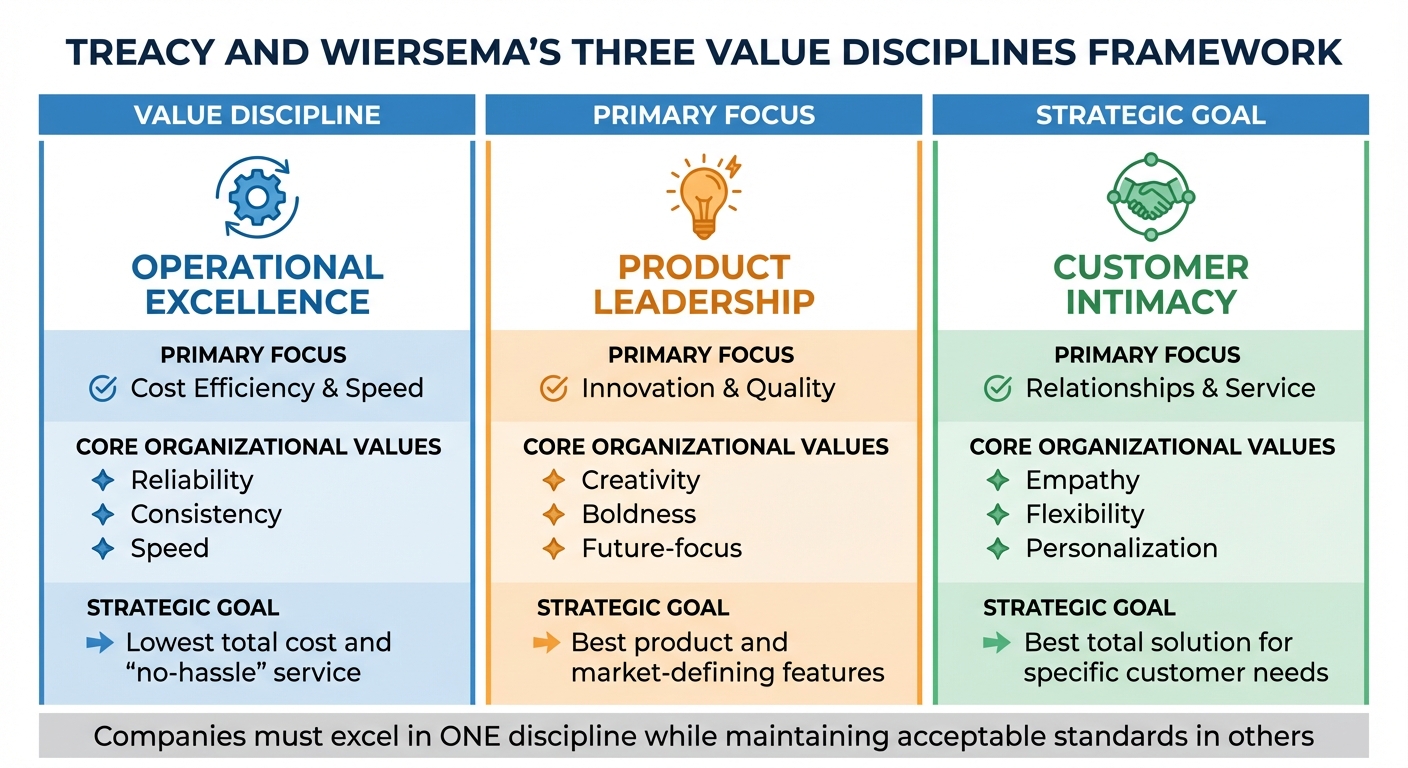
Treacy and Wiersema's Three Value Disciplines Framework
Using Treacy and Wiersema's Value Disciplines
Treacy and Wiersema's value disciplines offer a way for companies to stand out while forming the backbone of a Human Moat. To lead in the market, a company must focus its strategy, culture, and operations on one primary value discipline while maintaining acceptable standards in the others [8]. Here’s a breakdown:
- Operational excellence revolves around delivering products or services at the lowest total cost with minimal hassle. This requires values like efficiency, reliability, and streamlined logistics.
- Customer intimacy emphasizes tailoring products or services to meet specific customer needs. It thrives on values such as empathy, relationship-building, and fostering long-term loyalty.
- Product leadership prioritizes continuous innovation and being first to market with standout offerings. Values like creativity, bold thinking, and a willingness to take risks drive this discipline [8].
The most successful companies embed their chosen discipline so deeply into their identity that competitors struggle to replicate it [8]. A big part of this success comes from clarity - knowing not just what the company stands for, but also what it doesn’t. As Vinci Advisors puts it:
"Leaders know who they are and who they are not" [8].
Trying to excel in all three disciplines at once often leads to diluted efforts and a weaker competitive edge [8][9]. In today’s AI-driven world, where advantages like scale or proprietary data are becoming less distinct, human-centric values and ingrained workflows are emerging as new forms of defense [10]. This framework gives leaders a foundation to strengthen trust and accountability in their organizations.
| Value Discipline | Primary Focus | Core Organizational Values | Strategic Goal |
|---|---|---|---|
| Operational Excellence | Cost Efficiency & Speed | Reliability, Consistency, Speed | Lowest total cost and "no-hassle" service |
| Product Leadership | Innovation & Quality | Creativity, Boldness, Future-focus | Best product and market-defining features |
| Customer Intimacy | Relationships & Service | Empathy, Flexibility, Personalization | Best total solution for specific customer needs |
Leading at the Top of the Value Stack
Once a company has structured itself around a value discipline, leaders must take it a step further by focusing on uniquely human strengths. This approach helps build a solid Human Moat, especially in a world where AI is reshaping traditional competitive advantages. Leaders need to highlight human traits - like empathy, creativity, and adaptability - in their decision-making processes. They must also avoid the "speed trap", where AI-driven decisions outpace human oversight, potentially leading to unchecked algorithmic outcomes [10].
While workers skilled in AI earn a 56% wage premium [10], technical skills alone won’t suffice. Leaders should encourage human development by rewarding behaviors like knowledge-sharing and mentorship, rather than focusing solely on technical precision [10]. Additionally, brands can feel more relatable by being transparent - sharing insights openly, admitting when they don’t have all the answers, and staying visible. Visionik captures this idea perfectly:
"Trust is the one thing AI can't manufacture and competitors can't copy" [2].
Ultimately, the companies that succeed are those that prioritize human relationships over technology [2].
Embedding Values Across Your Organization
Defining Your Core Values
Building a strong "Human Moat" begins with understanding the values that naturally shape your organization's behavior. Often, these values already exist, even if they haven’t been formally outlined. To uncover them, talk to key stakeholders - founders, employees, and even customers. Ask questions like, “Who are we when we’re at our best?” or “What five to seven words capture our essence right now?” This process highlights the values already in action, rather than imposing abstract ideals that feel out of touch. These insights provide a foundation for weaving values into daily operations.
Once patterns emerge, compare them to your mission and vision. The values you promote should align with your organization’s purpose. Keep the list short - three to seven values - so employees can use them as a clear guide for tough decisions. Pernille Hippe Brun, CEO of Session, explains:
"Company values are: what you value and believe will best help and guide you on your journey towards success - as a company." [11]
Steer clear of vague terms like "integrity" or "respect." Instead, define each value with specific behaviors. For example, if "respect" is a value, clarify it with actionable examples like "Be mindful of others’ time" (a "do") and "Do not talk down to others" (a "don’t"). This level of clarity is critical, especially since only 23% of U.S. employees strongly agree they can apply their organization’s values in daily work [11]. Once defined, these values should influence every decision and process across the company.
Putting Values Into Practice
Values only hold meaning when they shape real-world actions. Start by embedding them into your hiring process. Tailor interview questions to explore how candidates’ past experiences align with your core principles. Ask candidates to share their personal values to see how well they match your organization’s culture.
Incorporate values into performance reviews by creating specific KPIs tied to behaviors that reflect those values. For instance, if innovation is a key principle, track efforts like testing new ideas or learning from mistakes. Recognition programs can also reinforce these behaviors. Take inspiration from companies like Capital One, which uses Spot Awards to reward employees with points redeemable for gifts or cash, or Wegmans, where senior leaders send personalized thank-you notes and offer public recognition [13].
The ultimate test of a values-driven culture comes when short-term gains clash with core principles. Leaders need to stand firm, even if it means addressing bad behavior or parting ways with high performers who undermine company values. As Sesheeka Selvaratnam puts it:
"Culture is the behavior you reward and punish." [12]
Consider the example of Brains, a creative agency. Initially, only 72% of employees felt positive about the company’s community giving efforts. After adjusting its approach to reflect employee-suggested values, pride in the company rose by 13 points [13]. To ensure these practices resonate across the organization, systematic training and storytelling are essential.
Scaling Values Through Training and Advisory
Once values are integrated into hiring and performance processes, scale their impact through training and advisory efforts. Use scenario-based training to help employees navigate real workplace challenges while reflecting on how values apply. For instance, Mastercard offers communication workshops for leaders, focusing on authentic connections and managing difficult conversations [13].
Encourage leaders to share personal stories about times they upheld a value, even when it was difficult. Rituals like team discussions, internal podcasts, or storytelling forums can make these principles more relatable and memorable.
For organizations aiming to build a "Human Moat" in the era of AI, workshops and advisory services provide structured support for embedding values at scale. These programs help leaders refine their decision-making and ensure that values become a lasting competitive advantage - not just abstract statements on a wall.
Measuring and Maintaining a Values-Driven Human Moat
Metrics for Values-Driven Performance
To maintain a values-driven approach, it’s important to measure both financial outcomes and indicators focused on people. For example, tracking employee retention, promotions, and sentiment through pulse surveys can reveal how well your organization supports its workforce. Data shows that companies excelling in workforce treatment achieve a 2.2% higher five-year return on equity [15]. Similarly, the Fortune 100 Best Companies to Work For® outperform market averages by 3.68× [13].
While financial metrics like five-year return on equity (ROE) and client renewal rates (top performers achieve over 98% [16]) provide one perspective, human-centered metrics offer another. These include measuring how quickly employees acquire new skills, progress toward pay equity, and trends in employee health [15]. Together, these metrics provide a fuller picture of whether your organization is nurturing its people or pushing them too hard.
In March 2024, Genpact introduced an innovative AI chatbot to gauge workforce sentiment in real time, producing a "mood score." This score directly influences 10% of bonuses for the company’s top 150 leaders, including the CEO [15]. Similarly, Mastercard ties employee bonuses to goals like carbon neutrality, financial inclusion, and gender pay parity [15]. These examples highlight how linking compensation to values can drive accountability.
Despite 80% of organizations defining core values, only 25% actively measure their application [14]. Bridging this gap involves tracking behavioral alignment - the consistency between stated values and what is actually rewarded. Gabriel Sander, Head of Human Resources at Cuervo, underscores this point:
"Companies can't offer you employment forever, but they should make you employable forever." [15]
By measuring and acting on results, organizations can reinforce their commitment to core values.
Building a Self-Reinforcing Cycle
Tracking values-driven metrics doesn’t just measure success - it creates a cycle of trust and performance. When values lead to visible results, they gain credibility. Employees trust these values more deeply when they see leaders make tough decisions based on principles, even at a short-term cost. This trust drives better decision-making, which leads to stronger outcomes, further validating the organization’s values. Over time, this creates a self-reinforcing cycle that strengthens your Human Moat [14].
Closing the feedback loop is critical. Seth Willis, Business Advisor at Great Place To Work, explains:
"Remember, you build trust by not only gathering feedback, but by telling your people what you'll do, when you'll do it, and how it's going." [13]
Take Wellstar Health System as an example. Using Trust Index™ Survey data, they identified a gap between their mission of care and employee concerns about physical safety. Leadership responded with targeted investments in safety protocols, which reduced turnover and improved patient satisfaction [13]. This transparent action strengthened the connection between their values and employees’ daily experiences.
It’s also crucial to align systems with values. Audit your bonus structures, promotion criteria, and recognition programs. If you emphasize collaboration but reward only individual achievements, you risk undermining your culture [13]. Ensure your systems encourage the behaviors you want to see.
Updating Values Over Time
As metrics and feedback reveal performance trends, it’s essential to refine your values. Values aren’t fixed - they must adapt as your organization evolves and markets change. What worked five years ago may not be effective tomorrow. In today’s AI-driven world, domain knowledge is becoming less of a differentiator. The Human Moat now lies in distinctly human abilities like ethical judgment, relationship-building, and contextual understanding [17].
Revisit your values annually through employee surveys, exit interviews, and leadership discussions. Look for patterns that signal misalignment, such as employees leaving due to perceived inconsistencies in promotions or customers noticing gaps between your stated principles and their experiences. These insights highlight areas where your values may need to evolve.
Consider the example of Thomson Reuters. When its stock dropped in February 2026 amid fears of AI competition, CEO Steve Hasker reassured stakeholders during a Q4 earnings call. He emphasized the company’s focus on "trusted content" and "editorial oversight" as advantages that general AI couldn’t replicate [16]. This demonstrates how leaders can articulate their values to reinforce resilience during disruptive times.
Refining values means adapting behaviors to reflect enduring principles in changing contexts. As Venkat Peri, an engineering leader, notes:
"The professionals who thrive will be those who develop their uniquely human capabilities rather than compete with AI in knowledge retrieval and recall." [17]
Conclusion: Using Values to Build Long-Term Advantage
How Leaders Sustain Values
Values become a lasting Human Moat only when leaders treat them as foundational - woven into compensation systems, product design, and capital allocation - rather than as superficial branding. Stephen Klein, Founder and CEO of Curiouser.AI, puts it this way:
"The moat of the future isn't your tech stack, your patents, or your capital efficiency. It's your customers. Your community. Your credibility. Not as transactions, but as believers." [4]
Leaders sustain these values by willingly adopting strategic constraints. Examples like honoring long-standing pricing promises or placing company ownership into environmental trusts show how such decisions create a unique competitive edge. These self-imposed limitations are nearly impossible for competitors to duplicate because they’re embedded deeply within the organization’s structure [4].
In today’s AI-driven world - where content production costs have dropped by 80% and tools like GitHub Copilot write nearly half of committed code [4] - trust emerges as the only asset that cannot be copied. Leaders build this trust by consistently demonstrating accountability, making transparent trade-offs, and aligning actions with stated values. While AI can simulate competence, it cannot replace accountability. Ultimately, human authority and judgment remain the defining differentiators [1].
By adhering to these principles, leaders can take meaningful, practical steps to integrate and sustain values across all aspects of their organizations.
Next Steps for Leaders
Start by evaluating your organization's values to ensure they drive real trade-offs. If a value hasn’t led to difficult decisions - like sacrificing revenue, speed, or efficiency - it’s likely more of a marketing statement than a true competitive advantage [4]. Identify areas where your organization is willing to accept constraints to uphold its principles, and embed these into visible systems, such as compensation policies, promotion criteria, and product strategies.
As AI takes over more routine tasks, shift organizational focus toward roles that emphasize judgment. The competitive edge now lies in determining what truly matters, recognizing quality, and taking full accountability for outcomes [3]. Invest in developing skills for oversight - like auditing, explaining, and ethically evaluating AI-generated outputs - especially in high-stakes situations. This ensures human judgment remains at the core [1].
Finally, revisit your values regularly. Use tools like employee surveys, exit interviews, and leadership discussions to assess whether behaviors still align with your principles. While core values should remain steady, the ways they’re expressed may need to evolve as markets shift and AI transforms industries. Organizations that treat values as structural necessities - not optional extras - will build lasting trust, differentiation, and resilience. In a world where intelligence is abundant, sound judgment and unwavering principles are the true enduring advantages.
FAQs
What is a “Human Moat”?
In an AI-driven world, a "Human Moat" refers to the distinctly human qualities that organizations can tap into to maintain their edge and thrive. While AI excels at automating tasks like writing reports or analyzing contracts, the real advantage lies in leveraging human traits such as judgment, accountability, creativity, and cultural understanding - qualities that AI struggles to replicate. These attributes not only foster trust and resilience but also set organizations apart, creating a lasting strategic advantage.
How do we turn values into daily decisions?
Making values a part of daily decisions means weaving them into routines and how choices are made. It’s about ensuring that actions and behaviors consistently reflect the organization's core principles. To make this happen, companies can:
- Define values clearly: Be specific about what the organization stands for, so there’s no ambiguity.
- Create decision-making frameworks: Use these frameworks to ensure every choice aligns with the stated values.
- Encourage leadership to lead by example: Leaders who embody these values set the tone for everyone else.
Additionally, tying values to performance metrics and accountability systems helps solidify their influence, ensuring they remain central to everyday operations and interactions.
How can we measure whether our values are real?
To figure out if your values are real and not just words on paper, take a close look at how often they guide actions and decisions throughout your organization. Tools like value alignment surveys or cultural audits can be useful for this. They help measure how well your values show up in everyday operations and decision-making processes. These insights can reveal whether your values are deeply rooted in your company culture or need more attention.