
Articles May 11, 2026 9:00:00 AM Seth Mattison 14 min read

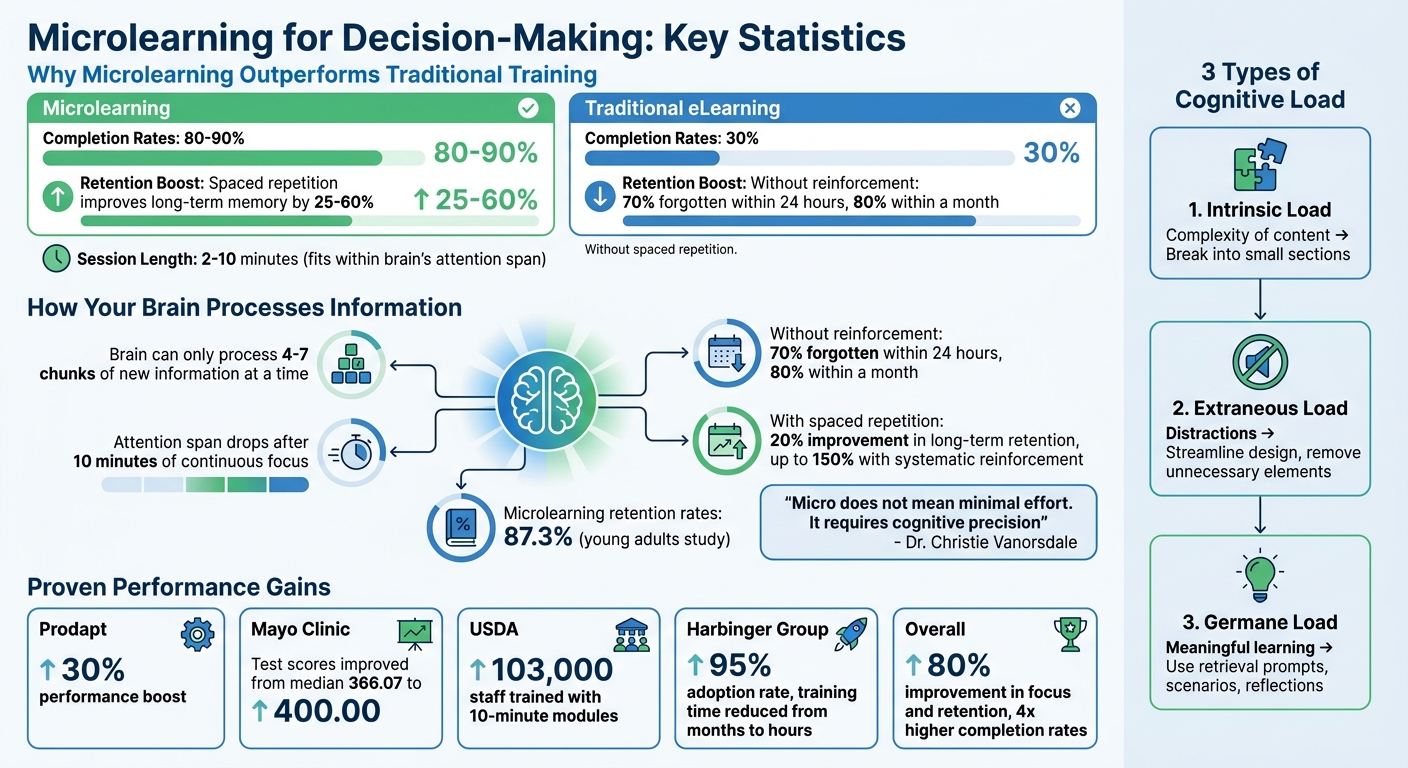
Microlearning simplifies professional development by breaking lessons into short, focused sessions (2–10 minutes). This approach aligns with how our brains work - processing only 4–7 pieces of new information at a time - and combats the forgetting curve through spaced repetition. The result? Higher retention, better decision-making, and improved leadership skills.
Key takeaways:
- Completion rates: 80–90%, compared to 30% for traditional eLearning.
- Retention boost: Spaced repetition improves long-term memory by 25–60%.
- Brain-friendly: Sessions fit within the brain's attention span (10 minutes max).
- Real results: Examples include a 30% performance boost at Prodapt and improved decision-making at the USDA.
Microlearning works because it delivers practical, actionable insights tailored to immediate needs, making it ideal for leaders and teams in fast-paced environments.
How Microlearning Affects the Brain
The human brain can only manage four to seven "chunks" of new information at a time [2]. Jonathan M. Pham from ITD World explains it well:
The human brain can effectively process only about four to seven 'chunks' of new information at any given time. ... Their working memory acts like a sponge that can hold no more water; any additional information simply spills away [2].
This limitation is why traditional hour-long training sessions often fall short. When the brain's capacity is exceeded, the extra information doesn’t stick - it simply gets discarded. Microlearning works within these natural boundaries by breaking down concepts into manageable pieces, giving each piece the focus it needs to be retained.
Cognitive Load Theory and Microlearning
Not all mental effort is created equally. John Sweller’s Cognitive Load Theory outlines three types of mental load that the brain handles during learning [2][5]:
| Cognitive Load Type | Definition | Microlearning Strategy |
|---|---|---|
| Intrinsic | Effort needed to grasp complex content | Breaking material into small, clear sections [5] |
| Extraneous | Effort spent on distractions or irrelevant details | Streamlining design, removing unnecessary elements, and keeping tasks focused [5][6] |
| Germane | Effort used for meaningful learning and building mental frameworks | Incorporating exercises like retrieval prompts, scenarios, and reflections [5] |
Microlearning eliminates distractions (extraneous load) while encouraging deeper learning (germane load) [5][7]. Dr. Christie Vanorsdale, a Learning Systems Architect, highlights the importance of this approach:
Micro does not mean minimal effort. It requires cognitive precision [5].
Additionally, research shows that the brain's attention span starts to drop after about 10 minutes of continuous focus [8]. Microlearning modules, which typically last 2 to 10 minutes, finish before this decline, ensuring learners stay engaged and absorb information when their minds are most alert [2][8]. This efficiency is especially important for leaders who need to make quick, informed decisions.
Memory Retention and Brain Science
Without reinforcement, people forget 70% of new information within 24 hours and 80% within a month [2][8]. This "forgetting curve" explains why one-off training sessions often fail to create lasting knowledge.
Microlearning tackles this issue through spaced repetition, which involves multiple short sessions instead of one long cram. This method forces the brain to repeatedly recall information, transferring it from short-term to long-term memory. The impact is impressive: spaced practice improves long-term retention by about 20%, and systematic reinforcement can boost it by up to 150% [8].
Using active recall techniques like quizzes and scenarios strengthens neural pathways far more effectively than passive review. One study found that young adults using microlearning methods achieved retention rates as high as 87.3% [8], far surpassing traditional learning formats. When spaced repetition is paired with active recall, microlearning can enhance long-term retention by 25% to 60% compared to conventional courses [2]. This not only helps solidify knowledge but also improves decision-making under pressure.
What Research Shows About Microlearning and Decision-Making
Studies show that microlearning can significantly improve decision-making skills. Organizations across various sectors, including government and healthcare, have reported measurable success when short, focused learning modules replace traditional, lengthy training programs [1].
Leadership and Emotional Intelligence Gains
Microlearning is particularly effective at enhancing soft skills like emotional intelligence and critical thinking - both crucial for making sound decisions. Instead of overwhelming learners with hours of material, microlearning delivers bite-sized, interactive content. This approach often includes behavioral demonstrations and real-world scenarios.
Dr. Christie Vanorsdale, a Learning Systems Architect, highlights this benefit:
Microlearning is most effective when it is used to... offer decision-making practice in familiar scenarios [5].
Interactive branching scenarios, for example, encourage learners to evaluate trade-offs and consequences, sharpening their critical thinking and judgment [5][9]. Anu Galhotra, a Learning and Development Leader at InfoPro Learning, explains:
Scenario-based simulations help employees relate to the learning content and better understand how it applies to them... this interactive format also helps participants build critical thinking and problem-solving skills [9].
One notable example comes from the Mayo Clinic. In March 2026, the clinic conducted a pilot study with cardiology clinician-educators to improve decision-making in creating continuing medical education materials. Participants completed a microlearning module featuring four short videos and templates aimed at writing better multiple-choice questions. Their test scores rose from a median of 366.07 to 400.00, with follow-up results four months later confirming that participants were still applying what they had learned. Lead investigator Darci L. Lammers observed:
Microlearning appears to be a scalable, flexible approach to faculty development, well-suited to clinical educators [4].
Additionally, participants shared their newfound knowledge with colleagues, demonstrating that microlearning fosters immediate application and meaningful behavioral shifts [4]. These improvements in emotional intelligence help leaders confidently navigate high-pressure situations.
Case Study: High-Pressure Decision-Making
In fast-paced, high-stakes environments, microlearning's just-in-time delivery method proves invaluable. Leaders and staff can quickly access critical information - such as compliance protocols or stakeholder feedback - right when they need it, bridging the gap between learning and application [1].
A case in point involves a USDA pilot program where 103,000 staff members used custom simulation modules to enhance decision-making skills. These 10-minute interactive modules replaced traditional, lengthy compliance courses, allowing employees to practice making high-stakes decisions in a risk-free setting. This approach not only boosted confidence but also prepared staff for real-world challenges [1].
Another example from Harbinger Group showed how microlearning cut training completion times from months to hours while maintaining a 95% adoption rate, proving that shorter training sessions can still be highly effective [1].
Research underscores these benefits, showing that microlearning improves focus and retention by up to 80%. It also achieves course completion rates four times higher than traditional methods [3]. Techniques like spaced repetition and active recall further enhance the practical application of decision-making skills in real-world scenarios.
How to Design Microlearning for Better Decisions
Focused Content and Scenario Simulations
When designing microlearning, sticking to the "One Concept Rule" is key. Each module should focus on a single, actionable learning objective. For decision-making, this means targeting a specific goal like "addressing a customer objection" rather than tackling broad topics like "general sales techniques" [2]. This laser-focus helps avoid overwhelming learners and ensures they can apply what they’ve learned right away.
To make the content engaging and useful, balance the introduction of concepts with actionable tasks. Scenario-based branching is particularly effective for decision-making. It allows learners to explore different choices, see the outcomes of their decisions, and understand the consequences in a safe environment [1].
Timing is just as important as the content itself. Deliver microlearning modules through platforms employees already use daily - like Slack, Microsoft Teams, or WhatsApp. This ensures that the training is accessible exactly when it’s needed. For instance, a salesperson watching a quick 90-second video on product differentiators right before a client meeting will find it far more useful than sitting through a lengthy training session weeks earlier [2][3]. This approach naturally integrates learning into daily workflows and encourages continuous feedback to refine decision-making skills.
Feedback Loops and Performance Tracking
One of the standout features of effective microlearning is immediate feedback. When learners make decisions in a scenario simulation, they should instantly receive an explanation of why their choice was correct or not [10]. As instructional designer Jackie Pelegrin puts it:
Brevity without a performance anchor is just a shorter distraction [10].
This immediate feedback ensures that misunderstandings don’t turn into bad habits.
Organizations should go beyond tracking completion rates. Instead, focus on application rates - the percentage of trained skills that show up in actual work within 30 days. This metric provides a clearer picture of whether the training is leading to real behavior changes [1]. AI-driven platforms can analyze performance data and quiz results to identify specific skill gaps, delivering targeted follow-up modules to those who need them [2]. Some companies even track system activity, like completed steps in live systems or correctly submitted forms, to verify that learning translates into action [10].
To reinforce learning over time, spaced repetition is invaluable. It helps combat the forgetting curve, improving long-term retention by 25% to 60% compared to traditional training methods [2]. Combining immediate feedback, performance tracking, and spaced repetition creates a cycle of reinforcement that turns one-time lessons into lasting behavioral change. This, in turn, strengthens leaders’ ability to make quick, informed decisions under pressure.
Conclusion
Microlearning isn't just another trend; it's a purposeful strategy for leaders navigating the complexities of an AI-driven world. The real edge in such a landscape stems from human qualities like judgment, empathy, and ethical reasoning - traits that algorithms simply can't replicate. By focusing on these capabilities, microlearning fortifies the "Human Moat", a concept that underscores the lasting advantage of uniquely human skills. This method not only strengthens resilience but also sharpens the competitive edge leaders need to thrive alongside AI.
Studies show that microlearning offers timely insights, empowering leaders to make sound decisions under pressure while avoiding mental exhaustion. With projections indicating that AI will personalize 80% of corporate learning content by 2026 [11], organizations that embrace microlearning will be better equipped to maintain their human advantage. Even as AI transforms learning, human judgment remains central to strategic success. Interestingly, successful AI projects dedicate only 10% of their focus to algorithms, with the majority - 70% - centered on people, processes, and managing change [12].
To make the most of microlearning, design each module to address a single decision-making skill, weave them into daily workflows, and measure real-world outcomes. When leaders can gain the exact insight they need - whether it's challenging an AI recommendation or managing a sensitive conversation - in just a few minutes, they not only learn faster but also develop enduring skills that keep their organizations ahead.
This philosophy aligns with thought leader Seth Mattison's emphasis on the "Human Moat", highlighting the critical need to nurture human capabilities in an era where intelligence is abundant but uniquely human traits remain irreplaceable.
FAQs
How is microlearning different from short eLearning videos?
Microlearning is a teaching method that breaks down content into short, focused lessons, usually lasting between 2 to 10 minutes. While videos are a common example, microlearning can take many forms, including quizzes, interactive scenarios, and other engaging formats. The goal is to deliver targeted, goal-specific learning that works well for busy schedules. By using techniques like spaced repetition, it also helps improve retention and makes learning more effective.
What’s the best way to measure if microlearning improves decisions at work?
Evaluating whether microlearning improves workplace decision-making starts with analyzing employee performance metrics. Look at specific indicators like process speed, efficiency, and knowledge retention. Engagement levels and other relevant benchmarks also play a role. Together, these metrics offer clear insights into how microlearning influences decision-making effectiveness.
How often should microlearning be repeated to beat the forgetting curve?
To combat the "forgetting curve", microlearning benefits greatly from spaced repetition. This means revisiting content at carefully planned intervals - usually over days or weeks, depending on how complex the material is. By spreading out reviews, learners can strengthen their memory and retain knowledge more effectively over time.